How to Customize Trading Bots for Optimal Crypto Results
Crypto traders in Argentina, Turkey, and Nigeria know that market volatility and currency devaluation increase the urgency for precise, automated strategies. As opportunities and risks surge, connecting Darkbot.io to trusted exchanges lays the foundation for smarter trading, while advanced bots help you manage exposure in unpredictable economies. Learn how to combine automation, risk controls, and AI-powered strategies to create resilient trading systems tailored for high-inflation environments.
Quick Summary
| Key Point | Explanation |
|---|---|
| 1. Connect API for Trading | Generate API keys from your exchange and securely connect them to Darkbot.io for automated trading. |
| 2. Choose Effective Strategies | Select a trading strategy that matches market conditions and your investment goals for enhanced bot performance. |
| 3. Implement Risk Management | Customize risk parameters such as position sizing and stop-loss settings to protect your investments while trading. |
| 4. Fine-Tune AI Parameters | Optimize machine learning settings to improve your bot’s ability to make informed trading decisions and adapt to market changes. |
| 5. Test and Monitor Bots Regularly | Continuously backtest and monitor your trading bot’s performance to identify weaknesses and optimize its efficiency. |
Step 1: Connect Darkbot.io with Your Exchange Accounts
Successfully connecting your cryptocurrency exchange accounts to Darkbot.io is the critical first step in automating your trading strategy. This process enables seamless data transfer and allows your trading bot to execute transactions across multiple platforms.
To get started, you’ll need to generate API keys from your preferred cryptocurrency exchange. These keys provide secure, read-only or trade-enabled access for Darkbot trading automation. Follow these essential steps:
- Log into your cryptocurrency exchange account
- Navigate to API key management section
- Create a new API key with appropriate permissions
- Copy your generated API key and secret
- Disable withdrawal permissions for maximum security
When generating your API keys, select trade execution permissions rather than full account access. This ensures your bot can place trades while preventing unauthorized fund withdrawals. Most major exchanges like Binance, Coinbase Pro, and Kraken offer straightforward API key generation processes.
Protect your API keys like sensitive financial credentials. Never share them publicly or store them in unsecured locations.
Pro tip: Enable IP address whitelisting in your exchange account settings to add an extra layer of security for your API connections.
Step 2: Select and Configure Trading Strategies
Selecting the right trading strategy is crucial for maximizing your cryptocurrency bot’s performance. Your chosen strategy will define how your bot interprets market signals and executes trades across different market conditions.
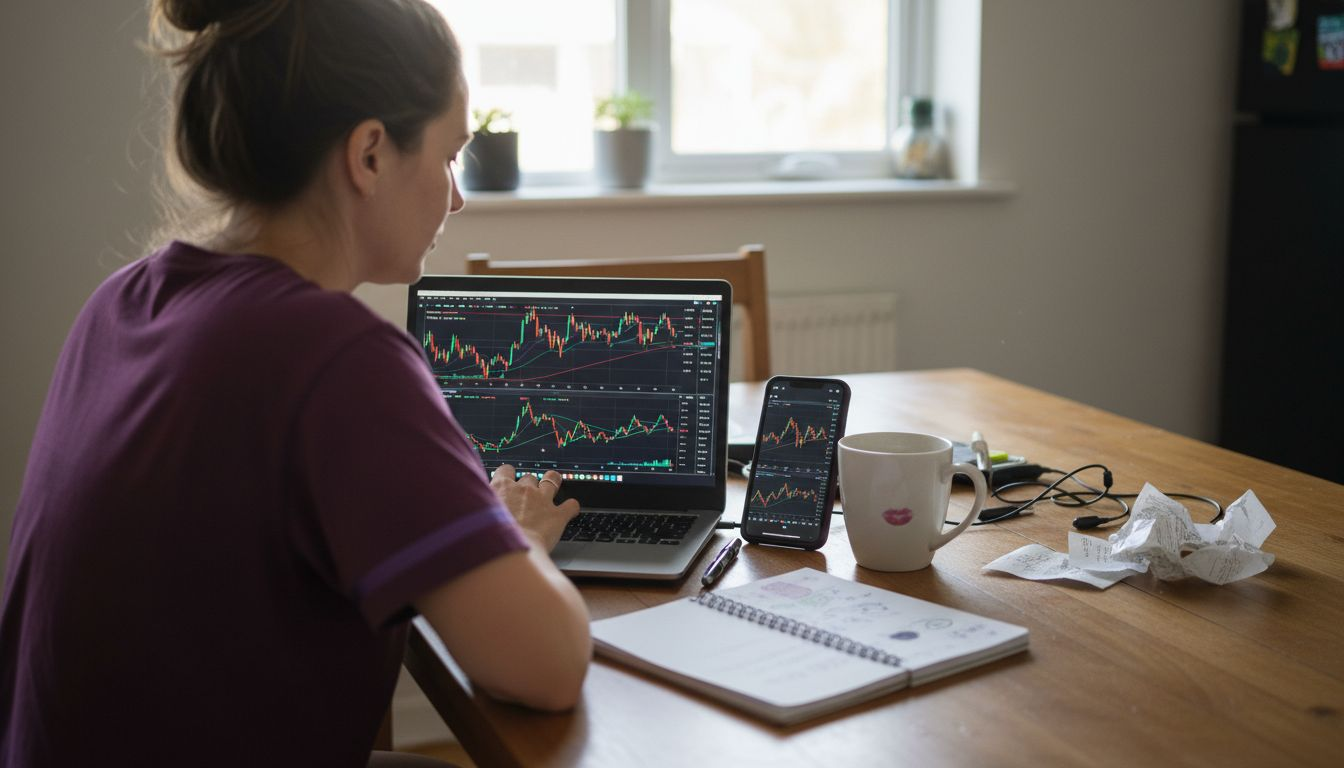
Modern trading bots offer multiple strategy types, each designed for specific market behaviors. Crypto trading strategies typically include approaches like:
Here’s a comparison of popular crypto trading strategies and their ideal market conditions:
| Strategy Type | Ideal Market Scenario | Main Benefit |
|---|---|---|
| Trend Following | Sustained price trends | Captures larger price moves |
| Arbitrage | Price differences exist | Exploits market inefficiencies |
| Grid Trading | Sideways or volatile | Generates profit from swings |
| Mean Reversion | Overextended moves | Leverages price corrections |
| Market Making | High liquidity markets | Earns spread consistently |
- Trend following
- Arbitrage trading
- Grid trading
- Mean reversion
- Market making
When configuring your strategy, focus on risk management and performance parameters. Consider your risk tolerance, available capital, and specific market conditions. Each strategy requires careful configuration to match your investment goals.
Not all trading strategies work equally well in every market. Continuous monitoring and adaptation are key to long-term success.
To optimize your bot’s performance, implement detailed configuration steps:
- Select a base strategy matching your risk profile
- Define precise entry and exit rules
- Set stop-loss and take-profit levels
- Configure position sizing parameters
- Enable backtesting to validate strategy effectiveness
Pro tip: Start with conservative settings and gradually increase complexity as you gain confidence in your bot’s performance.
Step 3: Adjust Bot Settings for Risk and Portfolio Management
Successfully managing risk and optimizing your cryptocurrency trading bot’s performance requires strategic configuration of key parameters. Risk management techniques are critical to protecting your investment while maximizing potential returns.
Your bot’s risk management strategy should encompass several crucial elements:
- Position sizing to limit potential losses
- Stop-loss configuration for automatic trade exit
- Asset diversification across multiple cryptocurrencies
- Risk per trade percentage limits
- Portfolio rebalancing settings
When configuring these parameters, consider your personal risk tolerance and overall investment objectives. Different trading strategies require unique risk management approaches, so customize your bot’s settings to align with your specific financial goals.
Effective risk management is not about eliminating risk entirely, but about controlling and minimizing potential negative outcomes.
To implement robust risk controls, follow these detailed configuration steps:
- Determine your maximum risk percentage per trade
- Set precise stop-loss and take-profit levels
- Define maximum portfolio allocation for individual assets
- Enable automatic portfolio rebalancing
- Establish trailing stop mechanisms
Pro tip: Regularly review and adjust your risk settings based on market performance and changing cryptocurrency market conditions.
Step 4: Fine-Tune AI and Machine Learning Parameters
Taking control of your trading bot’s artificial intelligence requires strategic parameter configuration that transforms raw data into intelligent trading decisions. Machine learning models can significantly enhance your cryptocurrency trading performance when properly optimized.
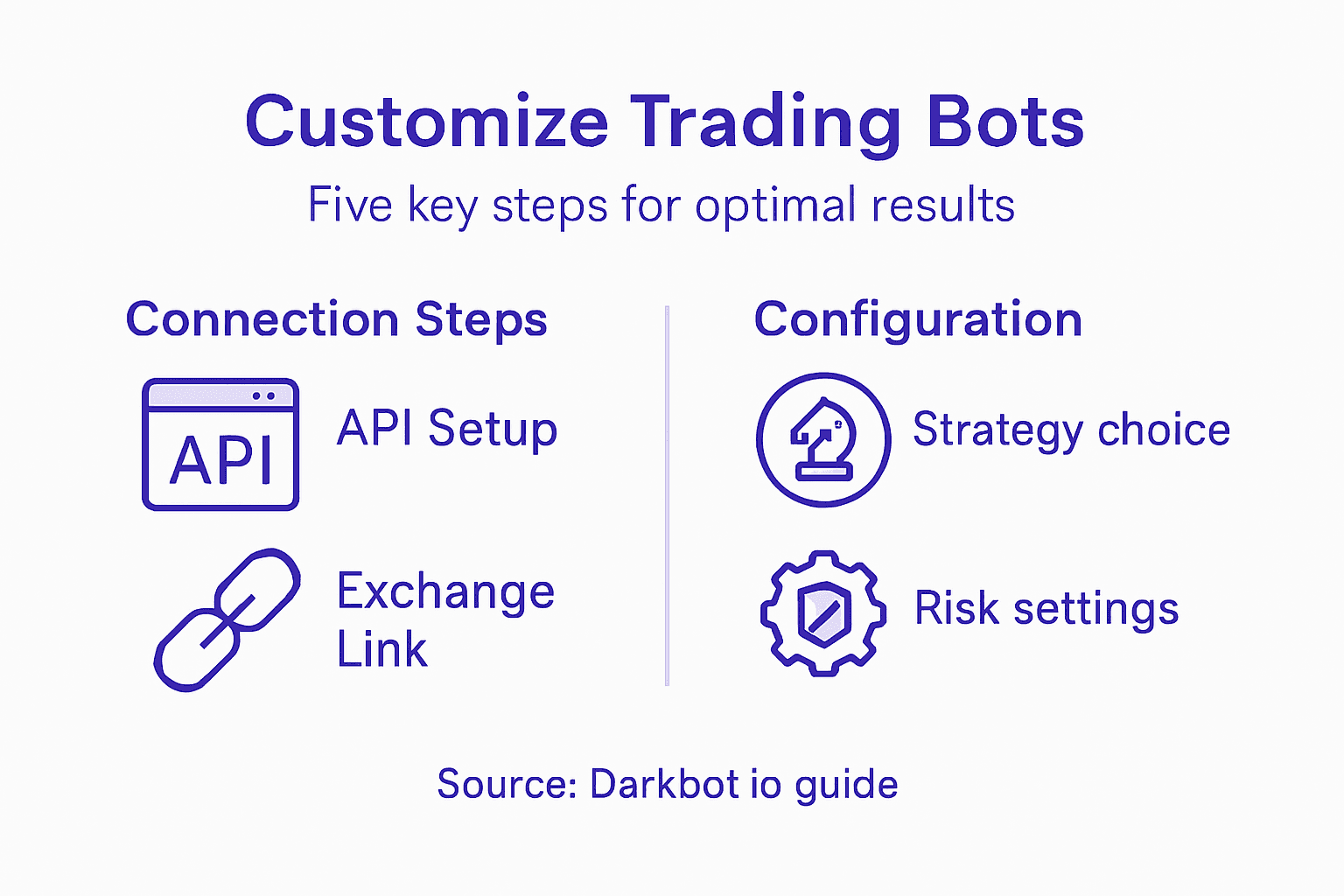
Successful AI parameter tuning involves multiple critical components:
Below is a quick reference of key AI trading bot parameters and their roles:
| Parameter | Description | Impact on Performance |
|---|---|---|
| Feature Selection | Chooses input market data | Improves model relevance |
| Model Complexity | Controls algorithm depth | Balances speed and accuracy |
| Training Frequency | Sets how often the model learns | Adapts bot to new patterns |
| Performance Metrics | Monitors trading outcomes | Guides ongoing adjustments |
| Adaptive Mechanisms | Enables self-improvement | Boosts long-term success |
- Feature selection for input data
- Model complexity management
- Training frequency configuration
- Performance metric tracking
- Adaptive learning mechanisms
Understanding the nuanced interactions between these parameters allows you to create a more responsive and intelligent trading system. Each machine learning model requires unique calibration to match your specific trading strategy and risk profile.
Effective AI tuning is not about perfect predictions, but about creating robust adaptive systems that can navigate market uncertainty.
To optimize your AI trading bot’s performance, implement these strategic configuration steps:
- Analyze historical market data for feature relevance
- Select appropriate machine learning algorithms
- Define clear performance benchmarks
- Establish regular model retraining intervals
- Monitor and adjust model parameters dynamically
Pro tip: Start with conservative AI settings and progressively increase complexity as you validate the model’s real-world performance.
Step 5: Test and Monitor Customized Bots for Performance
Validating your trading bot’s performance requires systematic testing and continuous monitoring to ensure consistent results across different market conditions. Trading bot workflows help you implement structured evaluation techniques.
Effective bot performance testing involves several critical strategies:
- Backtesting historical market scenarios
- Paper trading without real money risk
- Live trading with minimal initial investment
- Performance metric tracking
- Comparative analysis between strategies
Careful monitoring allows you to identify potential weaknesses and optimize your trading bot’s overall performance. By implementing a structured approach, you can progressively refine your automated trading system to improve its accuracy and reliability.
Performance monitoring is not a one-time event but an ongoing process of continuous improvement and adaptation.
To effectively test and monitor your customized trading bot, follow these systematic steps:
- Implement comprehensive backtesting
- Conduct simulated paper trading
- Start with small live trading positions
- Track key performance indicators
- Regularly review and adjust bot parameters
Pro tip: Maintain detailed performance logs and screenshot key metrics to build a comprehensive understanding of your bot’s trading behavior.
Unlock the Full Potential of Your Customized Crypto Trading Bots
Customizing trading bots for optimal crypto results involves mastering complex strategies like risk management, AI tuning, and seamless exchange integration. If you find yourself challenged by configuring these elements or seeking a reliable way to automate and enhance your crypto trading, Darkbot.io offers the perfect solution. Our platform merges advanced AI and machine learning with intuitive tools designed for traders who demand precision, security, and real-time control.
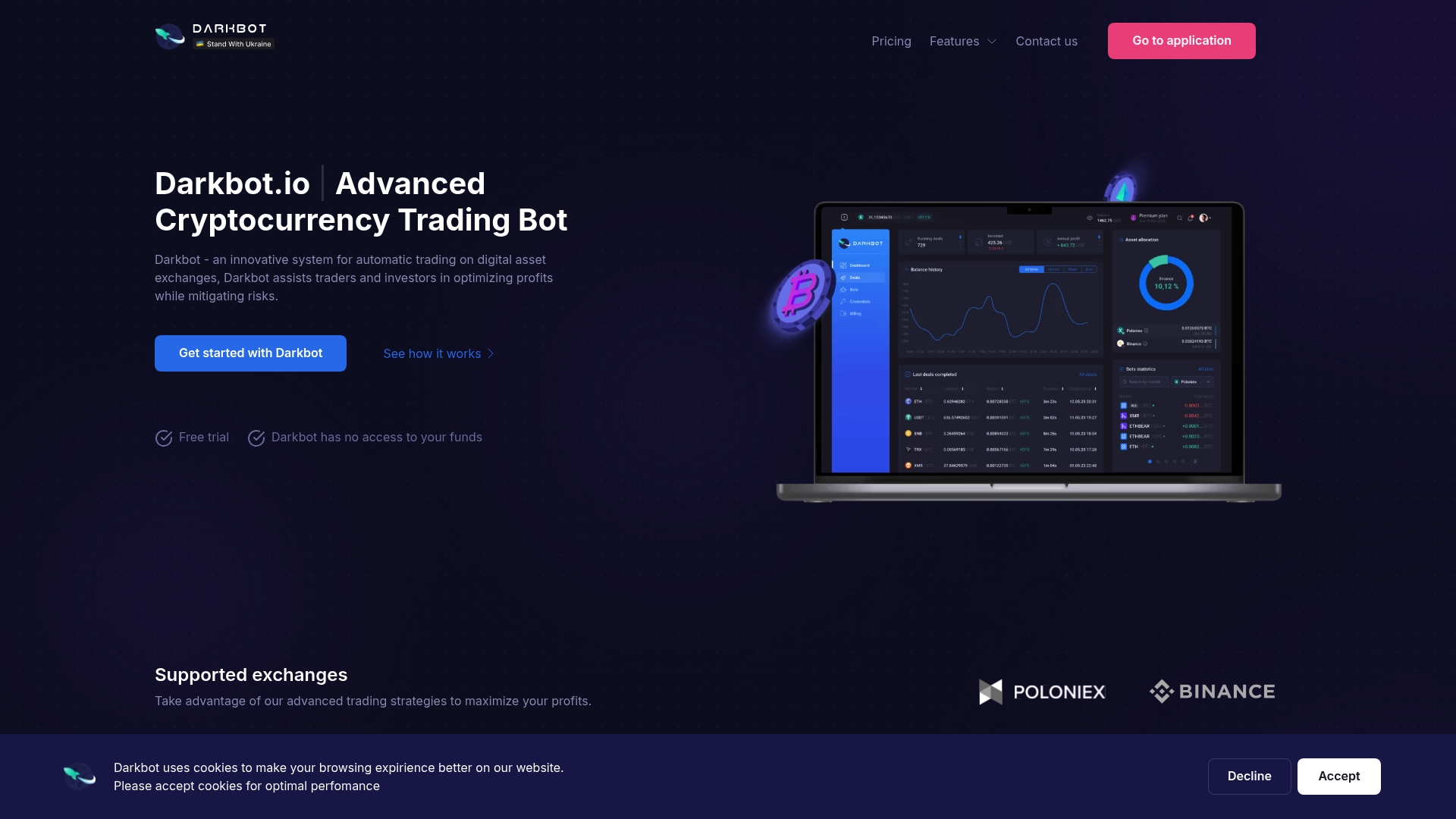
Take control of your crypto investments today by leveraging Darkbot.io’s powerful features. Easily connect your exchange accounts with secure API keys, tailor trading strategies to your unique goals, and monitor performance with real-time analytics. Whether you are new to automated trading or an experienced investor, explore how our platform can simplify your process and maximize your trading success. Visit Darkbot.io to get started and discover in-depth guidance on how to connect your exchange and implement effective trading bot workflows right now. Your path to confident, optimized crypto trading begins here.
Frequently Asked Questions
How do I connect my cryptocurrency exchange account to Darkbot.io?
To connect your cryptocurrency exchange account to Darkbot.io, you need to generate API keys from your exchange account. Log into your account, navigate to the API key management section, create a new API key, and ensure you set it with trade execution permissions, while disabling withdrawal permissions for security.
What are the most effective trading strategies for customizing my bot?
The effectiveness of trading strategies depends on market conditions. Consider strategies such as trend following, arbitrage, or grid trading, and match them to current market behavior to maximize your bot’s performance. Start by evaluating your risk tolerance and aligning strategies to your investment goals.
How can I implement risk management when customizing my trading bot?
To implement effective risk management, configure key parameters such as position sizing, stop-loss limits, and asset diversification. Set a maximum risk percentage for each trade and enable automatic portfolio rebalancing to control losses and protect your investments.
What parameters should I fine-tune for my trading bot’s AI?
Fine-tuning your trading bot’s AI involves adjusting parameters such as feature selection, model complexity, and training frequency. Analyze historical data to identify relevant features and set clear performance benchmarks to improve your bot’s decision-making capabilities.
How can I test my customized trading bot for performance?
To test your customized trading bot, start with backtesting using historical market data, followed by simulated paper trading to evaluate performance without financial risk. Finally, begin live trading with minimal initial investment and track your key performance indicators regularly for continuous improvement.
What should I do if my trading bot’s performance dips?
If your trading bot’s performance dips, review and adjust its parameters based on recent market conditions. Analyze the strategies being used and consider tweaking your risk management settings or AI algorithms to enhance performance and adapt to evolving market trends.
Recommended

Start trading on Darkbot with ease
Come and explore our crypto trading platform by connecting your free account!
Free plan available • No credit card required