0.05% Fee Risk: Pionex Alternatives for US Traders, Including Darkbot

Darkbot stands out as a direct alternative for traders who want AI-assisted automation with structured risk controls rather than a signal-driven bot. Beyond Darkbot, the field splits into three categories worth knowing: exchange-native bots built into platforms like KuCoin, Binance, and OKX, exchange-integrated terminals such as Bitsgap and 3Commas, and subscription bot platforms like Cryptohopper and TradeSanta. Fee structure and US availability differ sharply across each, so the right choice depends on trade frequency and jurisdiction.
TL;DR:
- Subscription platforms like Darkbot benefit active traders with fixed fees, accurate backtesting, and no custody of funds, making them suitable for rule-based automation.
- Exchange-integrated bots, such as those on Binance or OKX, usually come free with the exchange and offer limited automation tools embedded within the trading platform.
- Confirm platform registration with US authorities before connecting API keys, as US compliance varies and affects legal and security considerations.
- The choice between platforms depends heavily on trade frequency, listed pairs, backtesting accuracy, API security, and customer support responsiveness.
- Running paper trades on the same exchange pairs and timeframe before live trading is critical to avoid unexpected fee or slippage surprises.
Shortlist of alternative platforms by category
Traders leaving Pionex usually fall into one of three buckets: they want a platform tied directly to an exchange, a terminal that sits on top of several exchanges, or a dedicated subscription service built around automation logic. Each category trades off cost, control, and regulatory exposure differently.
Subscription automation platforms
- An AI-based crypto trading automation platform connects via exchange API keys, applies machine learning based risk controls, and supports paper trading and backtesting before capital goes live. Best for traders who want strategy customization with structured, rule-driven execution rather than a signal feed.
- 3Commas runs a cloud-based terminal with SmartTrade and a strategy marketplace, suited to retail traders who prefer template-driven setups.
- Cryptohopper adds a signal marketplace and strategy designer on top of standard bot automation, fitting traders who want copy-style inputs alongside their own rules.
- Coinrule uses a no-code rule builder, aimed at traders who think in “if this, then that” logic rather than code.
- TradeSanta focuses narrowly on grid and DCA templates for spot and futures markets.
- Mizar leans analytics-first, built for operators who want strategy execution tied closely to performance data.
- Equeum offers custom analytics and workshops, aimed at teams that need bespoke workflow support rather than an off-the-shelf bot.
Multi-exchange terminals
- Bitsgap provides a unified interface across many exchanges, useful for traders managing positions on several venues at once.
- GoodCryptoX supports advanced order types and broad coverage across centralized exchanges and perpetual DEXs.
Exchange-native bots
- KuCoin bundles bot features directly into a platform with wide altcoin listings.
- OKX offers on-exchange automation with advanced order types for professional traders.
- Binance includes native bot tools inside one of the largest exchange order books available.
- Gemini offers a more limited automation set but operates under tighter US regulatory registration than many competitors.
Regulatory footing varies just as much as features. US-based traders should confirm any platform’s registration status before connecting API keys, since Pionex’s own US compliance path runs through FinCEN Money Services Business registration, a bar not every alternative clears the same way.
| Category | Pricing model | US availability | Exchange coverage | Key automation features |
|---|---|---|---|---|
| Subscription platforms (Darkbot, 3Commas, Cryptohopper, Coinrule, TradeSanta, Mizar, Equeum) | Monthly or annual subscription | Varies by provider; check registration before connecting | Multi-exchange via API | Grid, DCA, backtesting, paper trading vary by platform |
| Multi-exchange terminals (Bitsgap, GoodCryptoX) | Subscription | Varies by provider | Broad multi-exchange and perp DEX support | Advanced order routing, unified dashboards |
| Exchange-native bots (KuCoin, OKX, Binance, Gemini) | Often free or built into trading fees | Depends on exchange’s own market access | Native to that exchange only | Grid and DCA tools built into the exchange interface |
How fees, exchange support, and features change outcomes
The pricing model matters more than it looks on a features page. A platform charging a flat per-trade fee compounds that cost every time a grid or DCA bot fires, and Coin Bureau’s review of Pionex notes that a 0.05% per-trade fee can erode returns for high-frequency grid trading compared with platforms tied to exchanges that offer volume-based fee tiers. A subscription model shifts that cost structure because the fee is fixed regardless of trade count, which tends to favor active grid or DCA strategies that execute frequently.
Multi-exchange integration introduces its own tradeoffs:
- Routing orders directly to an exchange, rather than holding funds on the bot platform, reduces the platform’s role as custodian and lowers counterparty exposure.
- Every additional exchange connection is another API key to secure and another latency path that can affect fill quality on fast-moving grid orders.
- Backtesting reliability depends on whether the platform accounts for exchange-specific fee tiers and maker versus taker designations. Coin Bureau’s analysis of Pionex points out that skipping this step overstates back tested returns relative to what a live account will see.
Traders overestimate the reliability of a backtest run without matching fee assumptions to the exchange actually used. Paper trading on the same exchange pairs the strategy will run live is the only way to catch that gap before committing capital.
US availability adds a separate layer of friction. CoinLedger’s review confirms Pionex operates its US-compliant arm under FinCEN Money Services Business registration, and any alternative platform’s registration status should be checked the same way rather than assumed.
Choosing an alternative: checklist and user profiles
Before moving capital to a new platform, work through a short priority list rather than picking on brand recognition alone.
- Confirm the fee model (subscription versus per-trade) against your expected trade frequency.
- Check exchange coverage against the pairs and venues you actually trade.
- Verify backtesting and paper trading use the same fee assumptions as live execution.
- Review the API custody model: does the platform hold funds, or route orders directly to the exchange?
- Confirm US regulatory status if you trade from the United States.
- Test customer support responsiveness before funding an account.
Three profiles map to different priorities. A beginner should weight ease of use, paper trading access, and support quality first. A frequent or grid trader should weight fee structure and exchange latency first, since those costs compound with trade count. A quant or institutional user should weight API depth, backtesting accuracy, and direct order routing first.
Watch for red flags before migrating: no published fee schedule, no paper trading mode, or vague language about where API keys and funds are held.
Pro Tip: Run any new platform in paper trading mode across the same exchange pairs and time window you plan to trade live before moving real capital.
What Darkbot offers as a direct alternative
Darkbot is built around systematic execution rather than signal-following. Its feature set is designed to give traders repeatable, rule-based control over automation instead of predictive promises.
- API-based integration across supported exchanges, with strategy customization for grid, DCA, and custom logic.
- Backtesting and paper trading modes to validate a strategy before it runs on live capital.
- Automated rebalancing and support for running multiple bots simultaneously.
- Real-time analytics for monitoring execution quality across active strategies.
- Tiered subscription plans available that scale from casual experimentation to higher-volume use.
…
Customer support quality and responsiveness
Support quality is one of the harder attributes to compare on paper, since most platforms advertise “24/7 support” without specifying response times or escalation paths. In practice, the distinction that matters is whether support can address account-level issues like API connection errors or order execution disputes, not just general onboarding questions.
Exchange-native bots (KuCoin, OKX, Binance, Gemini) route support through the exchange’s existing customer service infrastructure, which tends to be well-staffed but generalized across all exchange functions, not bot-specific. Subscription platforms built around automation, including Darkbot, 3Commas, and Cryptohopper, typically offer more specialized support for bot configuration and strategy troubleshooting, since that is the core product.
Before committing to a platform, test its support channel directly: submit a real question about API permissions or fee calculation and note the response time. A platform that cannot answer a technical question about its own automation logic before you have funded an account is unlikely to improve once you have.

Mobile app availability and functionality
Most platforms in this category offer a mobile app for monitoring bots and account balances, though functionality varies. Exchange-native platforms like Binance, OKX, and KuCoin tend to have the most complete mobile apps, since the app also handles spot trading, deposits, and withdrawals, with bot management as one feature among many.
Dedicated automation platforms often ship lighter mobile experiences focused on monitoring rather than full strategy configuration. That distinction matters for traders who want to adjust grid parameters or pause a bot from a phone rather than simply check performance. Anyone dependent on mobile management should confirm during a trial whether the app supports the specific actions they need, such as editing bot parameters or withdrawing funds, rather than assuming parity with the desktop dashboard.
User community and educational resources
Educational depth differs by platform type. Exchange-native bots benefit from the broader educational content the exchange already publishes for spot and futures trading, which sometimes includes bot-specific tutorials. Dedicated automation platforms tend to publish more focused guides on strategy construction, backtesting methodology, and risk parameter tuning, since that is closer to their core product.
Community discussion also plays a role in due diligence. Forum threads and community discussions, including Reddit threads discussing Pionex alternatives, surface recurring complaints about onboarding complexity and minimum capital requirements that official marketing materials tend not to mention. Reading a handful of these before committing capital is a reasonable step, understanding that individual reports are not a substitute for testing the platform directly.
Reliability and uptime
Platform reliability affects automated strategies differently than manual trading, since a bot that misses an execution window during downtime cannot simply be re-entered by hand a few minutes later. Grid and DCA bots in particular depend on continuous uptime to maintain their order ladders.
None of the platforms compared here publish a standardized, independently audited uptime figure, so claims about reliability should be treated as marketing statements until verified through direct use. The more useful diagnostic is architectural: platforms that route orders directly to the exchange rather than holding an intermediate order book reduce the number of points where a service interruption could delay execution. Traders running latency-sensitive grid strategies should ask any prospective platform, including Darkbot, how it handles a dropped API connection mid-trade, since the answer reveals more about operational reliability than an uptime percentage would.
Account funding and withdrawal options and times
Funding and withdrawal mechanics depend on which layer of the stack holds the money. Exchange-native bots (Binance, OKX, KuCoin, Gemini) use the exchange’s own deposit and withdrawal rails, so funding times and available methods match whatever that exchange already supports for spot trading.
Subscription automation platforms like Darkbot typically do not custody trading funds at all: they connect via API keys directly to the exchange account, meaning deposits and withdrawals happen on the exchange side, not on the bot platform. This is a meaningful distinction for security purposes, since a direct order-routing model reduces the platform’s role as an intermediary holding client funds. Traders should confirm during setup whether a given automation platform requires depositing funds into its own wallet or only requires API permissions scoped to trading, since the latter is generally the lower-exposure arrangement.
When switching from Pionex actually makes sense
Switching makes practical sense under specific triggers: US regulatory restrictions on your current platform, fee erosion on high-frequency grid strategies, or a need for backtesting depth your current tool lacks. Migration should start with API-only paper trading across the same pairs and timeframe, then small live capital, watching fees and slippage before scaling. Avoid overfitting a strategy to one backtest environment.
— Grisha
Getting started with Darkbot
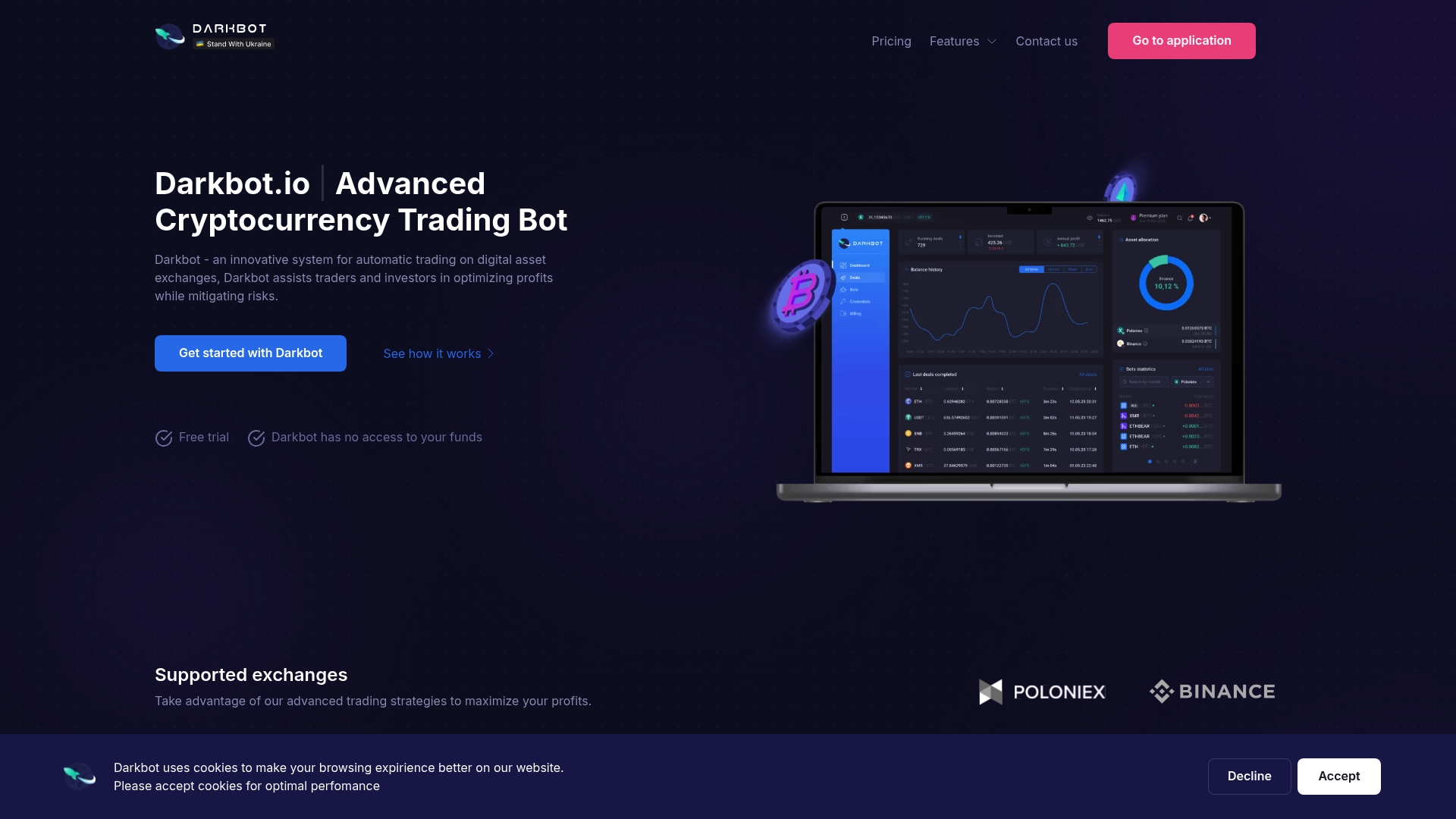
Darkbot’s plans scale from a no-cost entry point to full institutional support, so the migration path can start small and expand as confidence in the strategy builds.
- Free plan for testing core features without a subscription commitment.
- Standard Plan at a monthly subscription fee for traders ready to run live strategies with fuller feature access.
- Premium Plan at a higher monthly subscription tier for higher-volume automation and expanded analytics.
- Enterprise for teams needing custom support arrangements.
Full plan details, feature breakdowns, and signup are available on the Darkbot pricing page.
Sources
FAQ
Can US customers use Pionex?
Pionex operates a US-compliant version through an entity registered with FinCEN as a Money Services Business, which is how Pionex.US serves American traders under that registration. Not every alternative platform holds the same registration, so US-based traders should verify status before connecting funds.
What is the most profitable bot on Pionex?
No verified, independently audited profitability figures for specific Pionex bots are publicly available, so any specific claim should be treated with caution. Grid and DCA bots are the most commonly used strategies on the platform, but results depend heavily on market conditions and fee structure rather than a fixed performance figure.
What is the best bot trading platform?
There is no single best platform: the right choice depends on fee model, exchange coverage, and jurisdiction. For traders who want AI-assisted, rule-driven automation with backtesting and paper trading built in, Darkbot is a strong fit within the subscription category, while exchange-native bots suit traders who prefer to stay inside one exchange’s ecosystem.
What is the top 3 crypto exchanges?
Market rankings vary by metric and change over time, so no fixed top three is stated here. Binance, OKX, and KuCoin are commonly cited among major exchanges with built-in bot features, alongside Gemini for traders prioritizing tighter US regulatory registration.
Recommended

Start trading on Darkbot with ease
Come and explore our crypto trading platform by connecting your free account!
Free plan available • No credit card required