Survive the Worst 1% Market Days With a Crypto Portfolio Hedging Bot
A portfolio hedging bot automates protective trades around existing holdings, using rules or models to open offsetting positions when risk conditions are met. It suits crypto-heavy portfolios and systematic risk overlays where manual monitoring cannot keep pace with volatility. The main failure mode is not the strategy logic: it is margin calls, liquidity gaps, and execution slippage that can undermine a hedge that looked sound on paper.
TL;DR:
- Margin and liquidity constraints on exchanges can cause forced liquidations of hedges, especially during market stress or high carry periods.
- Futures-based hedges and dynamic rebalancing are susceptible to execution slippage and margin calls, which can undermine their effectiveness in volatile markets.
- A risk management system must enforce hard limits and run thorough backtests, stress tests, and paper trades before deploying live hedging strategies.
- Combining multiple hedging methods tends to mitigate cost and liquidity issues better than relying on a single approach.
- Proper implementation involves detailed operational planning, including clear runbooks, API permissions, and continuous monitoring of margin usage and position drift.
How portfolio hedging bots work: system components and execution flow
A hedging bot is not a single algorithm. It is a pipeline with distinct layers, each responsible for one job, so a failure in one does not silently corrupt the others.

The signal or strategy layer decides when a hedge is warranted, based on volatility thresholds, correlation breaks, or exposure drift. The execution engine translates that decision into orders sized for the target exchange, while exchange connectors handle order routing, authentication, and rate limits across venues. A separate risk management system (RMS) sits outside the strategy logic and can override or block any order that breaches predefined limits, which matters because a strategy module optimized for returns has no built-in incentive to protect capital.
Execution models vary by use case:
- Continuous hedging rebalances exposure on every price tick or fixed interval, suited to fast-moving derivatives books.
- Periodic hedging adjusts positions at set times (hourly, daily), reducing turnover and fees.
- Event-driven hedging triggers only when a defined condition fires, such as a volatility spike or a funding rate crossing a threshold.
Monitoring outputs, including fill confirmations, margin usage, and position drift, feed back into the RMS in real time. Without that feedback loop, a bot can keep sending orders into a market that no longer supports the strategy’s assumptions. For a broader view of how automation interacts with portfolio-level decisions, see this guide to crypto portfolio automation.
Common hedging strategies bots implement
Bots typically draw from a small set of proven hedging mechanics, chosen based on cost, liquidity, and how precisely the hedge needs to match the underlying exposure.
- Futures-based hedges short a futures contract against a spot holding, which is capital-efficient but exposes the position to basis risk and margin calls if the market moves against the short leg.
- Options overlays buy puts or construct collars to cap downside while retaining some upside, at the cost of a premium that erodes returns in calm markets. SEC structured-product filings show how these protection layers are disclosed, including the scenarios where they limit upside or fail to fully protect principal.
- Dynamic rebalancing adjusts position sizes continuously to target a fixed volatility level, trimming exposure as realized volatility rises rather than reacting to a single price trigger.
- Correlated-asset hedges use a liquid proxy instrument when the “correct” hedge is illiquid or expensive to trade. Research on hedging with correlated liquid assets finds this approach can outperform a theoretically precise hedge once transaction costs are modeled in. A non-crypto example of this logic is using gold as a diversification instrument against broad market drawdowns.
Each method trades precision for cost or liquidity in a different place, which is why most operational hedging stacks combine more than one. For crypto-specific mechanics and trade-offs, see this breakdown of hedging strategies for volatile crypto markets.
Pro Tip: Model transaction costs before choosing a hedge instrument. The theoretically correct hedge is often not the cheapest one to execute.
Operational risks and margin frictions that can break automated hedges
A hedge can be directionally correct and still fail operationally, because crypto derivatives markets impose constraints that spot trading does not.
Cross-margin support is inconsistent across exchanges. When a venue treats each position’s margin separately rather than netting exposure across a portfolio, a profitable hedge leg can still trigger a liquidation on the losing leg if that leg’s isolated margin runs out first. Research on crypto carry finds that increases in carry predict substantial rises in liquidations of short futures positions over the following month, which means the carry conditions that make a short hedge attractive are often the same conditions that raise the odds of it being forced closed.
Liquidity and margin constraints materially reduce the effectiveness of futures-based dynamic hedges, and optimal hedging under a borrowing constraint calls for smaller hedge sizes when margin risk is significant.
This finding comes from BIS research on dynamic hedging under borrowing constraints, which also notes that margin calls occur intraday and can force liquidation before a mean-reverting price move would have justified holding the hedge.
A documented pattern: BIS findings on crypto carry show that carry spikes precede sharp increases in forced liquidations of short futures positions, a mechanical link between a profitable-looking hedge setup and a higher chance of it being closed out at a loss.
Slippage compounds this in fast markets, where an order sized correctly at decision time fills at a worse price by execution time. Practical mitigations include sizing hedges below maximum allowable leverage, holding a collateral buffer above exchange minimums, and staggering execution across multiple smaller orders rather than one large one. Industry standards on margin requirements for non-centrally cleared derivatives reinforce the same point: margin models need to be validated against stress scenarios, not just average conditions.

Designing a risk-first portfolio hedging bot
A hedging bot should be built as a risk desk with execution capability attached, not a strategy engine with risk checks bolted on afterward.
The independent RMS layer enforces hard rules regardless of what the strategy module recommends: maximum position size per asset, a daily loss limit that halts trading once breached, and regime detection that reduces or suspends hedging activity when volatility or correlation patterns shift outside historical norms. These rules sit between the signal and the exchange connector, so no single strategy decision can exceed the portfolio’s risk budget.
Before any capital is committed, the sequence should run backtesting, then paper trading, then stress testing against historical tail events, validating metrics like maximum drawdown, hedge effectiveness ratio, and realized slippage at each stage. Ongoing monitoring with alerting on margin usage and position drift, combined with a manual override path, keeps a human in the loop for conditions the model was not built to handle. Secure API practices, including read-only keys where possible and withdrawal permissions disabled, limit the damage from a compromised credential.
- Strategy customization lets you encode the specific hedge logic (futures, options, rebalancing) matched to your portfolio’s risk profile.
- Backtesting and paper trading validate that logic against historical and live-simulated conditions before capital is at risk.
- Automated rebalancing keeps hedge ratios aligned with portfolio drift without manual intervention.
Strategy customization, backtesting, and automated rebalancing features map directly onto this blueprint, which is detailed further in this piece on risk management architecture for crypto trading bots.
Pro Tip: Treat the RMS as a separate module with veto power over the strategy layer, never as a parameter inside the strategy itself.
Implementation checklist: backtesting, paper trading, infra, and runbooks
Moving from concept to live hedging requires a defined sequence, not an ad hoc rollout.
- Source clean historical data and simulate realistic fills, including spread and slippage, rather than assuming execution at the quoted price.
- Run walk-forward testing, re-fitting the strategy on rolling windows to check whether performance holds outside the original sample period.
- Paper trade in live market conditions and track fill rate, latency, and deviation from backtested performance before committing real capital.
- Build a runbook covering funding buffers sized above margin minimums, a kill switch that flattens positions on connectivity loss, and a documented escalation path for manual intervention.
- Set exchange API permissions to the minimum required, typically trading enabled with withdrawals disabled, and test rate limits and order rejection handling before going live.
Developer-level implementations, such as open-source hedge-bot code for impermanent loss, illustrate how these steps translate into actual order logic and position tracking.
How to evaluate a hedging bot or service
Selecting a hedging bot or service comes down to a small number of checks that separate a disciplined system from a marketing claim.
- RMS visibility: confirm that risk limits are enforced at the system level, not just configurable suggestions the strategy can override.
- Reproducible backtests: look for transaction-cost modeling and out-of-sample validation, not a single curve-fit result.
- Execution metrics: request data on latency and fill rate under volatile conditions, since that is when hedges matter most.
- Collateral and cost transparency: confirm margin requirements, fees, and any premium costs (for options-based hedges) are stated clearly before committing funds.
Tools built for related problems, such as AI-driven portfolio construction in equities, apply the same risk-first evaluation logic even outside crypto markets.
Author perspective: pragmatic lessons from deployments
The most common operator error is over-hedging: sizing protection for a worst-case scenario that rarely occurs, which quietly erodes returns through fees and premiums in normal markets. The second is ignoring margin friction entirely, treating a hedge as complete once the offsetting position is opened rather than monitoring whether it can survive a liquidation cascade. Automation suits continuous monitoring and rule enforcement; manual intervention still has a place when market structure itself is breaking down. Validate any hedge against the worst 1% of historical market days, not the average ones.
— Grisha
Darkbot.io: a risk-first automation platform for portfolio hedging
A platform provides strategy customization, backtesting, and automated rebalancing, the same components this guide identifies as necessary for a risk-first hedging setup, built around systematic execution rather than discretionary calls.
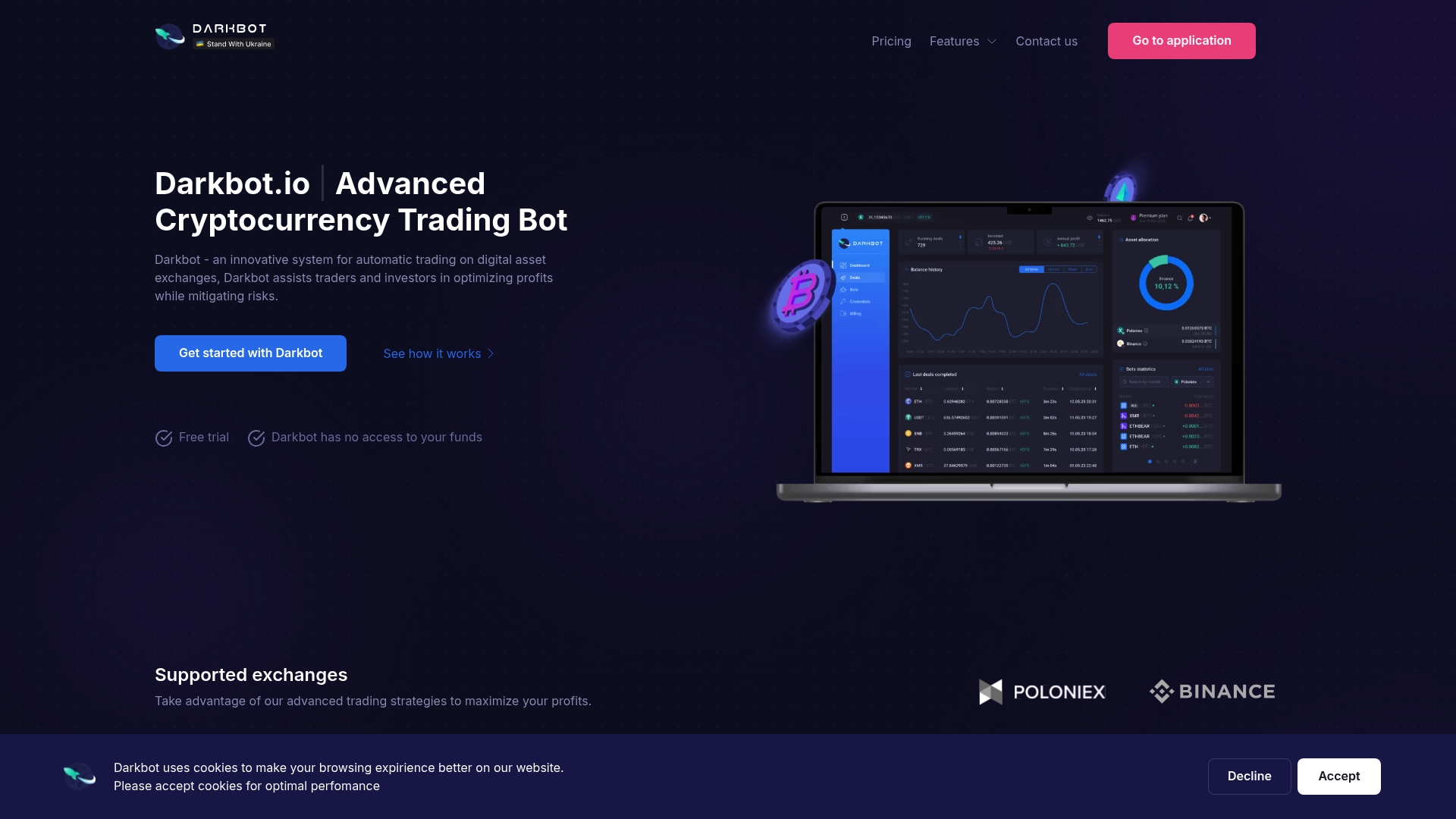
- Strategy customization lets you define hedge rules matched to your portfolio’s exposure.
- Backtesting and paper trading validate those rules before live capital is committed.
- Automated rebalancing maintains hedge ratios without manual rework.
Readers can start on the Free plan or compare the Standard and Premium tiers on the Darkbot pricing page.
This article is general information, not a substitute for advice from a qualified financial advisor. Consult a qualified financial professional about your own circumstances before acting on anything here.
FAQ
What is the best way to hedge a stock or crypto portfolio?
There is no single best method: futures offer capital efficiency but carry margin risk, options cap downside at the cost of a premium, and correlated-asset hedges reduce transaction costs at the expense of basis risk. The right choice depends on liquidity, holding period, and how much premium or margin risk the portfolio can absorb.
What is the most successful AI trading bot?
No independent, verifiable ranking of AI trading bot performance exists publicly, since results depend heavily on strategy, market conditions, and risk settings. Evaluation should focus on backtesting rigor, RMS enforcement, and execution transparency rather than performance claims.
Can ChatGPT or another LLM build a trading bot?
A large language model can generate code for strategy logic, order execution, or data handling, but it does not validate that logic against historical risk or margin constraints on its own. Any LLM-assisted bot still needs backtesting, paper trading, and an independent RMS before it manages real capital.
Are AI trading bots illegal?
Automated trading itself is legal in most jurisdictions when it complies with the exchange’s terms of service and applicable securities or commodities regulations, though specific rules vary by country and asset class. Readers should confirm the regulatory status for their jurisdiction and review a primer on automated trading legality rather than assume a blanket answer applies everywhere.
What is Darkbot’s pricing?
Darkbot.io offers a Free plan, a Standard Plan at $12.50 per month, a Premium Plan at $25.00 per month, and an Enterprise tier with pricing available on request, all listed on the Darkbot pricing page.
Sources
Recommended

Start trading on Darkbot with ease
Come and explore our crypto trading platform by connecting your free account!
Free plan available • No credit card required