Step by step trading automation: 70% crypto trades automated

Cryptocurrency markets never sleep, but you need to. Missing profitable trades because you can’t monitor charts 24/7 frustrates even experienced investors. Trading automation solves this by executing your strategies continuously without emotional decisions or fatigue. This guide walks you through every step to automate crypto trading effectively in 2026, from secure API setup to ongoing optimization, helping you compete in markets where automated trading bots can execute trades in milliseconds based on predefined strategies.
Key takeaways
| Point | Details |
|---|---|
| Trading bots execute crypto trades instantly 24/7 reducing emotional decisions | Automation removes human bias and enables continuous market coverage unavailable to manual traders |
| Secure API setup and exchange choice are foundational for safe automation | Criteria for reliable exchanges include liquidity, security, and API support requiring restricted permissions |
| Strategy customization aligned to goals is critical for effective bot performance | Dollar-Cost Averaging, Grid, and Arbitrage strategies serve different investment objectives |
| Backtesting and monitoring improve bot success and reduce financial risks | Testing strategies with historical data before live deployment validates effectiveness |
| Risk management rules like stop-loss limits protect capital in volatile markets | Position sizing and daily loss caps prevent catastrophic losses during market swings |
Introduction to crypto trading automation
Crypto trading automation uses software bots to execute buy and sell orders based on predefined rules without human intervention. In 2026, automated trading bots can execute trades in milliseconds based on predefined strategies, removing emotional bias and enabling 24/7 market coverage. This technology fundamentally changes how investors participate in digital asset markets.
Over 70% of cryptocurrency trading volume now involves automation, reflecting a dramatic shift toward efficiency. Manual trading simply cannot compete when markets operate continuously across global time zones. Bots process price data instantly, identify opportunities within milliseconds, and execute trades faster than any human reaction time allows.
Automation eliminates emotional decision making that often destroys trading accounts. Fear causes premature exits from profitable positions. Greed leads to holding losing trades too long. Bots follow your crypto trading strategy guide precisely, never deviating due to stress or excitement. They execute the same logic whether markets surge or crash.
Automated systems maintain discipline during extreme volatility when human judgment typically fails, protecting capital through consistent rule application regardless of market conditions.
The increasingly volatile crypto environment demands automation for competitive participation. Price swings of 10% or more within hours create opportunities manual traders miss while sleeping or working. Bots capture these moves automatically, rebalancing portfolios and taking profits according to your predetermined parameters. For investors with limited time to monitor markets, automation transforms trading from a full-time job into a managed system requiring only periodic oversight.
Prerequisites: exchange selection and API setup
Before deploying any trading bot, you must choose a reliable cryptocurrency exchange and configure secure API access. Start by evaluating exchanges based on three critical factors: trading volume liquidity ensuring your orders fill at expected prices, robust API infrastructure supporting automated connections, and security track records protecting user funds.
Major exchanges like Binance, Coinbase Pro, and Kraken offer strong API support with comprehensive documentation. Check that your chosen platform supports the trading pairs you want to automate. Lower liquidity on smaller exchanges can cause slippage where your bot executes trades at worse prices than anticipated, eroding profits.
Generating API keys requires careful attention to permissions. Log into your exchange account and navigate to API management settings. Generate API keys with trading-only permissions and tested with small trades to verify functionality before risking significant capital. Never enable withdrawal permissions on bot API keys. This restriction ensures that even if your keys are compromised, attackers cannot drain your account.
Follow these steps for secure API configuration:
- Create a new API key specifically for bot trading, separate from any keys used for manual access
- Enable only “read” and “trade” permissions, explicitly disabling “withdraw” capabilities
- If your exchange supports IP whitelisting, restrict API access to your bot server’s IP address
- Store API keys in encrypted configuration files, never in plain text or version control systems
- Test new API keys by executing a minimal trade manually before connecting your bot
Common security pitfalls include using the same API key across multiple bots or services, storing credentials in unencrypted files, and failing to rotate keys periodically. Many exchanges display API key creation dates, helping you track when rotation is due. Consider rotating keys every 90 days as a security best practice.
Pro Tip: After generating API keys, execute a small test trade manually through the API before connecting your automated bot. This verifies permissions work correctly and helps you understand your trading strategy setup guide requirements.
Fund your exchange account with capital you can afford to risk. Start with a small testing amount, perhaps 1-5% of your intended trading capital. This conservative approach lets you verify your bot operates correctly before scaling up. Many traders lose money not from bad strategies but from configuration errors caught too late.
Strategy selection and bot customization
Choosing the right trading strategy determines your automation success more than any other factor. Popular approaches include Dollar-Cost Averaging (DCA) for steady accumulation, Grid trading for range-bound markets, and Arbitrage for exploiting price differences across exchanges. Effective bot strategies include Dollar-Cost Averaging, Grid, and Arbitrage, with customization aligning strategy to investment objectives.
DCA bots purchase fixed amounts at regular intervals regardless of price, ideal for long-term investors wanting to build positions gradually. This strategy reduces timing risk by averaging your entry price over weeks or months. Grid bots place multiple buy and sell orders at predetermined price levels, profiting from market oscillations within a range. They work best when assets trade sideways rather than trending strongly in one direction.
Arbitrage bots identify price discrepancies for the same asset across different exchanges, buying low on one platform and selling high on another. This strategy requires fast execution and sufficient capital on multiple exchanges but offers more consistent returns with lower directional risk. However, exchange fees and withdrawal times can erode arbitrage profits quickly.
Align your bot strategy with specific investment goals:
- Choose DCA for long-term accumulation with minimal daily management
- Select Grid trading for active profit-taking during volatile but range-bound periods
- Use Arbitrage when you have capital distributed across multiple exchanges and can monitor spreads
- Consider momentum strategies if you want to ride trends but accept higher risk
Customizing bot parameters requires balancing complexity with usability. Simple strategies with fewer parameters are easier to understand and debug. Complex multi-indicator strategies might capture more opportunities but become difficult to optimize and prone to over-fitting historical data. Start simple and add complexity only when you clearly understand why each parameter improves performance.
Key parameters to customize include trade frequency determining how often your bot checks for opportunities, order size controlling capital at risk per trade, and threshold levels triggering buy or sell signals. A DCA bot might trade once daily with 1% of your capital. A Grid bot could place 20 orders spanning a 10% price range. Your bot strategy optimization guide helps refine these settings.
Pro Tip: Begin with conservative parameters using only 10-20% of your intended capital. Once you verify the bot behaves as expected over several days, gradually increase position sizes while monitoring results closely through your customize trading bots interface.
Avoid over-trading by setting appropriate cooldown periods between trades. Excessive trading generates more exchange fees than profits. Many beginners configure bots to trade on every minor price movement, depleting capital through fees rather than market losses. Quality trades matter more than quantity.
Bot deployment, monitoring, and optimization
Deploying your trading bot safely requires starting small and verifying stability before committing significant capital. Follow this systematic process:
- Complete backtesting using historical price data to evaluate strategy performance across different market conditions
- Run paper trading mode if your bot platform supports it, executing simulated trades with fake money to verify logic
- Deploy with minimal capital, perhaps 1-2% of your total intended investment, monitoring for 48-72 hours
- Gradually scale up position sizes after confirming the bot executes trades correctly without errors
- Establish a regular review schedule, checking performance metrics at least weekly initially
Backtesting and paper trading improve success rates and reduce risk by catching configuration mistakes before they cost real money. Most bot platforms provide backtesting tools that replay historical price data through your strategy, showing theoretical performance. While past results never guarantee future success, backtesting reveals obvious flaws like strategies that only work in bull markets or parameter combinations causing excessive trading.
Monitoring real-time bot analytics becomes essential once you deploy. Track these performance metrics continuously:
| Metric | Purpose | Target |
|---|---|---|
| Win Rate | Percentage of profitable trades | Above 50% for most strategies |
| Average Return | Mean profit/loss per trade | Positive after fees |
| Maximum Drawdown | Largest peak-to-trough decline | Under 20% of capital |
| Trade Frequency | Number of trades per day | Aligned with strategy design |
| Sharpe Ratio | Risk-adjusted return | Above 1.0 indicates good risk/reward |
Your bot platform should provide trade logs showing every execution with timestamps, prices, and outcomes. Review these logs regularly to identify patterns. Are losses concentrated during specific market conditions? Does your bot trade more during high volatility periods? Understanding these patterns enables targeted optimizations.
Strategic optimization cycles involving regular review of bot performance help maintain profits as market conditions evolve. What worked during a bull market might fail when trends reverse. Schedule monthly strategy reviews examining performance against benchmarks. If your bot underperforms simply holding the asset, adjust parameters or switch strategies.
Pro Tip: Create a performance journal documenting every parameter change with dates and rationale. This record helps you understand which adjustments improved results and prevents repeatedly making the same mistakes. Your trading strategy optimization efforts benefit from this structured approach.
Market regime changes require parameter adjustments. Trending markets favor momentum strategies with wider stop losses. Range-bound markets suit Grid bots with tighter price levels. Recognize when your current strategy no longer fits market conditions and adapt accordingly. Most successful automated traders run different bot configurations for different market phases.
Risk management and security best practices
Protecting your capital requires implementing robust risk controls that prevent catastrophic losses. Effective protocols include stop-loss orders, position sizing limits, and daily loss caps as foundational safeguards.
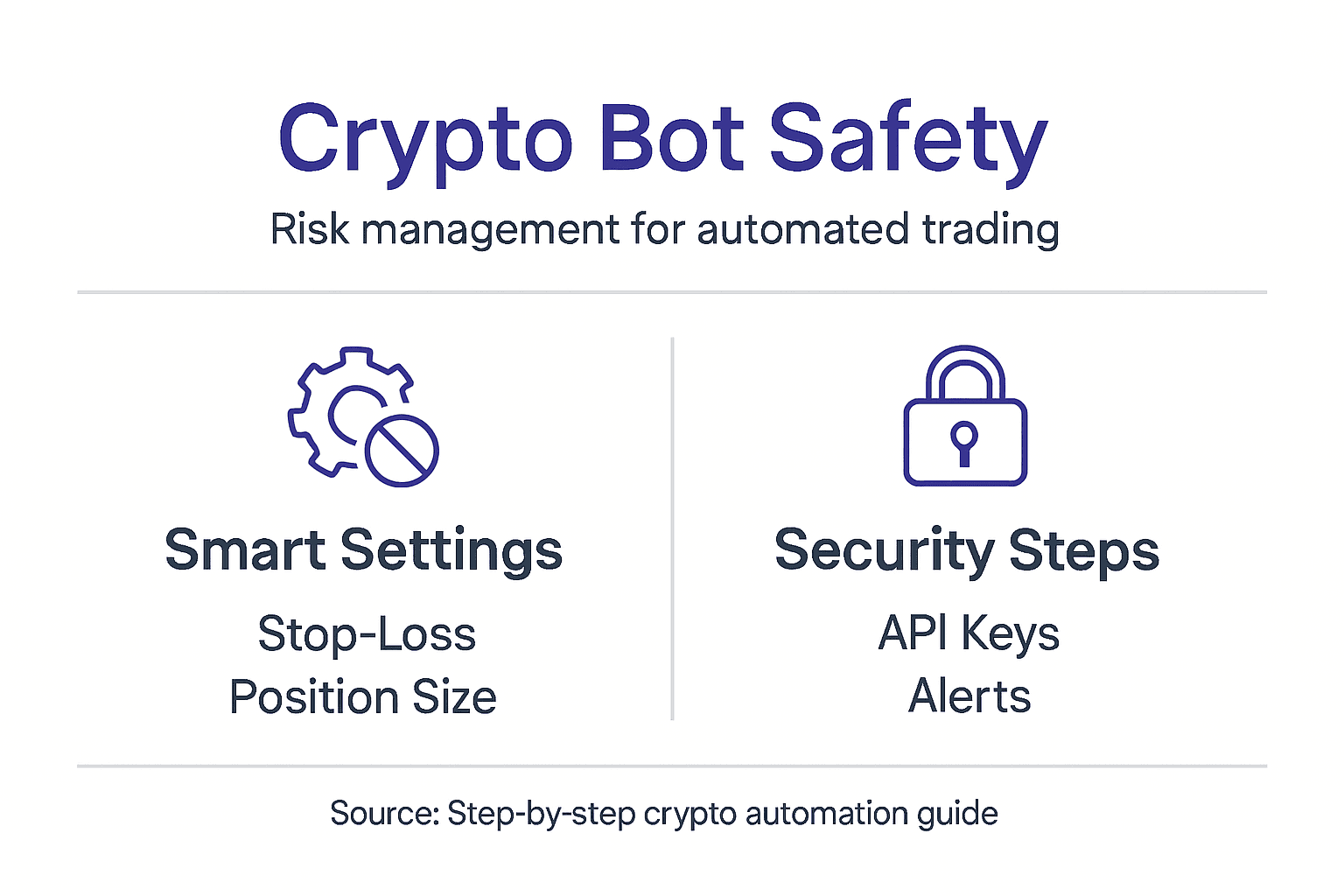
Stop-loss orders automatically close positions when prices move against you by a predetermined amount, limiting damage from any single trade. Configure your bot to exit positions losing more than 2-3% of allocated capital. This seemingly small threshold prevents any one bad trade from destroying your account. If you risk 2% per trade across 10 positions, you could survive 5 consecutive losses with half your capital intact.
Position sizing determines how much capital each trade risks. Never allocate more than 5-10% of your total trading capital to any single position. Smaller position sizes reduce the impact of individual losses while maintaining sufficient exposure to capture gains. A common mistake is over-concentrating in one asset because it performed well recently, ignoring diversification principles.
Daily loss limits provide an emergency brake when market conditions turn unexpectedly volatile. Configure your bot to stop trading if cumulative daily losses exceed 5% of your account value. This circuit breaker prevents emotional decision making during crashes when you might be tempted to override your bot and make the situation worse.
API key security requires ongoing vigilance beyond initial setup:
- Restrict API permissions to trading only, never enabling withdrawal capabilities
- Use IP whitelisting if your exchange supports it, allowing API access only from known addresses
- Enable two-factor authentication on your exchange account protecting against unauthorized access
- Monitor API activity logs for unexpected patterns like trades during hours you normally sleep
- Rotate API keys every 90 days, creating new keys and deleting old ones
Compromised API keys can execute unauthorized trades or, if withdrawal permissions are enabled, drain your entire account within minutes before you notice. Always configure the minimum necessary permissions.
Pro Tip: Set up mobile alerts for unusual trading activity such as trade sizes exceeding your normal parameters or API access from unrecognized IP addresses. Early detection of security breaches minimizes potential losses. Your bot setup guide includes alert configuration instructions.
Continuous security monitoring catches issues before they escalate. Review your exchange account activity weekly, checking for trades you don’t recognize or unexpected balance changes. Enable email notifications for all trades, deposits, and withdrawals. While these alerts can feel overwhelming initially, they provide essential oversight of automated systems operating independently.
Common mistakes and troubleshooting in crypto bot automation
Many traders sabotage their automation success through avoidable mistakes. Common mistakes include inadequate API key security, skipping backtesting, over-trading, and ignoring performance data, which cause preventable losses.
Insecure API configuration ranks as the most dangerous error. Enabling withdrawal permissions on bot API keys creates catastrophic risk if credentials leak. Always restrict keys to trading only. Using the same API key across multiple bots or services multiplies exposure. If one system is compromised, attackers gain access to all connected accounts.
Skipping backtesting leads to deploying untested strategies on live capital. You might discover after losses that your bot only profits during specific market conditions that no longer exist. Always backtest across multiple years including both bull and bear markets. Paper trading provides additional validation before risking real money.
Over-trading destroys profitability through excessive exchange fees. Some traders configure bots to execute on every minor price fluctuation, generating dozens of trades daily. Each trade incurs maker or taker fees typically ranging from 0.1% to 0.5%. At 20 trades per day with 0.2% fees, you pay 4% in fees alone, requiring your strategy to generate 4% gross returns just to break even.
Neglecting performance monitoring causes traders to leave underperforming bots running for weeks or months. Without regular reviews, you won’t notice when your strategy stops working due to changed market conditions. Schedule weekly check-ins examining key metrics like win rate, average return, and drawdown.
Practical troubleshooting solutions:
- If your bot stops executing trades, verify API keys remain valid and permissions unchanged
- When trades execute at unexpected prices, check for adequate exchange liquidity on your trading pairs
- For persistent connection errors, confirm your server IP remains whitelisted if you use IP restrictions
- If performance suddenly degrades, review recent parameter changes in your journal and consider reverting
- When over-trading occurs, increase cooldown periods between trades and raise threshold requirements for signals
Misconfigured bots often place orders at market price instead of limit price, accepting worse fills through slippage. Configure limit orders specifying maximum acceptable prices unless immediate execution matters more than price. Market orders should be rare in automated trading.
Pro Tip: When troubleshooting unexpected bot behavior, temporarily reduce position sizes to 10% of normal while you diagnose issues. This protects capital during investigation without completely stopping your automation. Consult your crypto bot troubleshooting resources for platform-specific guidance.
Disciplined trade frequency prevents exhausting your capital through fees and slippage. Quality setups that meet all your criteria matter more than quantity. If your bot generates signals constantly, tighten parameters to filter out marginal opportunities. Fewer, higher-quality trades typically outperform high-frequency approaches for retail traders.
Alternative bot strategies and tradeoffs
Different bot types suit different trading styles and risk tolerances. Market-making bots require inventory risk management but earn bid-ask spreads; arbitrage bots need low latency for steady gains; momentum bots are simpler but sensitive to slippage.
| Strategy | Best For | Main Advantage | Key Challenge |
|---|---|---|---|
| Market Making | High liquidity pairs | Earns bid-ask spread consistently | Requires capital on both sides and inventory risk |
| Arbitrage | Multiple exchange access | Lower directional risk with steady returns | Needs fast execution and capital distribution |
| Momentum | Trending markets | Simple logic easy to understand | Vulnerable to slippage and delayed signals |
| Grid Trading | Range-bound assets | Profits from volatility without predicting direction | Performs poorly in strong trends |
| DCA | Long-term accumulation | Minimizes timing risk and requires little monitoring | No active profit-taking during runs |
Market-making bots simultaneously place buy orders below current price and sell orders above, profiting from the spread between them. This strategy works best on liquid trading pairs where you can place tight spreads without waiting hours for fills. The main challenge involves inventory risk where price trends in one direction, leaving you holding depreciating assets or missing rallies after selling too early.
Arbitrage bots exploit temporary price differences for identical assets across exchanges. When Bitcoin trades at $45,000 on Exchange A but $45,200 on Exchange B, the bot buys on A and sells on B, capturing the $200 difference. Success requires extremely fast execution since arbitrage opportunities disappear within seconds as other traders exploit them. Exchange fees and withdrawal delays often eliminate apparent profits, making this strategy harder than it appears.
Momentum bots identify trending assets and enter positions expecting trends to continue. These strategies use indicators like moving averages or RSI to generate signals. Simplicity makes momentum bots accessible to beginners. However, delayed signals cause you to enter trends late, experiencing slippage as prices move against you before orders fill. False signals during choppy markets generate losses through whipsaws.
Choosing the right bot type depends on several factors:
- Your available capital: Market making requires substantial funds on both sides of the order book
- Time commitment: DCA needs minimal monitoring while arbitrage demands constant oversight
- Risk tolerance: Momentum strategies accept higher volatility than arbitrage approaches
- Market conditions: Grid bots excel in ranges while momentum strategies need trends
Consider running multiple bot types simultaneously if you have sufficient capital. A DCA bot could accumulate positions while a Grid bot trades a separate allocation for active income. This diversification reduces reliance on any single strategy or market condition. Review your trading strategy comparisons to understand which combinations complement each other.
Latency sensitivity varies dramatically across strategies. Arbitrage requires sub-second execution or profits evaporate. Market making tolerates slightly slower speeds since you provide liquidity rather than taking it. DCA and Grid strategies operate on much longer timeframes where execution speed matters little. Match your infrastructure capabilities to strategy requirements.
Expected results and success metrics
Setting realistic expectations prevents disappointment and helps you evaluate whether your automation performs adequately. Successful crypto trading bots typically achieve consistent trade execution 24/7, capture opportunities manual traders miss during off-hours, and generate returns aligned with your risk tolerance and strategy design.
Optimized bot performance shows in specific measurable outcomes:
- Continuous market monitoring enabling instant response to price movements without human intervention
- Emotion-free execution following your strategy precisely regardless of market fear or greed
- Win rates above 50% for most strategies, though exact targets depend on approach
- Risk-adjusted returns measured by Sharpe ratio exceeding 1.0, indicating adequate compensation for volatility
- Maximum drawdowns staying under 20% demonstrating effective risk management
These metrics indicate your bot operates as intended rather than guaranteeing profits. Cryptocurrency markets remain inherently volatile and unpredictable. Even well-designed bots experience losing periods during adverse conditions. The key measure is whether your bot outperforms your alternative, typically buy-and-hold or manual trading.
Regular strategy reviews sustain long-term success as market dynamics shift. What worked in early 2026 might fail by year-end if conditions change substantially. Schedule monthly performance evaluations comparing your bot’s returns against relevant benchmarks like Bitcoin or Ethereum price changes. If your bot consistently underperforms, investigate whether parameter adjustments might help or whether you should switch strategies entirely.
Market condition changes necessitate bot parameter adjustments. Bull markets reward momentum strategies with looser stop losses allowing trends room to breathe. Bear markets require tighter risk controls and potentially switching to DCA accumulation rather than active trading. Successful automation requires active management, not set-it-and-forget-it mentality.
Your bot success metrics dashboard should display:
- Total return percentage since bot activation
- Comparison against buy-and-hold benchmark performance
- Number of winning versus losing trades
- Average holding period for positions
- Fee impact as percentage of gross returns
Improvement comes through iterative refinement based on data rather than gut feelings. Document every parameter change with rationale and results. This discipline separates successful automated traders from those who constantly tweak settings randomly without learning what actually works. Patience and systematic optimization beat constant interference.
Discover Darkbot for seamless crypto trading automation
You’ve learned the complete process for automating cryptocurrency trading from strategy selection through ongoing optimization. Now transform this knowledge into action with Darkbot’s AI-powered trading platform designed for traders at every experience level. Our system handles the technical complexity while you focus on strategy and results.
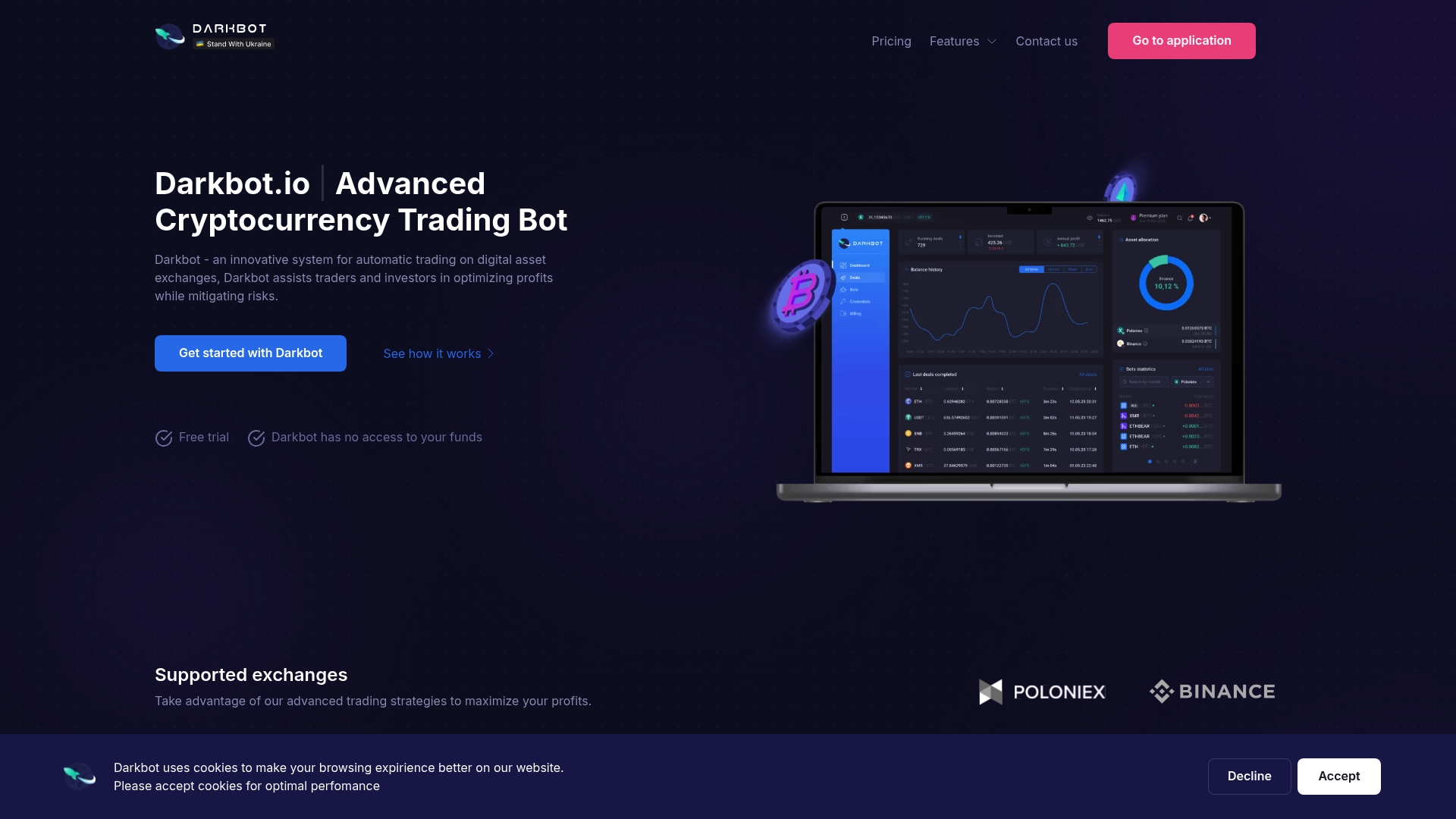
Darkbot integrates seamlessly with major exchanges through secure API management that implements the safety practices covered in this guide. Our intuitive interface guides you through trading bot setup guide procedures, ensuring proper configuration from your first deployment. Choose from proven strategies including DCA, Grid, and Arbitrage, then customize parameters matching your specific investment goals and risk tolerance.
Continuous optimization features help you refine strategies as market conditions evolve. Real-time analytics dashboards display the performance metrics that matter, tracking win rates, drawdowns, and risk-adjusted returns automatically. Access comprehensive educational resources and dedicated support whenever you need guidance maximizing your automation success.
Start automating your crypto trades today with Darkbot AI trading bot for improved efficiency, reduced emotional decision making, and risk controls protecting your capital through volatile market swings. Join thousands of traders already using automation to capture opportunities around the clock.
Frequently asked questions
What is the safest way to connect my trading bot to an exchange?
Use API keys with trading-only permissions and explicitly disable withdrawal rights to prevent unauthorized fund access. Enable IP whitelisting if your exchange supports this feature, restricting API connections to known addresses. Always test new API keys with minimal capital before deploying your full strategy.
How often should I review and update my trading bot strategy?
Review bot performance weekly during initial deployment, then monthly once you verify stable operation. Adjust strategies promptly when performance metrics degrade or market conditions shift substantially, such as transitioning from trending to range-bound markets. Document all changes in a performance journal tracking what adjustments improved results.
Can I automate trading if I’m new to cryptocurrency?
Yes, especially using simplified strategies like Dollar-Cost Averaging bots that require minimal configuration and monitoring. Start with small capital allocations and paper trading modes to build confidence without risking significant funds. Focus on understanding one strategy thoroughly before attempting more complex approaches.
What are the main risks of using a trading bot?
Bots execute strategies automatically but cannot guarantee profits in unpredictable crypto markets. Security risks emerge if API keys are compromised, potentially allowing unauthorized trades or account access. Market volatility causes unexpected losses without proper risk limits like stop-loss orders and position sizing controls protecting your capital.
How soon can I expect results from automated crypto trading?
Expect initial small-scale results within days or weeks after deployment, though early performance often reflects testing periods with conservative parameters. Consistent returns typically require continuous optimization over months as you refine strategies adapting to evolving market conditions. Patience and systematic improvement beat expecting immediate dramatic profits.
Recommended

Start trading on Darkbot with ease
Come and explore our crypto trading platform by connecting your free account!
Free plan available • No credit card required