How to Route Telegram Signals to a Bot Safely
Yes, you can turn Telegram trading signals into live executed orders. The fastest safe path is a managed, guardrail-first service like Darkbot. If you need maximum control over routing logic or execution targets, a self-hosted stack built on a regex or LLM parser with a dedicated router and exchange executor works, but it requires more setup time and ongoing maintenance.
Before you go further, three things you can act on right now:
- Connect a dedicated Telegram session account (never your personal account) to your automation stack.
- Map one signal channel to one paper-trading account and verify parse output before touching live funds.
- Enable paper mode and replay at least 50 historical messages to confirm parse accuracy and execution logic.
Pro Tip: Keep HMAC signing enabled on every webhook from day one. Retrofitting it after a live deployment is harder than it sounds, and an unsigned webhook is an open door for signal injection.
Key Takeaways
Routing Telegram signals to a bot safely requires a tested pipeline with mandatory stop-losses, HMAC-signed webhooks, and a paper-mode validation phase before any live execution.
| Point | Details |
|---|---|
| Choose your path first | Managed (Darkbot) for speed and guardrails; self-hosted for MT4/MT5 control; custom for unusual routing needs. |
| Paper mode is mandatory | Run at least 50 historical messages through the full pipeline before connecting live funds. |
| Mandatory SL on every fill | Configure the system to reject any order that lacks a stop-loss, not just flag it. |
| Dedicated Telegram session | Use a secondary account for the listener to contain session-token exposure away from personal chats. |
| HMAC signing from day one | Sign and verify every webhook before processing; retrofitting signing after a live deployment creates gaps. |
How do Telegram signals become executable orders?
The pipeline has three stages: listener, parser, and router/executor. Every failure mode in automated signal trading traces back to one of these three.
Listener captures messages from Telegram channels in real time. The two main approaches are a user-session listener (using python-telegram-bot or Telethon) and a bot-account listener via the Bot API. User-session listeners can read any channel the account is subscribed to, which makes them more flexible. Bot API listeners only receive messages in channels where the bot has been added as a member. For most signal channels, a user-session approach is necessary. Polling is a fallback when webhooks are blocked, but it adds latency.
Parser converts the raw text into a structured object: symbol, side (buy/sell), entry price, stop-loss, take-profit, and leverage. Two parsing strategies dominate:
- Regex/template parsers match known message formats deterministically. They are fast, auditable, and produce zero false positives on well-formatted channels. The leionion/telegram-signal-parser-to-webhook project is a production example that normalizes messages to JSON, handles dedupe windows, routes parse failures to a dead-letter queue, and signs outbound webhooks with HMAC.
- ML/LLM parsers handle messy or inconsistent formats. The vooi-app/vooi-signals-bot-example demonstrates LLM-based extraction paired with safety watchdogs (breakeven supervisor, SL/TP watchdog, reconciler) that catch positions left without a stop.
Router/executor takes the structured signal and sends it to the right account on the right exchange or MT4/MT5 instance. For exchange targets, this means a REST or WebSocket API call with a signed order payload. For MT4/MT5, an Expert Advisor (EA) receives the routed signal via a local socket or file bridge. Multi-account routing assigns each incoming signal to a per-account queue, so one bad parse does not cascade across all accounts simultaneously.
Integrity checks belong at the router boundary: HMAC signature verification on inbound webhooks, a dedupe window to suppress duplicate posts, and a reconciler loop that cross-checks open positions against exchange state after every fill.

Pro Tip: Add a symbol normalization map at the parser output stage. Channels often post “BTCUSDT”, “BTC/USDT”, and “BTC-USDT” interchangeably. A single alias table at the parser prevents downstream execution rejects.
Which implementation path fits your situation?
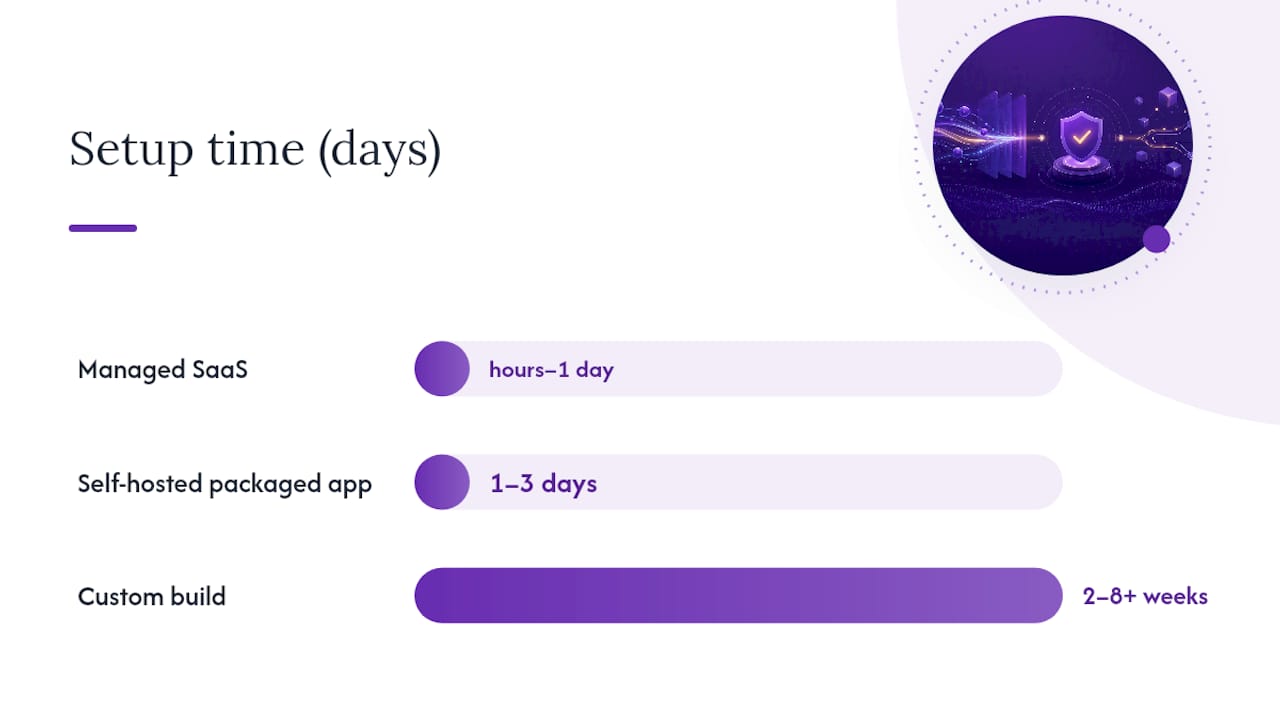
Choose managed for speed and guardrails. Choose self-hosted packaged for control over MT4/MT5 execution. Choose a custom build only when your routing logic or exchange mix is unusual enough that packaged options cannot cover it.
Managed SaaS
- Best for: traders who want to go live quickly without maintaining infrastructure.
- Execution targets: exchange APIs, multi-account routing.
- Parsing approach: configurable templates, often with ML-assisted fallback.
- Risk controls: mandatory SL, drawdown limits, per-account sizing, kill-switch.
- Setup complexity: low (hours to one day).
- Cost shape: monthly subscription, predictable per-account tiers.
Self-hosted packaged app
- Best for: forex and crypto traders who need MT4/MT5 execution and want a desktop UI.
- Execution targets: MT4/MT5 via EA bridge, some exchange API support.
- Parsing approach: AI-assisted or template-based, per-channel mapping.
- Risk controls: varies by product; audit logs and parse-fail refusal are common in well-maintained projects like Mahdi-hasan-shuvo/telegram-trade-linker.
- Setup complexity: moderate (1–3 days including tests).
- Cost shape: one-time license or open-source free plus VPS or desktop hosting.
Custom build
- Best for: teams with engineering resources who need unusual exchange routing, proprietary risk logic, or integration with internal systems.
- Execution targets: any exchange or broker with an API.
- Parsing approach: fully configurable regex, LLM, or hybrid.
- Risk controls: whatever you build; reconciler and watchdogs are your responsibility.
- Setup complexity: high (2–8+ weeks for a production-grade stack with monitoring).
- Cost shape: engineering hours plus ongoing hosting, logging, and LLM inference if used.
Pro Tip: Always provision a dedicated Telegram session account for the listener. Linking automation to a personal account exposes all your private chats to the session token. A secondary account contains that risk entirely.
Step-by-step setup to get signals executing safely
Follow these steps in order. Skipping the paper-mode phase is the single most common cause of live losses in the first week.
- Choose source channels and verify message formats. Collect 50–100 historical messages per channel. Note format variations, edited messages, and reply threads.
- Provision a dedicated Telegram session or bot account. Generate the session token or bot token in isolation from personal accounts. Store credentials in an encrypted secrets manager, not a plain config file.
- Select and configure your parser. For consistent channel formats, start with a regex/template profile. For variable formats, add an ML/LLM profile as a fallback. Reference the Avenmoqe/MT5-Telegram-Signal-AutoTrader project for a working template-to-MT5 implementation with explicit parse-fail refusal.
- Map channels to accounts. Assign each channel to one or more execution accounts. Keep a one-to-one mapping during testing; expand to multi-account routing only after paper tests pass.
- Configure position sizing and mandatory SL. Set per-account position size as a fixed percentage of account equity, not a fixed lot size. Require a stop-loss on every order. If the parsed signal has no SL field, the system should reject the order, not execute without one.
- Enable paper mode and replay historic messages. Run at least 50 messages through the full pipeline in paper mode. Check parse output, order construction, and fill simulation. Fix any parse-fail or symbol-mapping errors before proceeding.
- Enable monitoring and the reconciler. Set up audit logs that record signal receipt time, parse output, order send time, and fill confirmation. The reconciler should run on a loop and alert if any open position lacks a stop.
- Staged rollout: single account first, then multi-account. Go live on one account with a reduced position size (25–50% of target). After one week of clean execution, expand to additional accounts.
Before you go live, confirm these three things: your parser rejects signals it cannot parse (no silent execution), your SL is mandatory on every fill, and your reconciler is running and alerting. A stack that passes all three is ready for a small live pilot.
Pro Tip: During the first live week, cap total exposure at a level you are comfortable losing entirely. The goal is to validate execution behavior, not to generate returns. Treat it as a paid test.
Regex vs. LLM parsing: which one should you use?
Regex/template parsers are deterministic and fast. For channels that post in a consistent format, they are the right default. The leionion/telegram-signal-parser-to-webhook project demonstrates symbol alias normalization, multiline TP extraction, and parse-failure routing to a dead-letter queue. Parse output is a normalized JSON object: {"symbol": "BTCUSDT", "side": "buy", "entry": 67400, "sl": 66800, "tp": [68200, 69000], "leverage": 10}.
ML/LLM parsers handle channels that vary their format, post in multiple languages, or embed signals in image captions. The tradeoff is higher compute cost, added latency (typically 200–800ms per message depending on model and hosting), and the need for confidence thresholds. Open-source examples like amirphl/Telegram-Trading-Bot show LLM parsing configurations with custom prompts per channel. For connecting an AI agent to Telegram, the ClawBase developer guide covers the integration pattern in detail.
Key tradeoffs at a glance:
- Determinism: regex is fully auditable; LLM output can vary on identical inputs without careful prompt pinning.
- False-positive rate: regex produces zero false positives on matched formats; LLM can hallucinate fields on ambiguous messages.
- Maintainability: regex profiles break when channel format changes; LLM profiles degrade gradually and are harder to detect.
- Multi-language support: LLM handles non-English channels without separate regex profiles.
- Edited messages: both approaches need explicit handling. A message edit should trigger a re-parse and, if the signal changed, a position amendment or cancel-and-replace.
Best practices regardless of parser type: maintain source-specific parser profiles, set a dedupe window (typically 30–120 seconds) to suppress duplicate posts, route all parse failures to a dead-letter queue for manual review, and set a confidence threshold below which the system routes to dead-letter rather than executing.
Pro Tip: *Start with a template profile for each channel. After two weeks of live data, review the dead-letter queue."
Security and U.S. compliance before you go live
Secure sessions, least-privilege API keys, signed webhooks, and dedicated accounts are the minimum configuration to reduce attack surface to an acceptable level.
Session and account security:
- Use a dedicated secondary Telegram account for the listener. Credential and session exposure from automation software can leak personal chat data if the session token is compromised.
- Store OTP/2FA recovery codes in a hardware-backed secrets manager. Never paste them into a config file or environment variable in plaintext.
- Rotate session tokens on a schedule and immediately after any suspected compromise.
API key configuration:
- Grant exchange API keys only the permissions the bot actually needs: typically trade and read, never withdraw.
- Whitelist the bot’s outbound IP address on every exchange API key. Most major U.S.-accessible exchanges support IP whitelisting.
- Store keys encrypted at rest. Never commit them to version control.
Webhook integrity:
- Verify HMAC signatures on every inbound webhook before processing. The leionion/telegram-signal-parser-to-webhook project includes a working HMAC signing implementation.
- Reject any webhook that fails signature verification and log the attempt.
U.S. compliance considerations:
- Maintain complete audit logs of signal receipt, parse output, order submission, and fill confirmation. This supports recordkeeping obligations and internal review.
- KYC/AML responsibility rests with the exchanges and regulated providers you connect to, not with the automation layer itself.
- Automating signals from a Telegram channel does not constitute providing investment advice, but distributing those signals to others for compensation may trigger regulatory obligations. If you are relaying signals to third-party accounts, consult a qualified securities attorney.
Pro Tip: Review your risk management configuration against a published checklist before going live. A structured review catches permission and signing gaps that informal setup misses.
Paper mode, replay testing, and the guardrail-first checklist
Always validate in paper/replay mode and configure per-account guardrails before any live execution. A stack that has not been tested against real historical messages is not ready for live funds, regardless of how clean the code looks.
Testing phases in order:
- Unit parse tests. Feed 50+ historical messages from each channel through the parser in isolation. Confirm symbol, side, entry, SL, TP, and leverage fields parse correctly. Confirm parse failures route to dead-letter.
- Dry-run webhook routing. Send parsed signals through the router without connecting a live exchange. Confirm account mapping, order construction, and SL attachment.
- End-to-end paper mode. Connect a paper trading account and run the full pipeline for at least one week of real-time signals. Review audit logs daily.
- Small live pilot with strict drawdown limits. Go live on one account at reduced size. Set a daily loss limit that auto-flattens all positions if breached. The vooi-app/vooi-signals-bot-example architecture includes a breakeven supervisor and SL/TP watchdog that enforce this automatically.
- Ramp plan. After two clean weeks, increase position size incrementally. Add accounts one at a time.
Guardrail-first controls to configure before step 4:
- Mandatory SL on every fill. No exceptions.
- Per-channel confidence threshold. Signals below threshold go to dead-letter.
- Kill-switch that halts all new orders instantly.
- Daily-loss auto-flatten at a defined drawdown limit.
- Reconciler running on a loop, alerting on any unprotected open position.
For a structured drawdown control framework, the mt4copier guide covers per-account loss limits in practical terms.
Pro Tip: Use historical replay to estimate your real parse-failure rate before going live. That tells you how much signal volume you are actually capturing and whether the dead-letter queue needs daily attention.
Common failure modes and how to fix them
Failures fall into three categories: parsing, delivery, and execution. Check logs first, replay the failing message second, inspect the exchange API response third.
Parsing failures:
- Symptom: message arrives but no order is placed; dead-letter queue grows.
- Immediate action: replay the message through the parser in debug mode. Identify which regex pattern or LLM prompt failed to extract the required fields.
- Follow-up: update the channel’s parser profile. Add the new format variant to the template library. Monitor dead-letter queue daily for the next week.
Duplicate signals:
- Symptom: the same trade is opened twice in rapid succession.
- Immediate action: check the dedupe window setting. A window shorter than the channel’s typical re-post interval will allow duplicates through.
- Follow-up: lengthen the dedupe window to 60–120 seconds. Confirm the deduplication key includes message ID, not just content hash.
Execution rejects:
- Symptom: order is constructed but the exchange returns an error.
- Immediate action: inspect the exchange API error code. Common causes: symbol not found (check symbol mapping), precision error (lot size or price decimal places), insufficient margin, or API permission scope missing.
- Follow-up: fix the symbol map or precision config. Re-test with a paper order before re-enabling live routing.
Missing stop-loss:
- Symptom: position is open without a stop; reconciler alerts.
- Immediate action: trigger the safety flatten for that position. Do not wait to see if the trade recovers.
- Follow-up: trace the audit log to identify whether the SL was absent in the parsed signal or was dropped during order construction. Enforce mandatory SL at the order-construction stage, not just at the parser.
The Avenmoqe/MT5-Telegram-Signal-AutoTrader project explicitly refuses execution on parse failure and maintains a signal-vs-order timeline in its audit log, which makes this kind of post-incident trace straightforward.
Pro Tip: Keep a dedicated dead-letter queue and schedule a 15-minute review every morning. Most parse failures cluster around format changes that signal providers make without announcement. Catching them the next day beats discovering them a week later.
What does this actually cost, and how long does setup take?
Budget and timeline differ significantly across the three paths.
Managed SaaS (e.g., Darkbot):
- Cost shape: monthly subscription, tiered by features and account count. No hosting or infrastructure cost.
- Setup timeline: hours to one day for a standard configuration. Paper testing adds one to three days.
- What to budget: subscription fee only.
Self-hosted packaged app:
- Cost shape: one-time software license or open-source free, plus a VPS (typically $10–$40/month for a basic cloud instance), plus a database for audit logs.
- Setup timeline: one to three days for installation and configuration, plus one to two weeks of paper testing.
- What to budget: VPS, logging/database, and any per-channel license fees.
Custom build:
- Cost shape: engineering hours (the dominant cost), plus ongoing hosting, monitoring infrastructure, and LLM inference credits if using an ML parser.
- Setup timeline: two to eight weeks for a production-grade stack that includes a reconciler, watchdogs, dead-letter routing, and monitoring. The QuickNode overview of Telegram trading bots catalogs the range of commercial and open-source approaches available and confirms that managed options are the faster path when guardrails are a priority.
- What to budget: engineering time, cloud VPS, logging/DB, LLM inference credits, and exchange API rate-limit handling (some exchanges charge for high-frequency API access).
For a practical breakdown of trading bot setup costs and configuration, the mt4copier guide covers infrastructure decisions in detail.
Why Darkbot is a recommended managed option for U.S. crypto traders
Darkbot is built as a managed, guardrail-first automation platform for cryptocurrency trading. It connects to exchange APIs directly, supports multi-account routing, and enforces risk controls at the execution layer rather than relying on the signal source to be well-formatted.
Feature alignment with the comparison dimensions above:
- Execution targets: exchange API integration with multi-account support and per-account queues.
- Parsing approach: configurable templates with ML-assisted parsing for variable signal formats.
- Risk controls: mandatory SL on every fill, per-account position sizing, drawdown limits, and a kill-switch.
- Setup complexity: low. The platform is designed for traders, not engineers. Paper mode is available from day one.
- Pricing model: subscription-based with free, standard, and premium tiers, plus a 14-day money-back guarantee.
U.S. compliance and security fit: Darkbot handles API key storage with encrypted credentials, maintains audit logs for trade records, and separates role permissions so the execution layer does not have withdrawal access. For U.S. traders who need to maintain trade records for tax and compliance purposes, the audit log covers signal receipt through fill confirmation.
For traders who want to automate trading in Telegram crypto communities, Darkbot’s documentation walks through the full configuration sequence.
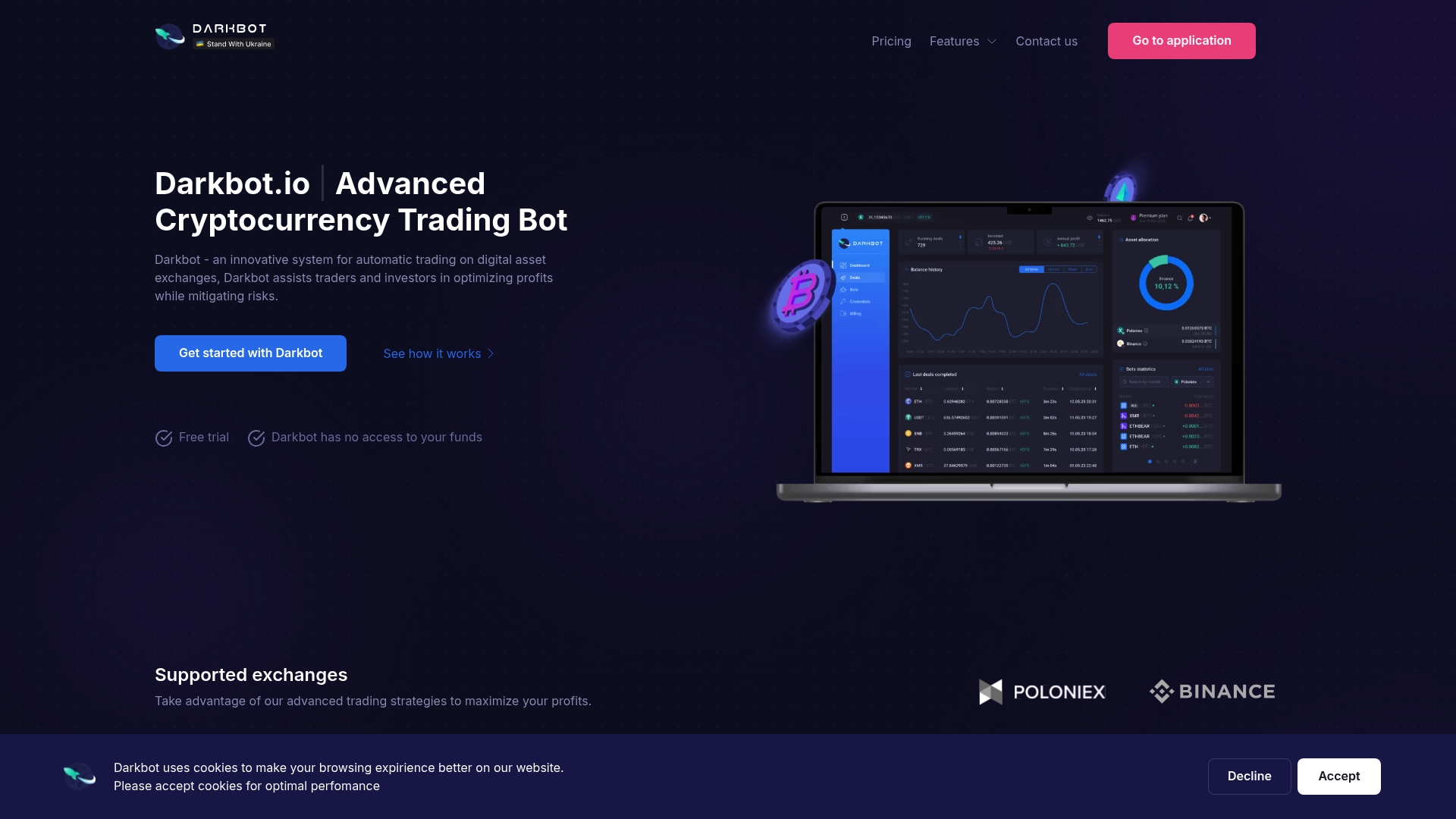
Start with a paper-mode configuration on Darkbot before connecting live funds. The platform’s paper trading environment runs against real market data, which gives you a realistic signal-to-execution test without capital at risk. Visit Darkbot to review pricing plans and begin setup.
A practical note on responsible automation
The most common mistake in Telegram signal automation is not a technical one. It is skipping the paper-mode phase because the setup looks clean and the signals look reliable. A parser that handles 95% of messages correctly still fails on 1 in 20. At any meaningful position size, that failure rate matters.
Two things I have seen hold up across deployments: start with a single-account pilot at reduced size, and treat the first two weeks as a calibration exercise rather than a trading period. The second is simpler but harder to follow in practice: require a mandatory SL on every fill, enforced at the order-construction layer. Not as a preference, not as a default that can be overridden. If the signal has no SL, the order does not go out.
Automation done this way is a disciplined execution framework. It removes latency and emotional decision-making from the process. What it does not remove is the need for a well-designed risk structure underneath. Paper test first, configure guardrails before going live, and use a platform like Darkbot that enforces those controls at the infrastructure level rather than leaving them as optional settings.
This article is general information, not a substitute for advice from a qualified financial advisor. Consult a qualified financial professional about your own circumstances before acting on anything here.
Sources
These repositories and libraries are practical starting points for building or auditing a Telegram-to-bot stack.
- leionion/telegram-signal-parser-to-webhook
- vooi-app/vooi-signals-bot-example
- Mahdi-hasan-shuvo/telegram-trade-linker
- python-telegram-bot
- Top 10 Telegram Trading Bots for Crypto in 2026
When evaluating any repository for production use, prioritize those that implement dedupe, dead-letter routing, and a reconciler. A stack without these three components will eventually leave positions unprotected or execute duplicate orders.
Recommended

Start trading on Darkbot with ease
Come and explore our crypto trading platform by connecting your free account!
Free plan available • No credit card required