How Much Do Crypto Trading Bots Cost in 2026
Crypto trading bot pricing spans a wide range: retail SaaS subscriptions run roughly $0–$100+ per month, self-hosted open-source setups cost $0 in licensing but $5–$50/month in hosting, and custom-built systems range from $300 for a simple indicator bot to $10,000+ for a multi-exchange platform. According to market pricing data from Finder, monthly SaaS plans cluster between $11.96 and $178 for stock and AI tools, with many crypto-focused plans landing in the $29–$100 range. The CFTC advises treating any vendor promising guaranteed returns with serious skepticism — actual performance depends on strategy quality, fees, slippage, and risk management.
The most common pricing structures you will encounter:
- Freemium / tiered SaaS: free entry tier with limited bots or exchanges, paid tiers unlocking more simultaneous strategies and features
- One-time custom development: a fixed or hourly fee to build a proprietary bot, with ongoing hosting and maintenance costs on top
- Open-source / self-hosted: no licensing fee, but you absorb infrastructure, setup, and developer time
For most traders, the practical starting point is a freemium or low-cost SaaS tier with strict risk limits. Move to self-hosted or custom only when your strategy genuinely requires it.
Pro Tip: Before comparing headline prices, confirm whether backtesting, paper trading, and exchange API connections are included in the base plan or locked behind a higher tier. That single question often reveals the real cost.
Key Takeaways
Trading bot costs range from $0 for open-source setups to $10,000+ for custom enterprise builds, and the headline price rarely reflects true total cost of ownership once exchange fees, slippage, and infrastructure are included.
| Point | Details |
|---|---|
| SaaS subscription range | Retail plans run $0–$178+/month; most active traders operate in the $30–$80/month mid-tier. |
| Custom build cost bands | Simple bots start at $300; complex multi-strategy systems reach $5,000–$10,000+. |
| Hidden costs matter most | Exchange fees, slippage, hosting, and security audits often exceed the subscription cost for active traders. |
| CFTC regulatory caution | The CFTC warns against any vendor claiming guaranteed returns from AI trading bots. |
| Darkbot’s recommended path | Start on Darkbot’s free tier with paper trading, then upgrade to a paid tier only when live performance justifies the cost. |
How vendors and developers price trading bots
Understanding the pricing model behind a quote matters as much as the number itself. The same monthly fee can mean very different things depending on what is bundled and what is billed separately.

Freemium gives you a working bot with limited functionality — typically one exchange connection, one active strategy, or capped trade volume. The goal is to get you using the platform before asking for payment. Freemium plans rarely include backtesting or priority support.
Tiered subscriptions are the dominant model for retail SaaS platforms. Each tier unlocks more simultaneous bots, additional exchange integrations, advanced order types, or AI-driven strategy features. Billing is monthly or annual, with annual plans typically discounted 15–25%. Hosting, data feeds, and support are usually bundled. As Finder’s pricing survey shows, choosing by raw price often misses bundled services like data and support that materially affect total cost of ownership.
Per-bot or per-API seat pricing charges per active bot instance or per exchange API connection. This model suits traders running a small number of high-value strategies but becomes expensive quickly when scaling to multiple pairs or exchanges.
Performance fees take a percentage of realized profits, typically 10–30%. There is no upfront subscription cost, but the fee structure creates a misalignment: the vendor profits whether or not your net position after all costs is positive.
White-label licensing is an enterprise arrangement where a firm licenses the underlying engine to deploy under its own brand. Costs are negotiated, often starting at several thousand dollars per month plus setup fees.
One-time custom development covers the full build cost paid to a developer or agency. You own the code, but you absorb all hosting, maintenance, and future development costs.
Open-source / self-hosted carries zero licensing cost. The real expenses are a VPS or cloud server, any premium data feeds, and developer hours for setup, configuration, and ongoing maintenance.
- Does the plan include backtesting and historical data, or are those add-ons?
- How many exchange API connections are included, and what is the overage cost?
- Is there a per-trade or volume-based fee on top of the subscription?
- Who holds API keys, and what custody and security controls are in place?
- What is the support SLA, and is it email-only or includes live assistance?
Pro Tip: Ask vendors for a sample invoice from an active customer at your expected trade volume. Headline pricing rarely reflects what a mid-volume trader actually pays once add-ons are included.
Concrete price ranges for SaaS, self-hosted, and custom builds
Retail SaaS subscription tiers
Entry-level plans typically run $0–$30/month. They cover one or two exchange connections, a single active bot, and basic order types. Backtesting is often absent or limited to short lookback windows.
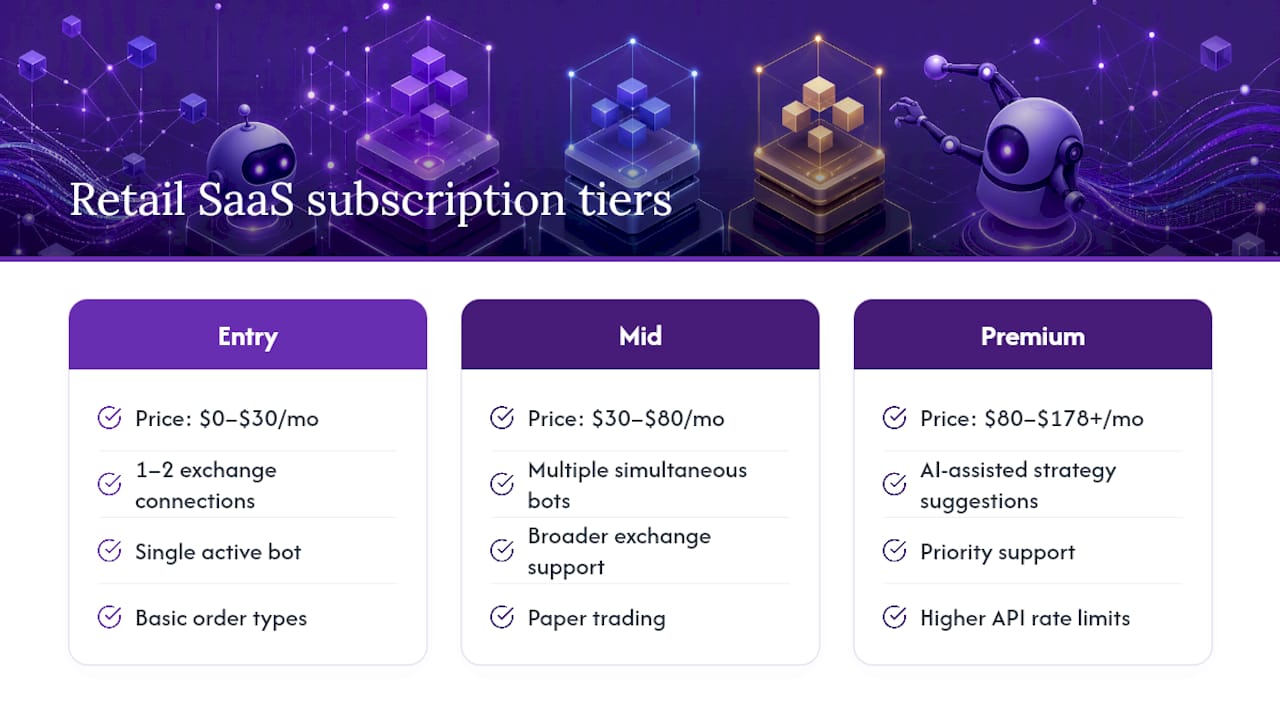
Mid-tier plans fall in the $30–$80/month range. These unlock multiple simultaneous bots, broader exchange support, paper trading, and basic portfolio analytics. Most serious retail traders operate at this level.
Premium plans at $80–$178+/month add AI-assisted strategy suggestions, priority support, higher API rate limits, and sometimes a strategy marketplace. Finder’s market survey places the upper end of retail AI tool pricing at roughly $178/month for the most feature-complete plans.
Self-hosted / open-source cost profile
| Cost item | Typical monthly | Notes |
|---|---|---|
| Software license | $0 | Open-source frameworks |
| VPS / cloud hosting | $5–$50 | Depends on uptime and compute needs |
| Market data feed | $0–$100 | Free exchange feeds vs. premium tick data |
| Developer setup (one-time) | $200–$1,000 | Varies by technical skill required |
| Ongoing maintenance | $0–$500/mo | DIY vs. contracted developer |
Custom development cost bands
Kawlo Dev’s published cost guide breaks custom builds into four bands:
| Complexity | One-time cost range | Key cost drivers |
|---|---|---|
| Simple indicators and alerts | $300 | Basic signal logic, single exchange |
| Basic trading bot | $1,000–$2,000 | Order execution, position sizing, one strategy |
| Advanced bot | $3,000–$5,000 | Multi-strategy, backtester, risk controls |
| Complex multi-strategy system | $5,000–$10,000+ | Multi-exchange, ML features, security audit |
Most of the variability in custom pricing comes from strategy complexity, backtesting infrastructure, and required security and compliance controls.
Example: mid-tier SaaS plan (monthly budget)
- Subscription: $49/month
- Exchange fees (maker/taker on $10k monthly volume): ~$20–$40
- Total monthly: ~$70–$90
Example: mid-range custom build (one-time + ongoing)
- Development: $3,500 (advanced bot tier)
- Security review: $500–$1,500
- VPS hosting: $20/month
- Data feed: $30/month
- Year-one total: ~$5,100–$6,100
Recurring and hidden costs that change the real price
The headline subscription or build cost is rarely what you actually spend. Several recurring and occasional line-items can quietly double your total cost of ownership.
Recurring operating costs:
- Exchange maker/taker fees, typically 0.05–0.1% per trade for major venues
- Network and gas fees on on-chain transactions
- Slippage on illiquid pairs, which can erode thin strategy edges entirely
- VPS or cloud hosting for uptime-critical deployments
- Premium market data feeds when exchange-provided data is insufficient
- Monitoring, alerting, and logging services
- Backup and disaster recovery for strategy configurations and trade logs
Occasional but material costs:
- Security audits and penetration testing ($500–$3,000+ per engagement)
- Legal or compliance advice if your strategy touches regulated instruments
- Margin and leverage financing costs if your bot uses borrowed capital
- Developer hours for bug fixes, exchange API changes, or strategy updates
As The Magpie Journal’s analysis documents, the majority of retail bot users underperform once fees, slippage, and overfitting are fully accounted for. Costs destroy thin edges. A strategy that looks profitable in backtesting at 0.5% per trade can turn negative in live trading once exchange fees and slippage are applied.
Compliance is a cost driver that many first-time buyers overlook. Altrady’s compliance guide notes that strategies touching wash trading or spoofing territory carry legal risk that may require documented controls and legal review.
Regulatory caution: The CFTC explicitly warns that vendors claiming AI trading bots will generate guaranteed or unusually high returns should be treated with skepticism. No legitimate platform can guarantee returns. Profitability depends on strategy quality, market conditions, fees, and risk management — not the technology label. Verify the identity of key personnel and the domain history of any platform before committing capital. (CFTC advisory on AI trading bots)
Estimating monthly TCO: Add your subscription or amortized build cost + exchange fees on expected volume + hosting + data feeds + a 10–15% buffer for slippage and unexpected maintenance. For a mid-tier SaaS user trading $15,000/month, a realistic TCO lands between $100 and $200/month before any leverage costs.
What actually drives the price up or down
Not every feature on a vendor’s pricing page justifies its cost. Understanding which drivers are technically necessary for your strategy prevents overpaying for infrastructure you will never use.
Feature drivers:
- Number of exchange integrations (each additional API connection adds complexity)
- Real-time versus delayed data feeds
- Advanced order types: trailing stops, OCO, iceberg orders
- Leverage and margin support
- Portfolio management and automated rebalancing
- Strategy marketplace access
- AI and ML features — though as Dexly notes, “AI” is frequently a marketing label; evaluate these features on transparency and auditability, not the label alone
Technical drivers:
- Latency requirements: colocation or low-latency VPS costs significantly more than standard cloud hosting
- Fault tolerance and redundancy for uptime-critical strategies
- Backtesting framework depth and historical data coverage
- Logging, auditability, and reproducible signal documentation — features that DisciplineAI’s commentary identifies as essential for any platform claiming AI-driven performance
- Multi-custody or multi-wallet support
Operational drivers:
- Support SLA tier (email vs. live chat vs. dedicated account manager)
- Managed hosting versus self-managed infrastructure
- Compliance reporting and audit log exports
Pro Tip: Unless your strategy depends on sub-100ms execution, skip the colocation and ultra-low-latency VPS tiers. For most retail crypto strategies, a standard $10–$20/month VPS performs adequately. The latency premium is real money spent on a marginal gain.
How to decide: buy, self-host, or build from scratch
The right path depends on five variables: your technical skill, strategy uniqueness, required latency, available budget, and how much ongoing operational work you can absorb.
Decision checklist:
- Can you describe your strategy in plain rules? If yes, a SaaS platform likely supports it.
- Does your strategy require exchange features or data sources no SaaS platform supports? If yes, self-host or build.
- Do you need sub-second execution or colocation? If yes, custom build is probably necessary.
- Is your budget under $100/month? Start with SaaS freemium or a low-cost tier.
- Do you have developer resources or a budget of $3,000+? Self-hosted or custom becomes viable.
- Can you maintain infrastructure, handle API deprecations, and monitor uptime yourself? Self-host is realistic. If not, SaaS is safer.
- Are there regulatory or compliance requirements specific to your firm? Factor in legal review costs before committing to a custom build.
User profile to path mapping:
- Beginner / first bot: SaaS freemium or entry tier. Run paper trading for 30 days before committing real capital. Use the automated trading checklist to validate your setup before going live.
- Experienced retail trader: Mid-tier SaaS ($30–$80/month) with backtesting. Upgrade to self-hosted only when the SaaS platform’s exchange or strategy limits become a genuine constraint.
- Quant / developer: Self-hosted open-source or custom build. Budget $3,000–$7,000 for a solid initial build plus $50–$150/month in ongoing infrastructure.
- Institutional / multi-strategy: Custom enterprise build or white-label. Budget $10,000+ for development plus ongoing maintenance and security audits.
30/90/180-day action steps for a SaaS path:
- Day 1–30: Sign up for a freemium tier, connect one exchange via API, run paper trading only. Track all simulated costs including fees.
- Day 31–90: Evaluate paper trading results against your TCO estimate. If the edge survives fees, move to a small live allocation on a paid tier.
- Day 91–180: Review live performance, assess whether exchange or strategy limits are binding. If they are, evaluate self-hosted alternatives. If not, stay on SaaS.
For custom builds, add a security audit to your timeline before going live with real capital. Skipping it is a false economy. Understanding the key risks in automated trading before committing to a build path helps avoid the most common and costly mistakes.
Pro Tip: For any custom build, get a fixed-price quote that includes QA and a basic security review, not just development hours. Developer-hour contracts without a defined scope routinely run 40–60% over initial estimates.
What the pricing conversation usually misses
Most buyers focus on the monthly subscription number or the developer quote. Both are the wrong starting point.
The more useful question is: what is the minimum cost at which your strategy’s edge survives? The fee structure embedded in the platform matters more than the subscription line item for active traders.
The second mistake is treating “AI” as a quality signal. Vendors charge a premium for AI-branded features, but as Dexly’s analysis makes clear, the label alone tells you nothing about whether the underlying logic is sound. The questions that actually matter are: can the vendor show you auditable, reproducible performance data? Are the risk controls configurable? Can you inspect what the system is doing and why?
The third mistake is underestimating operational cost. A custom build that costs $5,000 to develop will cost another $1,000–$2,000 in its first year just in hosting, maintenance, and one security review. Buyers who budget only for development routinely find themselves with a system they cannot afford to maintain properly.
Risk controls and auditability should be prioritized over flashy feature lists. A bot with configurable stop-losses, position limits, and exportable trade logs is worth more in practice than one with a sophisticated ML model and no way to inspect its decisions. That is the tradeoff worth paying attention to when evaluating smart automation for risk management.
Darkbot’s pricing structure for crypto traders
Darkbot offers a transparent tiered model built around the same cost logic this article describes: a free entry tier to validate your setup, standard and premium paid tiers that unlock additional simultaneous bots, exchange connections, backtesting depth, and portfolio management features, and enterprise pricing for institutional or multi-strategy needs.
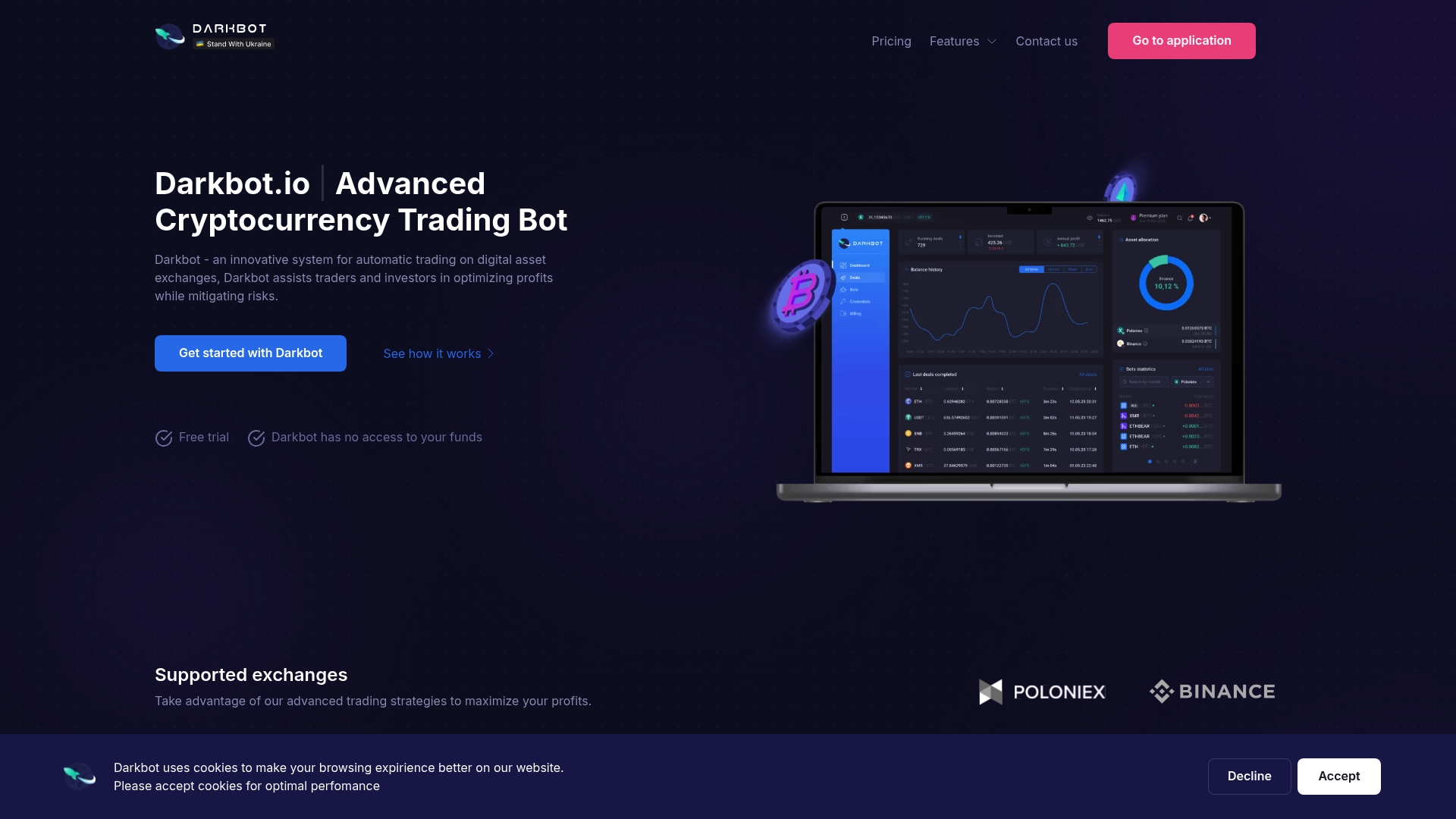
For a beginner running one or two strategies on a single exchange, the free tier provides a genuine working environment, not a stripped demo. Active retail traders who need multiple simultaneous bots, real-time analytics, and automated rebalancing fit the standard or premium tiers. Power users and institutions requiring deeper AI-driven pattern evaluation, multi-exchange execution, and priority support move to the premium or enterprise tier.
Every paid plan includes a 14-day money-back guarantee, which gives you a low-risk window to validate live performance against your TCO estimate before committing. Darkbot’s portfolio management features are particularly relevant for traders whose cost concern is not just the subscription but the drag from uncoordinated positions across multiple assets.
Start with the free tier, run paper trading, and upgrade only when the platform’s limits become a real constraint. Darkbot to match your profile to the right tier.
Sources
The following sources were used to verify pricing ranges, regulatory guidance, and profitability analysis in this article:
- CFTC advisory on AI trading bots
- Best AI trading bot in 2026: Top stock & forex AI bots compared — Finder
- How Much Does a Custom Trading Bot Cost? | Kawlo Dev
- Are Trading Bots Actually Profitable? An Honest Answer | The Magpie Journal
This article is general information, not a substitute for advice from a qualified financial advisor. Consult a qualified financial professional about your own circumstances before acting on anything here.
Recommended

Start trading on Darkbot with ease
Come and explore our crypto trading platform by connecting your free account!
Free plan available • No credit card required