Top advantages of AI trading algorithms for crypto investors

TL;DR:
- AI trading algorithms provide unmatched speed and predictive analytics for crypto markets.
- They outperform humans, especially during high volatility, by executing rapid, data-driven decisions.
- Successful trading combines AI automation with strategic oversight and risk management.
Crypto markets never sleep, and they move fast enough to punish hesitation. A single news event can swing Bitcoin 10% in under an hour, leaving manual traders scrambling to react while algorithmic systems have already opened and closed dozens of positions. AI trading algorithms aren’t just a convenience anymore. They’ve become a structural advantage that separates consistently profitable traders from those who rely on gut instinct and slow execution. This article breaks down the core advantages you gain when you put machine intelligence to work in your portfolio, from raw speed to predictive accuracy to real-world return data that’s hard to ignore.
Key Takeaways
| Point | Details |
|---|---|
| Instant market reaction | AI algorithms can execute trades and process data in milliseconds, giving you a significant speed advantage over manual trading. |
| Smarter decision-making | These systems analyze many data sources—social, technical, and on-chain—to improve trade prediction accuracy. |
| Consistent, higher returns | Empirical studies show AI often outperforms traditional strategies, delivering notably higher ROI and Sharpe Ratios. |
| Performance in volatility | AI trading bots adapt quickly during unpredictable markets, outperforming humans in both speed and accuracy. |
| Human-AI synergy | Combining AI’s power with your personal strategy and oversight is key to long-term trading success. |
Blazing fast data processing and execution
Speed is the most immediate advantage AI brings to crypto trading, and the gap between machine execution and human reaction time is enormous. When a price discrepancy appears between two exchanges, or when a key support level breaks, the window for profitable action is often measured in milliseconds, not minutes. Human traders simply cannot compete at that level, no matter how experienced or focused they are.
AI-powered systems scan and process data across dozens of exchanges, news feeds, and market indicators simultaneously. They don’t pause to think. They analyze, decide, and act within the same automated sequence, executing orders at speeds that far exceed what any manual trader can achieve. As research confirms, AI delivers superior speed in processing vast real-time data, detecting patterns, and executing trades in milliseconds, outperforming human reaction times at every stage of the trade lifecycle.

This capability is especially valuable in two specific scenarios: high-frequency trading (HFT) and arbitrage.
In HFT, algorithms place hundreds or thousands of small trades per day, each capturing a tiny edge. Accumulated over time, those edges compound into significant returns. In arbitrage, speed determines everything. If Bitcoin trades at $63,000 on Exchange A and $63,150 on Exchange B, there’s a $150 opportunity per coin. That gap closes in seconds. Only an automated system running algorithmic trading AI can consistently catch these windows before they disappear.
Key performance advantages of AI execution include:
- Sub-millisecond order routing across multiple exchanges without manual input
- Simultaneous monitoring of hundreds of trading pairs and market conditions
- Instant reaction to stop-loss triggers, price alerts, and volatility signals
- 24/7 operation without fatigue, distraction, or emotional interference
- Consistent rule-based execution that never second-guesses a pre-set strategy
Pro Tip: Even if you’re not running HFT strategies, speed matters in volatile markets. A bot that can execute your buy order within milliseconds of your target price being hit will consistently produce better fills than manual entries, especially during news-driven price spikes.
Platforms built around ML models in HFT are now making these capabilities accessible to retail traders, not just institutional desks. The democratization of speed is one of the most underrated shifts in modern crypto trading.
Advanced predictive analytics leveraging diverse data
Speed gets you into the trade fast. Predictive analytics gets you into the right trade. This is where AI algorithms truly separate themselves from simple rule-based bots that only respond to price triggers.
Modern AI trading systems don’t just watch price charts. They synthesize information from dozens of distinct data streams at once: order book depth and changes, on-chain wallet movements, social media sentiment, news headlines, derivatives market positioning, and macroeconomic signals. Each of these data types carries signal about where price might move next. Processed individually, they provide limited insight. Processed together by a deep learning model, they reveal patterns that no human analyst would spot in real time.
“AI processes diverse data sources including on-chain metrics, sentiment, and order books for better predictions and arbitrage opportunities.” This multi-layer approach gives algorithms a meaningful forecasting advantage over traders relying on charts alone.
This is more than pattern recognition. Machine learning models continuously improve their predictive accuracy by learning from their own outcomes. When a model makes a prediction and the trade succeeds or fails, that result feeds back into the system, refining future predictions. Over thousands of trades, the model becomes increasingly calibrated to the specific market conditions it operates in.
Consider what this looks like in practice. A deep learning model might detect that large wallet accumulation on-chain, combined with a spike in positive social sentiment and narrowing bid-ask spreads, has historically preceded a 5% to 8% price rally within 24 hours. A human analyst reviewing each data source separately would need hours to reach the same conclusion. The AI does it in seconds, and acts on it immediately.
Here’s what comprehensive smarter, safer trading looks like through predictive analytics:
- On-chain analytics tracking large holder behavior and network activity
- Sentiment analysis across Twitter, Reddit, Telegram, and news outlets
- Order book imbalance detection to anticipate short-term directional pressure
- Cross-exchange correlation mapping to identify arbitrage and pricing inefficiencies
- Volatility forecasting to size positions appropriately before major moves
The practical result is fewer false signals, better entry and exit timing, and a meaningful reduction in losses caused by acting on incomplete information. Information overload is one of the most common reasons traders make poor decisions. AI eliminates that problem entirely by distilling massive data volumes into clear, actionable signals.
Consistent profit optimization and real-world ROI
Discussions about AI trading often get abstract quickly. So let’s look at the actual numbers, because the empirical evidence is compelling and specific.
Benchmark studies show AI-driven strategies outperforming buy-and-hold approaches with measurable consistency. In one comparative analysis using a skin market proxy, AI algorithms produced a 20% ROI over 6 months, compared to just 5% to 10% for passive buy-and-hold strategies. More importantly, the AI strategies achieved a Sharpe Ratio above 10, versus 7 to 9 for traditional methods. The Sharpe Ratio measures return per unit of risk, so a higher score means you’re earning more without taking proportionally more risk. That’s the kind of performance that compounds dramatically over time.
At the more specialized end, hybrid C-LSTM models incorporating Fibonacci technical levels have demonstrated up to 45% ROI gains in high-frequency predictions on 1-minute BTC and ETH price data. The C-LSTM (Convolutional Long Short-Term Memory) architecture combines spatial pattern recognition with time-series learning, making it particularly effective at identifying micro-trends in fast-moving markets.
Here’s how AI performance compares to traditional strategies across key metrics:
| Metric | Buy-and-hold | Rule-based bot | AI algorithm |
|---|---|---|---|
| 6-month ROI | 5% to 10% | 10% to 15% | 20% to 45% |
| Sharpe Ratio | 7 to 9 | 8 to 10 | 10+ |
| Reaction to volatility | None | Rule-triggered | Adaptive learning |
| Data sources analyzed | None | Price/volume | Multi-layer synthesis |
| Strategy refinement | Manual | Manual | Continuous self-optimization |
To understand why AI achieves better risk-adjusted results, consider these strategy optimization with AI principles:
- Dynamic position sizing that adjusts trade size based on current volatility and confidence level
- Portfolio-level correlation management to avoid overexposure to correlated assets
- Automated strategy evaluation that compares live performance against historical benchmarks
- Drawdown protection mechanisms that reduce exposure during losing streaks
- Continuous backtesting against new market data to validate strategy effectiveness
The compound effect of these optimizations is significant. Better entries, better exits, smaller losses, and larger wins create a performance gap that widens over months and years. AI doesn’t need a lucky streak. It needs consistent, marginal improvements across hundreds of trades.
Superior performance in unpredictable markets
Here’s the uncomfortable truth that most trading advice ignores: strategies that work in calm markets often fail catastrophically during high volatility. The exact conditions that create the most profit opportunity are also the ones most likely to destroy undisciplined traders. This is where AI algorithms prove their most decisive advantage.
When markets spike or crash suddenly, human traders face a brutal combination of cognitive overload, emotional stress, and information lag. Fear causes premature exits. Greed causes over-exposure. Confusion causes paralysis. AI systems experience none of this. They execute their pre-defined logic with perfect consistency, regardless of how chaotic the market becomes.
| Scenario | Human trader response | AI algorithm response |
|---|---|---|
| 15% BTC flash crash | Panic sell, miss recovery | Executes stop-loss, reassesses signals |
| News-driven volatility spike | Hesitation, missed opportunity | Immediate position adjustment |
| Exchange liquidity gap | Manual re-routing delay | Automated order splitting |
| Multi-asset correlation break | Slow manual rebalancing | Instant portfolio recalibration |
The data backs this up clearly. GPT-powered trading bots outperformed human traders by 15% to 25% during high-volatility periods, according to 2025 research. That performance gap widens precisely when human decision-making degrades under pressure, which is exactly the opposite of what most traders experience.
Hybrid machine learning models add another layer of advantage here. By combining multiple architectures, such as reinforcement learning paired with transformer models, these systems can rapidly update their understanding of market dynamics when conditions shift. A model that learned patterns during a bull run can adapt its signals when the market transitions to a bear phase, something that takes human traders months to recognize and adjust to.
You can explore more detail on AI trading benefits for investors and how volatility-focused strategies are structured to protect and grow capital simultaneously.
Pro Tip: During volatile market periods, the biggest gains often come from not losing money, not from catching every spike. AI systems that protect capital during sharp drawdowns give you the staying power to benefit from the recovery. That’s why drawdown protection is a core feature to look for in any automated trading platform.
The discipline that AI enforces is not a limitation. It’s a feature. Removing emotion from the execution process forces you to compete on strategy quality alone, which is a much more level and learnable playing field.
A fresh perspective: Why AI alone isn’t a magic bullet for crypto traders
We’ve covered the real, measurable advantages that AI algorithms bring to crypto trading. But here’s something that deserves equal attention: AI amplifies your edge, it doesn’t create one from nothing.
An AI system trained on a flawed strategy will execute that flawed strategy with perfect, relentless efficiency. Fast execution of a bad plan produces fast losses. This is why traders who simply deploy an AI bot and walk away often underperform those who actively engage with their strategy, monitor results, and make adjustments as market conditions evolve.
The most successful algo traders we’ve observed combine AI execution with clear strategic thinking and sound money management. They know what market conditions their system is designed for. They know when to pause a bot during unusual events. They understand the risk parameters and set them deliberately, not by default.
Markets also evolve. A model that performs beautifully in one macro environment may need retraining or reconfiguration when conditions shift significantly. This is why AI’s role in trading success is best understood as a partnership between human judgment and machine intelligence, not a replacement of one by the other.
The traders who will win long-term are not those who hand over control to an algorithm and hope for the best. They’re the ones who build, test, monitor, and refine continuously. AI does the heavy lifting, but you still need to be the one holding the steering wheel.
Ready to automate your trading with AI?
The advantages covered in this article are real and they’re available to you right now. You don’t need a team of quants or a six-figure investment to put AI algorithms to work in your crypto portfolio.
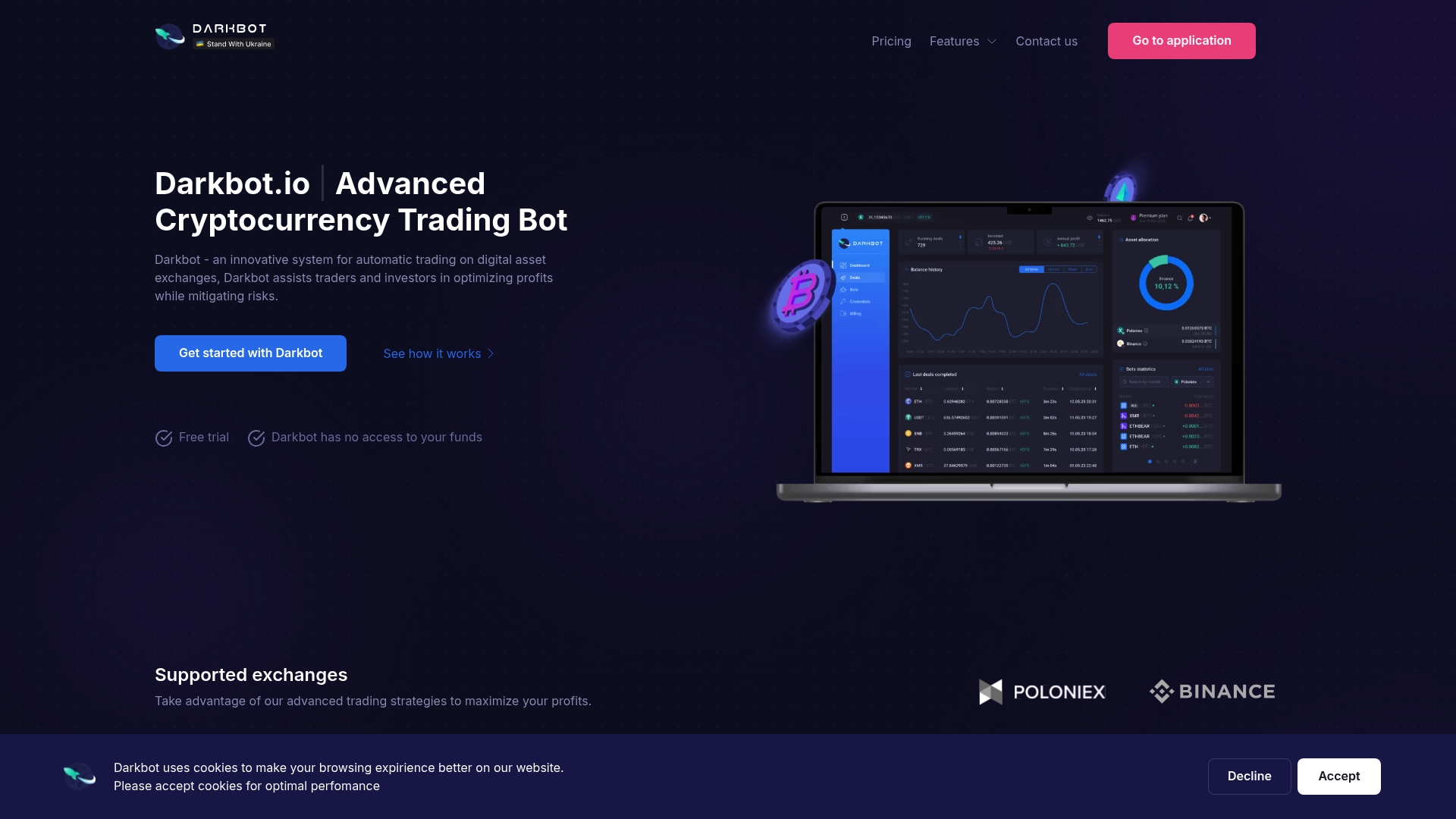
Darkbot.io gives you access to a fully automated AI trading bot that connects to your existing exchange accounts via API, deploys multiple simultaneous strategies, and continuously optimizes performance in real time. From high-frequency execution to crypto portfolio management and automated rebalancing, every feature is built to give you the competitive edge this article has described. Plans start free, with premium tiers for advanced multi-bot configurations. Set up takes minutes, not months.
Frequently asked questions
How do AI trading algorithms identify opportunities?
They use machine learning models to analyze price data, sentiment, and on-chain metrics simultaneously, surfacing profitable signals that no single data source would reveal on its own.
Are AI trading algorithms profitable in volatile crypto markets?
Yes. GPT-powered bots outperformed human traders by 15% to 25% during high-volatility periods, making them most effective precisely when manual trading is hardest.
Can AI trading algorithms guarantee profits?
No algorithm can guarantee profits. Even advanced AI strategies can experience losses during extreme market dislocations or black swan events, which is why risk management settings remain essential.
Do I need coding skills to use AI trading bots?
Modern platforms like Darkbot.io are designed for traders of all technical backgrounds, offering intuitive interfaces that require zero coding to deploy, configure, and manage AI trading bots effectively.
Recommended

Start trading on Darkbot with ease
Come and explore our crypto trading platform by connecting your free account!
Free plan available • No credit card required