Unlock trading efficiency with exchange integration in 2026

Most crypto traders believe managing separate exchange accounts manually gives them better control. This misconception costs them time, missed opportunities, and higher error rates. Exchange integration transforms this fragmented approach by connecting trading software directly to multiple platforms through APIs, enabling automated execution and unified portfolio oversight. In 2026, seamless integration has become essential for traders seeking to maximize efficiency and capitalize on volatile market conditions. This guide reveals how proper exchange integration streamlines operations and enhances profitability.
Key takeaways
| Point | Details |
|---|---|
| Unified control | Exchange integration consolidates multiple accounts into one interface for simplified management |
| Faster execution | API connections enable real-time automated trade execution across platforms |
| Reduced errors | Automation eliminates manual data entry mistakes and operational delays |
| Better insights | Integrated portfolio data provides comprehensive visibility for informed decisions |
| Easy scaling | Adding new exchanges becomes straightforward without disrupting existing setups |
Why exchange integration matters in automated crypto trading
Exchange integration means connecting your trading software directly to crypto exchange APIs, creating a seamless data flow between platforms and your automation tools. This connection allows your trading bots to execute orders, retrieve market data, and manage positions without manual intervention. Many traders mistakenly believe manual management gives them better oversight, but this approach actually introduces delays and inconsistencies that hurt performance.
Another common misconception is that integration requires advanced technical skills or creates security vulnerabilities. Modern platforms have simplified the process significantly, making API-based exchange integration accessible even for traders without programming backgrounds. When implemented correctly, integration actually enhances security by reducing the need to log into multiple exchange interfaces and minimizing exposure to phishing attempts.
True integration enables real-time data exchange between your trading system and exchanges. Your automated strategies receive live price updates, order book changes, and account balance information instantly. This immediate access allows your bots to react to market movements within milliseconds rather than minutes, capturing opportunities that manual traders miss entirely.
The operational benefits extend beyond speed. Integration creates a single source of truth for your entire crypto portfolio, regardless of how many exchanges you use. You can monitor positions, track performance, and analyze risk across all platforms simultaneously. This unified view eliminates the confusion of switching between different exchange interfaces and reconciling data manually.
Pro Tip: Start with read-only API keys when testing new integrations to familiarize yourself with the data flow before enabling trading permissions.
Key advantages of proper exchange integration include:
- Elimination of manual order entry across multiple platforms
- Automatic synchronization of portfolio data and balances
- Reduced latency between market signals and trade execution
- Centralized monitoring of all trading activity
- Simplified tax reporting through consolidated transaction records
Core benefits of exchange integration for crypto traders
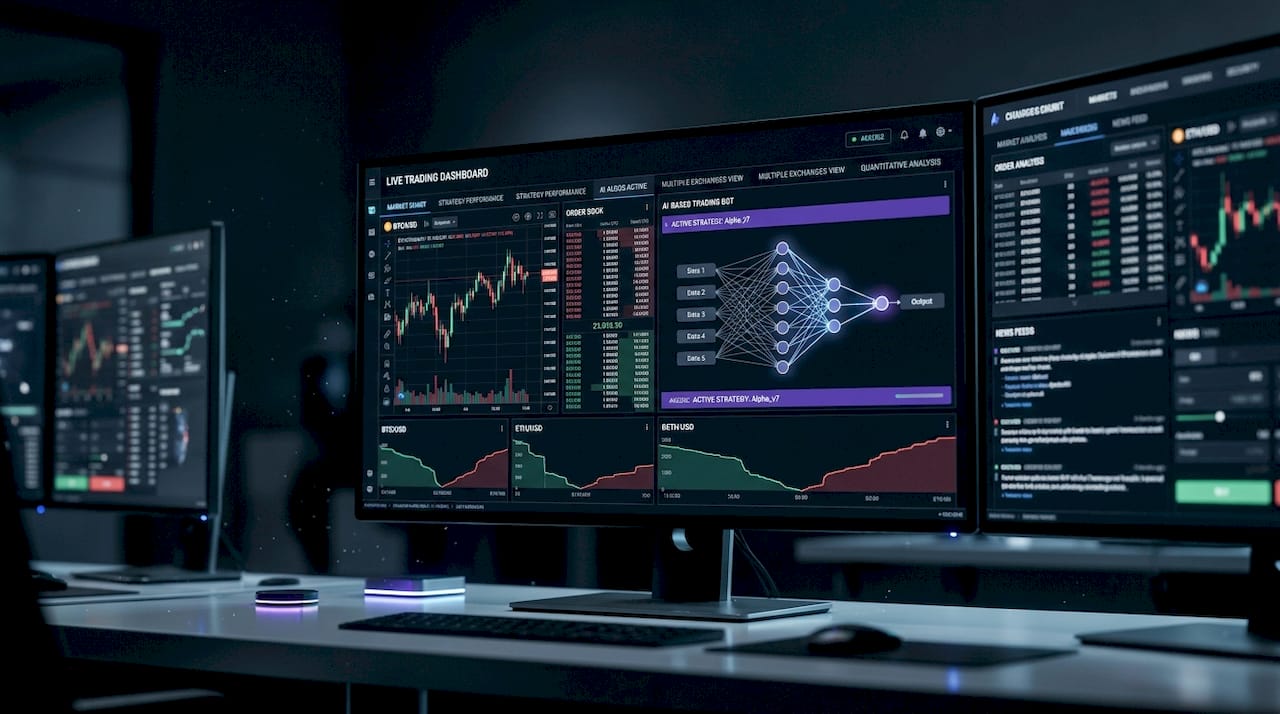
Unifying multiple exchange accounts into one interface dramatically reduces operational complexity. Instead of logging into separate platforms to check balances, place orders, or monitor positions, you access everything through a single dashboard. This consolidation saves hours each week and prevents costly mistakes from outdated information or missed notifications.
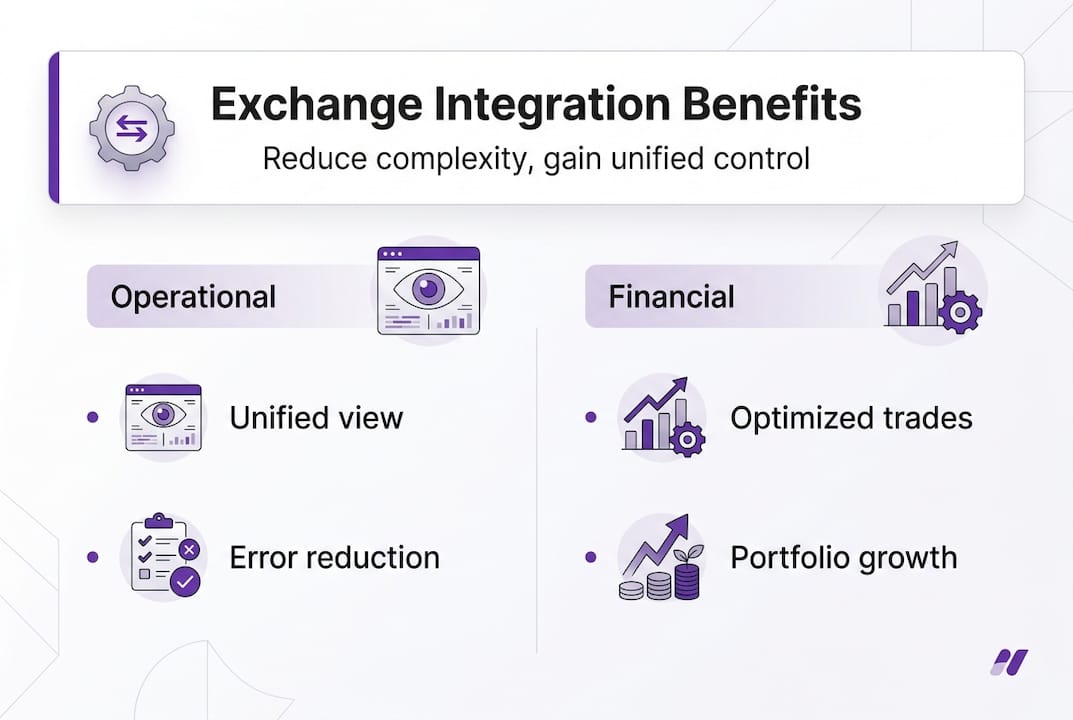
Multi-exchange integration provides operational and financial benefits such as unified portfolio management and optimized trade execution. When your trading bot can access liquidity across multiple venues simultaneously, it executes orders at better prices by routing to the exchange offering the most favorable conditions. This smart order routing can improve your average entry and exit prices by 0.5% to 2%, which compounds significantly over hundreds of trades.
The speed advantage becomes critical during volatile market conditions. Automated systems connected via API can execute trades in under 100 milliseconds, while manual processes typically take 30 seconds or longer. During rapid price movements, this difference determines whether you capture profitable opportunities or watch them disappear. Integration also enables advanced order types and conditional logic that would be impossible to manage manually across multiple platforms.
Error reduction represents another substantial benefit. Manual trading involves copying addresses, entering quantities, and selecting trading pairs, each step introducing potential mistakes. A single misplaced decimal point or wrong address can result in significant losses. Automated systems eliminate these human errors by executing pre-programmed instructions with perfect consistency.
| Approach | Average Execution Time | Error Rate | Platforms Managed Efficiently |
|---|---|---|---|
| Manual Trading | 30-60 seconds | 2-5% of trades | 1-2 exchanges |
| Integrated Automation | Under 0.1 seconds | Less than 0.01% | 5+ exchanges |
Improved decision-making stems from having complete portfolio visibility. When you can see your total exposure across all exchanges, you identify concentration risks and rebalancing opportunities that remain hidden in fragmented views. Real-time profit and loss tracking across platforms helps you evaluate strategy performance accurately and make data-driven adjustments.
Integration also enables sophisticated risk management that would be impractical manually. You can set portfolio-wide stop losses, automatically rebalance allocations when they drift from targets, and implement hedging strategies across multiple venues. These protective measures run continuously without requiring constant attention, reducing stress and protecting capital during unexpected market moves.
Additional benefits include:
- Automated portfolio rebalancing based on predefined rules
- Cross-exchange arbitrage opportunity detection
- Consolidated reporting for performance analysis
- Reduced subscription costs by eliminating redundant tools
- Better capital efficiency through optimized allocation
How seamless exchange integration enhances automated trading strategies
Automated trading strategies depend on reliable, high-speed API access to function effectively. Your algorithms need continuous market data feeds to identify trading signals and immediate order execution capabilities to act on those signals before conditions change. Automated trading strategies properly integrated with exchange APIs enable rapid reaction to market changes, boosting profitability and reducing latency.
The process of connecting exchanges and configuring strategies follows a structured approach. First, you generate API keys from each exchange you want to integrate, carefully setting appropriate permissions. Most traders start with read-only access to verify data flows correctly before enabling trading capabilities. Next, you input these credentials into your trading platform, which establishes secure connections and begins pulling market data.
Once connected, you configure your trading strategies by defining entry and exit rules, position sizing parameters, and risk management settings. The integration allows your strategy to monitor multiple trading pairs across different exchanges simultaneously, something impossible with manual approaches. Your bot can execute complex multi-leg strategies that involve coordinated actions across platforms, such as simultaneously buying on one exchange while selling on another to capture arbitrage spreads.
Trading bots and AI systems benefit enormously from integrated exchange ecosystems. Machine learning algorithms require large datasets to identify patterns and optimize performance. Integration provides continuous access to historical and real-time data across multiple markets, enabling your AI to learn from diverse conditions and improve its predictions. The more data sources you integrate, the more robust and adaptable your automated strategies become.
Pro Tip: Configure separate API keys for different strategies or bots to maintain clear attribution of trades and simplify troubleshooting if issues arise.
Scalability becomes straightforward with proper integration architecture. When you want to add a new exchange to your trading ecosystem, you simply generate API credentials and add them to your platform. Your existing strategies can immediately access the new liquidity source without requiring code changes or manual reconfiguration. This flexibility lets you expand into new markets or exchanges offering better fee structures without disrupting your current operations.
The performance impact of integration extends to strategy refinement. Integrated systems generate detailed execution logs showing exactly when signals occurred, how quickly orders were placed, and what slippage occurred. This granular data helps you identify bottlenecks and optimize your strategies. You might discover that certain exchanges consistently provide better execution quality for specific trading pairs, allowing you to route orders more intelligently.
Steps for optimizing integrated trading strategies:
- Monitor API response times and identify exchanges with the lowest latency
- Analyze execution quality metrics to determine optimal routing for each pair
- Implement failover logic to switch exchanges if primary connections experience issues
- Set up alerts for unusual API behavior or connection problems
- Regularly review and update API permissions to maintain security
- Test strategy modifications in paper trading mode before deploying to live accounts
Practical tips for implementing and optimizing exchange integrations
Using official exchange APIs ensures you receive reliable data and maintain compliance with platform terms of service. Third-party or unofficial API solutions may offer convenience but often lack proper support and can violate exchange policies, risking account suspension. When generating API keys, verify you are on the legitimate exchange website to avoid phishing attacks that steal credentials.
Testing integration in simulated environments before live deployment prevents costly mistakes. Most trading platforms offer paper trading or sandbox modes that connect to real exchange APIs but execute simulated orders. This testing phase lets you verify your strategies work as expected, confirm data flows correctly, and identify any configuration issues without risking actual capital. Spend at least a week monitoring simulated performance before enabling live trading.
Regularly monitoring API limits prevents unexpected interruptions. Exchanges impose rate limits on API calls to prevent system overload, and exceeding these limits can result in temporary bans or throttled access. Configure your trading software to respect these limits and implement exponential backoff when approaching thresholds. Some exchanges offer higher rate limits for verified accounts or paid tiers, which may be worthwhile for active traders.
Trading strategy setup steps following structured approaches improve integration reliability and streamline maintenance. Document every aspect of your integration configuration, including which API keys connect to which exchanges, what permissions each key has, and which strategies use which connections. This documentation becomes invaluable when troubleshooting issues or recovering from failures.
Backing up integration configurations protects against data loss. Export your strategy settings, API configurations, and custom parameters regularly. Store these backups securely offline so you can quickly restore your trading environment if your primary system fails. Some platforms offer cloud backup features, but maintaining your own local copies provides additional security.
Optimizing portfolio management using integration-enabled tools requires understanding your platform’s capabilities. Modern solutions offer automated rebalancing that maintains target allocations across exchanges, tax-loss harvesting to minimize liabilities, and performance attribution showing which strategies or exchanges generate the best returns. Leverage these features to reduce manual workload and improve results.
Best practices for secure and efficient integration:
- Rotate API keys quarterly to minimize security risks from potential compromises
- Use IP whitelisting when exchanges support it to restrict API access to known addresses
- Enable two-factor authentication on all exchange accounts for additional protection
- Monitor API key usage logs to detect unauthorized access attempts
- Set up withdrawal address whitelists to prevent unauthorized fund transfers
- Implement circuit breakers that halt trading if losses exceed predefined thresholds
- Keep detailed logs of all API interactions for auditing and troubleshooting
- Update integration software promptly when exchanges release API changes
Improve your crypto trading with Darkbot’s integrated solutions
Managing exchange integrations manually becomes overwhelming as your trading operation grows. Darkbot’s AI-powered trading bot enables seamless API-based integration across multiple exchanges, eliminating the complexity of maintaining separate connections and configurations. The platform provides intuitive setup wizards that guide you through connecting your crypto exchanges securely, with built-in validation to ensure credentials work correctly before you deploy strategies.
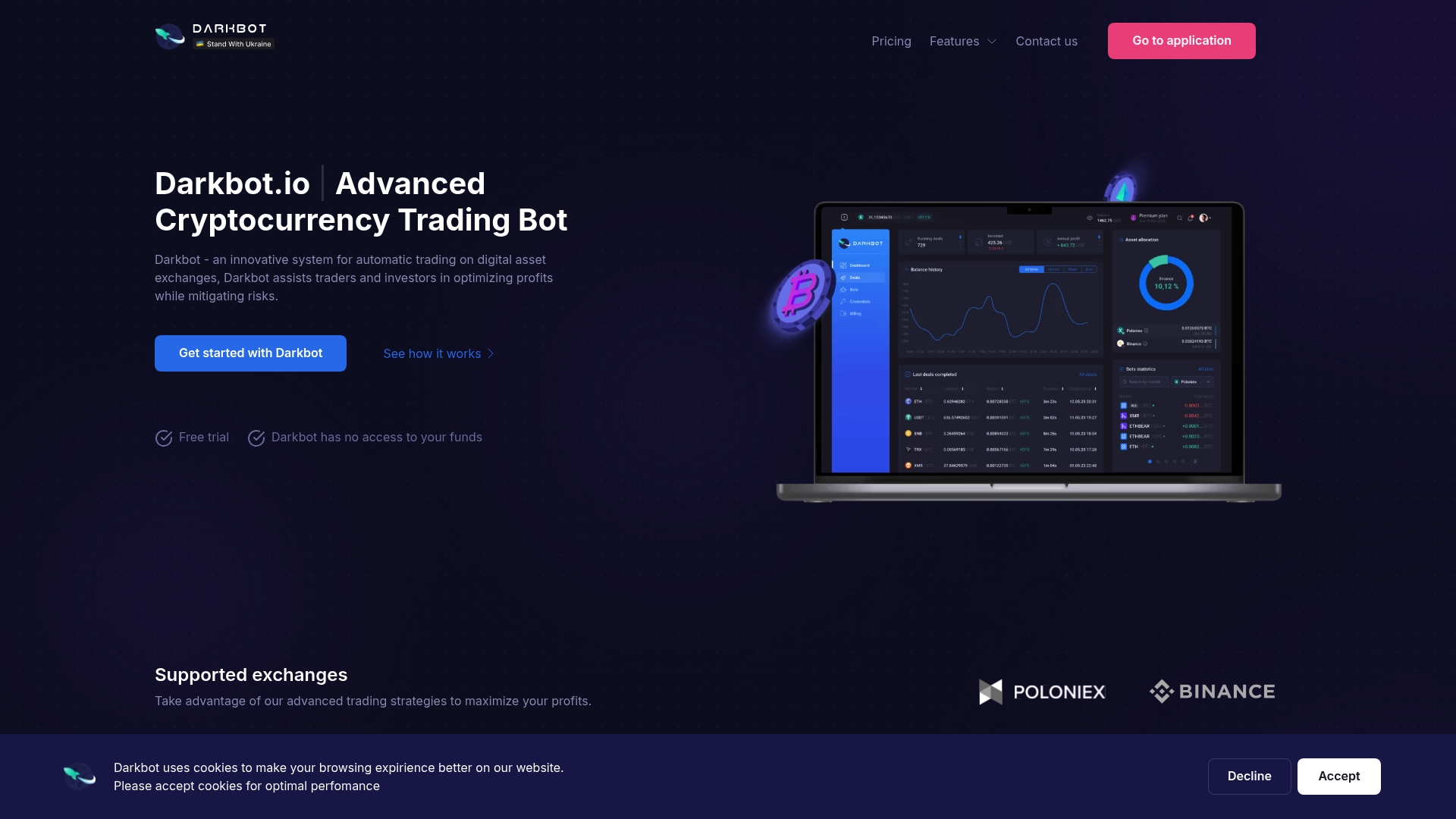
Darkbot’s advanced cryptocurrency portfolio management features consolidate your holdings across all integrated exchanges into a single, real-time dashboard. You can track performance, analyze risk exposure, and execute rebalancing strategies without switching between platforms. The AI-powered algorithms continuously monitor market conditions and optimize your trading strategies based on historical performance and current volatility, maximizing efficiency while managing risk effectively. Whether you’re running multiple simultaneous bots or fine-tuning a single strategy, Darkbot provides the infrastructure to scale your automated trading operation seamlessly.
Frequently asked questions
What is exchange integration in crypto trading?
Exchange integration connects your trading software directly with crypto exchange APIs, enabling automated data exchange and order execution. This differs from manual trading, where you log into each exchange separately to place orders and check balances. Integration creates a continuous connection that allows your trading bots to monitor markets and execute strategies without human intervention.
How does exchange integration improve trading efficiency?
API integration reduces trade execution latency from 30 seconds or more to under 100 milliseconds, capturing opportunities before market conditions change. Automation eliminates human errors like incorrect order quantities or wrong trading pairs that occur in 2-5% of manual trades. Unified portfolio data helps you monitor positions and react to market movements across all exchanges simultaneously rather than checking each platform individually.
What are common challenges when integrating crypto exchanges?
API key management requires careful attention to security, including proper permission settings and regular rotation to prevent unauthorized access. Different exchanges use varying API standards and rate limits, requiring platform-specific configuration and monitoring. Maintaining integrations demands ongoing updates when exchanges modify their APIs or introduce new features, plus continuous monitoring to detect connection issues before they impact trading performance.
Can beginners successfully implement exchange integration?
Modern trading platforms have simplified integration to the point where beginners can connect exchanges without programming knowledge. Most solutions provide step-by-step setup wizards that guide you through generating API keys and establishing connections. Starting with read-only permissions and paper trading allows you to learn the system safely before enabling live trading capabilities.
How many exchanges should I integrate for optimal results?
Most active traders benefit from integrating three to five major exchanges to access diverse liquidity pools and trading pairs. Adding too many exchanges creates unnecessary complexity and monitoring overhead, while limiting yourself to one or two restricts opportunities and competitive pricing. Focus on exchanges with strong reputations, good API reliability, and the specific trading pairs relevant to your strategies.
Recommended

Start trading on Darkbot with ease
Come and explore our crypto trading platform by connecting your free account!
Free plan available • No credit card required