Master API integration in financial technology for crypto

Many crypto traders believe API integration is too technical or risky to tackle alone, but this misconception holds them back from unlocking powerful automation capabilities. In reality, mastering API integration opens doors to optimized trading strategies, precise risk management, and consistent execution across volatile markets. Whether you’re just starting with automated trading or refining advanced strategies, understanding how APIs connect your bot to exchanges transforms your approach. This guide breaks down API integration fundamentals, architecture design, risk controls, and expert techniques to help you trade smarter and more efficiently in the fast-moving cryptocurrency landscape.
Key Takeaways
| Point | Details |
|---|---|
| API types for trading | REST handles orders and balances, while WebSocket streams live price updates and order book changes for faster reactions. |
| Rate limits and latency | Exchanges impose rate limits and latency ranges that force you to design polling and data flow accordingly. |
| API security basics | Protect API keys with secret signing, restrict permissions to minimize risk, and never expose keys in public code. |
| Bot architecture components | A robust bot architecture combines data feeds, strategy engines, risk managers, and execution layers to process data and enforce controls. |
| Strategy vs API approach | High frequency strategies rely on WebSocket connectivity and colocated servers, while longer term approaches can work with REST polling every few seconds. |
How API integration powers crypto trading automation
API integration forms the technical backbone that connects your trading bot to cryptocurrency exchanges, enabling automated order execution and real-time market monitoring. Understanding these protocols helps you build reliable systems that respond instantly to market conditions.

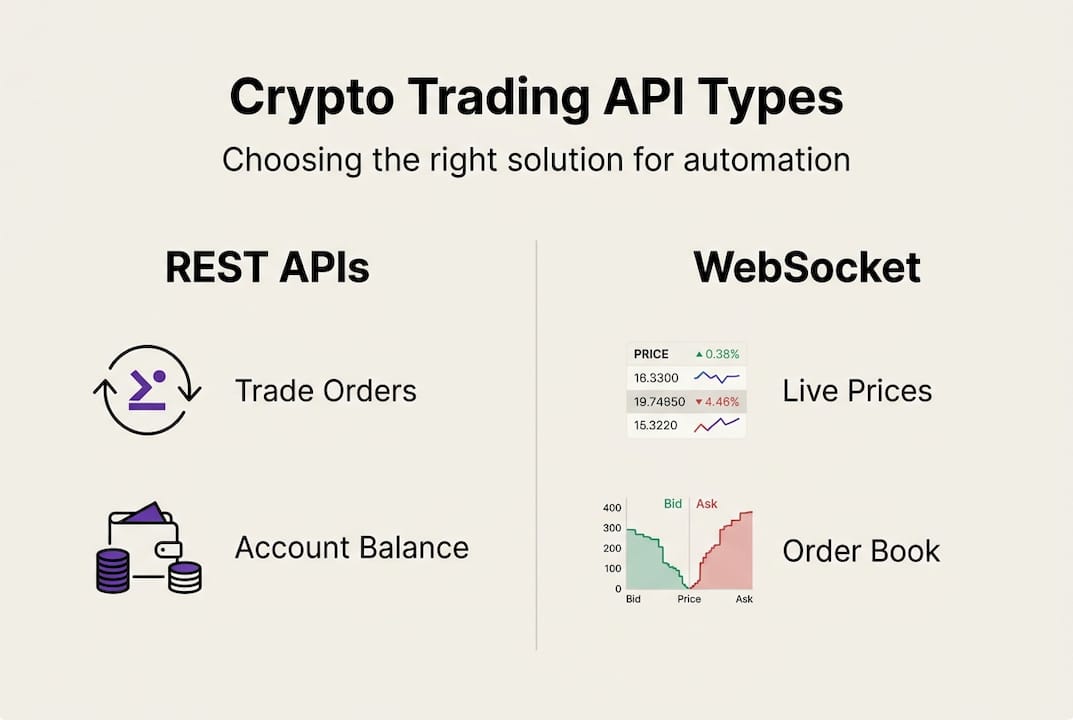
API integration uses REST for orders and balances while WebSocket connections stream live price updates and order book changes. REST APIs work like traditional web requests where your bot sends a query and receives a response, perfect for checking account balances or placing orders. WebSocket APIs maintain persistent connections that push data to your bot the moment market conditions change, eliminating the delay of repeated polling.
Standard libraries like CCXT simplify the integration process by providing unified interfaces across dozens of exchanges. Instead of learning each exchange’s unique API quirks, you write code once and connect to Binance, Coinbase, Kraken, or others through a common framework. This saves hundreds of development hours and reduces the chance of costly implementation errors.
Exchange rate limits and latency benchmarks vary significantly and directly impact your trading strategy:
- Binance allows 1200 requests per minute on REST endpoints
- Bitget permits 20 requests per second for public data
- Coinbase Pro enforces tiered limits based on your trading volume
- Latency typically ranges from 10ms to 200ms depending on server location
Security through API keys and request signing protects your account from unauthorized access. When you generate API keys, exchanges provide a public key and secret key pair. Your bot uses the secret key to cryptographically sign each request, proving it originated from you. Never share secret keys or commit them to public code repositories. Most exchanges also let you restrict API key permissions, allowing read-only access or limiting withdrawal capabilities.
Choosing the right API approach depends on your crypto trading automation techniques and strategy frequency. High-frequency strategies require WebSocket feeds and colocated servers, while longer-term position trading works fine with REST polling every few seconds. Understanding these fundamentals ensures your bot architecture matches your trading goals and technical constraints.
Architecture and risk management in API-based crypto trading bots
Building a robust trading bot requires more than just connecting to exchange APIs. The internal architecture determines how reliably your system processes market data, executes strategies, and protects your capital through disciplined risk controls.
Bot architecture includes data feed components, strategy engines, risk managers, and execution layers working together. The data feed continuously pulls market information through WebSocket or REST APIs, normalizing it into a consistent format your strategy engine can analyze. Strategy engines implement your trading logic, whether that’s technical indicators like RSI and MACD, machine learning models, or arbitrage detection algorithms.
Risk managers act as gatekeepers between strategy signals and actual order execution. Even when your strategy identifies a promising trade, the risk manager verifies it won’t violate your predefined safety rules. This separation prevents emotional override and ensures consistent discipline across all market conditions.
Effective risk management incorporates multiple layers of protection:
- Stop-loss orders automatically exit positions when losses reach 2% of position value
- Take-profit targets lock in gains at predetermined levels like 5% returns
- Maximum daily loss limits halt all trading after losing $500 in a single day
- Position sizing restricts each trade to 1-2% of total portfolio value
- Correlation checks prevent overexposure to similar assets
Risk management parameters should match your risk tolerance and market volatility. Conservative traders might use 1% stop-loss levels and 0.5% position sizes, while aggressive approaches could accept 5% drawdowns per trade. The key is defining these rules before trading begins and letting your bot enforce them without exception.
Position sizing frameworks like the Kelly Criterion calculate optimal trade sizes based on your win rate and average profit-to-loss ratio. If your strategy wins 55% of the time with a 1.5:1 reward-to-risk ratio, Kelly suggests risking about 10% per trade. Most traders use fractional Kelly (like 25% of the full amount) to reduce volatility while still growing capital efficiently.
The execution layer handles the actual API calls to place, modify, and cancel orders. It manages order types (market, limit, stop-limit), tracks fill rates, and handles partial executions. Sophisticated execution logic can split large orders across multiple price levels to minimize slippage and market impact.
Pro Tip: Create separate API keys for each trading bot with restricted permissions that match their specific needs. A market-making bot only needs order placement rights, while a portfolio rebalancer requires withdrawal permissions. This compartmentalization limits damage if one key becomes compromised and makes troubleshooting easier when tracking down unexpected behavior.
Understanding safer crypto trading risk management principles ensures your automated system protects capital even during extreme market volatility. The architecture you build today determines whether your bot survives the inevitable drawdown periods that challenge every trading strategy.
Handling technical challenges and improving API integration performance
Even well-designed trading bots face technical obstacles that can disrupt execution and erode profits. Recognizing these challenges and implementing expert solutions separates reliable systems from those that fail during critical market moments.
Rate limits vary dramatically across exchanges and API endpoint types. Public endpoints that provide market data typically allow higher request volumes than private endpoints for account management and order placement. Exceeding these limits results in temporary bans ranging from one minute to several hours, during which your bot cannot trade.
| Exchange | Public Rate Limit | Private Rate Limit | Typical Latency |
|---|---|---|---|
| Binance | 1200 req/min | 50 req/10sec | 15-30ms |
| Bitget | 20 req/sec | 10 req/sec | 20-40ms |
| Coinbase Pro | 10 req/sec | 5 req/sec | 25-50ms |
| Kraken | 15-20 req/sec | Tier-based | 30-60ms |
Handling rate limiting with exponential backoff and WebSocket reconnects maintains stable trading during network issues. Exponential backoff means when a request fails, you wait an increasing amount of time before retrying: first 1 second, then 2 seconds, then 4 seconds, and so on. This prevents your bot from hammering the exchange with repeated failed requests that worsen the situation.
WebSocket connections can drop unexpectedly due to network issues, exchange maintenance, or timeout policies. Implementing automatic reconnection logic with state preservation ensures your bot resumes data streaming without missing critical price movements. Store the last received message timestamp and request historical data to fill any gaps after reconnecting.
Precision and rounding errors cause costly mistakes when exchanges reject orders or execute at unintended prices. Cryptocurrency prices and quantities have specific decimal precision requirements that vary by trading pair. Bitcoin might allow 8 decimal places while some altcoins only permit 2. Your bot must round order quantities and prices according to each exchange’s rules before submitting requests.
Floating-point arithmetic in programming languages introduces tiny errors that compound over thousands of trades. Use decimal libraries designed for financial calculations instead of standard float types. Validate that your calculated order size multiplied by price equals your intended position value within acceptable tolerance.
Latency optimization becomes critical for strategies competing on speed:
- Colocate servers in the same data centers as exchange matching engines
- Use WebSocket feeds instead of REST polling for market data
- Implement asynchronous API calls to handle multiple requests simultaneously
- Minimize data processing between receiving signals and placing orders
- Choose VPS providers with direct network paths to major exchanges
Servers located near exchange infrastructure can achieve under 20ms round-trip latency, while distant connections might experience 200ms or more. For high-frequency strategies, this difference determines whether you capture profitable opportunities or consistently arrive too late.
Pro Tip: Regularly validate API responses for stale or outlier data to avoid faulty trades. Check that timestamps are recent (within the last few seconds), prices fall within reasonable ranges compared to recent history, and order book depths make sense. Exchanges occasionally send corrupted data during system stress, and trading on bad information can instantly wipe out weeks of profits.
Addressing these technical challenges systematically reduces automated trading risks and builds confidence in your system’s ability to perform consistently. The most successful traders treat infrastructure reliability as seriously as strategy development, knowing that execution quality directly impacts bottom-line returns.
Advanced strategies and data insights for API-driven crypto trading
Once you master the fundamentals of API integration and risk management, advanced techniques using AI, alternative data, and sophisticated models can further refine your trading edge. These approaches require careful validation to avoid overfitting and ensure real-world profitability.
Hybrid models combining LSTM and ARIMA outperform single-method approaches by capturing both short-term patterns and longer-term trends. LSTM neural networks excel at learning complex nonlinear relationships in price sequences, while ARIMA models handle linear time series components effectively. Combining their predictions through weighted averaging or stacking creates more robust forecasts that adapt to changing market regimes.
Social sentiment analysis offers measurable improvements, particularly during bull markets when retail trader enthusiasm drives momentum. Analyzing Twitter mentions, Reddit discussions, and news headlines for positive or negative sentiment provides early signals of shifting market psychology. Studies show sentiment-enhanced strategies can improve returns by 3-8% in trending markets, though the edge diminishes during ranging or bear market conditions.
Reinforcement learning algorithms like Soft Actor-Critic (SAC) and Twin Delayed Deep Deterministic Policy Gradient (TD3) show promising results in optimizing trade timing and position sizing. These RL strategies can increase Sharpe ratios by 41% compared to traditional technical analysis alone. The algorithms learn optimal actions through trial and error, discovering patterns that human traders and conventional algorithms miss.
| Strategy Type | Average Return Improvement | Sharpe Ratio Gain | Validation Requirement |
|---|---|---|---|
| Hybrid LSTM-ARIMA | 5-12% | 0.3-0.6 | 2+ years out-of-sample |
| Sentiment-enhanced | 3-8% | 0.2-0.4 | Multiple market cycles |
| Reinforcement learning | 8-15% | 0.4-0.8 | Extensive backtesting |
| Dynamic hedging | 2-6% | 0.3-0.5 | Stress testing required |
Dynamic hedging using volatility metrics enhances risk control during market swings. When implied volatility spikes, your bot can automatically reduce position sizes, tighten stop-losses, or open offsetting positions in negatively correlated assets. This adaptive approach protects capital during crashes while maintaining exposure during calmer periods that favor your core strategy.
Implementing advanced strategies requires careful consideration of several factors:
- Conduct rigorous out-of-sample testing on data your model never saw during development
- Validate performance across multiple market regimes (bull, bear, sideways)
- Monitor for model degradation as market conditions evolve over time
- Implement continuous retraining pipelines to keep models current
- Use walk-forward analysis to simulate realistic deployment scenarios
- Set realistic expectations based on transaction costs and slippage
Overfitting remains the biggest pitfall when developing sophisticated trading models. A strategy that performs brilliantly on historical data but fails in live trading likely learned noise rather than genuine patterns. Reserve at least 30% of your data for final validation testing and never peek at it during model development.
Continuous monitoring becomes essential with complex strategies. Track key performance metrics daily, comparing live results to backtest expectations. Significant deviations signal that market conditions have shifted or your model assumptions no longer hold. Be prepared to pause trading and retrain models when performance degrades beyond acceptable thresholds.
Exploring automated trading advantages through advanced techniques requires balancing sophistication with robustness. The most profitable traders combine cutting-edge methods with disciplined validation and realistic expectations about what AI can and cannot predict in chaotic cryptocurrency markets.
Explore smart automation with Darkbot’s crypto trading solutions
Now that you understand the technical foundations and advanced strategies behind API-driven crypto trading, you might be wondering how to implement these concepts without building everything from scratch. Darkbot provides a complete platform that handles the complex infrastructure while giving you control over strategy and risk parameters.
Our AI-powered crypto trading bot leverages the API integration principles covered in this guide, connecting seamlessly to major exchanges through secure, tested connections. You focus on defining your trading approach while Darkbot manages rate limiting, reconnection logic, and precision handling automatically.
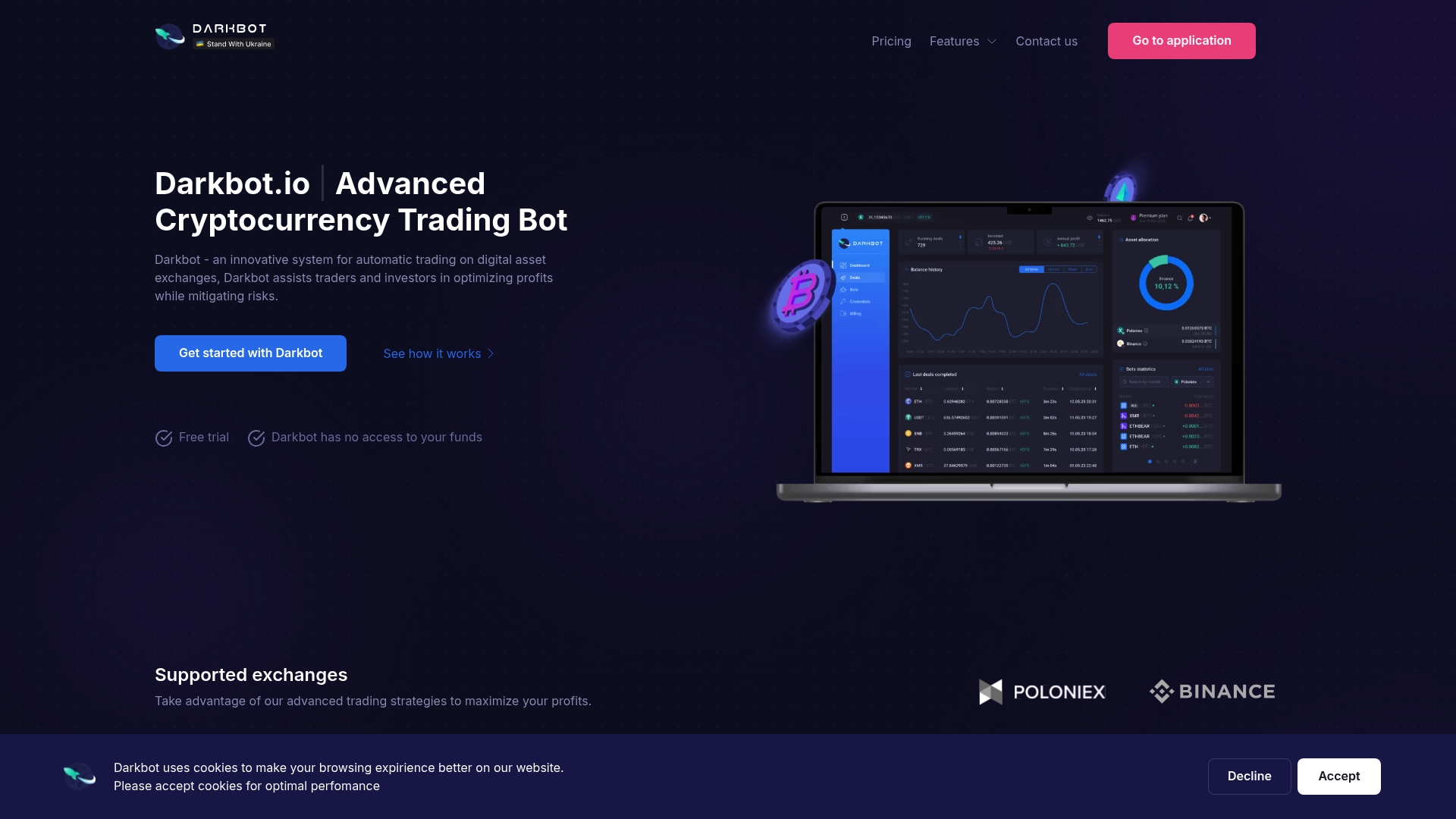
The platform includes comprehensive cryptocurrency portfolio management tools that implement the risk management frameworks discussed earlier. Set your stop-loss levels, position sizing rules, and daily loss limits through an intuitive interface. Darkbot enforces these controls consistently across all your trading bots, protecting your capital even during volatile market conditions.
Getting started is straightforward when you connect your crypto exchange using API keys with appropriate permissions. Our detailed guides walk you through generating keys, setting restrictions, and verifying connections work correctly before you risk any capital. Whether you’re running simple technical indicator strategies or sophisticated machine learning models, Darkbot’s infrastructure scales to match your needs.
Frequently asked questions
What is API integration in financial technology?
API integration in financial technology connects software applications to exchange platforms, enabling automated data retrieval and order execution. It uses REST APIs for account management and WebSocket protocols for real-time market data streaming, allowing trading bots to operate without manual intervention.
How does API integration improve cryptocurrency trading?
API integration eliminates manual order entry, reduces emotional decision making, and enables 24/7 market monitoring across multiple exchanges simultaneously. Automated systems execute strategies consistently, respond to opportunities within milliseconds, and implement disciplined risk management that humans struggle to maintain during volatile market conditions.
What security measures should I take when using exchange APIs?
Generate separate API keys for each bot with minimum required permissions, never allowing withdrawal rights unless absolutely necessary. Store secret keys in encrypted environment variables rather than code, enable IP whitelisting when exchanges support it, and regularly rotate keys every few months to limit exposure from potential compromises.
How can I manage risks with automated trading bots?
Implement multiple protective layers including stop-loss orders at 2% of position value, maximum daily loss limits, and position sizing rules that risk only 1-2% of capital per trade. Use separate risk management modules that validate every trade signal before execution, and regularly review performance metrics to ensure your bot behaves as expected.
What common technical challenges arise with API integration?
Rate limiting causes temporary bans when bots exceed request quotas, requiring exponential backoff strategies and request queuing. WebSocket disconnections interrupt data streams and need automatic reconnection with gap filling. Precision errors from improper rounding lead to rejected orders, while latency issues can cause slippage on time-sensitive strategies.
Recommended

Start trading on Darkbot with ease
Come and explore our crypto trading platform by connecting your free account!
Free plan available • No credit card required