Fractional Crypto Trading: A Bot Trader's Guide
TL;DR:
- Fractional crypto trading allows buying or holding small portions of native coins, offering precise portfolio control. It improves diversification, enables dollar-cost averaging, and facilitates micro-rebalancing, but custody, fees, and tax implications must be verified beforehand. Proper API, exchange constraints, and risk management ensure that fractional strategies operate efficiently and accurately.
Fractional crypto trading means buying or selling a decimal portion of a native coin, such as 0.01 BTC, or holding a tokenized fraction of a higher-value asset. That fraction carries proportional market exposure, just like a whole unit would. Before you wire up a bot, three things matter immediately:
- Custody: Confirm whether your platform holds native on-chain units you can withdraw or records only an internal ledger balance.
- Bot implications: Fractional sizing changes minimum order thresholds, fee drag on small fills, and how your API reports balances.
- Verification steps: Check minimum order size, withdrawal rules, and API decimal precision before deploying any live strategy.
The sections below cover mechanics, benefits, custody risks, bot execution constraints, and a pre-deployment checklist.
What is fractional crypto trading, and how does it work?
Native divisibility vs. platform-level fractions
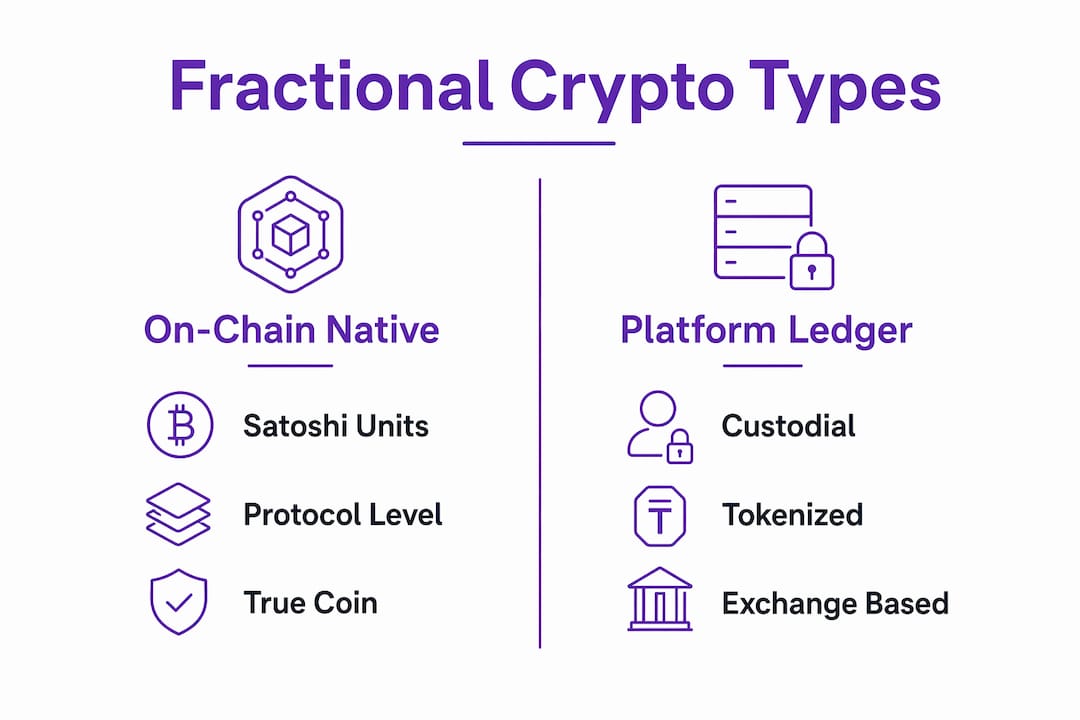
Bitcoin is divisible to one satoshi, which is 1/100,000,000 BTC. That divisibility is native to the protocol. Most other major coins share similar decimal precision. When you trade a fraction on an exchange, you are usually buying a proportional amount of the actual coin, not a synthetic instrument.
The distinction that matters operationally is where that fraction lives. On-chain native fractions are real coin units recorded on the blockchain, withdrawable to a self-custody wallet. Platform-level fractions are often internal ledger entries: the exchange holds pooled assets and credits your account with a decimal balance. Both look identical in your dashboard, but they behave differently when you try to move funds.
A separate model exists for fractionalized tokenization: an asset is locked in a smart contract, and fungible ERC-20-style tokens representing proportional claims are issued. This is common for real-world assets and NFTs, and it introduces governance and buyout mechanics that standard crypto fractions do not have.
Execution and settlement flow
Most platforms convert a dollar amount into the corresponding coin fraction at the current market price. You enter $50, the platform returns 0.000X BTC. Settlement timing and withdrawability depend entirely on the exchange’s custody model.
| Dimension | On-chain native fraction | Custodial ledger fraction |
|---|---|---|
| Ledger record | Blockchain transaction | Internal database entry |
| Withdrawable to self-custody | Yes, subject to network fees | Often no, or restricted |
| Fee sensitivity | Network fee + exchange fee | Exchange fee only |
| API balance reporting | Coin amount, full precision | Coin amount, may be rounded |
| On-chain settlement visibility | Publicly verifiable | Not visible externally |
Exchange-imposed minimums create a practical floor well above one satoshi. Flat fees can consume a disproportionate share of a very small order, which matters when a bot is firing many micro-trades.
What are the main benefits for systematic traders?
Fractional trading improves risk management by letting traders spread capital across more assets rather than concentrating it in whole-coin positions, as explained in Foreign Exchange Market Risk Management Techniques & Solutions - CorpHedge. For a bot running a multi-asset portfolio, that granularity is operationally useful, not just conceptually appealing.
Key benefits for automated traders:
- Finer position sizing: Allocate exact dollar amounts to each asset without rounding to the nearest whole coin, which tightens adherence to target weights.
- Broader diversification: Smaller allocations across more assets reduce exposure to any single asset’s volatility.
- Dollar-cost averaging (DCA): Fractional purchases enable fixed-dollar investments at regular intervals regardless of coin price, making automated DCA strategies practical.
- Micro-rebalancing: A bot can make small corrective trades to restore target allocations without waiting to accumulate enough capital for a whole-coin purchase.
- Liquidity access: Fractionalization creates more entry and exit points for high-value assets, improving price discovery and reducing the capital required to participate.
One liquidity caveat: fractional orders on thin order books can still face meaningful slippage. A bot placing many small fractional orders in rapid succession may move the market more than a single larger order would. Factor that into your fill model.
For a broader view of how position sizing fits into a crypto risk management framework, the principles apply directly to fractional strategies.
Common misconceptions and custody risks to verify
Fractional crypto is not always a derivative
A recurring misconception is that fractional crypto is a synthetic product. Buying fractional crypto normally means owning a proportional amount of the actual coin, not a derivative claim. The exception is custodial platforms that issue only internal ledger credits. Verify before assuming.
Fractionalized tokenization (smart-contract-locked assets with issued tokens) is a genuinely different model. It involves governance rights, buyout mechanisms, and transferability rules that standard fractional coin trading does not. Conflating the two leads to wrong assumptions about withdrawability and portability.
Custody and withdrawal implications
Users can often withdraw fractional amounts to a self-custody wallet, but network fees may consume a significant portion of a very small holding. A bot strategy that accumulates many tiny fractional positions needs to account for minimum withdrawal thresholds and network fee costs before those positions can be moved off-exchange.
| Custody check | What to verify |
|---|---|
| Who holds private keys | Exchange (custodial) or you (self-custody) |
| Withdrawable as native coin | Yes / No / Minimum threshold |
| Minimum withdrawal amount | Stated in coin or USD equivalent |
| On-chain settlement visible | Blockchain explorer verifiable |
| Typical withdrawal fee | Network fee + exchange fee |
U.S. tax treatment
The IRS treats every fractional crypto trade as a taxable event, the same as a whole-coin trade. Each buy and sell creates a cost-basis lot. A bot executing dozens of fractional trades per day generates a corresponding number of taxable events. Track cost basis per lot and confirm your platform exports a complete trade history in a format compatible with U.S. tax software. This is general information; consult a qualified tax professional for your specific situation.
How fractional trading affects automated bots
Fractional trading primarily changes three things for a bot: sizing precision, fee impact on small fills, and minimum-order handling. Get those three right and the rest of the strategy logic stays intact.
Before connecting a bot, verify these API and exchange constraints:
- Minimum order size: Exchanges publish minimum order amounts in coin or USD. A bot that calculates a position smaller than the minimum will have its order rejected.
- Lot and tick size: APIs enforce allowed decimal precision. A bot must round order quantities to the exchange’s permitted tick size or the order fails silently.
- Order types supported: Confirm whether limit, market, and stop orders all support fractional quantities on your target pairs.
- Balance reporting precision: Some APIs truncate fractional balances in responses. Confirm the API returns full decimal precision so the bot’s internal accounting stays accurate.
- Withdrawal support: If the strategy involves moving funds off-exchange, confirm the API supports fractional withdrawal requests and what the minimum is.
- Rate limits: High-frequency fractional rebalancing can hit API rate limits faster than expected. Map the bot’s expected order frequency against the exchange’s published limits.
For a structured approach to bot risk configuration, including order sizing and safety checks, the operational principles transfer directly to fractional strategies.
Pro Tip: Backtest and paper-trade using a fill model that reflects the exchange’s actual minimum order sizes, fee tiers, and slippage for fractional orders. A backtest that assumes zero-fee fills on any quantity will overstate performance for strategies that rely on many small fractional trades.

Pre-deployment checklist for U.S. traders
Before going live with a fractional bot strategy, work through these checks:
- Verify minimum executable order size in USD and in coin units for each trading pair.
- Confirm whether fractional balances are withdrawable as native coin and what the minimum withdrawal threshold is.
- Confirm API decimal precision and that the exchange returns full fractional balances in responses.
- Review the fee schedule for small orders; check whether the platform applies flat fees, percentage fees, or spread markups that affect tiny fills.
- Confirm the platform exports complete trade history with cost basis data in CSV or a format compatible with U.S. tax software (1099-B, 1099-K, or equivalent CSV).
- Check whether the platform supports the order types your bot uses (limit, market, stop-limit) for fractional quantities.
Sample questions to send to exchange support:
- “What is the minimum executable order size in USD for BTC/USD?”
- “Can I withdraw fractional BTC to an external wallet, and what is the minimum withdrawal amount?”
- “How are fractional balances recorded — on-chain or as internal ledger entries?”
- “Does your API return full decimal precision for fractional coin balances?”
- “What tax reporting documents or export formats do you provide for U.S. customers?”
For portfolio rebalancing strategies that depend on fractional trades, these checks directly affect whether the rebalancing logic executes as designed.
Two worked examples
Example 1: Simple fractional buy. You instruct a bot to allocate $50 to BTC. At a market price of $100,000, the platform converts $50 to 0.0005 BTC. If the exchange charges a 0.1% taker fee, the fee is $0.05, and the net position is approximately 0.00049950 BTC. Small in absolute terms, but the fee percentage is identical to a larger order.
Example 2: Bot rebalancing — batching vs. micro-trades. A portfolio rebalancing target requires $500 of BTC. Option A: one $500 order, one fee event at 0.1% = $0.50 in fees. Option B: ten $50 micro-trades, ten fee events = $5.00 in fees. Batching reduces fee drag by a factor of ten and uses fewer API calls. Micro-trades can be preferable when spreads are volatile and a single large order risks worse average fill prices, but for most systematic rebalancing scenarios, batching is the more fee-efficient path.
Key Takeaways
Fractional crypto trading gives automated strategies precise sizing control, but custody verification and fee modeling determine whether that precision translates into clean execution.
| Point | Details |
|---|---|
| Definition | A fractional trade buys a decimal coin portion (e.g., 0.0005 BTC) with proportional market exposure. |
| Custody check | Verify whether fractions are withdrawable on-chain or recorded only as internal ledger entries. |
| Bot execution items | Confirm API decimal precision, minimum order size, and lot size before deploying any live strategy. |
| Fee and tax discipline | Batch orders where possible to reduce fee drag; every fractional trade is a taxable event under IRS rules. |
| Darkbot application | Darkbot’s API integration, decimal-precision sizing, and backtesting tools support fractional strategy validation before going live. |
A practical perspective on fractional trading for bot operators
Fractional trading is often discussed as an accessibility feature, which undersells its operational significance for systematic traders. The real value is not that you can buy $10 of Bitcoin. It is that precise decimal sizing lets a bot maintain exact portfolio weights, execute DCA on a fixed schedule, and rebalance without accumulating rounding errors over hundreds of trades. Those properties compound over time in ways that whole-coin rounding cannot match.
What most guides skip is the custody layer. A bot that executes fractional trades on a platform using internal ledger credits is exposed to counterparty risk on every open position because of the custody model. That is a different risk profile than holding native on-chain units, and it belongs in any honest risk assessment of a fractional strategy. Pair that with the tax reality: a bot running 50 fractional trades a day generates 50 taxable lots. Without automated cost-basis tracking, tax season becomes an accounting problem, not just a reporting one.
The traders who get the most out of fractional sizing are the ones who treat it as an operational decision first. Verify custody, model fees accurately, and backtest with realistic fills. The sizing precision follows from that groundwork.
Darkbot supports fractional trading strategies end to end
Precise fractional sizing only delivers its theoretical advantages when the execution layer can actually support it. Darkbot connects to major exchanges via API, handles decimal-precision order sizing, and runs backtests with exchange-like fee and fill models so you can validate a fractional strategy before it touches live capital.
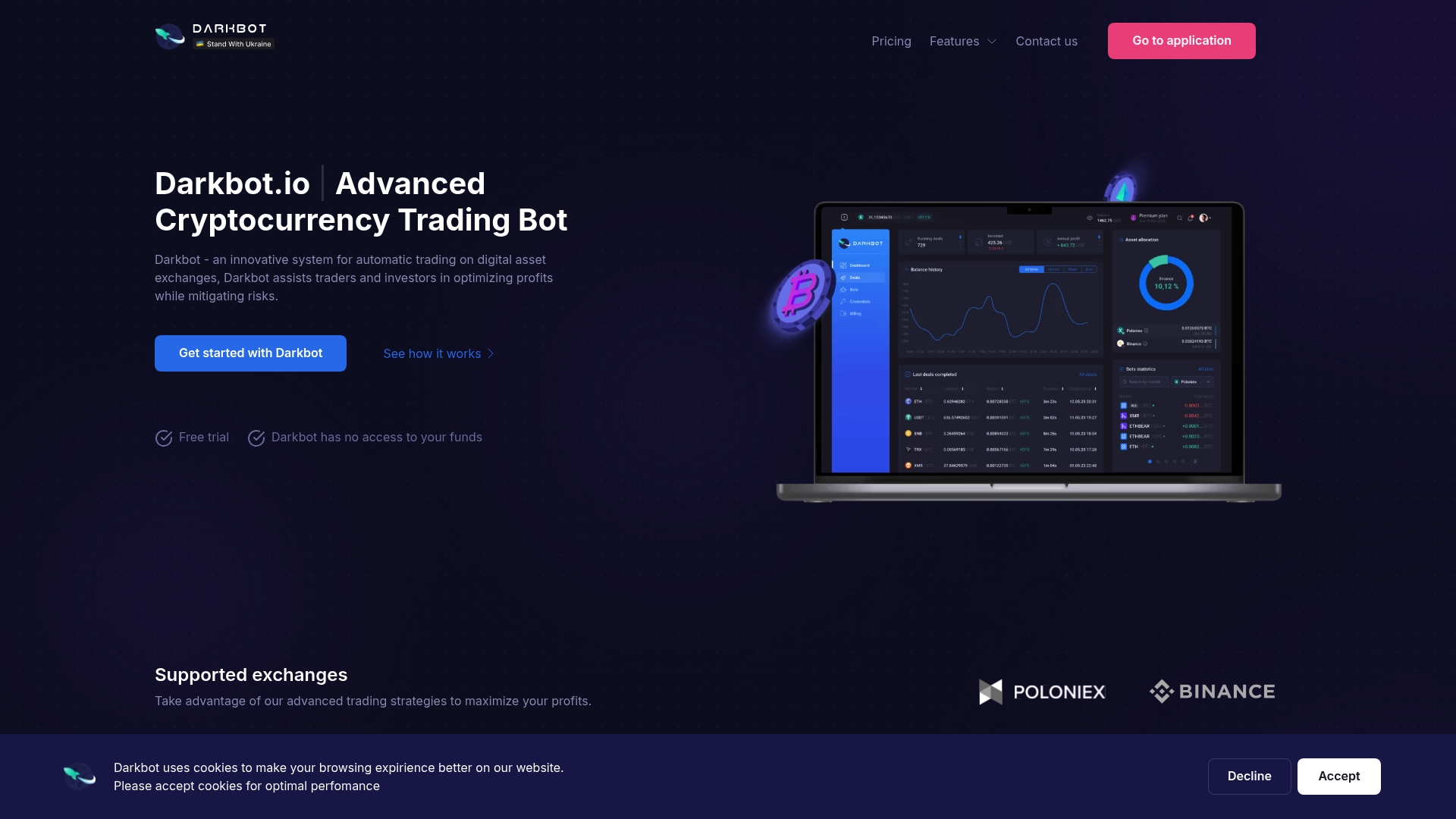
The portfolio management tools handle automated rebalancing with fractional trades, and the platform exports complete trade history for cost-basis tracking and tax reporting. For traders checking exchange compatibility, the supported exchanges page lists integrations and custody details by platform.
Start with a paper-trade on Darkbot using your target exchange’s actual minimums and fee tiers. That single step surfaces most execution problems before they cost real capital.
Useful sources
- Fractionalization glossary, Ledger Academy: Best starting point for understanding the technical difference between native fractional coins and tokenized fractionalized assets.
- Bitcoin fractional buying guide, Decentral Digest: Covers custody models and the distinction between native ownership and platform ledger credits.
- Bitcoin minimum investment and fees, InvestingInTheWeb: Detailed breakdown of exchange-imposed minimums and how flat fees affect small fractional orders.
- Fractional withdrawal considerations, Oobit: Explains withdrawal thresholds and network fee impact on tiny fractional balances.
- IRS virtual currency guidance: Primary source for U.S. tax treatment of crypto transactions, including fractional trades and cost-basis requirements.
Recommended

Start trading on Darkbot with ease
Come and explore our crypto trading platform by connecting your free account!
Free plan available • No credit card required