4 Operational Checks for WunderTrading Alternatives

The strongest category of WunderTrading alternative is a multi-exchange automation platform that treats execution quality as the product, not a bundled signal service, and Darkbot fits that description as the publisher’s recommended direct alternative. The decision comes down to four axes: API coverage, execution controls, backtesting realism, and total cost once exchange fees and slippage are counted. Everything below breaks those axes down against ten other options traders commonly research.
TL;DR:
- Darkbot supports multi-exchange routing with API-based connection and offers configurable strategies, backtesting, and paper trading before live deployment.
- The main decision factors are execution control, API permission security, backtesting realism, and total operational cost, not just platform features or marketing claims.
- Evaluating a new platform should include staged migration, testing exchange error handling, and verifying restricted API keys before funding real capital.
- Darkbot’s tiered plans allow testing essential controls and backtesting features at low cost, enabling traders to validate order handling prior to scaling.
- User reviews emphasize support responsiveness and satisfaction but should be secondary to technical testing of API permissions and trading reliability.
What Are the Best WunderTrading Alternatives Right Now?
Most “alternatives” lists mix things that don’t belong together. Exchanges, wallets, and charting tools get lumped in with actual multi-exchange automation platforms, and that conflation makes comparison shopping harder than it needs to be. Review aggregators are especially prone to this: a G2 comparison page for WunderTrading will surface Coinbase and Kraken right next to genuine bot platforms, even though one group executes trades on your behalf across venues and the other is just where you hold or trade assets natively.
Darkbot leads this list because it’s built specifically for execution-focused traders who need routing across several exchanges at once, not just one. It supports multiple simultaneous bots, strategy customization, backtesting, paper trading, and portfolio rebalancing, all through API-based exchange connections rather than manual order entry.
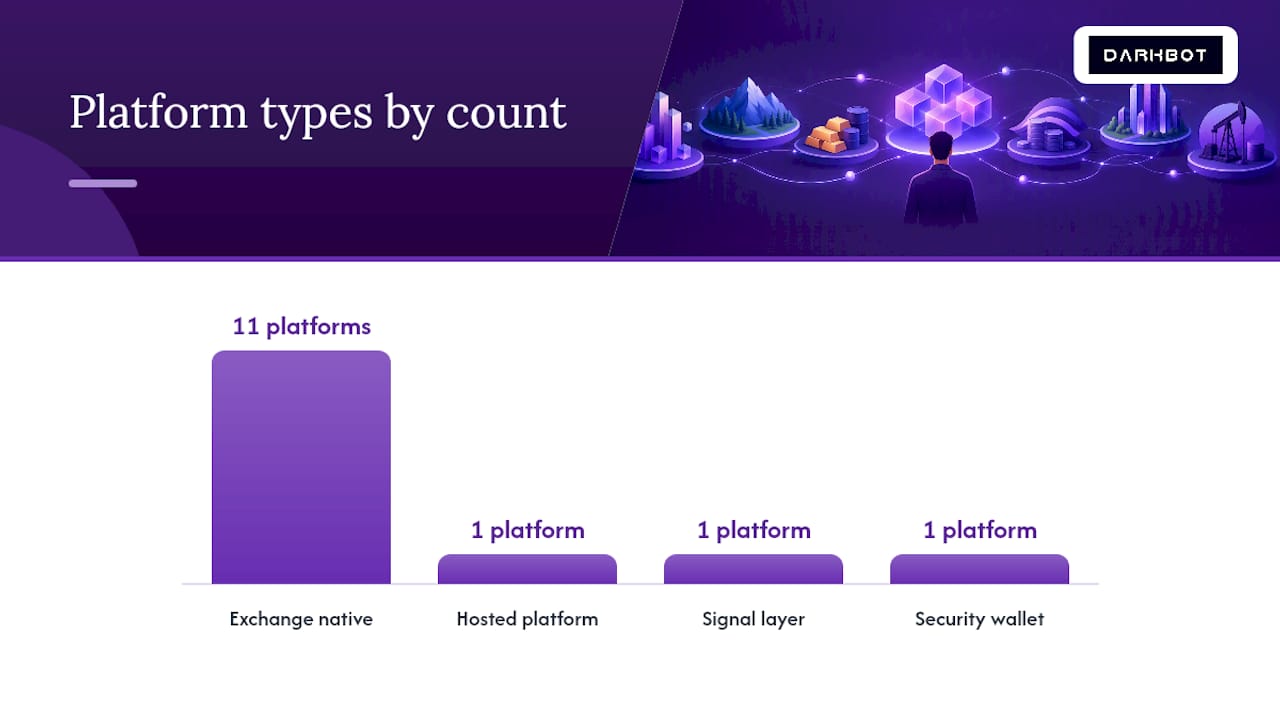
The other nine entrants split into three groups: exchange-native automation (Coinbase, Kraken, Binance, Gate.io, OKX, Bitfinex, Bitstamp, Uphold, CoinDCX, PrimeXBT, eToro), a signal and charting layer (TradingView), and a security-focused wallet (Zengo Wallet) that doesn’t execute trades at all.
| Platform | Best for | Pricing shape | Exchange coverage | Strategy types | Backtesting/paper trading |
|---|---|---|---|---|---|
| Darkbot | Execution-first traders needing multi-exchange routing | Free, Standard $12.50/mo, Premium $25/mo, Enterprise (quote) | Multiple major exchanges via API | DCA, grid, signal-based, custom rules | Backtesting and paper trading included |
| Coinbase | Traders who want native fiat rails | Exchange fee schedule, no bot subscription | Coinbase only | Exchange-native order automation | Limited to exchange tools |
| Kraken | Regulated exchange access with solid API docs | Exchange fee schedule | Kraken only | API-driven custom scripts | Depends on third-party integration |
| Binance | High-volume traders needing deep liquidity | Exchange fee schedule | Binance only | Wide API-supported strategies | Depends on third-party integration |
| TradingView | Chart-driven alerts routed to execution tools | Free and paid charting tiers | Signal source, not an exchange | Alert and webhook-triggered signals | Not applicable (signal layer) |
| Gate.io | Broad altcoin exposure | Exchange fee schedule | Gate.io only | API-driven custom scripts | Depends on third-party integration |
| OKX | Derivatives alongside spot automation | Exchange fee schedule | OKX only | Futures and spot API strategies | Depends on third-party integration |
| Bitfinex | Advanced order types and margin | Exchange fee schedule | Bitfinex only | Margin and advanced order automation | Depends on third-party integration |
| Bitstamp | Straightforward spot trading via API | Exchange fee schedule | Bitstamp only | Basic API-driven orders | Limited |
| eToro | Social and copy-trading style exposure | Exchange fee schedule | eToro only | Copy-trading, not rule-based bots | Limited |
| Zengo Wallet | Secure custody, not automated execution | Wallet fee structure | Not an execution venue | None (custody only) | Not applicable |
A few trade-offs stand out once you look past the feature lists:
- Hosted versus exchange-native: a hosted platform like Darkbot routes orders across several exchanges from one dashboard, while Coinbase, Kraken, Binance, Gate.io, OKX, and Bitfinex only automate within their own walls.
- Free versus subscription: exchange-native tools carry no separate bot fee but confine you to that one venue’s liquidity and order types.
- Signal versus execution: TradingView generates alerts; it doesn’t hold API keys or place orders on its own, so it needs a downstream execution layer to do anything with those signals.
- Custody versus trading: Zengo Wallet secures assets but has no strategy engine, backtesting, or order routing whatsoever.
Framework documentation on platform comparisons, including the Freqtrade REST API docs, consistently flags exchange/API coverage, strategy types, backtesting realism, and total cost as the criteria that actually distinguish these tools, not marketing copy.
How Do You Evaluate a WunderTrading Alternative Before Switching?
Rank criteria in this order: execution controls first, then API-key permissions, then backtesting realism, then monitoring and alerts, then security and support, and only then total cost. Cost matters, but a cheap subscription tied to sloppy order handling costs more in slippage and missed fills than the fee difference ever saves.
- Ask for a test environment. Any serious platform should let you connect a sandbox or read-only API key before you commit real capital. If a vendor pushes you straight to live trading, that’s a signal worth taking seriously.
- Request API permission documentation. You want trading-only keys with withdrawals disabled, and you want to verify the platform can’t touch anything beyond order placement. The Freqtrade REST API documentation lays out this permission model clearly, and it’s a reasonable baseline for any platform you evaluate.
- Check backtest assumptions. Ask whether backtests include fees, spread, slippage, and realistic fill assumptions, or whether they’re running on idealized price data. A 2026 production study on AI trading fleets found that operating controls and risk settings shaped outcomes more than any predictive edge, which is exactly why realistic backtesting matters more than a headline win rate.
- Run a staged migration. Paper trade first. Move to a small live allocation next. Monitor for 24 to 72 hours before scaling up. Track order fill rate, retry behavior, and latency during that window, since these are the metrics that expose problems backtests miss.
Pro Tip: Before funding any bot with real capital, deliberately simulate an exchange error, like a rejected order or a dropped connection, during paper trading. How the platform recovers tells you more about its reliability than any backtest chart.
Watch for red flags: no paper trading option, a platform that requires withdrawal-enabled API keys, or no idempotent order handling (meaning a retried order could duplicate instead of safely resubmitting). Any one of these is reason enough to keep looking, and the fix is usually simple: restrict the key, demand a sandbox, or walk away.
Where Darkbot Fits the Decision Criteria
Darkbot’s feature set maps directly onto the execution-first checklist above rather than around it. The platform connects to major exchanges through API-based integration, supports customizable strategies with backtesting and paper trading before any live deployment, and runs multiple simultaneous bots with portfolio rebalancing and real-time monitoring.
Operational controls, including permissioned API keys and staged rollout, tend to matter more for real-world outcomes than any single strategy’s backtested return, according to research on production AI trading fleets.
Key capabilities that align with the evaluation framework:
- Exchange API integration across multiple venues, avoiding single-exchange lock-in
- Strategy customization with rule-based configuration
- Backtesting and paper trading before capital is committed
- Multiple simultaneous bots for portfolio-level diversification
- Automated rebalancing and risk management tools
- Real-time analytics and monitoring for ongoing oversight
Darkbot’s approach to staged deployment and API-key security follows the same logic the migration checklist recommends: trading-only permissions, incremental capital exposure, and monitoring before scaling. The platform’s own documentation and support resources are the place to verify current specifics, since capability sets evolve and this article won’t restate every configuration detail here.
No-Code Configuration vs. Code-Based Scripting
Most traders start with no-code configuration and only move to scripting when a strategy needs logic a template can’t express. No-code setups use pre-built strategy templates, adjustable parameters, and visual rule builders, so you can launch a DCA or grid bot without writing a line of code. Code-based platforms, by contrast, let you define custom entry and exit logic, integrate external signals, and control order handling at a granular level.
The trade-off is speed versus flexibility. A no-code interface gets a strategy live in minutes but caps what you can adjust. Code-based scripting takes longer to configure and often requires familiarity with a scripting language or a platform’s own rule syntax, but it removes the ceiling on complexity.
Darkbot leans toward accessible configuration for common strategy types like DCA, grid, and signal-based bots, while still allowing parameter-level customization for traders who want to fine-tune entries, exits, and risk limits. That middle ground matters because a platform that’s entirely no-code eventually frustrates traders who outgrow the templates, while a platform that’s entirely code-based turns away traders who just want a reliable DCA bot running by lunchtime. TradingView sits at the far scripting end of this spectrum, since its alerts rely on Pine Script logic that then has to be routed elsewhere to actually place an order.
Comparing Interfaces and Ease of Use
Interface complexity tends to track directly with how many asset classes and order types a platform supports. Exchange-native tools like Coinbase and Bitstamp keep things simple because they’re only managing orders within one venue, which makes their dashboards approachable but limited once you want to coordinate positions across exchanges.
Multi-exchange platforms face a harder design problem: showing bot status, portfolio allocation, and execution logs across several venues without burying the trader in tabs. Darkbot’s dashboard consolidates bot management, backtesting results, and portfolio rebalancing into one view, which matters more than it sounds, since switching between five exchange dashboards to piece together a portfolio picture is exactly the kind of friction that leads to missed alerts.
Derivatives-heavy platforms like OKX and Bitfinex necessarily add interface complexity, since margin, leverage, and futures contracts introduce more fields and more ways to misconfigure an order. That’s a reasonable trade for traders who need those instruments, but it’s worth factoring into your evaluation if your strategy is purely spot-based DCA or grid trading.
Exchange Coverage and Asset Classes Beyond the API Layer
API access is table stakes; what varies more is the breadth of asset classes each platform actually reaches. Binance and Gate.io offer some of the widest altcoin selections among the exchanges on this list, while OKX and Bitfinex add derivatives and margin instruments on top of spot markets. Kraken has built a reputation for regulatory clarity across multiple jurisdictions, which matters if compliance posture factors into your platform choice.
A multi-exchange automation layer like Darkbot doesn’t originate liquidity itself. It routes strategies across whichever exchanges you connect through API keys, so your effective asset coverage is the union of every exchange you link, not a fixed list the platform controls. That’s a meaningful distinction: your available markets scale with how many exchanges you’re willing to manage keys for, rather than being capped by one venue’s listing decisions.
Zengo Wallet sits outside this comparison entirely on asset classes, since it’s a custody tool, not a trading venue. It secures holdings but has no order book, no execution path, and no strategy layer.
How Strong Is the Developer and Community Ecosystem?
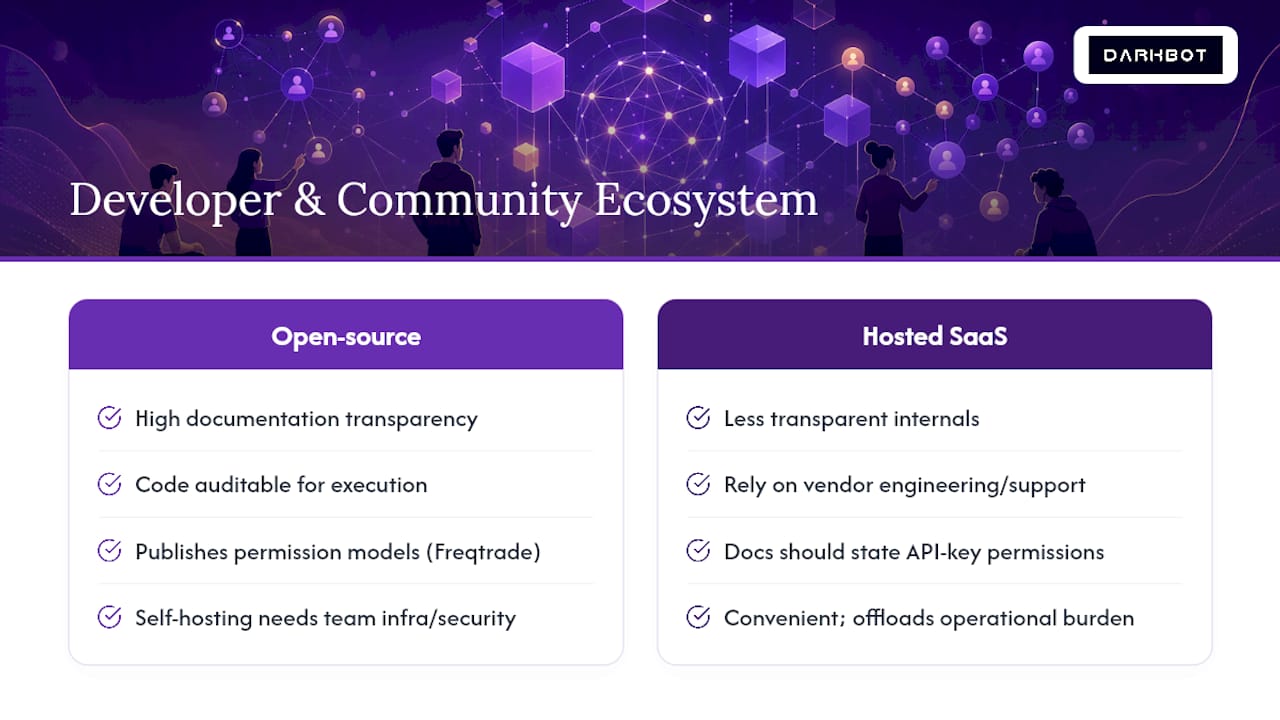
Ecosystem strength shows up in two places: documentation quality and third-party integration support. Open-source frameworks tend to win on transparency here, since anyone can inspect the code handling order execution. Freqtrade’s REST API documentation is a frequently cited example of a framework that publishes its permission model and endpoint behavior in enough detail for developers to audit before connecting real funds.
Hosted SaaS platforms trade some of that transparency for convenience. You’re relying on the vendor’s internal engineering rather than auditing code yourself, which shifts the ecosystem question toward how responsive support is and how clearly the platform documents its API-key permission requirements. Both open-source frameworks and hosted platforms are legitimate choices; the right one depends on whether your team has the infrastructure and security responsibility to self-host, or whether you’d rather offload that operational burden to a managed platform.
TradingView’s ecosystem advantage is its webhook and alerting community. Traders share Pine Script strategies and alert configurations widely, which makes it a strong signal-generation layer even though it needs a separate execution platform to act on those signals. For broader ecosystem resources across the space, the Web3 directory of crypto tools is a reasonable starting point for finding adjacent integrations.
What Do Customer Reviews Actually Tell You?
Star ratings and review counts are worth a glance, but they answer a narrower question than most traders assume: they tell you about support responsiveness and general satisfaction, not whether a platform’s order execution is reliable under stress. A platform with hundreds of positive reviews can still have gaps in retry logic or order idempotency that only surface during a volatile market swing, since most reviewers never test that edge case.
That’s why the evaluation framework in this article puts backtesting realism and execution controls ahead of review volume. Reviews are a useful sanity check on customer service quality and onboarding experience, but they don’t substitute for requesting API permission documentation or running your own paper trading test. Treat reputation metrics as one input among several, not the deciding factor.
When Switching From WunderTrading Actually Makes Sense
A novice running a single simple strategy has little reason to switch unless a specific execution gap is causing real losses. An active day trader who needs multi-exchange routing and tighter execution controls has a much stronger case. A quant developer building custom logic benefits most from a platform, or framework, that exposes granular API permissions and audit trails.
Operational hygiene should outweigh marketing claims in every scenario. Verify API-key permissions and run a genuine paper trading period before trusting any platform, including this one, with live capital. Treat migration as a deliberate, staged process rather than a one-time switch.
— Grisha
Try Darkbot’s Plans Before You Commit Capital
If the comparison above left you weighing execution controls against subscription cost, Darkbot’s plan structure is built to let you test that trade-off directly rather than guess at it. You get backtesting, paper trading, and multi-exchange routing available from the entry tiers, so you can validate order handling before scaling up.
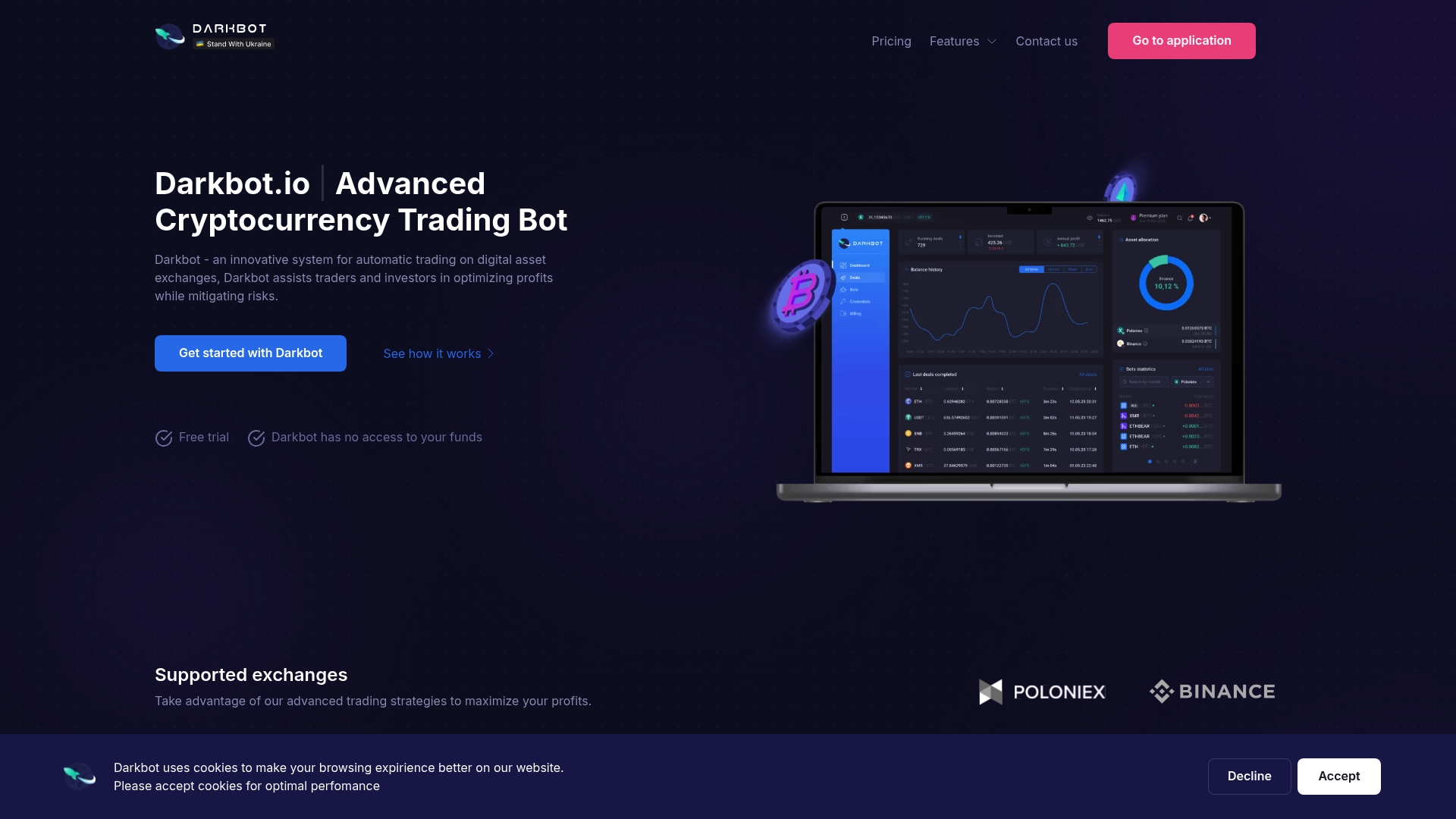
There is a free plan available to explore the interface and strategy templates. Standard and Premium subscription plans offer additional features such as enhanced strategy customization, monitoring, portfolio rebalancing, and support for multiple simultaneous bots. Current prices are detailed on the pricing page. An Enterprise tier is available for teams with larger operational needs, with pricing available on request. Compare the full breakdown on the Darkbot pricing page and start with paper trading before moving any capital live.
Sources
For deeper technical verification, see the Freqtrade REST API documentation on permission design, the 2026 production study on AI trading fleets, and the TradeGrub platform comparison for additional feature-matrix context.
FAQ
What Is the Most Successful AI Trading Bot?
There’s no single bot that qualifies as “most successful” across all market conditions, since production research on AI trading fleets found that operating controls and risk settings shaped outcomes more than any consistent predictive edge. Evaluate platforms on execution consistency and risk management rather than performance claims.
What Are People Saying About WunderTrading in Reviews?
Reviews on aggregator sites like G2 tend to mix genuine automation platforms with exchanges and wallets, which makes direct sentiment harder to isolate. Look past star ratings to specific comments about execution reliability and API permission handling.
Can ChatGPT Build a Trading Bot?
ChatGPT and similar tools can help generate or explain trading-bot code and integration scaffolding, but they don’t validate exchange behavior, security, or live profitability on their own. A safer workflow still requires code review, realistic backtesting with fees and slippage, paper trading, and restricted API keys before any live deployment.
Which Crypto Trading Bot Is the Most Profitable?
No bot can claim a guaranteed profit, and platforms that emphasize consistency and structured risk control over prediction claims tend to hold up better under real market conditions. Darkbot is built around this execution-first approach, with backtesting and paper trading available to validate a strategy before committing capital.
Is WunderTrading Worth It Compared to These Alternatives?
Whether WunderTrading is worth keeping depends on whether it satisfies your specific execution and API-permission requirements, not on its feature list alone. If you need broader multi-exchange routing or stronger operational controls, running a staged evaluation of an alternative like Darkbot alongside your current setup is the safest way to decide.
Recommended

Start trading on Darkbot with ease
Come and explore our crypto trading platform by connecting your free account!
Free plan available • No credit card required