Under $3,000? Why Pionex Often Beats 3Commas for Small Accounts

For most traders running capital across multiple exchanges, Darkbot’s API-first automation with built-in AI risk controls is the stronger structural fit, while 3Commas serves traders committed to TradingView signal execution and Pionex works best for small, single-exchange accounts that want free grid bots without a subscription. If your balance sits under roughly $3,000 and you don’t want to move funds anywhere, Pionex’s on-exchange model may suit you better than any API-based platform.
TL;DR:
- Pionex is ideal for accounts under roughly $3,000, as its fee-only model often costs less than subscription platforms at smaller sizes.
- API-only platforms like Darkbot and 3Commas are better suited for traders managing capital across multiple exchanges and with futures trading needs.
- Securing API access requires best practices such as read-only keys, IP whitelisting, and regular key rotation to mitigate security risks.
- Pionex’s simple, pre-configured bots work well for beginners with small accounts, while Darkbot offers deeper strategy customization and risk controls for advanced traders.
- Moving funds to Pionex generally involves deposit and withdrawal delays, whereas API-only platforms keep funds on existing exchanges, enabling more flexible management.
3Commas vs Pionex: Comparing the Core Platforms
The decision between these platforms starts with a structural question: do you want your funds to stay on one exchange, or do you want a bot that reaches across several exchanges through API keys? That single choice determines almost everything else, including cost, risk exposure, and which bot types you can actually run.
Darkbot, 3Commas, and Cryptohopper operate on the API-only model, where the trading bots send trade instructions without transferring custody of funds from the exchange account. Pionex is the opposite: it’s an exchange with bots built directly into it, so your capital sits on Pionex itself. SaintQuant appears in comparison roundups as a smaller alternative bot provider, though public documentation on its exchange coverage and fee structure is limited compared to the other four.
| Platform | Custody model | Pricing model | Exchanges supported | Bot types | Futures support | Best for |
|---|---|---|---|---|---|---|
| Darkbot | API-only (funds stay on your exchange) | Subscription: Standard $12.50/mo, Premium $25.00/mo | Multiple major exchanges via API | Grid, DCA, portfolio rebalancing, custom strategies | Yes | Traders needing multi-exchange automation with AI-assisted risk controls |
| 3Commas | API-only (funds stay on your exchange) | Subscription-based | Multiple exchanges via API | DCA, grid, signal/TradingView, futures bots | Yes | Traders with capital spread across exchanges who need TradingView signal execution |
| Pionex | On-exchange (funds held by Pionex) | Per-trade fee, about 0.05% per spot trade | Pionex exchange only | Free built-in grid, DCA | Limited | Small accounts wanting free, fast grid/DCA setup |
| SaintQuant | Not publicly documented in detail | Not publicly documented in detail | Not publicly documented in detail | Referenced in comparison roundups | Not publicly documented | Niche users referenced in aggregate comparisons |
| Cryptohopper | API-only (funds stay on your exchange) | Subscription-based | Multiple exchanges via API | Grid, DCA, marketplace strategies | Yes | Traders who want marketplace strategies without running their own infrastructure |
Darkbot is designed for traders who want one system monitoring several exchanges simultaneously, with automated rebalancing and real-time analytics integrated into the platform. Where 3Commas leans on subscription depth for advanced DCA and TradingView bridging, Darkbot pairs that same API-only custody model with portfolio-level tools designed around rule-driven risk management rather than manual babysitting.
What the Fee Math and Risk Tradeoffs Actually Look Like
Custody model isn’t an abstract detail. It determines who holds counterparty risk. With Pionex, your funds sit on one exchange’s balance sheet, so you’re exposed to that exchange’s solvency and operational security. With API-only platforms like Darkbot, 3Commas, and Cryptohopper, your funds stay on whichever exchange you already trust, and the bot only holds trade permissions, not custody.
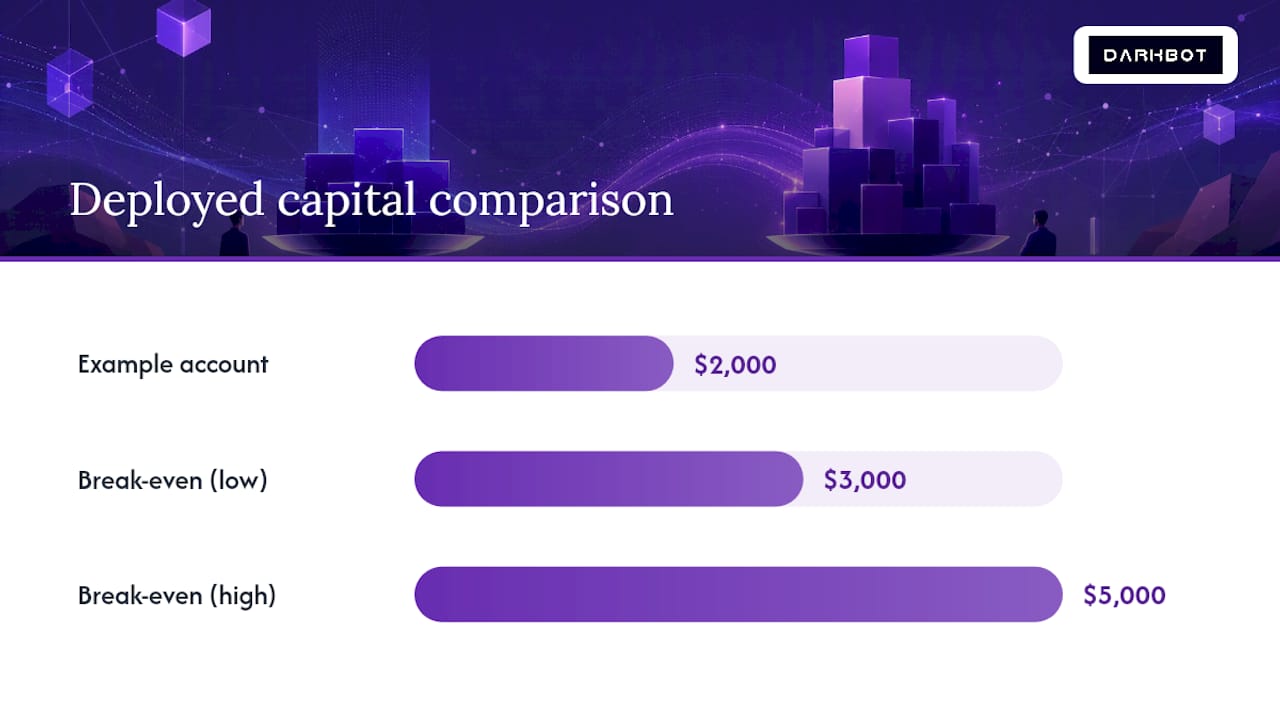
That tradeoff shows up directly in the numbers. Pionex’s flat trading fee runs about 0.05% per spot trade, with no monthly charge. On a $2,000 account running frequent grid cycles, that fee structure usually costs less than a subscription. But as capital grows, the math flips. Review data suggests the break-even point sits around $3,000 to $5,000 in deployed capital: below that, per-trade fees are cheaper; above it, a flat monthly subscription starts amortizing better, especially once you’re running multiple bots or trading on more than one exchange.
Bot depth is the next differentiator. Pionex bots are effective and simple: grid and DCA, tuned for sideways markets and small capital, fast to configure. 3Commas goes further with granular DCA settings, TradingView signal bridging, and futures bot support, but that depth is only useful if you’re managing enough capital or complexity to need it.
Exchange coverage matters more than people expect. If your capital is split across two or three exchanges, an API-only platform lets one system manage all of it. Pionex can’t do that. It only manages funds inside itself.
Security history deserves direct attention. In late 2022, Binance warned users to disable API keys tied to a leak connected to 3Commas, and 3Commas confirmed some of the leaked data was real. That incident doesn’t mean API-based automation is inherently unsafe. It means key hygiene isn’t optional.
- Use trade-only API keys with withdrawal permissions disabled.
- Enable IP whitelisting wherever the exchange supports it.
- Rotate keys periodically and after any platform security notice.
- Monitor bot activity logs weekly rather than assuming silence means normal operation.
Nearly $3,000 to $5,000 in account size is the rough line where subscription economics start beating per-trade fees, a detail worth checking against your own trading frequency before committing to either pricing model.
Pro Tip: Before funding any bot platform, generate a read-only API key first and let the bot run in paper mode for a week. If the platform’s execution logic matches what it claims in its documentation, only then upgrade to a trade-permitted key with IP whitelisting enabled.
How to Choose the Right Platform for Your Account
Matching a platform to your account isn’t guesswork if you work through it in order.
- Check your account size against the break-even threshold. Under roughly $3,000, Pionex’s fee-only model often costs less. Above $5,000, subscription platforms tend to amortize better.
- Decide your custody preference. If you’re uncomfortable holding funds on a second exchange, API-only platforms like Darkbot keep your capital where it already sits.
- Confirm futures needs. If you trade futures, Pionex’s support is limited; Darkbot and 3Commas both handle it.
- Check TradingView dependency. If your strategy relies on external signal alerts, 3Commas’ signal bridge is a documented strength.
- Test before scaling. Start with a read-only or paper-trading connection, move to a small live allocation, monitor for at least two weeks, then scale in tiers.
| Decision factor | Favors API-only (Darkbot, 3Commas, Cryptohopper) | Favors on-exchange (Pionex) |
|---|---|---|
| Account size | Above ~$3,000 to $5,000 | Below ~$3,000 |
| Custody comfort | Funds stay on your existing exchange | Comfortable moving funds to a bot exchange |
| Exchange spread | Capital split across multiple exchanges | All capital on one exchange |
| Futures trading | Needed | Not needed |
Before depositing anything, ask the platform directly: what happens to my API keys if there’s a security incident, what withdrawal permissions does the bot require, and is IP whitelisting supported? A platform that can’t answer clearly is a red flag regardless of its marketing.
Withdrawal and Deposit Process Compatibility
Withdrawal speed and deposit flexibility differ sharply between the two custody models. On Pionex, deposits and withdrawals run through the exchange’s own processing queue, since your funds live there directly. That means withdrawal times depend entirely on Pionex’s internal systems and whatever verification tier your account sits in.
API-only platforms work differently. Darkbot, 3Commas, and Cryptohopper never touch your funds directly, so deposits and withdrawals happen entirely on your exchange of choice, not on the bot platform itself. If you’re already comfortable with your exchange’s withdrawal process, connecting an API-only bot changes nothing about that experience. This is a practical advantage for traders who’ve already built trust with a specific exchange’s security and support and don’t want to add a second custodial relationship on top of it.
One compatibility detail worth checking before connecting any bot: confirm the exchange API supports the permission scopes the bot needs (trading only, no withdrawal access) before generating a key. Not every exchange offers granular permission scoping, and that limitation affects how safely you can automate on it regardless of which bot platform you choose.
Customer Support and Community Engagement
Support quality varies more than most comparisons admit. Pionex has active Trustpilot review activity, though sentiment is mixed, a common pattern for high-volume retail exchanges handling large support ticket queues. Community discussion around Pionex tends to concentrate in general crypto trading forums rather than a dedicated ecosystem.
3Commas maintains a longer-standing user community built around its multi-year presence in the bot space, with active discussion threads focused on DCA configuration and TradingView integration troubleshooting.
Darkbot’s support model centers on personalized assistance rather than high-volume ticket queues, an approach suited to traders who need direct help configuring API connections or risk parameters rather than generic troubleshooting scripts. For a category where a misconfigured API key or an unclear risk setting has real financial consequences, the value of support responsiveness scales with the complexity of what you’re running. A trader running one grid bot on one exchange has simpler support needs than one running multiple bots with portfolio rebalancing across several exchanges.
User Interface and Ease of Use
Interface complexity tracks bot depth almost exactly. Pionex’s interface is built around simplicity, since its bots are pre-configured with minimal setup required, which is part of why it appeals to traders just starting with automation. You pick a bot type, set a price range for grid bots, and activate it within minutes.
3Commas asks more of the user. Its DCA and TradingView signal bots involve more configuration screens, which rewards traders willing to learn the interface but can feel dense for a first-time bot user.
Darkbot’s interface is built around API-first setup with strategy customization exposed directly, rather than hidden behind multiple menu layers. That design suits traders who want to see and adjust their risk parameters and rebalancing rules without hunting through nested settings. The tradeoff with any API-first tool is a slightly steeper initial connection step: generating and entering exchange API keys correctly, compared to Pionex’s zero-setup, funds-already-there model. That extra step is also exactly where key hygiene practices matter most.
Backtesting and Strategy Customization Capabilities
Strategy customization depth separates these platforms more than almost any other dimension. Pionex’s built-in bots offer limited customization: grid range, number of grid lines, and investment amount. That’s sufficient for straightforward sideways-market grid trading but doesn’t extend to conditional logic or multi-indicator strategies.
3Commas allows deeper DCA configuration: entry conditions, safety order sizing, and take-profit logic, plus the ability to trigger trades from TradingView alerts. That flexibility is a documented strength for traders whose strategies originate from chart-based signal analysis rather than the platform’s own logic.
Darkbot’s strategy customization is built around adjustable parameters within its automated strategies, paired with paper trading so traders can validate a configuration’s behavior before committing live capital. That paper-trading step matters because backtesting logic and live execution logic don’t always match perfectly. Testing a configuration in a simulated environment before funding it live is the only way to confirm the rules behave as intended under real market conditions, rather than assuming a backtest result will repeat.
Performance and Reliability of Trading Bots
Neither factor is something a single review can fully verify, since execution quality depends heavily on exchange conditions, order book depth, and the specific strategy parameters a trader sets.
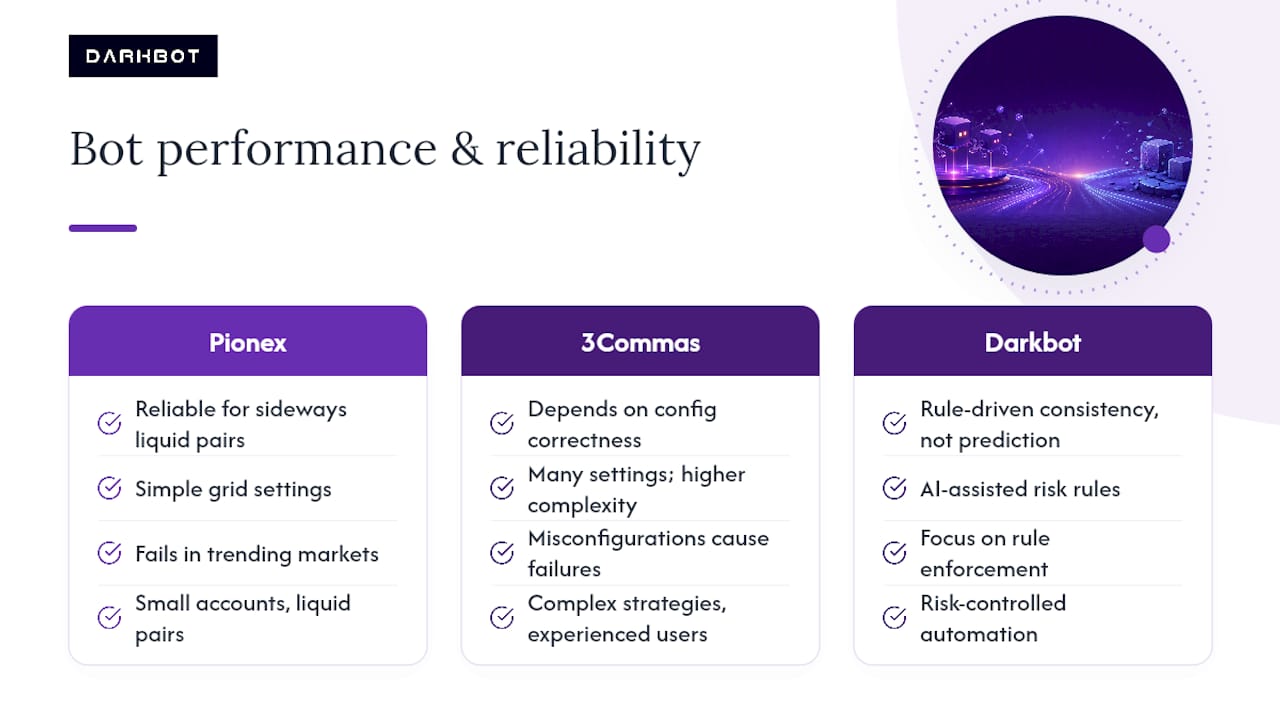
What the available comparison data does support is a pattern, not a guarantee: Pionex’s grid bots are consistently described as reliable for the narrow job they’re built for, sideways price action on liquid pairs. 3Commas’ reliability discussion centers more on configuration correctness, since its more complex DCA and signal bots have more settings that can be misconfigured, which shows up as underperformance that isn’t a platform failure so much as a setup error.
This is where a rule-driven, AI-assisted approach to risk control matters more than raw execution speed. Darkbot’s design treats consistency, disciplined rule enforcement, and probabilistic pattern evaluation as the goal, not prediction of where price is headed next. No automated trading platform, including Darkbot, should be evaluated on the basis of guaranteed returns. The right question isn’t “did this bot make money last month,” it’s whether the execution logic matches the rules you set and whether the risk controls behaved as designed when conditions turned volatile.
Mobile App Availability and Features
Mobile access matters for anyone who wants to monitor bots without staying at a desktop, but the depth of what a mobile app actually lets you do varies. Pionex offers a mobile app tied to its exchange, letting users manage bots and monitor balances directly since funds and bots both live on the same platform.
3Commas also provides mobile access for monitoring bot performance and account status, though deep configuration changes are generally easier to manage from a desktop browser given the number of settings involved in DCA and signal bots.
Darkbot’s platform is built around real-time analytics accessible from the account dashboard, letting traders check portfolio status and bot activity without needing to be at a full workstation. For any API-only platform, mobile monitoring serves a specific purpose: catching anomalies early, not making minute-by-minute manual trades, which would defeat the point of running an automated system in the first place.
A Practical Path for Testing Any of These Platforms
The safest way to evaluate any of these platforms is the same regardless of which one you’re leaning toward: start with a read-only or paper-trading connection, move to a small live allocation once the logic checks out, then scale in deliberate tiers rather than all at once. Traders spreading capital across multiple exchanges with a preference for AI-assisted risk controls tend to fit Darkbot’s model; traders anchored to TradingView signals fit 3Commas; traders with small, single-exchange accounts fit Pionex. Whichever path you choose, treat API key hygiene and a documented monitoring cadence as fixed requirements, not optional extras.
— Grisha
Start Testing Darkbot Without Moving Your Funds First
Darkbot’s API-only design allows evaluation without transferring funds from your existing exchange, unlike on-exchange bots that hold capital on their platform. Pricing plans include a Standard Plan, a Premium Plan, and a Free tier, with current details available on the pricing page.
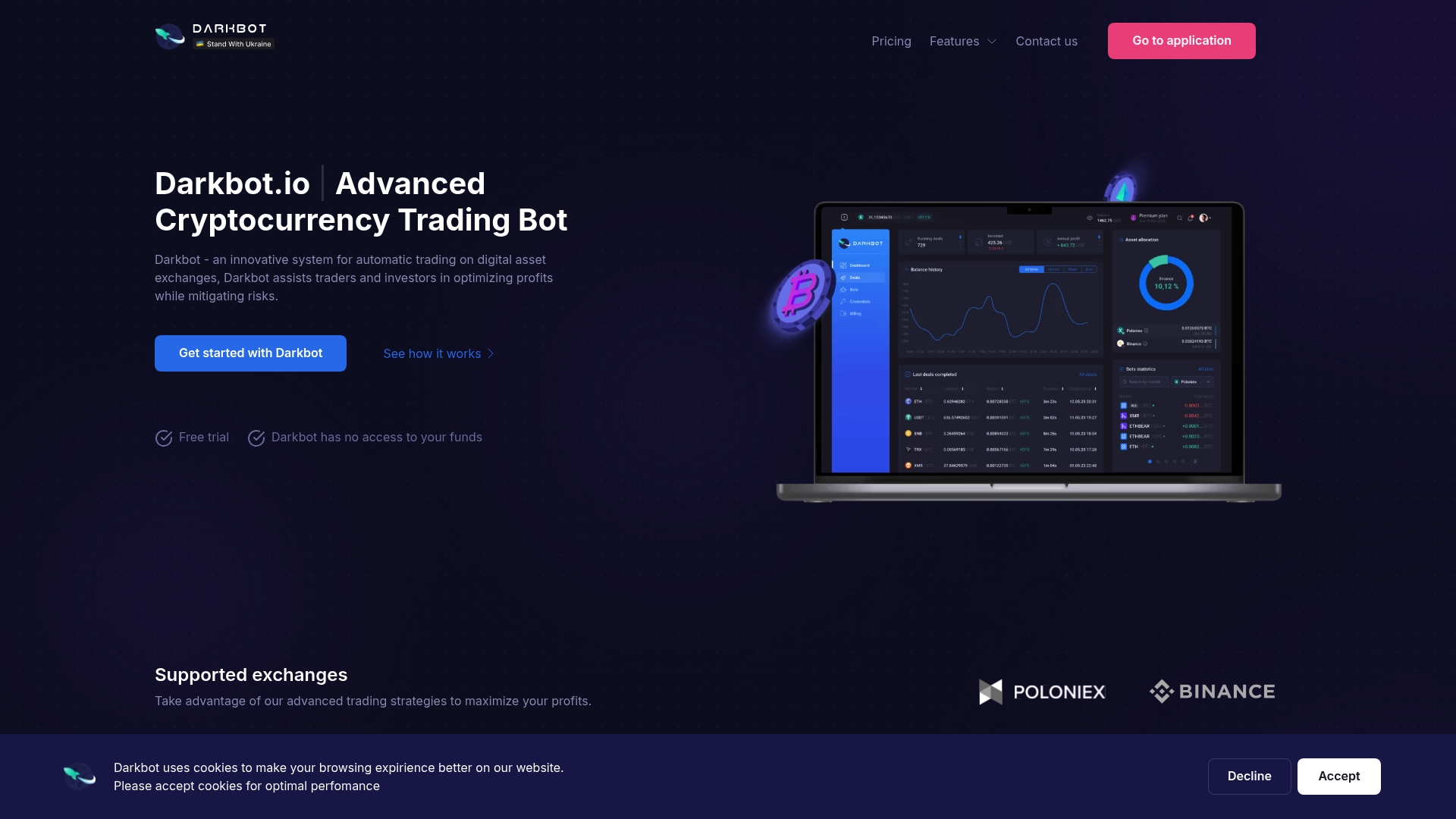
The practical first step is straightforward: generate a read-only API key on your exchange, connect it to Darkbot, and run a strategy in paper trading mode to confirm the execution logic matches your risk rules before any live capital is involved. Once you’re satisfied with how the rules behave, review the pricing page to compare plan tiers and move to a small live allocation. For more on setting up keys safely, Darkbot’s own guide on API-based exchange integration walks through trade-only permissions and IP whitelisting in detail.
This article is general information, not a substitute for advice from a qualified financial advisor. Consult a qualified financial professional about your own circumstances before acting on anything here.
Sources
FAQ
Are 3Commas Bots Profitable?
Profitability depends entirely on the strategy configuration and market conditions, not the platform itself. 3Commas’ DCA and signal bots can execute exactly as configured, but misconfigured safety orders or take-profit settings are a common cause of underperformance that reviewers attribute to setup rather than platform failure.
What Is the Most Successful AI Trading Bot?
No automated trading platform can claim guaranteed success, since outcomes depend on strategy design, risk parameters, and market conditions. Platforms like Darkbot focus on disciplined, rule-based execution and AI-assisted risk management rather than performance promises, which is a more reliable way to evaluate consistency than chasing a “most successful” label.
Is Pionex a Good Trading Bot?
Pionex is well suited to small accounts and sideways markets because its free grid and DCA bots require no subscription and minimal setup. It’s a weaker fit for traders needing multi-exchange automation, futures depth, or TradingView signal execution.
Is Pionex Legal in the USA?
Pionex operates in various jurisdictions, and its availability and regulatory status for USA-based traders can change; check Pionex’s own current terms and any regional restrictions directly before depositing funds. Regulatory status is not something a comparison article can confirm reliably, since exchange licensing shifts over time.
How Much Does Darkbot Cost Compared to 3Commas and Pionex?
Darkbot’s Standard Plan is $12.50 per month and its Premium Plan is $25.00 per month, both listed on the pricing page, alongside a Free tier.
Recommended

Start trading on Darkbot with ease
Come and explore our crypto trading platform by connecting your free account!
Free plan available • No credit card required