2025 Crypto Trading Tips for Smarter Risk Control

TL;DR:
- Most traders who lose their crypto accounts do so due to a lack of trading structure, not market knowledge. Effective 2025 strategies focus on risk management, pre-planned entries, and automated discipline amid high volatility and evolving regulations. Implementing rules like the 1-2% risk per trade, ATR-based stops, and systematic position management ensures long-term success.
Most traders who blow up their accounts in crypto don’t lack market knowledge. They lack structure. The 2025 crypto trading tips that actually move the needle aren’t about picking the next breakout token — they’re about what you do before you enter a trade, how much you risk, and what rules govern your exit. The 2025 crypto market brings fresh regulatory shifts, including new IRS reporting requirements for digital assets, alongside the same brutal volatility that has always defined this asset class. This guide gives you a practical framework for trading with discipline, managing risk precisely, and using automation where it matters most.
Key takeaways
| Point | Details |
|---|---|
| Risk 1-2% per trade | Cap each trade’s risk to protect capital from the inevitable losing streaks in volatile markets. |
| Size positions mathematically | Calculate position size from your stop-loss distance, not from gut feel or arbitrary round numbers. |
| Build a written trading plan | Define entry rules, invalidation points, and profit targets before placing any trade. |
| Use ATR-based trailing stops | Adaptive stops reduce false exits caused by normal price wicks without cutting winners short. |
| Automate for consistency | Rule-based execution removes emotional errors that cost traders the most in 24/7 crypto markets. |
2025 crypto trading tips that start with risk management
The single most overlooked truth in crypto trading is this: volatility is not the enemy. Uncontrolled exposure to that volatility is. Crypto volatility averages 3.5x that of equities, with Bitcoin’s average daily range sitting around 3.2% in 2025 compared to 0.9% for the S&P 500. Specific altcoins regularly move 8 to 12% in a single session. Trading these assets without a defined risk framework is not speculation. It’s gambling.
The foundation of any working crypto trading strategy starts with the 1 to 2% rule. Risk no more than 1 to 2% of your total trading capital on any single position. That might sound conservative, but this rule is what keeps a string of losses from becoming an account-ending event. If you have $10,000 in capital and risk 2% per trade, a ten-trade losing streak costs you $2,000. Painful, but survivable. At 10% per trade, the same streak wipes out the account.
Pro Tip: Never set your stop-loss first and then figure out position size. Do it in reverse. Decide how many dollars you’re willing to lose, place the stop where the trade is technically invalidated, and then use the formula to find your position size.
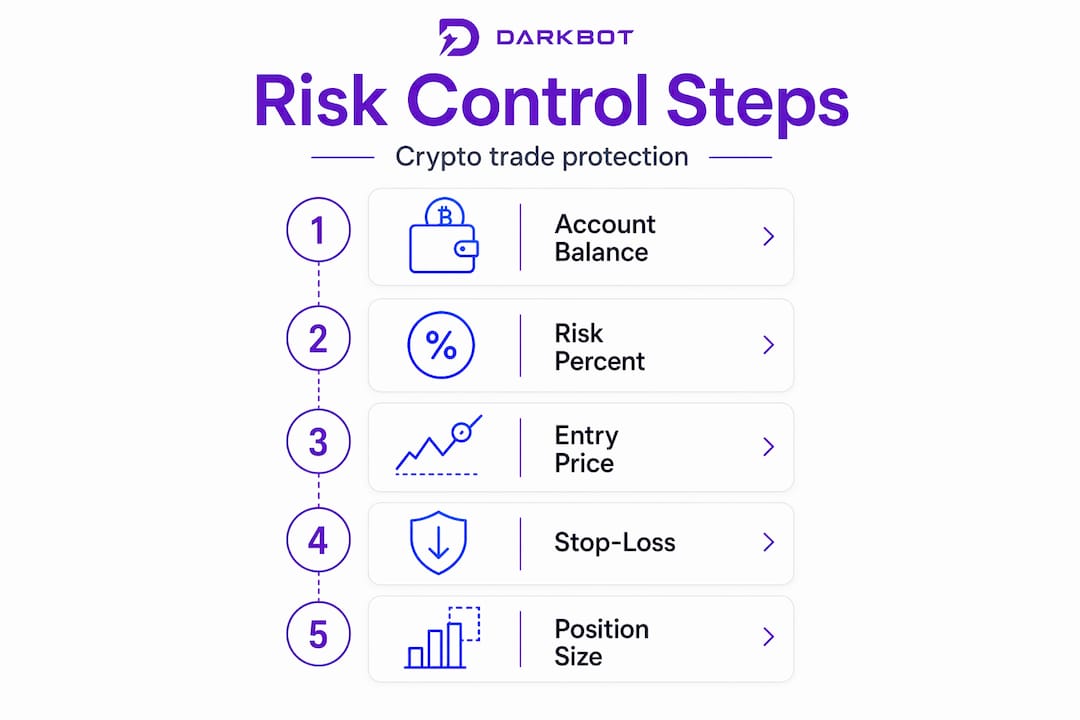
Here is what the position sizing formula looks like in practice:
Position Size = (Account Balance × Risk %) / (Entry Price − Stop-Loss Price)
The stop-loss distance should not be arbitrary. Placing a stop 2% below entry because it feels right ignores market structure. ATR-based stops, which anchor to the asset’s actual recent volatility range, consistently outperform fixed-percentage stops because they give the trade room to breathe without letting losses run further than necessary.
| Stop-loss method | Advantage | Risk |
|---|---|---|
| Fixed percentage (e.g., 2%) | Simple to apply | Ignores actual market structure |
| ATR-based (1-2× ATR below entry) | Adapted to volatility conditions | Requires recalculating position size |
| Structure-based (below key support) | Grounded in price behavior | Stop distance can be wide on some assets |
Beyond individual trade risk, portfolio-level controls matter just as much. Portfolio-level circuit breakers that cap daily or weekly losses and adjust position sizes dynamically prevent cascading drawdowns when multiple correlated positions move against you simultaneously. If you hold five altcoins that all track Bitcoin closely, you don’t have five independent bets. You have five expressions of the same directional risk.
For a deeper look at applying these controls systematically, the crypto trading risk checklist from Darkbot walks through practical implementation of the 1 to 2% rule step by step.
Designing a disciplined crypto trading plan
Good crypto trading strategies in 2025 share one common feature: they are written down before the market opens. A strong trading plan defines your goals, the assets you will trade, your setup criteria, and your exit rules. It removes the most expensive variable in trading, which is your emotional state in the moment.
Here is a practical sequence for building a plan that holds up under live market pressure:
- Define what you’re trading and why. Choose assets based on liquidity and volatility profile, not hype. Bitcoin and Ethereum offer the tightest spreads and the most reliable technical structure. Altcoins can offer larger moves but require wider stops and smaller position sizes.
- Specify your setup with an invalidation point. Every trade should have a condition that, if met, proves the trade idea wrong. This is your stop-loss location. If you can’t identify it before entering, you don’t have a trade. You have hope.
- Set your entry, stop-loss, and profit target before you place the order. Calculate the risk-reward ratio. Accepting trades with less than a 2:1 reward-to-risk ratio structurally disadvantages you over time. Anything below 1.5:1 is generally not worth executing, regardless of how confident you feel.
- Account for fees and slippage realistically. On high-frequency or leveraged positions, trading fees compound quickly. A trade that looks profitable on paper can become marginal or negative once execution costs are included. Build them into your plan calculations from day one.
- Review your trading journal weekly. Journaling is not optional for serious traders. Patterns in your losing trades — repeated setup types, specific market conditions, times of day — only become visible with data. A weekly review converts raw experience into structured learning.
Pro Tip: Set a rule that you will not take any trade that isn’t already described in your written plan. If the market presents a setup you haven’t pre-defined, it doesn’t exist for you that session. This single rule eliminates most impulsive losses.
The 2025 cryptocurrency investment advice that gets overlooked most often is this: how you trade crypto effectively depends less on your entry timing and more on the quality of the framework you operate within.
Position management after entry
Entering a trade is the easy part. Managing it once it’s live, under the pressure of real money moving against or for you, is where most traders lose their edge. The 3-5-7 rule provides a clear structure. It caps risk at 3% per individual trade, limits total portfolio exposure to 5% at any one time, and targets 7% profit on winning positions to maintain a consistently favorable risk-reward profile.
Once a trade moves in your favor, trail your stop rather than letting the original stop sit unchanged.
- Start the trailing stop at 1.5× ATR distance from price when the trade first moves to breakeven. This gives the trade room without giving back too much if conditions shift.
- Tighten the trail progressively to 0.75× ATR as the trade approaches your target. Adaptive ATR trailing stops reduce false exits caused by price wicks that would trigger fixed stops prematurely.
- Take partial profits at logical levels. Scaling out 30 to 50% of a position at an interim target locks in gains and reduces emotional pressure on the remaining position.
The case for automating position management is strong. Automated position management produces meaningfully higher returns and lower maximum drawdown compared to manual management, primarily because rule-based systems execute without hesitation, fear, or overconfidence. Systems designed around smart automation for risk control handle partial take-profits, adaptive stops, and time-based exits more consistently than any trader managing positions manually at 2 a.m. when a move is happening fast.
Pro Tip: Before you automate anything, verify that your manual process produces results you understand. Automating a poorly defined strategy doesn’t fix the strategy. It just executes the errors faster and more consistently.
Top cryptocurrencies and 2025 market trends to watch
Understanding the assets you trade is non-negotiable. Bitcoin, Ethereum, and select altcoins continue to dominate trading volume and liquidity in 2025, but their individual characteristics matter for execution.

Bitcoin remains the highest-liquidity, lowest-spread asset in crypto. Its price behavior tracks macro sentiment most closely, which makes it the clearest asset for technical setups grounded in market structure. Ethereum’s ongoing scalability improvements continue to drive DeFi and NFT ecosystem activity, making it sensitive to both macro conditions and on-chain developments. Altcoins further down the cap table offer larger directional moves but come with lower liquidity, wider spreads, and greater sensitivity to sentiment shifts.
| Asset class | Liquidity | Typical daily range | Primary driver |
|---|---|---|---|
| Bitcoin (BTC) | Very high | 2-4% | Macro sentiment, institutional flows |
| Ethereum (ETH) | High | 3-6% | On-chain activity, DeFi, upgrades |
| Large-cap altcoins | Medium | 5-10% | Sector narratives, BTC correlation |
| Small-cap altcoins | Low | 8-15%+ | Momentum, speculation |
The regulatory environment also shapes current crypto trading strategies in 2025. U.S. exchanges now issue IRS Form 1099-DA for digital asset transactions, increasing reporting oversight. Traders using foreign or decentralized platforms still bear full responsibility for accurate gains and loss reporting even without receiving the form. Macro events, interest rate decisions, and regulatory announcements continue to create sharp short-term volatility across all asset classes, which is why a written plan with pre-defined rules holds its value regardless of what the market is doing.
My take on discipline and automation in 2025
I’ve watched a lot of traders approach crypto with solid technical knowledge and still grind through account after account. The pattern is almost always the same. Risk management gets treated as an afterthought rather than the foundation. Position sizing is done by feel. Stop-losses get moved because the trade “looks like it’s coming back.”
What I’ve found, working closely with systematic trading tools, is that the traders who last are not necessarily the best analysts. They are the ones who build a structure and follow it, especially when it’s uncomfortable. The 24/7 nature of crypto markets is genuinely punishing. There’s always a move happening somewhere, and the temptation to override your plan when you’re tired or excited is constant.
Automation changed that dynamic for me in a meaningful way. When your trailing stop logic and position sizing are encoded in rules that execute without you having to make a decision in the moment, you remove the biggest source of variance in your results: yourself. That isn’t a criticism. It’s just an honest observation about how humans perform under financial pressure. The risk management frameworks that work long-term in crypto are the ones that don’t rely on willpower at 3 a.m. They rely on pre-defined rules running consistently.
— Grisha
How Darkbot supports disciplined, automated crypto trading
If the frameworks in this article resonate with how you want to trade, the next step is implementing them in a way that holds up under live conditions. Darkbot is an AI-powered trading automation platform built around exactly this kind of rule-based execution.
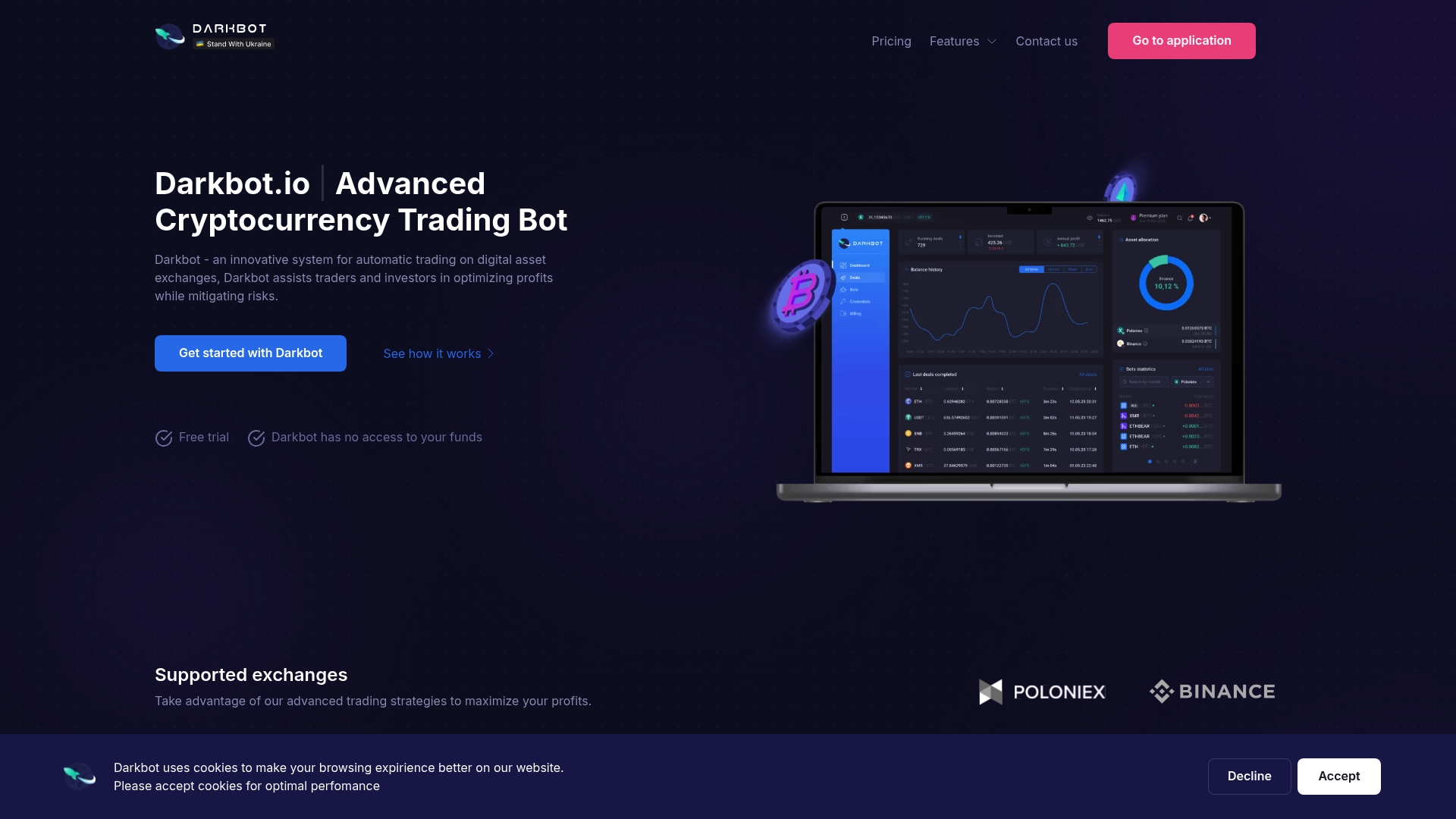
Darkbot connects to major crypto exchanges via API, allowing traders to configure their automated trading strategies with defined entry logic, stop-loss parameters, and adaptive trailing stops that execute without manual intervention. The platform also includes portfolio management tools that monitor overall exposure, apply position limits, and support the kind of portfolio-level risk control that prevents one bad trade from damaging weeks of disciplined work. Whether you’re running a single bot or managing multiple strategies across different assets, Darkbot gives structure to your process so execution stays consistent with your plan.
FAQ
What is the 1-2% rule in crypto trading?
The 1 to 2% rule means risking no more than 1 to 2% of your total trading capital on any single trade. It is the most widely used position risk limit in professional crypto trading because it protects capital across extended losing streaks.
How should I set a stop-loss in crypto?
Place your stop-loss at the point where the trade idea is technically invalidated, using ATR-based distance to account for the asset’s actual volatility. Fixed-percentage stops ignore market structure and often trigger prematurely on normal price wicks.
What is the 3-5-7 rule for crypto position management?
The 3-5-7 rule caps individual trade risk at 3% of capital, total portfolio exposure at 5%, and targets a minimum 7% gain on winning positions. It keeps risk-reward ratios favorable while limiting the damage any single position can cause.
Does automating crypto trades actually improve results?
Rule-based automated position management produces more consistent outcomes than manual trading by removing emotional decision-making, executing stops and take-profits precisely, and maintaining discipline across the 24/7 crypto trading cycle.
What cryptocurrencies are best to trade in 2025?
Bitcoin and Ethereum offer the highest liquidity and most reliable technical structure for traders in 2025. Altcoins with strong fundamental narratives and adequate liquidity can offer larger moves but require wider stops and reduced position sizes to manage the added risk.
Recommended

Start trading on Darkbot with ease
Come and explore our crypto trading platform by connecting your free account!
Free plan available • No credit card required