Beginner Trading Techniques for Crypto Newcomers

TL;DR:
- Most beginner crypto traders lose money quickly because they overlook fundamental principles. To succeed, they must start with spot trading, limit risk to 1-2%, and develop consistent, simple strategies over time. Proper risk management, practice, and avoiding scams are essential for long-term growth and safety in the market.
Crypto markets attract a lot of first-time traders, and most of them lose money within weeks. Not because the markets are rigged, but because they skip the basics. Beginner trading techniques aren’t about finding the perfect indicator or catching the next big move. They’re about understanding how the market works, controlling what you can lose, and repeating a process until it becomes reliable. This guide walks through the foundational skills every new crypto trader needs before risking real capital, from order types and position sizing to choosing a strategy and sticking with it.
Key takeaways
| Point | Details |
|---|---|
| Start with spot trading | Avoid leverage until you consistently execute a simple strategy without losing control. |
| Risk 1-2% per trade | Limiting exposure per trade is the single most effective way to survive early losses. |
| Pick one strategy for 90 days | Switching methods too quickly prevents the repetition needed to build real skill. |
| Paper trade before going live | Running 100 or more demo trades builds the habit and confidence that live trading demands. |
| Protect yourself from scams | Investment fraud caused over $7.9 billion in losses in 2025; verify every platform before depositing. |
Crypto trading basics you need first
Before applying any beginner trading techniques, you need a working vocabulary. Crypto markets have their own structure, and misreading it costs money.
The most important distinction for new traders is the difference between spot trading and derivatives. Spot trading means you buy the actual asset, such as Bitcoin or Ethereum, and own it outright. Derivatives include futures and margin products, where you’re trading a contract based on price movement, often with leverage. For newcomers, spot-first trading is the appropriate starting point because losses are capped at what you put in. Leverage multiplies both gains and losses, and most beginners are not ready for that exposure.
Here are the order types you’ll use most often:
- Market order: Buys or sells immediately at the current price. Fast but imprecise in volatile conditions.
- Limit order: Executes only at your specified price or better. More control, but no guarantee of fill.
- Stop-loss order: Closes your position automatically when price hits a defined level. Non-negotiable for risk management.
- Take-profit order: Exits the trade when your target price is reached. Locks in gains without requiring you to watch the screen.
Trading pairs matter too. Bitcoin/USDT, Ethereum/USDT, and similar pairs involving stablecoins are the most liquid markets on most exchanges. Higher liquidity means tighter spreads and more predictable execution. Low-liquidity pairs can move sharply on small order volumes, which makes them unpredictable for anyone still learning the basics.
Pro Tip: When you start, trade only the top five most liquid pairs on your chosen exchange. Market structure is cleaner there, and your order entries and exits will behave more like you expect.
Risk management: the real foundation
Risk management is not a supporting skill in trading. It is the skill. Every other technique depends on it working correctly.

The most widely cited framework for position sizing limits each trade to 1 to 2% of total account capital. On a $1,000 account, that’s $10 to $20 per trade at risk. It sounds conservative. It is conservative, and that’s the point. When you’re still learning, your win rate will not be high. A 1 to 2% rule means you can absorb 20 or more consecutive losses before your account drops below a dangerous threshold.
Here’s a practical framework for managing risk from day one:
- Define your stop-loss before entering. Calculate where the trade is invalidated, then set your stop there. Don’t adjust it after entry just because the trade is going against you.
- Calculate position size from risk, not instinct. Size by stop distance: divide your dollar risk amount by the distance between your entry price and stop-loss price. This gives you the correct number of units to trade.
- Set a daily loss limit. Many experienced traders stop trading after losing 3% of their account in a single day. This prevents emotional revenge trading from compounding losses.
- Avoid leverage entirely for the first three months. There’s no educational benefit to leverage at the start. It accelerates losses before you’ve developed any judgment.
- Review your trades weekly, not trade by trade. Evaluating each trade in isolation distorts your perception of a strategy’s actual performance.
Pro Tip: Track your average risk-reward ratio over at least 20 trades before drawing any conclusions. A single winning or losing week tells you nothing reliable about your strategy.
The 1-2% risk rule is not just theory. It’s the structural difference between traders who last long enough to improve and those who blow up their accounts before they understand what went wrong.
Accessible beginner trading strategies
Once you understand risk management, you can look at actual trading techniques. The goal at this stage is not to find the most profitable strategy. It’s to find one that is clear enough to apply consistently.
| Strategy | Holding period | Complexity | Why it fits beginners |
|---|---|---|---|
| Dollar-cost averaging (DCA) | Weeks to months | Very low | Removes timing pressure entirely |
| Swing trading | 2 days to 3 weeks | Low to moderate | Time to analyze and plan entries |
| Trend following | Days to weeks | Moderate | Uses clear, observable price structure |
| Day trading | Minutes to hours | High | Requires fast decisions and emotional control |
| Scalping | Seconds to minutes | Very high | Not appropriate for new traders |
Dollar-cost averaging means buying a fixed dollar amount of an asset at regular intervals regardless of price. You’re not trying to pick the bottom. You’re building exposure gradually over time. It’s one of the most defensible easy trading methods for people who are still learning market structure.
Swing trading suits beginners better than day trading because holding for days to weeks gives you time to analyze the trade before acting. You define support and resistance levels on a daily or four-hour chart, set your entry near support, place your stop below the level, and target the next resistance zone. The trade either works or it doesn’t. You review it and move on.
Trend following means trading in the direction of an established price trend. You identify that the market is making higher highs and higher lows, then look for pullbacks to enter in the trend direction. This is not a prediction. It’s an observation of what price has already done.
Day trading and scalping are not appropriate beginner techniques for most people. They require fast decision-making, emotional stability under pressure, and an execution speed that new traders haven’t developed yet. The advice to commit to one methodology for at least three months before evaluating or switching is well-founded. Repetition builds the pattern recognition that makes a strategy feel instinctive rather than mechanical.
Building a structured trading plan
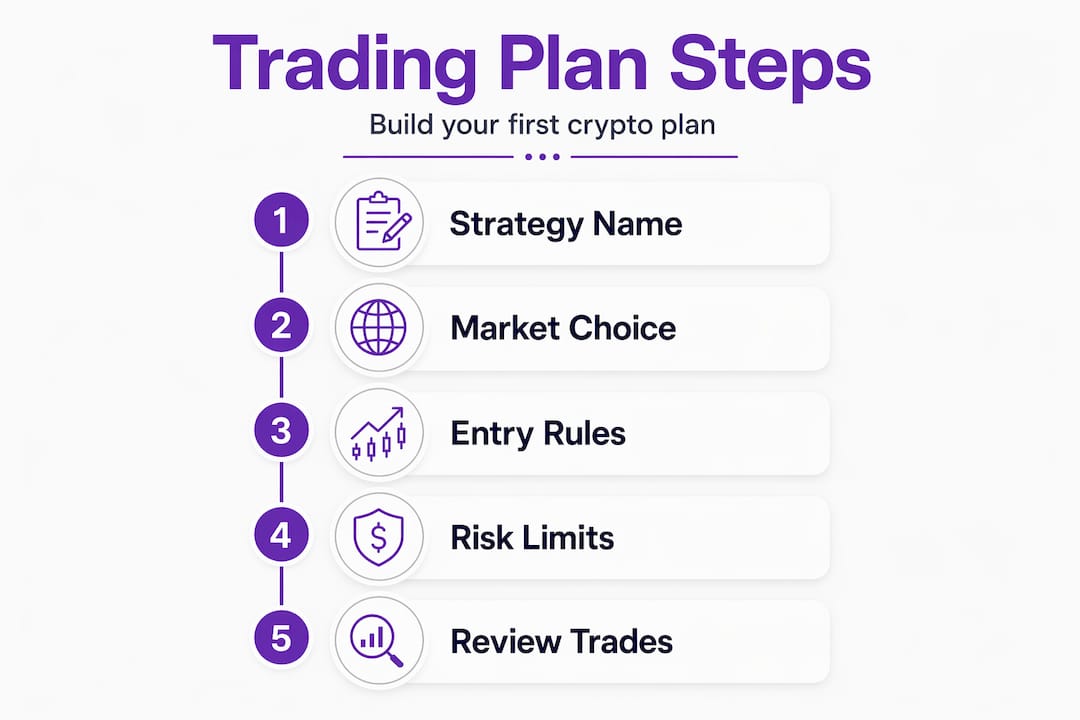
A trading plan is not a wish list. It’s a written set of rules that defines when you enter, where you place your stop, what your target is, and how much you risk. Any trade that doesn’t meet all four criteria does not get placed.
Start with a plan template. Write down your strategy name, the market you trade, the timeframe you use, your entry condition, your stop-loss rule, your target, and your position sizing formula. Then fill it in before every trade, not after. Research confirms that any trade lacking fully specified entry and exit rules introduces a gap where emotion fills in for logic.
Paper trading is the next step. A demo account for practice lets you execute trades using real market data without real money at risk. The recommendation from quantitative trading practice is to complete at least 100 trades in demo mode while maintaining profitability before switching to live capital. This isn’t just about mechanical skill. Transitioning to live trading involves emotional pressure that demo trading only partially prepares you for, which is why starting live with the smallest possible position size makes sense.
Journaling is how you convert trades into knowledge. After each trade, record the setup, your entry and exit, the result, and your reasoning. Over 30 to 50 trades, patterns emerge. You’ll see which setups perform better, which market conditions don’t suit your approach, and where your emotional discipline breaks down.
Time management matters more than most beginners expect. Designating a fixed trading window, such as one to two hours per day, prevents the impulsive trades that happen when you’re watching charts with nothing specific to act on. Trading should not be a passive screen-watching activity. It should be a deliberate process executed within defined hours.
Common pitfalls and scams to avoid
Beginner traders face two categories of risk: trading mistakes and external threats. Both deserve attention.
The most common trading mistakes include:
- Overtrading: Taking low-quality setups out of boredom or the urge to “be in the market.” Most profitable traders pass on the majority of potential setups.
- Switching strategies too often: Frequent strategy switching is one of the primary reasons beginners fail. You cannot evaluate a strategy after five trades.
- Adding to losing positions: Doubling down when a trade moves against you is not a management technique. It’s denial.
- Treating leverage as a beginner shortcut: Leverage magnifies not just gains but also the speed at which your account deteriorates.
On external threats, the scale of fraud in this space demands attention. Investment scams caused over $7.9 billion in losses in 2025. Most of them targeted people who were new to trading and drawn to the promise of fast returns. If anyone guarantees profits, offers unrealistic returns, or pushes you to fund an account quickly, those are exit signals. Use official tools like Investor.gov to verify registrations. Any trading platform worth using will have transparent licensing and verifiable ownership. Most beginner losses trace back to scams and operational errors rather than pure trading mistakes, which makes due diligence a fundamental trading skill.
My perspective on what actually moves the needle
I’ve watched a lot of new traders arrive with high expectations and leave the market broke, and the pattern is almost always the same. They spend too much time looking for the perfect setup and too little time thinking about what happens when the trade goes wrong.
The first year of trading is not about finding an edge. It’s about surviving long enough to develop one. Most people skip that distinction and go straight to complex indicators, looking for certainty in technical patterns that don’t offer any. In my experience, the traders who actually progress are the ones who commit to the boring work early: writing down their rules, trading small, reviewing their journal, and making incremental adjustments. The ones who want the shortcut are usually gone within six months.
The psychological shift from demo to live trading is real and mostly underestimated. Even a small live position triggers a different level of attention and anxiety than any demo trade. That emotional pressure changes your decision-making in ways you won’t fully anticipate until it happens. Starting live with positions that feel almost too small to bother with is not a weakness. It’s how you build the composure that the market eventually demands.
Patience doesn’t mean passivity. It means applying the same process enough times that you can actually measure whether it works.
— Grisha
How Darkbot supports structured beginner trading
When you’ve built a clear trading plan and understand your risk rules, automation becomes a practical next step rather than a shortcut.
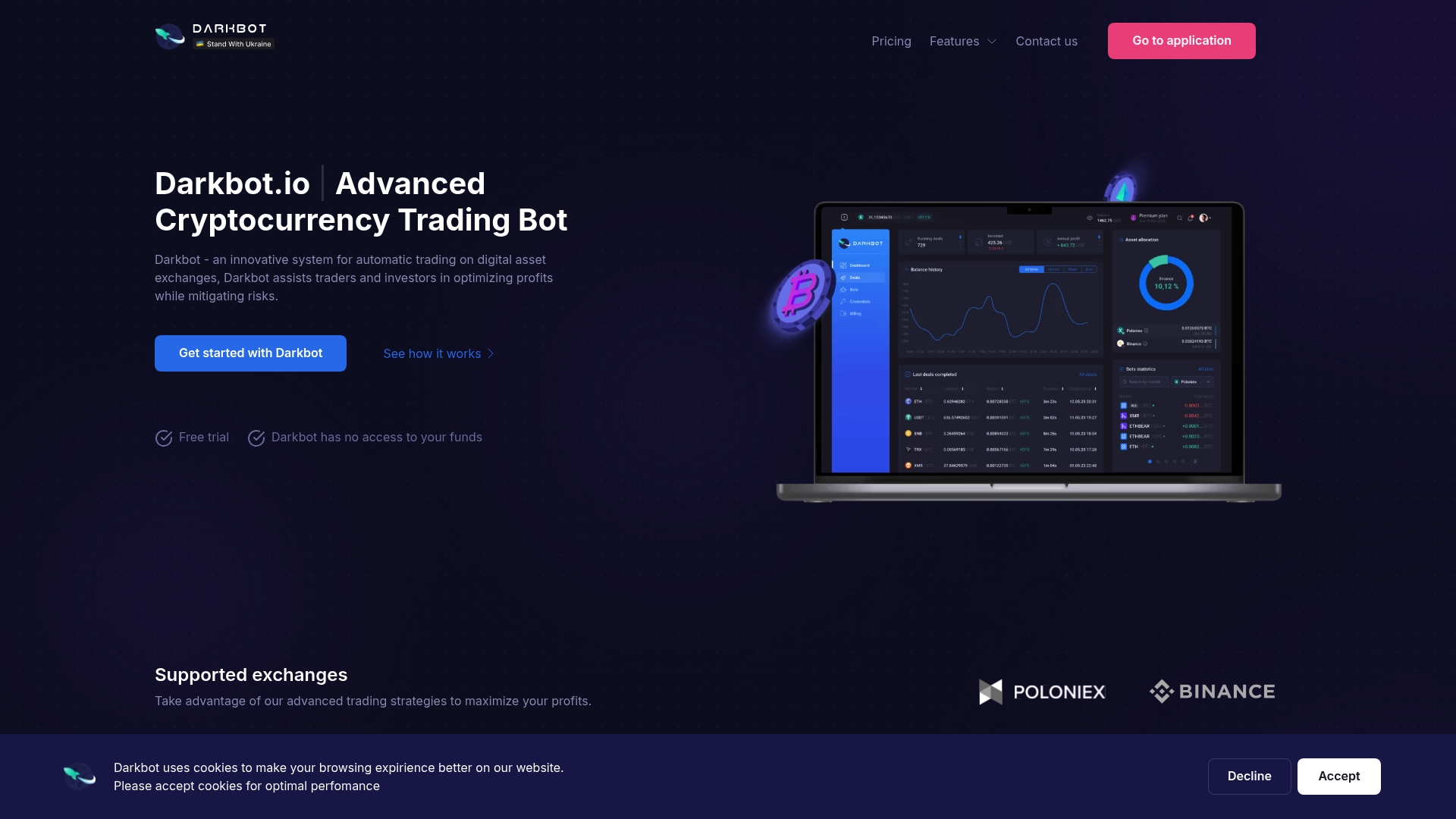
Darkbot is an AI-powered cryptocurrency trading platform designed around rule-driven execution. Rather than replacing your judgment, it applies your defined strategy consistently, removing the emotional interference that disrupts even well-designed plans. The platform supports paper trading for skill development, integrates position sizing parameters that align with the 1 to 2% risk model, and connects to multiple exchanges via API. For beginners building toward a structured approach, portfolio management tools on Darkbot allow gradual exposure scaling with automated risk controls. The platform offers free, standard, and premium tiers, making it accessible without requiring a large upfront commitment.
FAQ
What is the best beginner trading technique for crypto?
Dollar-cost averaging and swing trading are the most appropriate starting points because they limit timing pressure and give you time to plan entries and exits. Both techniques work well with defined stop-loss orders and a written risk management plan.
How much of my account should I risk per trade?
Experienced traders and professional guidance consistently recommend limiting risk to 1-2% per trade. On a $500 account, that’s $5 to $10 per trade at maximum risk.
Should beginners use leverage in crypto trading?
No. Leverage amplifies losses at the same rate it amplifies gains, and new traders don’t yet have the skill or emotional control to manage leveraged positions effectively. Starting with spot trading is the standard recommendation before considering any leveraged product.
How long should I paper trade before going live?
The practical benchmark is completing at least 100 demo trades while maintaining net profitability before switching to live capital. This builds execution consistency and partial emotional preparation for real-money conditions.
How do I avoid trading scams as a beginner?
Verify any platform through official licensing registries and treat any promise of guaranteed returns as a red flag. Investment fraud losses exceeded $7.9 billion in 2025, with beginners as the primary target. Skepticism and due diligence are not optional.
Recommended

Start trading on Darkbot with ease
Come and explore our crypto trading platform by connecting your free account!
Free plan available • No credit card required