AI crypto investing: strategies and tools explained
TL;DR:
- AI-driven crypto portfolios have shown significant returns but carry risks like overfitting and black swan vulnerability.
- Combining AI automation with human judgment creates a more resilient and effective trading strategy.
- Proper risk management, realistic backtesting, and platform transparency are essential for sustainable AI trading.
A live 6-month test showed an AI-driven portfolio delivering +89.7% returns with a Sharpe ratio of 2.4 and a 73% win rate, while the manual control group lost 12.3% over the same period. Numbers like that sound almost unbelievable, and honestly, they should trigger some skepticism. The gap between a well-built AI system and average manual trading is real, but so are the risks and misconceptions that come with it. This guide breaks down exactly how AI automates and optimizes crypto portfolios, how it handles risk, and the critical pitfalls that most new adopters walk straight into. You will leave with clear strategies, practical tools, and a realistic picture of what AI can and cannot do for your investments.
Key Takeaways
| Point | Details |
|---|---|
| AI boosts trading efficiency | AI automates complex strategies and adapts quickly for speed and consistency in crypto trading. |
| Risk management is crucial | AI enables dynamic risk controls, but investors must regularly review and adjust settings. |
| Human oversight needed | AI cannot replace human judgment in fast-changing or irregular markets. |
| Start simple and scale up | Begin with small capital and simple strategies before deploying advanced AI tools broadly. |
How AI transforms crypto investing: Key methods and frameworks
AI has moved from a buzzword into a genuine trading infrastructure layer. To use it well, you need to understand the core methods behind it. Not all AI is the same, and choosing the wrong framework for your strategy is one of the most common early mistakes.
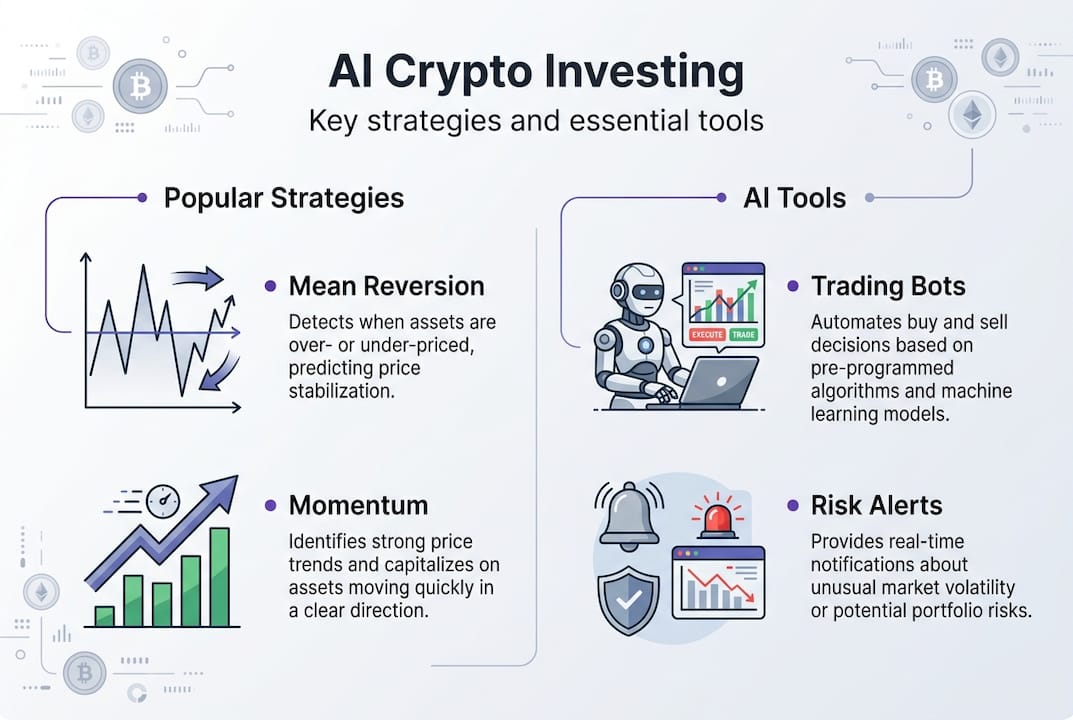
The main AI methodologies for crypto trading include technical indicators like RSI, EMA, and MACD, natural language processing for sentiment analysis, and machine learning models such as random forests and XGBoost. Each one solves a different problem. Technical indicators respond to price action. Sentiment analysis reads the market mood from news and social media. Machine learning models find patterns that human eyes would miss entirely.
Here are the most common strategies these systems automate:
- Mean reversion: Bets that prices will return to their historical average after extreme moves
- Momentum trading: Follows strong trends and exits when momentum fades
- Arbitrage: Exploits price differences across exchanges simultaneously
- Grid trading: Places layered buy and sell orders at set intervals to profit from volatility
- Portfolio rebalancing: Keeps your asset allocation aligned with target weights automatically
- Dollar cost averaging (DCA): Buys fixed amounts at regular intervals to smooth out entry prices
| AI model type | Best matched strategy | Core use case |
|---|---|---|
| Random Forest / XGBoost | Return prediction, classification | Identifying profitable entry signals |
| LSTM neural network | Time-series forecasting | Predicting short-term price direction |
| Reinforcement learning | Portfolio optimization | Dynamic allocation across assets |
| NLP models | Sentiment analysis | Gauging news and social signals |
| Rule-based systems | Grid trading, DCA | Systematic execution without prediction |
The economic impact of AI in crypto continues to grow as more institutional and retail players adopt these frameworks. Understanding machine learning in fintech helps you evaluate which tools are actually built on solid foundations versus marketing fluff. Platforms offering smarter automated trading typically combine multiple model types rather than relying on one approach.
Pro Tip: Tree-based models like XGBoost and Random Forest are more interpretable than deep neural networks and frequently outperform them for return prediction in crypto. If a platform cannot explain how its model makes decisions, that opacity is a red flag, not a feature.
Risk management with AI: Keeping your portfolio safe
Understanding AI strategies brings up a critical question: how do you protect your capital in a market this volatile? The answer lies in how well your AI system manages risk, not just how well it predicts price.
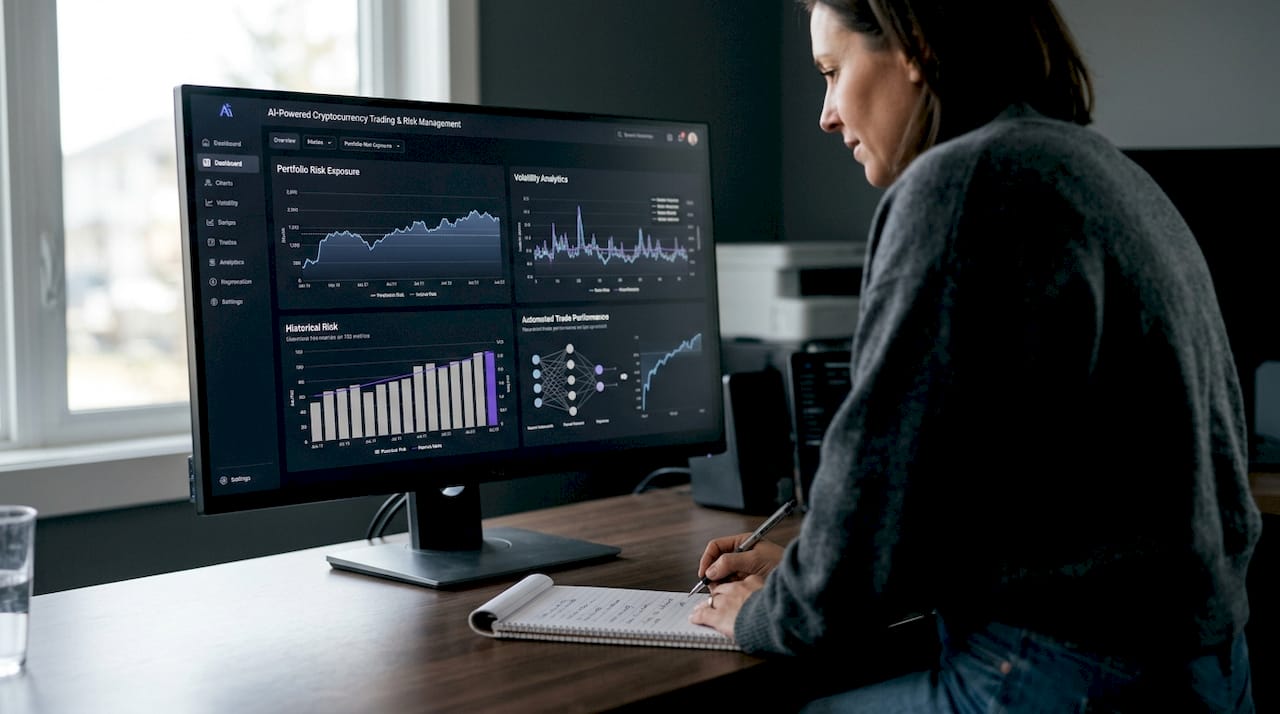
AI-powered tools adjust allocation dynamically using real-time volatility signals and risk metrics. When the market enters a high-volatility regime, a well-configured system reduces position sizes automatically. When conditions stabilize, it scales back up. This is fundamentally different from a human trader manually checking charts every few hours.
Here are the main risk controls that well-built AI systems enable:
- Dynamic position sizing using the Kelly Criterion to size bets relative to edge and bankroll
- Drawdown caps that halt trading when portfolio losses exceed a set threshold
- Volatility-based exposure that scales positions down during high-volatility periods
- Value at Risk (VaR) monitoring to quantify maximum expected loss over a given timeframe
- Monte Carlo simulation to stress-test strategies across thousands of hypothetical market scenarios
- Stop-loss systems that exit positions automatically when price moves against the trade
Research on dynamic position sizing confirms that combining the Kelly Criterion with stop-losses, volatility-based exposure controls, VaR, and clustering significantly reduces drawdown.
| Feature | Manual risk management | AI-automated risk management |
|---|---|---|
| Speed of response | Minutes to hours | Milliseconds |
| Emotional influence | High | None |
| Consistency | Variable | Consistent |
| 24/7 monitoring | Not feasible | Standard |
| Drawdown response | Reactive | Proactive |
For a deeper look at safer trading with AI, the key insight is that automation removes the two biggest sources of human error: slow reaction time and emotional decision-making. Portfolio-level AI for portfolio risk research shows consistent improvement in risk-adjusted returns when these controls are active.
Pro Tip: Even with a fully automated risk system, set conservative limits from the start and review them as market regimes shift. Bull market parameters can destroy accounts when conditions flip. Build in a monthly review as a non-negotiable habit.
Limitations, edge cases, and why humans still matter
Now that we have covered how AI manages risk, it is equally important to understand what these systems cannot do. Knowing the failure modes is what separates investors who use AI wisely from those who get caught off guard.
The most serious risks include:
- Overfitting: Models that perform brilliantly on historical data but fall apart on live markets because they learned noise instead of signal
- Lookahead bias and data leakage: Backtesting errors that make past performance look far better than it actually was
- Black swan vulnerability: Extreme, unpredictable events like exchange collapses or regulatory crackdowns that sit outside the model’s training distribution
- API and security threats: Automated systems connected to exchange APIs create attack surfaces that manual traders do not have
- Interpretability gaps: Many AI models are black boxes, making it hard to understand why a trade was placed or why it failed
Common backtesting pitfalls like overfitting, lookahead bias, data leakage, and black-box opacity lead to spectacular live failures even when historical results looked clean. Walk-forward testing and realistic slippage modeling are the two mitigants most platforms skip.
“Live drawdowns were 58% lower than manual trading in one controlled test, but AI can still fail spectacularly in chaos. The difference between a good system and a dangerous one is how it behaves when nothing in the training data prepared it for what just happened.”
A balanced review of AI vs human traders consistently shows that human judgment remains superior in three areas: reading macro narratives, adapting to sudden market structure changes, and making discretionary overrides when something feels structurally broken. A useful crypto investing guide frames AI as a powerful co-pilot, not an autopilot.
Practical steps to start using AI in your crypto investments
Given the opportunities and the real challenges, here is how to actually begin using AI-driven strategies without making the classic early mistakes.
- Research and vet platforms carefully. Look for strategy transparency, documented live results (not just backtests), and clear API security protocols. Community reviews and third-party audits matter.
- Run backtests that include realistic costs. Fees, slippage, and funding rates can cut apparent returns in half. A strategy that shows 40% annual return before costs might net 12% after them.
- Set hard risk limits before going live. Decide your maximum drawdown tolerance and configure your system to stop if it hits that number. Do this before emotions are involved.
- Enable monitoring and alerts. Most platforms let you set alerts for unusual behavior, drawdown thresholds, or connectivity issues. Use all of them.
- Schedule regular performance reviews. Monthly at minimum. Compare live results to expected behavior and check whether market conditions have shifted enough to require parameter updates.
The AI trading guide reinforces that no pure AI guarantees profits, and human oversight with realistic backtesting is essential for sustainable results. Check out how crypto automation explained in practice differs from what vendors typically advertise.
Pro Tip: Start with a small live allocation, something you could afford to lose entirely without disrupting your broader portfolio. Scale only after you have seen stable, consistent performance across at least two distinct market regimes, one trending and one ranging.
Our take: Why the hybrid AI-human approach is the real edge
Here is a misconception worth confronting directly. Many articles suggest that AI alone can generate outsized, hands-free crypto profits. In practice, the traders and funds consistently outperforming the market are not fully automated. They use a hybrid model.
AI is genuinely exceptional at 24/7 execution, processing thousands of data points simultaneously, reacting in milliseconds, and removing emotional interference. Humans are still better at interpreting macro narratives, recognizing when market structure has fundamentally changed, and making the kind of discretionary calls that keep a portfolio alive during irrational market behavior.
As hybrid AI-human research consistently shows, pure AI systems fail in irrational markets, while pure human trading fails from fatigue and emotion. The combination handles both failure modes. Insights on human roles in crypto trading from active practitioners reinforce the same conclusion.
The practical lesson: treat yourself as the fund manager and the AI as your best analyst and execution desk. It does the work you cannot do at scale. You make the calls it cannot make from data alone. That division of labor is where the real edge lives.
Ready to automate your crypto strategy? Explore powerful AI tools
For those ready to put these insights into action, the right platform makes all the difference between theory and results. Choosing a tool built on transparent strategies, solid risk controls, and real exchange integration is the foundation of everything covered in this guide.
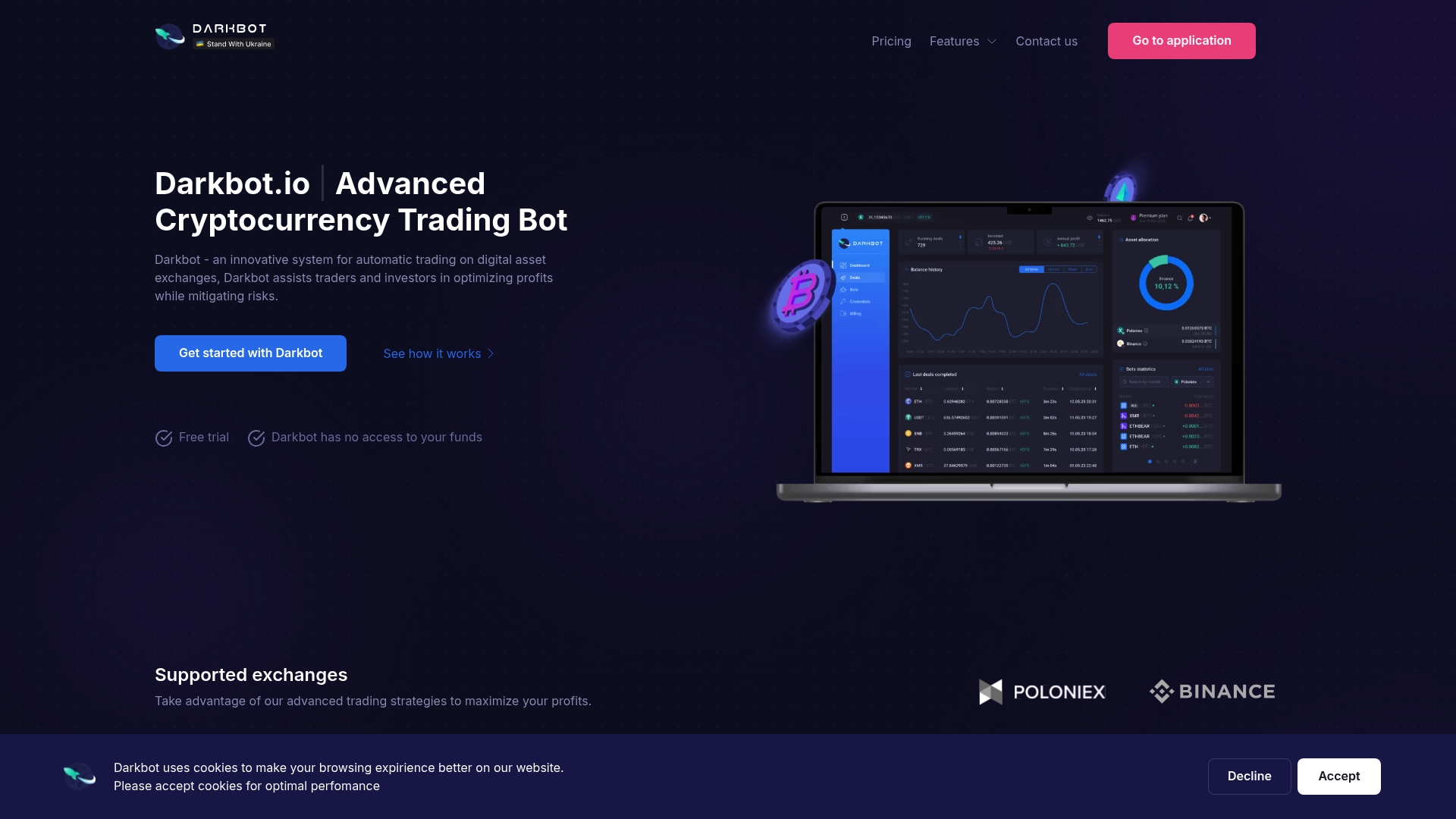
Darkbot automated trading gives you access to advanced AI-driven strategies, multi-exchange integration via API keys, real-time portfolio monitoring, and automated rebalancing, all through an interface designed for both new and experienced traders. Whether you want to run multiple simultaneous bots or fine-tune a single strategy, the platform’s portfolio management tools handle the execution while you stay focused on the bigger picture. Plans range from free to premium, so you can start small and scale as your confidence grows.
Frequently asked questions
How do AI-based crypto trading bots work?
AI bots use market data, technical indicators, and machine learning algorithms to automate trading decisions and manage portfolios around the clock. According to AI trading methodologies, these systems combine sentiment analysis, pattern recognition, and rule-based execution to act faster than any human trader.
What strategies can AI automate for crypto investing?
AI systems can automate mean reversion, momentum, arbitrage, grid trading, portfolio rebalancing, and dollar-cost averaging. These common strategies cover most market conditions and can be layered or switched based on regime signals.
Are AI-powered crypto strategies always profitable?
No. AI can improve consistency and execution speed, but it does not guarantee profits. Live AI trading performance frequently underperforms backtested results once real slippage, fees, and market randomness are factored in.
What are the main risks when using AI for crypto investment?
The core risks are overfitting models, vulnerability to black swan events, API security exposures, and the need for continuous human oversight. Backtesting biases like lookahead and data leakage also make many strategies look better on paper than they perform live.
Do I need coding skills to use AI crypto tools?
Most modern platforms let you deploy AI bots without writing a single line of code. That said, understanding the basics of how your system works helps you set smarter risk limits and catch performance issues before they become expensive problems.
Recommended

Start trading on Darkbot with ease
Come and explore our crypto trading platform by connecting your free account!
Free plan available • No credit card required