Grid Trading Bot Explained: How It Works in 2026
TL;DR:
- Grid trading bots automate buy and sell orders within a set range, profiting from market oscillations. They perform best in range-bound markets with sufficient volatility and require active risk management, including stop-loss orders and proper positioning. Advanced systems use filters like volatility and trend detection to adapt to changing conditions and improve performance.
A grid trading bot is an algorithmic tool that automatically places buy and sell orders at predefined price intervals to capture profit from market oscillations within a set range. The strategy requires no prediction of market direction. Instead, it automates the buy-low, sell-high cycle by dividing a price range into equal grid levels and executing limit orders at each level. This article explains how the mechanism works, which market conditions suit it best, what risks to manage, and how advanced platforms like Darkbot extend the basic grid concept with AI-driven rule sets.
What is a grid trading bot explained: the core mechanism
A grid trading bot works by defining three parameters: an upper price boundary, a lower price boundary, and a number of grid levels between them. The bot then places alternating limit buy and sell orders at each level. When price falls to a buy order, the bot fills it and immediately places a corresponding sell order one level above. When that sell order fills, the cycle repeats.
The sequence of a standard grid trade looks like this:
- The bot sets a price range, for example $90,000 to $100,000 for BTC, divided into 10 levels.
- A limit buy order sits at each level below the current price.
- When price drops to $91,000, the buy fills and a sell order is placed at $92,000.
- When price recovers to $92,000, the sell fills, locking in the $1,000 spread as gross profit.
- The bot resets the buy order at $91,000 and the cycle continues.
This self-repeating loop is what makes grid trading a range-bound profit mechanism rather than a directional bet. The bot does not need to know where price is going. It only needs price to oscillate within the defined range. BTC and ETH spot and perpetual futures markets are the most common instruments used, given their liquidity and consistent intraday movement.
Pro Tip: Set grid levels proportionally rather than at equal dollar intervals. On a $90,000 BTC position, equal percentage spacing captures more trades during normal volatility than equal dollar spacing.

What market conditions suit grid bots, and when do they fail?
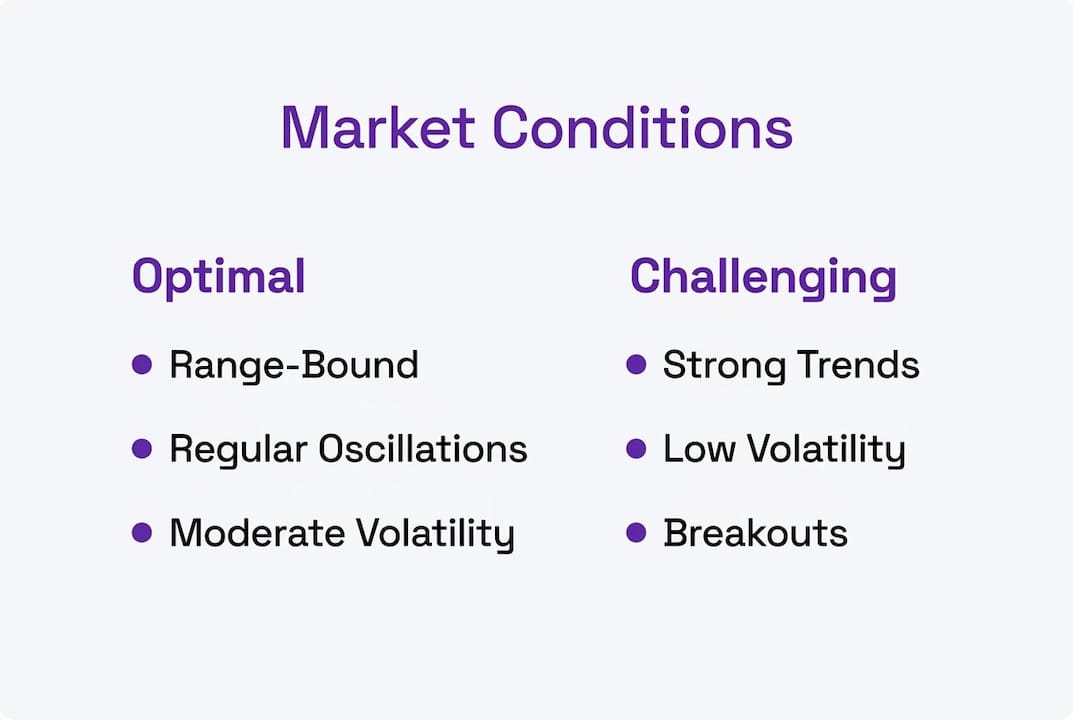
Grid bots perform best in range-bound markets with regular price oscillations. A market that moves up and down within a predictable band gives the bot repeated opportunities to fill both its buy and sell orders. BTC and ETH perpetual futures showed 5–10% daily ranges in may 2026, which represents the kind of volatility that supports active grid execution.
The table below compares market conditions where grid bots work well against conditions where they do not.
| Market condition | Grid bot performance |
|---|---|
| Sideways range with regular oscillations | Strong. Both buy and sell orders fill repeatedly. |
| Moderate volatility within a defined band | Good. Sufficient movement to cover fees and generate spread profit. |
| Strong uptrend or downtrend | Poor. Bot averages into losing positions as price exits the range. |
| Low volatility “sleepy range” | Weak. Insufficient movement to cover exchange fees and funding rates. |
| Sharp breakout beyond grid boundaries | Dangerous. Bot holds a fully loaded position with no exit. |
Grid bots fade the market by design. They buy dips and sell rallies, which is the opposite of trend-following. When a market trends strongly in one direction, the bot keeps buying as price falls or keeps selling as price rises, accumulating a losing position rather than a profitable one.
Low realized volatility markets are equally problematic. Known as “sleepy range” conditions, they generate too few fills to cover exchange fees and funding rates on perpetual futures. The primary market filter for any serious grid trader is comparing realized volatility against implied volatility adjusted for costs. Only markets where realized volatility exceeds the cost threshold justify running a grid.
Pro Tip: Before starting a grid bot, check the 7-day realized volatility of your chosen pair. If it is lower than your estimated fee and funding cost per round trip, the grid will lose money even if price stays in range.
What are the key risks of grid trading bots?
The largest risk in grid trading is a price breakout beyond the grid’s lower boundary. When this happens, the bot holds a fully loaded long position in a falling market with no mechanism to exit. Implementing a stop-loss just below the lower grid boundary is the standard defense. Without it, a single strong downtrend can erase weeks of accumulated grid profit.
Position sizing is the second critical risk factor. Each grid level should use only 10–20% of total capital, which limits exposure at any single price point and preserves capital to fill orders across the full range. Traders who allocate too much per level exhaust their available funds before price reaches the lower boundary, leaving unfilled buy orders and a gap in the grid’s coverage.
The top risk management practices for grid trading are:
- Place a hard stop-loss order just outside the lower price boundary before activating the bot.
- Allocate no more than 10–20% of grid capital per level to maintain coverage across all levels.
- Define a breakout response plan before the bot starts. Decide in advance whether to pause, reset, or close the grid if price exits the range.
- Monitor funding rates daily on perpetual futures grids. High funding costs erode profit margins even when the grid fills correctly.
- Avoid running grids on low-liquidity pairs where wide spreads prevent clean order fills.
Viewing grid bots as set-and-forget tools is a fundamental error. Professional use requires active parameter review, especially when market conditions shift from range-bound to trending. A grid configured for a sideways BTC market in one month may be entirely wrong for the following month. For a deeper look at protecting capital in automated strategies, Darkbot’s guide on crypto bot risk management covers stop-loss implementation and exit frameworks in detail.
How do advanced grid bots differ from basic order loops?
A basic grid executor places a fixed set of limit orders and resets them after each fill. That is the mechanical floor of the strategy. High-end grid trading systems go further by using technical indicators and volatility filters to decide when to activate, pause, or adjust the grid entirely.
The distinction matters because market conditions change. A bot that runs continuously regardless of volatility regime will underperform one that only activates when conditions are favorable. Automated grid bots that rely on rule-based filters are categorically different from simple pending order loops.
Key technical filters used in advanced grid trading include:
- Volatility threshold filters: The bot activates only when realized volatility exceeds a minimum level, preventing operation in sleepy range conditions.
- Trend detection filters: Indicators like the Average Directional Index (ADX) or moving average slope detect trending conditions and pause the grid before losses accumulate.
- Funding rate monitors: On perpetual futures, the bot checks funding rates before each cycle and pauses when rates make the trade unprofitable.
- Dynamic grid adjustment: Instead of fixed boundaries, the bot recalculates grid levels based on recent price action, keeping the range centered on current market activity.
Darkbot applies AI-driven evaluation to these filters continuously. Rather than relying on a trader to manually reconfigure parameters, Darkbot’s system assesses market conditions in real time and adapts order placement accordingly. This is the practical difference between types of trading bots that simply repeat a loop and those that apply structured decision logic to each trade cycle. Traders new to this distinction can also review the basics of trading automation to understand how filters integrate with execution.
Key Takeaways
A grid trading bot profits from price oscillations within a defined range by automating alternating buy and sell limit orders at each grid level, requiring no directional prediction.
| Point | Details |
|---|---|
| Core mechanism | The bot places buy and sell limit orders at equal intervals and resets them after each fill. |
| Optimal conditions | Range-bound markets with sufficient realized volatility to cover fees are required for consistent performance. |
| Primary risk | A breakout below the lower boundary creates a losing position; a stop-loss just outside that boundary is non-negotiable. |
| Position sizing | Allocate 10–20% of capital per grid level to maintain coverage and avoid exhausting funds mid-range. |
| Advanced bots vs. basic loops | High-end systems use volatility and trend filters to activate only under favorable conditions, not on a fixed schedule. |
Why grid trading demands more discipline than most traders expect
Grid trading looks simple on paper. You set a range, the bot trades, and profits accumulate. The reality is more demanding. The traders I see struggle most with grid bots are not the ones who misconfigure the parameters. They are the ones who refuse to intervene when the market changes character.
The “set and forget” assumption is the most expensive mistake in this strategy. A grid that worked well during a two-week consolidation phase in BTC will start bleeding the moment a macro catalyst pushes price into a sustained trend. The bot does not know this. It keeps buying the dip because that is what it is built to do. The trader has to recognize the regime change and act.
Risk management is not a feature you add to a grid bot. It is the foundation the entire strategy rests on. A stop-loss below the lower boundary, a clear breakout plan, and a position size that does not exhaust capital at the first adverse move are not optional refinements. They are the difference between a strategy that compounds slowly and one that wipes out in a single session.
What I find genuinely useful about platforms like Darkbot is the shift from manual parameter management to rule-driven adaptation. The AI layer does not predict price. It evaluates whether current conditions match the criteria the strategy requires. That is a fundamentally different and more disciplined approach than a trader manually deciding whether to keep the bot running. Systematic execution beats discretionary override almost every time, especially under pressure. For traders who want to avoid common beginner errors in automated strategies, the principle is the same: rules first, judgment second.
— Grisha
Darkbot’s approach to automated grid trading
Grid trading is one of the most systematic strategies in crypto automation, and it rewards platforms built around structured execution rather than guesswork. Darkbot’s AI-driven platform supports full grid bot configuration, including dynamic boundary setting, volatility filters, and integrated stop-loss controls that activate automatically when price exits the defined range.

Darkbot connects to multiple exchanges via API and runs grid strategies continuously without requiring manual resets after each fill cycle. The platform’s real-time analytics show exactly how each grid level is performing, which funding costs are accumulating, and when conditions shift away from the bot’s optimal range. Traders who want a structured, rules-based approach to crypto portfolio management can configure and monitor grid bots directly within Darkbot’s interface, with risk controls built into the workflow from the start.
FAQ
What is a grid trading bot?
A grid trading bot is an automated tool that places alternating buy and sell limit orders at equal price intervals within a defined range, profiting from repeated price oscillations without predicting market direction.
Is grid trading profitable?
Grid trading generates profit when price oscillates within the configured range and realized volatility exceeds the cost of fees and funding rates. It produces losses when price trends strongly outside the grid boundaries.
What is the best market condition for a grid bot?
Range-bound markets with moderate, consistent volatility are optimal. BTC and ETH perpetual futures with 5–10% daily ranges provide the kind of movement that supports repeated grid fills.
How do I set up a grid trading bot?
Define an upper boundary, a lower boundary, and a number of grid levels. Allocate 10–20% of capital per level, place a stop-loss just below the lower boundary, and activate the bot only when realized volatility justifies the trade.
What is the biggest risk in grid trading?
A price breakout below the lower grid boundary is the primary risk. The bot accumulates a fully loaded long position with no exit mechanism unless a stop-loss is placed in advance, which is why setting stops outside grid bounds is a core best practice.
Recommended

Start trading on Darkbot with ease
Come and explore our crypto trading platform by connecting your free account!
Free plan available • No credit card required