Automate Basis Trades in Crypto With 1–2% Risk Controls

A crypto basis trade pairs a long spot position with a short derivative, either a dated future or a perpetual contract, to capture the spread between spot and futures prices without taking a directional bet on the underlying asset. The strategy works when funding rates or futures premiums are wide enough to cover fees and financing costs, which typically happens during periods of heavy leveraged demand for long exposure. It suits traders who want yield derived from market structure without taking a directional bet on the underlying asset.
TL;DR:
- Basis trades rely on a wide enough spread between futures and spot prices to cover trading fees and financing costs during high-demand leveraged periods.
- Dated futures offer fixed, predictable yields with no need for daily rate monitoring but risk roll-over costs if positions are extended.
- Perpetual funding farming provides more liquidity and flexibility but requires active tracking of fluctuating funding rates and potential negative reversals.
- Automated execution tools help prevent partial fills, manage margin buffers, and make trades more consistent amid market volatility and funding reversals.
- Typical annualized basis yields range from single to low double digits, with larger capital sizes needed to generate modest daily gains like $100.
What Is a Basis Trade in Crypto? Mechanics and Variants
The basis is the gap between a futures price and the spot price of the same asset: basis = futures price − spot price. When futures trade above spot, the market is in contango, and that gap is what a basis trade converts into yield. Crypto markets offer two structurally different ways to run this trade, and the choice between them changes how you monitor risk.
Dated futures (cash-and-carry). You buy the asset on the spot market and simultaneously short a dated futures contract, such as a quarterly BTC future. Because that future must converge to spot by its expiry date, the basis you lock in at entry is your yield, fixed and predictable regardless of what happens to price in between. This is the classic cash-and-carry arbitrage structure, and it removes the need to monitor funding rates day to day.
Perpetual funding farming. Perpetual futures never expire, so exchanges use a funding rate instead, a periodic payment (commonly every eight hours) exchanged between longs and shorts to keep the perp price tethered to spot. Buying spot and shorting the perp lets you collect that funding payment when it’s positive. Unlike a dated future’s locked-in basis, perpetual funding is variable and can compress or flip with little warning.
The two variants differ in more than payout timing:
- Dated futures require no ongoing rate monitoring but tie up capital until expiry and expose you to roll risk if you want to extend the position.
- Perpetual trades offer daily liquidity and flexibility but demand active tracking of funding trends.
- Margin treatment differs too. Dated contracts often settle with fixed maintenance margin schedules, while perps recalculate unrealized P&L continuously, which changes how much buffer you need.
- Capital efficiency also varies. Some venues allow portfolio margining that nets the spot and derivative legs against each other, reducing the capital locked up for the same basis exposure.
Neither variant is inherently better. Dated futures suit traders who want a known return over a fixed horizon; perpetuals suit traders comfortable adjusting position size as funding conditions shift.
Why the Basis Exists: Contango, Leveraged Longs, and ETF Flows

The basis isn’t free money sitting on the table. It’s compensation for providing liquidity to leveraged speculators who want long exposure without holding spot. When retail and institutional traders pile into long futures positions, they push futures prices above spot, and basis traders step in to sell that overpriced exposure while hedging with spot. That imbalance between want-to-be-long capital and available short capital is what sustains the premium.
Spot ETF launches changed this dynamic in a specific way. Once regulated spot ETF shares existed alongside CME-listed futures, institutional desks gained a clean way to hold spot exposure and hedge it with regulated futures on the same underlying reference rate. That expanded arbitrage capacity and tightened the basis in more liquid markets, because more capital was available to close the gap whenever it widened.
Typical range check: Practitioner estimates suggest normal-market annualized basis and funding yields often sit in the single digits to low double digits, while euphoric market phases have pushed perp funding above 30 to 50 percent APR before mean-reverting.
That range matters because it tells you what “normal” looks like. A funding rate spiking well outside that band usually signals a leverage-driven distortion rather than a stable yield regime, and distortions correct. Academic work on cash-futures basis trades in Treasury markets shows the same underlying mechanic: basis trades supply liquidity and absorb one-sided demand, and the yield compresses once that demand imbalance eases. Crypto’s basis behaves the same way, just with faster cycles and thinner liquidity than Treasury futures markets.
How to Execute a Basis Trade: Venues, Margin, and Order Tactics
Execution quality determines whether the basis you see on a screen is the basis you actually capture. The gap between quoted and realized yield comes almost entirely from slippage, fees, and timing mismatches between the two legs.
Venue selection first. Regulated dated-futures venues offer clearer custody protections and standardized settlement, but often lower leverage and less basis dispersion. Offshore perpetual exchanges typically offer wider funding spreads and deeper leverage, at the cost of less transparent custody and counterparty history. A comparison of major exchange features is worth reviewing before committing meaningful capital to any single platform.
Margin model matters just as much as venue choice. Cross-margin and portfolio margin accounts let you net the spot and derivative legs, which frees up capital that would otherwise sit idle as separate collateral. Unified margin accounts on some exchanges extend this further across multiple assets and instrument types, improving capital efficiency for traders running several basis positions at once. Reviewing derivatives usage in a broader risk framework helps clarify how margin choices interact with overall portfolio exposure.
A basic execution sequence looks like this:
- Confirm the basis or funding rate is wide enough to clear fees, slippage, and financing cost before entering.
- Place the spot buy and derivative short as close to simultaneously as possible, ideally through linked or algorithmic orders, to avoid one leg filling without the other.
- Use limit orders on the less liquid leg first, then market or aggressive limit orders on the more liquid leg to minimize timing gaps.
- Set a margin buffer above the exchange’s maintenance requirement, not just the minimum.
- Define exit triggers in advance: a target basis level, a funding threshold, or a maximum holding period.
Pro Tip: Never leg into a basis trade manually across two exchanges without a plan for what happens if only one order fills. A partial fill turns a market-neutral position into a naked directional bet, often at the worst possible moment.
What Can Go Wrong: Funding Reversals, Liquidation, and Exchange Risk
Basis trades are market-neutral in direction, not risk-free. Most losses come from three sources: funding reversing against you, margin mismanagement on the short leg, and counterparty failure at the exchange level.
When funding flips negative on a perpetual position, you go from collecting payments to making them, and the trade’s economics invert while your spot holding is unaffected. If you don’t have a rule for exiting or resizing when this happens, the erosion compounds every funding interval until the trade becomes a net cost.
Liquidation risk lives entirely on the short derivative leg. If the underlying price rallies sharply, the short future or perp needs enough margin to absorb the unrealized loss until the spot leg’s gain offsets it; a margin call executed late forces you to close the short at a bad price while still holding the spot side unhedged. Practical mitigations include:
- Keep margin utilization on the short leg meaningfully below the exchange’s liquidation threshold, not just above the maintenance minimum.
- Diversify basis positions across more than one exchange to limit exposure to any single venue’s outage or withdrawal freeze.
- Watch for signs of exchange stress, delayed withdrawals, unusual fee changes, or thin order books, and treat them as exit signals rather than noise.
- Account for roll costs explicitly when a dated future approaches expiry and you intend to extend the position into the next contract.
- Prefer venues with a demonstrated withdrawal history and transparent proof-of-reserves practices over the highest advertised funding rate.
A detailed breakdown of automation-related operational risks covers how these failure modes compound when execution is manual and reaction time is slow. Slippage on entry and exit, and the practitioner-documented tendency for basis and funding to revert sharply after extreme readings, are both well-covered mechanics worth internalizing before sizing a position aggressively.
A Worked Example: Calculating Net Yield on Both Trade Types
Numbers make the strategy concrete. Assume a $50,000 notional position in both examples below.
Dated futures. Spot BTC trades at $60,000, and the three-month future trades at $61,200. Subtract estimated round-trip trading fees and expected slippage, and the net annualized yield lands slightly lower.
Perpetual funding. The perp’s funding rate averages a small positive percentage every 8 hours, which annualizes to a low double-digit percentage before costs. Subtracting funding volatility drag and trading fees yields a realistic net expectation in the single to low double digits, assuming funding stays positive on average.
Before converting these numbers into live orders, confirm the fee schedule for both legs on the specific exchanges used, size the position so margin buffers hold under a realistic adverse price move, and set a minimum acceptable basis or funding threshold below which you close the trade rather than let it run at breakeven or worse.
Monitoring the Trade: Metrics, Thresholds, and Automation Hooks
Running a basis trade well means watching a small set of numbers consistently, not checking in occasionally. Four metrics matter most: the funding rate trend (not just the current print), the shape of the futures curve across expiries, open interest and order book depth, and, for BTC and ETH, ETF creation and redemption flow data.
Set a minimum threshold before entry, if the expected basis or funding doesn’t clear fees and slippage by a reasonable margin, don’t enter. Many practitioners use a trailing average of funding over several days rather than a single reading, since perp funding can spike and revert within hours.
Useful automated alerts include:
- Consecutive negative funding periods beyond a set count, signaling the trade may be turning against you.
- A sudden drop in open interest, which often precedes reduced liquidity and wider slippage on exit.
- Withdrawal halts or unusual delays on any venue holding part of the position.
- A futures curve that flattens or inverts, indicating the basis opportunity is closing.
Avoid entering new basis positions during liquidity droughts or when funding signals are ambiguous, mixed positive and negative readings across venues, since ambiguous conditions make it harder to size the trade with confidence.
Automation and Risk Controls in Basis Trade Execution
Manual execution of a two-legged trade introduces timing risk that automation is built to remove. An automated system can submit the spot and derivative orders together, reducing the window where only one leg fills, and can continuously recalculate margin utilization across both positions rather than relying on periodic manual checks.

Systematic execution also enforces rules a trader might skip under pressure: maximum exposure per position, minimum margin buffer thresholds, and predefined unwind triggers when funding or basis conditions deteriorate. Applying a structured 1 to 2% risk allocation per position keeps any single basis trade from dominating portfolio risk if a funding reversal or liquidation event occurs. The value of automation here isn’t speed for its own sake. It’s consistency: the same entry, sizing, and exit logic applied every time, regardless of market noise or emotional pressure in the moment.
Tax Treatment and Reporting for Basis Trades
Basis trades generate multiple taxable events, and the treatment differs by leg and by jurisdiction. Closing the short futures or perpetual position typically triggers a realized gain or loss on that leg, calculated separately from the spot position’s cost basis. Funding payments received or paid on perpetual contracts are generally treated as ordinary income or expense in many jurisdictions, distinct from capital gains treatment on the underlying asset, though the exact classification depends on local tax rules.
Cost basis tracking becomes more complex than it is for simple spot holding because a basis trade involves two positions opened and closed independently, often at different times if you roll a dated future into a new contract. Each roll can be a separate taxable disposal of the expiring contract. Keeping a clear record of entry price, exit price, and holding period for both the spot and derivative legs, ideally exported directly from exchange trade history, is the only reliable way to reconstruct accurate figures at filing time.
Jurisdictions vary widely on how they classify funding income, futures gains, and short-term versus long-term treatment for the spot leg. Some tax authorities treat frequent basis trading as business income rather than investment income if the frequency and structure resemble active trading, which can carry different rates and reporting obligations. Given how much this varies by country and even by trade structure, consulting a tax professional familiar with cryptocurrency derivatives before running basis trades at scale is a reasonable precaution rather than an optional step.
Where Basis Trading Fits in a Yield-Seeking Portfolio
Basis trading earns its place when funding or futures premiums are wide enough to justify the operational overhead, and thins out fast when they aren’t. I’d treat it as one tool among several yield approaches, not a replacement for passive strategies, and size it modestly relative to total crypto exposure, since correlated funding reversals across venues can hit multiple positions at once.
What changed the calculus for smaller traders isn’t the strategy itself, it’s disciplined automation. A two-legged, time-sensitive trade that once demanded constant screen time now runs on rules instead of reflexes, which is where the real accessibility gain sits.
— Grisha
Automate Basis Trade Execution With Darkbot
Running a basis trade by hand means watching funding rates, margin ratios, and two order books at once, and a delay of even a few seconds on one leg can turn a hedged position into a directional bet. Darkbot connects to major exchanges through API keys and lets you configure risk rules, position sizing limits, and multi-venue execution logic that fire consistently, without relying on you to catch every funding shift in real time.
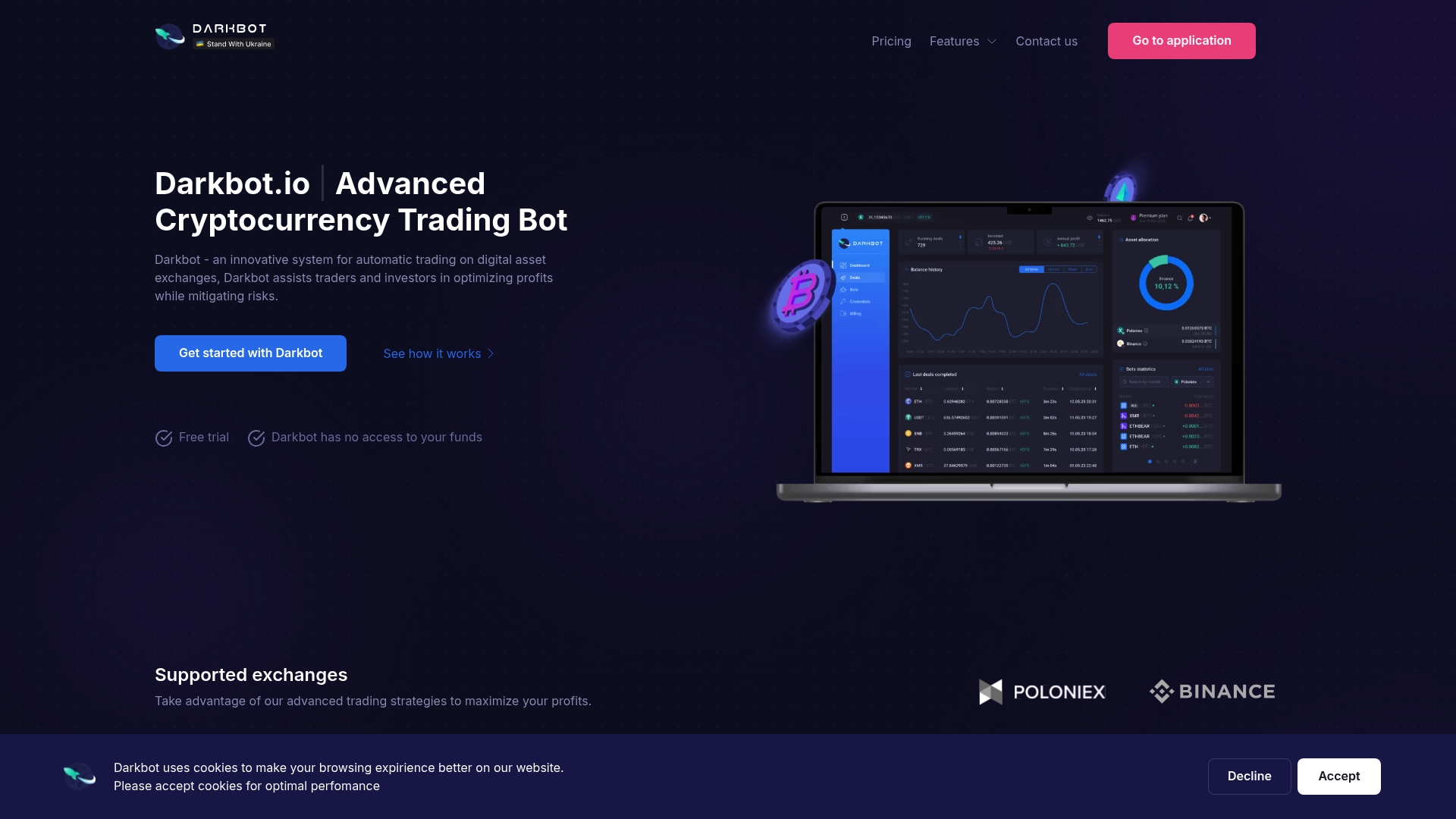
The platform offers backtesting tools to evaluate historical performance of basis or funding thresholds and includes portfolio management features that track margin utilization across multiple positions. None of this predicts where funding rates go next. It applies the same entry, sizing, and exit rules every time, which is the discipline that basis trading depends on. For information on configurable risk rules and automated execution options, visit Darkbot to review current plans and details.
Sources
For deeper technical detail, see the CFTC’s briefing on basis trade mechanics and the Wikipedia overview of cash-and-carry arbitrage.
This article is general information, not a substitute for advice from a qualified financial advisor. Consult a qualified financial professional about your own circumstances before acting on anything here.
- What is basis trading? Cash-and-carry arbitrage
- Basis Trading in Crypto: Capturing the Spot-Futures Spread — Derivatives Journal
- Spot ETFs give rise to crypto basis trading — CME Group OpenMarkets
- Recent developments in hedge funds’ Treasury futures and repo positions — Federal Reserve (FEDS Notes)
FAQ
What is an example of a basis trade?
A trader buys $50,000 of spot BTC and simultaneously shorts an equivalent notional in a three-month BTC future trading at a 2% premium to spot, locking in that 2% as yield when the future converges to spot at expiry.
Can you make $100 a day trading crypto with basis trades?
It depends entirely on notional size and prevailing funding or basis levels; at typical annualized yields of roughly 8 to 9%, generating $100 daily would require a notional position in the range of several hundred thousand dollars, not a small account.
How do I find my cost basis for crypto used in a basis trade?
Cost basis is the price paid for the spot asset plus any fees, tracked separately from the derivative leg’s entry and exit prices, and both need to be reconstructed from exchange trade history for accurate tax reporting.
Is basis trading profitable?
Basis trading has produced positive net yield in many market conditions historically, with annualized returns often in the single to low double digits, but profitability depends on funding staying positive, fees and slippage staying low, and no liquidation event occurring on the short leg.
Does Darkbot support basis trade automation?
Darkbot provides exchange API integration, configurable risk rules, and multi-venue execution tools that traders can apply to systematic strategies including basis trades, though the specific configuration depends on the connected exchanges and account setup.
Recommended

Start trading on Darkbot with ease
Come and explore our crypto trading platform by connecting your free account!
Free plan available • No credit card required