Start Safely: Best Beginner Crypto Bots With $25–$50 Position Rules

For most newcomers, Darkbot is the most sensible entry point into automated crypto trading because it pairs a straightforward interface with built-in risk controls and a paper trading mode that lets you validate a strategy before any capital is at risk. The practical first move is to open a free account, connect a trade-only API key, and run a preset strategy in paper mode for several weeks before committing real funds.
TL;DR:
- Beginners should prioritize platforms offering backtesting and paper trading to validate strategies without risking real funds.
- Using trade-only API keys with restricted permissions is essential to minimize the risk of fund loss if a platform is compromised.
- Consistently small initial positions, setting loss limits, and testing configurations thoroughly are critical for safe hands-on trading.
- Evaluating platforms based on security, support, cost, and strategies is more important than chasing advertised returns or AI claims.
- Extending paper trading and avoiding strategies overly reliant on a few outsized trades helps build a more reliable, long-term trading approach.
Which beginner-friendly bot path fits you
Beginners generally choose from four practical paths, and the right one depends on how much control you want versus how much setup work you are willing to do. Each path carries a different balance of convenience, custody risk, and technical overhead.
- Exchange-native bots: built into the exchange itself, so funds never leave the venue’s custody, but strategy options and cross-exchange flexibility are limited.
- Hosted SaaS platforms: run in the cloud, connect to multiple exchanges through API keys, and typically include a dashboard, presets, and support, which suits most beginners.
- Self-hosted or open-source bots: give full control over the code and logic but require server management, coding familiarity, and a higher tolerance for troubleshooting.
- Publisher-style SaaS platforms: focus on structured onboarding, documentation, and customer support alongside the automation itself, which helps someone who wants guidance rather than a blank canvas.
An absolute beginner with no coding background usually does best starting with an exchange-native bot or a hosted SaaS platform, since both remove the burden of infrastructure management. Someone who wants to learn the mechanics of trading logic without full customization might treat a hosted platform as a learning environment, testing presets like dollar-cost averaging or grid strategies in paper mode before adjusting parameters. A more technical user who wants complete control over execution logic may eventually migrate to a self-hosted setup, accepting the added maintenance work in exchange for flexibility. A trader who wants ongoing support and a managed experience, rather than a DIY project, is better served by a platform offering onboarding materials and tiered plans.
Whichever path you pick, the immediate actions are the same: paper trade before going live, keep initial position sizes small, and check that any API key you generate is restricted to trading permissions only, never withdrawals. This single setting determines whether a compromised key can drain funds or simply place trades within the limits you set. A beginner’s walkthrough of automation basics is a useful reference before connecting any account.
What actually matters when choosing a bot
Most beginners evaluate bots on the wrong criteria, focusing on advertised returns instead of the structural factors that determine whether a bot can be trusted with real funds. The following framework prioritizes the elements that affect outcomes.
- Security and custody model. Never share a withdrawal-enabled API key with any platform. Prefer trade-only permissions or exchange-native bots for small accounts, since this limits the damage a compromised key or a dishonest operator can cause.
- Backtesting and paper trading availability. A platform without either feature gives you no way to validate a strategy before risking money, so treat their absence as a disqualifying gap rather than a minor inconvenience.
- Supported strategies and presets. Simple, well-understood presets such as dollar-cost averaging, grid trading, and trailing stops are easier to reason about than opaque “AI-optimized” strategies with no visible logic.
- Fees and total cost of ownership. Compare the subscription cost against exchange trading fees and expected slippage, since a low monthly fee can still result in a high total cost if the strategy trades frequently.
- Support, documentation, and onboarding. A platform with clear setup guides and responsive support reduces the chance of a misconfiguration going unnoticed.
- Monitoring and alerts. Bots that run unattended need notifications for execution errors, unusual drawdowns, or connectivity issues, since a silent failure can leave a position unmanaged for hours.
Pro Tip: Before connecting any funds, write down the answers to these questions: What permissions does the API key have? Is paper trading available and for how long? What happens if the exchange connection drops mid-trade? What is the maximum daily loss the bot can incur before it stops itself?
The security question deserves the most weight because it is the one variable a beginner controls completely. A trade-only API key cannot be used to withdraw funds even if the platform itself is compromised, which is why secure API key setup is treated as a baseline requirement rather than an advanced setting. Backtesting and paper trading matter almost as much, since they are the only way to see how a strategy would have behaved without paying for the lesson in real losses.

Fee structures deserve closer attention than most beginners give them. A strategy that trades dozens of times a day can accumulate exchange fees that outweigh a modest subscription cost, so total cost of ownership should be calculated across a realistic trading frequency rather than compared as a flat monthly number. Support quality is harder to quantify but shows up quickly: a platform with thin documentation forces you to guess at settings that materially affect risk, such as position sizing or stop-loss thresholds.
Bot types explained, and a safe setup checklist
The three broad bot categories differ mainly in where control sits and how much responsibility falls on you. Exchange-native bots run inside the exchange’s own infrastructure, which keeps setup minimal and custody simple, but they are limited to that exchange’s liquidity, order types, and strategy menu. Hosted SaaS bots run in the cloud and connect to one or more exchanges through API keys, which gives access to more strategy customization, a unified dashboard, and typically stronger documentation and support than a native tool bundled into an exchange. Self-hosted or open-source bots offer the most control since you own the code and can modify anything, but they require server maintenance, security hardening, and enough technical background to debug issues without a support team, which makes them a less forgiving starting point for a novice.
A safe setup checklist applies regardless of which type you choose:
- Enable two-factor authentication on both the exchange account and the bot platform.
- Generate a trade-only API key with withdrawal permissions explicitly disabled.
- Run the strategy in paper mode before allocating any real capital.
- Cap position sizes to a small, fixed dollar amount rather than a percentage that grows with the account.
- Set a circuit breaker and a maximum daily loss limit so the bot halts automatically if losses exceed a predefined threshold.
A conservative starter configuration for a small account might use $25 to $50 per position, a weekly or biweekly dollar-cost averaging cadence, and a stop rule that pauses the bot after two consecutive losing trades pending manual review. None of these numbers are guarantees of performance. They are guardrails that limit how much a single bad stretch can cost while you learn how the bot behaves across different market conditions.
One structural risk beginners underestimate is return concentration. Research on autonomous trading frameworks found that in a 15-day paper-traded deployment, a very small fraction of trades produced all of the cumulative profit, meaning a small number of outsized trades drove nearly all the reported gains. A strategy that looks profitable in a short backtest can be entirely dependent on one or two trades, which is why position sizing and drawdown limits matter more than chasing a headline return figure.
Regulatory warnings and operational red flags to avoid
Regulators have repeatedly flagged AI trading bots as a vehicle for fraud, and the warning signs are consistent enough to check against systematically. The CFTC’s customer advisory on AI and algorithmic trading scams describes fraudsters marketing AI trading systems with guaranteed-return claims, and recommends verifying a company’s registration and background before trusting any platform with funds. Separately, SEC enforcement actions reported in late 2025 targeted fake AI-branded trading platforms that used social media and messaging apps to recruit victims into an investment club structure, resulting in substantial reported losses.
Fraudsters market AI trading systems with claims of guaranteed returns, and such claims have been the basis of significant investor losses.
CFTC customer advisory on AI and algorithmic trading scams
The common thread across these cases is a set of recognizable signals that a beginner can check for before depositing funds:
- Any promise of guaranteed or fixed monthly returns, since no legitimate trading strategy can guarantee an outcome in volatile markets.
- Pressure to deposit quickly or to increase deposits to “unlock” better performance.
- Withdrawal limits or delays that appear only after funds are deposited.
- Performance claims that cannot be independently verified through a public track record or audited results.
- Recruitment through influencers or social media groups promoting a specific platform with urgency.
Operational red flags inside the product itself matter just as much as external marketing claims. A platform that asks for a withdrawal-enabled API key, offers no guidance on restricting key permissions, or routes orders through an opaque process with no visibility into execution should be treated with caution. The CFTC advisory specifically recommends checking domain registration age, running reverse-image searches on the people behind a platform, and seeking a second opinion before trusting AI trading claims. Practical mitigations that cost nothing and take only minutes include generating trade-only API keys, running any new bot in paper mode first, and reviewing the security practices a platform publishes before connecting an exchange account.
How to validate a bot before risking money
A backtest shows how a strategy would have performed on historical data, but it is easy to overstate what that result means. Two problems recur constantly: overfitting, where a strategy is tuned so precisely to past data that it fails on new data, and look-ahead bias, where the backtest accidentally uses information that would not have been available at the time of the trade. Neither flaw is visible from the headline return number alone, which is why a single backtest result should never be the basis for committing real capital.
A more reliable validation process follows a few concrete steps:
- Reserve a holdout period of data the strategy was not tuned on, and check performance separately on that period.
- Model realistic trading fees and slippage rather than assuming perfect, cost-free execution.
- Run paper trading for a meaningful stretch of time or number of trades, not just a few days.
- Track how concentrated returns are across trades, since a strategy that depends on a handful of outsized wins is fragile.
- Watch maximum drawdown as closely as total return, since it shows how much the account value could have dropped at its worst point.
Safety filters that reduce risk also reduce trading frequency, and that tradeoff needs to be understood before it is judged. The arXiv 2026 study on adaptive risk management compared a streamlined filter configuration that executed 190 trades in a 15-day window against a thirteen-layer safety variant that produced zero trades in the same period. Neither result is inherently right or wrong: a stricter filter stack that trades rarely is not necessarily a failure, since it may simply be avoiding conditions it was designed to avoid, and a filter that never trades is generally too conservative to learn anything useful from.
When backtest and paper results are inconclusive, meaning the sample is too small to distinguish skill from noise, or returns are concentrated in one or two trades, the appropriate response is to extend the paper trading period rather than move to live capital. A strategy that has not shown consistent, non-concentrated performance across a reasonable sample has not yet earned real money.
A 7-step checklist to start safely with a bot
Moving from account setup to a small live test works best as a sequence, since skipping a step tends to surface as a problem later rather than disappearing.
- Secure your accounts first. Enable two-factor authentication and use a unique, strong password on both the exchange and the bot platform.
- Choose a bot type and confirm API permissions. Select an exchange-native or hosted SaaS bot for your first attempt, and generate a trade-only key with withdrawal access disabled.
- Backtest and set conservative parameters. Start with a simple preset like dollar-cost averaging, then move to paper mode before any live trading.
- Start small and scale gradually. Use a small, fixed position size and increase it only after paper results have stayed consistent across varied market conditions.
- Set alerts and hard stops. Configure a circuit breaker, a maximum daily loss limit, and notifications for execution errors or dropped connections.
- Review weekly and document changes. Keep a simple log of any parameter change and check performance on a fixed schedule rather than reacting to daily swings.
- Know when to stop. Decide in advance what loss level or behavior pattern will trigger you to pause the bot, and follow that rule even if the platform is showing recent gains.
Pro Tip: Change only one parameter at a time and note the date and reason in your log. This makes it possible to tell which adjustment actually affected performance instead of guessing after the fact.
Consideration of local know-your-customer requirements matters too, since most exchanges require identity verification before enabling API trading, and skipping that step will block automation entirely regardless of which bot you choose.
Publisher background and platform capabilities
This guide is written by Grisha for Darkbot’s editorial content on beginner-focused crypto automation, drawing on the platform’s own documented features and publicly available regulatory guidance. Darkbot is built around API-based exchange integration, backtesting, paper trading, and configurable risk controls, positioned as an execution and automation layer rather than a source of trading signals or return predictions.
The platform’s core capabilities relevant to a beginner include trade-only API key connections to supported exchanges, a backtesting environment for testing presets against historical data, a paper trading mode for validating a configuration before it runs live, and risk management settings such as position size limits and stop rules. Darkbot’s pricing structure spans a free tier for initial exploration through Standard and Premium subscription plans, alongside an Enterprise offering for larger operations, details of which are published on its pricing page.
That distinction matters for a beginner evaluating any automated platform, since a tool built around disciplined, repeatable logic behaves differently from one marketed around predictive claims it cannot substantiate.
What a beginner should realistically expect
Automation does not remove the need for judgment, it relocates where that judgment applies. Instead of reacting to every price move, you spend your attention upfront: choosing a sound preset, setting conservative limits, and reviewing logs afterward rather than watching charts in real time.
The learning curve is iterative by design. Paper trade a configuration long enough to see how it behaves across a few different market conditions, read the trade logs rather than just the summary return, and keep a human check on the process even after a bot has run cleanly for a while. A strategy that performed well for a month has not been tested against a full market cycle, and treating early results as proof of anything more than short-term behavior is a common and avoidable mistake.
If you are exploring this for the first time, testing a free tier or a paper trading mode costs nothing but a little time, and that time is the entire point.
— Grisha
Try Darkbot’s free tier before committing capital
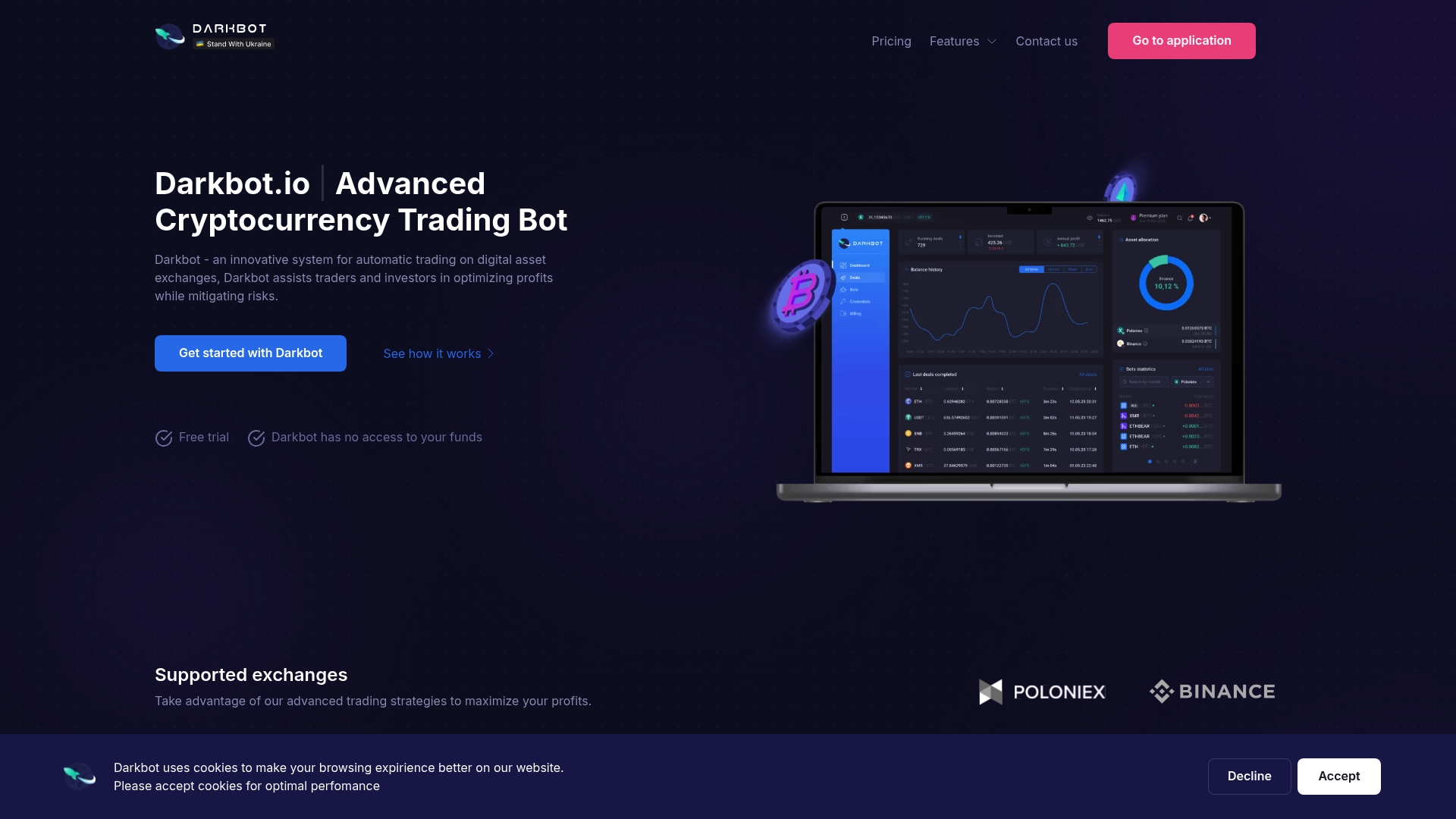
Darkbot gives beginners a structured way to test automation without upfront cost: a free plan for initial exploration, backtesting and paper trading built into the workflow, and risk controls including position limits and stop rules configurable before any strategy goes live. The platform supports API integration with major exchanges using trade-only permissions, and includes tiered support as accounts move from a free plan to the Standard or Premium subscriptions.
Beginner-relevant features include:
- An interface built around simple preset strategies rather than requiring code.
- Backtesting against historical data before any live deployment.
- Paper trading mode to validate a configuration with no capital at risk.
- Configurable risk limits, including position sizing and stop rules.
- A free plan alongside Standard and Premium subscription tiers for expanded features.
Darkbot suits someone who wants a managed, safety-oriented starting point rather than building infrastructure from scratch. The pricing page lists current plan details, including the free tier, so you can compare what each level includes before deciding whether to upgrade.
Sources
This article draws on the CFTC’s customer advisory on AI and algorithmic trading fraud, SEC enforcement reporting on fake AI trading platforms, an arXiv 2026 study on adaptive risk filters in autonomous trading, and research on on-chain and off-chain algorithmic trading design that informs the custody and transparency tradeoffs discussed above.
This article is general information, not a substitute for advice from a qualified financial advisor. Consult a qualified financial professional about your own circumstances before acting on anything here.
- CFTC customer advisory: AI and algorithmic trading scams (2024)
- Hour-aware adaptive risk management for autonomous memecoin trading (arXiv, 2026)
FAQ
Can I make $100 a day from crypto trading bots?
No bot can guarantee a specific daily return, and regulators including the CFTC have specifically warned against platforms that market guaranteed-return claims. Returns depend on market conditions, position sizing, and strategy design, and a beginner should validate any strategy through paper trading before expecting consistent results.
Which AI bot is best for trading as a beginner?
The right choice depends on your priorities: exchange-native bots offer the simplest setup, while hosted platforms like Darkbot add backtesting, paper trading, and configurable risk controls in one place. Beginners generally do best starting with a platform that includes paper trading and trade-only API key support before considering more advanced or self-hosted options.
Can ChatGPT build a trading bot?
A general-purpose language model can help generate code snippets or explain trading logic, but it cannot backtest, connect to exchange APIs securely, or manage live risk controls on its own. Building a functional, safe trading bot still requires a dedicated platform or development environment with proper API permission handling and testing tools.
What are the best bots for crypto trading?
There is no single best bot for every trader, since the right choice depends on technical comfort, desired control, and risk tolerance. Beginners are generally best served by exchange-native bots or hosted SaaS platforms such as Darkbot that include paper trading and trade-only API permissions, while more technical users may prefer self-hosted, open-source options for full control.
Recommended

Start trading on Darkbot with ease
Come and explore our crypto trading platform by connecting your free account!
Free plan available • No credit card required