Protect Your Crypto: 6 Checks to Choose the Best DCA Bots
For disciplined crypto accumulation, a reputable automated DCA platform beats manual buying almost every time. The best DCA bots combine flexible scheduling, safety orders, and paper trading so you can validate a strategy before risking capital. Start conservative: scope your API keys to trading only, run the plan in a simulated environment first, then fund it in stages.
TL;DR:
- The most important security step is to restrict API keys to trading only, avoid withdrawal permissions, and regularly rotate keys during deployment.
- Backtesting and paper trading are essential before going live to verify strategy reliability and ensure fill execution matches expectations.
- Automated DCA works best for disciplined, long-term accumulation and should be paired with careful safety order spacing and distinct risk management rules.
- Platforms supporting multiple exchanges, transparent fee structures, clear logs, and active support teams tend to be more trustworthy and reliable.
- Starting with free or staged testing before scaling up ensures signals of system stability, with gradual allocation reducing the risk of unexpected errors or losses.
What Are DCA Bots, and What Types Should You Know?
Dollar-cost averaging means buying a fixed amount of an asset on a set schedule, regardless of price, to smooth out volatility over time. A DCA bot automates that schedule so you don’t have to remember to buy every week or fight the urge to time the market.
Three logic types dominate the category. Time-based bots buy at fixed intervals, weekly or monthly, no matter what the price is doing. Price-based bots wait for a dip of a certain percentage before executing, layering in “safety orders” as the price falls further. Hybrid bots blend both, running a base schedule while adding opportunistic buys when volatility spikes.
Architecture matters as much as logic. Recent platform roundups show three distinct models competing for traders’ attention:
- Exchange-native DCA tools, built directly into an exchange’s interface, offering simplicity but limited customization and single-exchange coverage.
- Third-party SaaS bots, which connect to your exchange through an API and typically support multiple exchanges, richer risk controls, and backtesting.
- DIY bots, custom-coded scripts that give full control over logic but demand programming skill and ongoing maintenance.
Exchange-native tools suit a trader with one exchange and a simple weekly buy. SaaS platforms fit anyone managing several assets or exchanges who wants safety orders and stop-loss integration without writing code.
How Do You Choose the Right DCA Bot?
Picking among the best crypto DCA tools comes down to six evaluation axes, not marketing copy. Run every candidate through this checklist before connecting a live API key.
- Custody and API model. Confirm the bot trades through API keys you control on your exchange account, never a model where you transfer funds to the platform’s own wallet.
- Scheduling flexibility. Check whether you can set custom intervals, not just daily or weekly presets, and whether the platform supports both time-based and price-based triggers.
- Risk controls. Look for configurable safety orders, stop-loss thresholds, and take-profit rules that integrate with the DCA logic rather than running as a separate, conflicting system.
- Backtesting and paper trading. A platform that lets you simulate a strategy against historical data before going live is showing you it has nothing to hide.
- Observability and logging. You need a clear record of every order placed, filled, or canceled, with timestamps you can audit later for taxes or performance review.
- Pricing transparency. Compare subscription tiers against the number of simultaneous bots and exchanges you actually need, not the flashiest feature list.
Before funding an account, ask any vendor directly what API permissions their platform requests, whether they publish a change-notice policy for strategy updates, and what their service-level commitments look like during high-volatility periods. A vendor that answers vaguely or dodges the withdrawal permission question is a vendor to skip.
Watch for red flags that show up again and again in enforcement cases: promises of guaranteed returns, claims of FDIC-style insurance on crypto holdings, or pressure to move funds into an unfamiliar custodial wallet. The SEC’s litigation release against Nathan Fuller documents exactly this pattern: an AI trading bot marketed with false promises of guaranteed, rapid returns and misrepresented insurance claims. Any platform using that language belongs on your avoid list, not your shortlist.
Pro Tip: Ask a vendor to walk you through their paper-trading mode before you ask about pricing. If they can’t show you a simulated run in under five minutes, that tells you more than any feature comparison chart.
What Are the Best DCA Bot Settings to Start With?
The right DCA bot settings depend on your capital, time horizon, and how much volatility you can tolerate without touching the plan. Start by picking a cadence: weekly buys smooth out short-term swings better than monthly ones, but they also mean more transaction fees on some exchanges, so match frequency to your fee structure.
Safety orders need careful spacing. Cap the number of active safety orders. Unlimited orders on a sustained downtrend can commit far more capital than you intended.
Stop-loss and take-profit rules work best as a separate risk layer rather than baked directly into the DCA logic. Letting the DCA plan handle entries while a distinct risk manager enforces a maximum drawdown limit avoids the two systems issuing conflicting cancel orders at the worst possible moment.
Three configurations cover most use cases:
- Passive accumulator: weekly buys, no safety orders, wide take-profit target, minimal maintenance.
- Active dip buyer: base order plus 3 to 5 safety orders spaced 2 to 4% apart, moderate take-profit, active monitoring.
- Rebalancer: scheduled buys paired with periodic portfolio rebalancing to maintain target allocations across assets.
Before running any of these live, backtest against at least one full market cycle, then paper trade for two to four weeks to confirm fills match your expectations. Quicknode’s roundup notes that trailing entries, conditional triggers, and rebalancing are the advanced features separating serious platforms from basic scheduling tools. Note that automated DCA is generally built for disciplined, long-term accumulation rather than short-term profit hunting, so calibrate your expectations to that purpose before you set a single parameter.
What Security Risks Should You Watch For?
API key hardening is the single most important control you’ll set up. Never grant withdrawal permissions to any trading bot. Restrict keys to trading and read-only account access, apply IP whitelisting where your platform supports it, and rotate keys periodically rather than leaving the same credentials active indefinitely.

Operationally, treat every new configuration like an experiment before it’s a strategy. Replicate the plan in paper trading first, then run a micro-live pilot with a small fraction of your intended capital, and monitor fills and slippage for several weeks before scaling up. Unexpected cancellations or partial fills during that pilot window are your signal to pause and investigate, not to scale faster.
Regulatory scrutiny of AI trading claims has intensified. Beyond the Fuller case, the SEC has issued administrative orders against firms for misrepresenting how they used AI in performance marketing, reinforcing that verifiable, transparent claims are a regulatory expectation, not a nice-to-have.
Guaranteed returns, undisclosed strategy changes, and insurance-style claims on crypto holdings are the three clearest signals that a trading bot promoter is not operating in good faith. If a platform’s marketing sounds too confident about outcomes, treat that confidence itself as the red flag.
Validate any vendor’s security claims by checking whether they publish their permission requirements plainly, rather than burying them in support documentation you have to request.
How Darkbot Aligns With This Evaluation Checklist
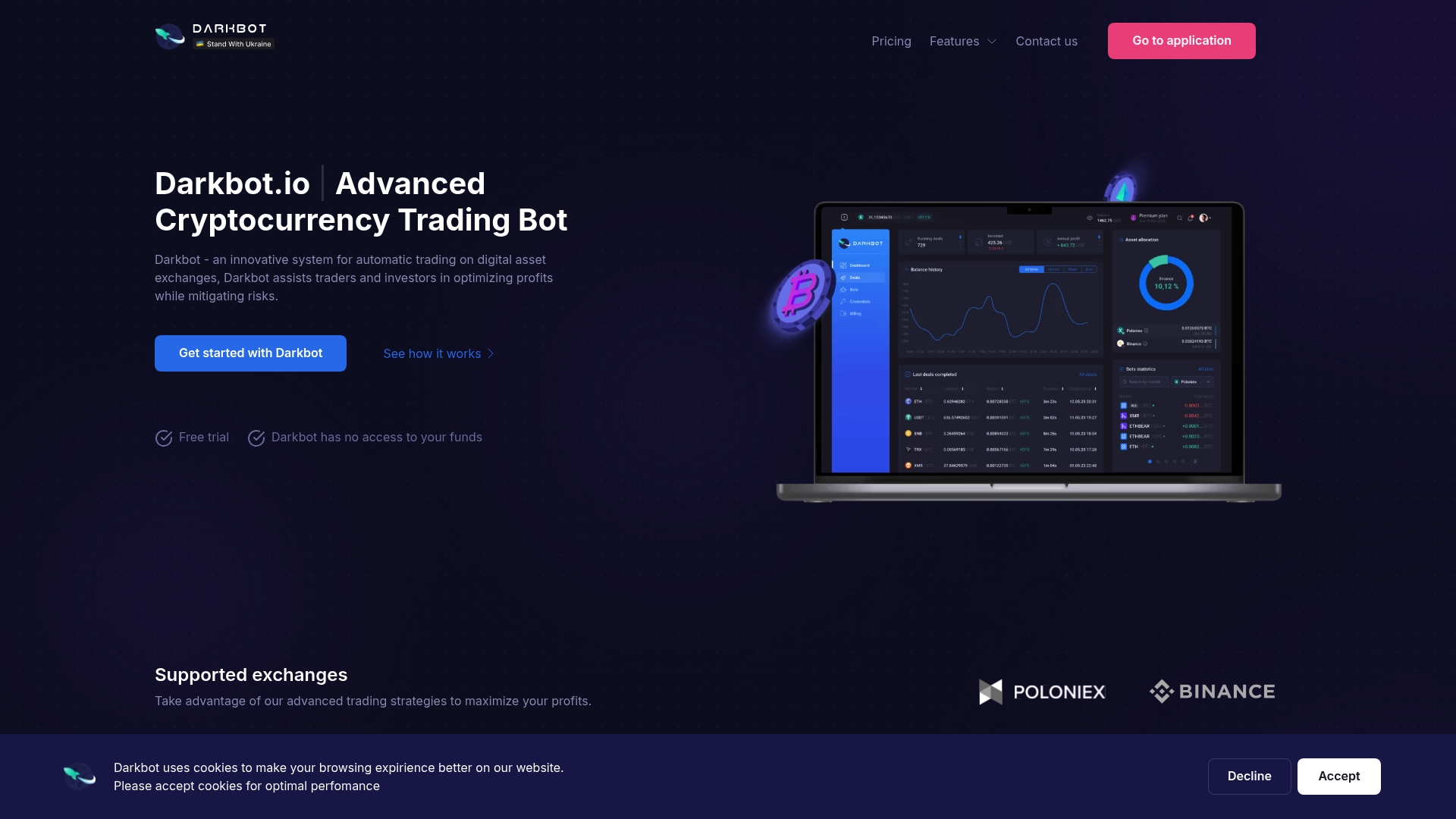
The platform connects to major exchanges through API integration, keeping custody on your exchange account. It supports customizable DCA strategies with configurable safety orders, backtesting, and paper trading so you can validate logic before committing capital.
Portfolio rebalancing and real-time analytics give you the observability layer the checklist above calls for: a record of what the system did and when. Security posture follows the same hardening principles outlined earlier, with API-based connections that never require withdrawal permissions.
For a staged rollout with Darkbot, the sequence looks like this:
- Start on a free tier to explore the interface and strategy builder without financial commitment.
- Connect your exchange with API keys scoped to trading only, never withdrawal.
- Run your configuration in paper-trading mode for at least two to four weeks.
- Move to a small live allocation on a standard or premium plan once fills and slippage match your paper-trading results.
This mirrors the systematic, rule-driven approach the rest of this guide recommends: verify first, scale gradually, and let logs, not confidence, tell you whether a strategy is working.
How Do Popular DCA Bots Compare on Performance and Reviews?
Comparing DCA bots on “performance” is trickier than it sounds, because DCA is a discipline tool, not a profit-maximizing strategy, so raw return figures across platforms often measure different things: different assets, different time windows, different market conditions. A bot that shows strong returns during a sustained bull run tells you little about how it behaves during a prolonged drawdown, which is the period DCA is actually designed to smooth.
User reviews across the platforms covered in Quicknode’s 2026 roundup tend to cluster around a few recurring themes rather than headline profit numbers: how reliably the bot executes fills during volatile stretches, how clear the fee structure is, and how responsive the platform is when an order behaves unexpectedly. Platforms that publish backtesting methodology and offer paper trading consistently score better on trust, independent of any specific return claim.
The more useful comparison axis is process quality: does the platform log every order with timestamps you can audit, does it separate safety-order logic from stop-loss logic cleanly, and does it degrade gracefully during exchange outages or API rate limits? Those operational details predict long-term reliability far better than a screenshot of one good month. Treat any platform advertising specific historical percentage returns with skepticism, since past performance under one market regime rarely holds under another.
What Exchanges and Wallets Do DCA Bots Support?
Integration breadth determines how much of your portfolio a single bot can actually manage. Most third-party SaaS platforms connect to major exchanges through read-and-trade API keys, letting you run one strategy across several exchanges from a single dashboard rather than juggling separate exchange-native tools.
Coverage varies meaningfully between platforms, so check the specific exchange list before committing to a subscription tier, especially if you hold assets on a less common exchange. Some bots also support wallet-level tracking for portfolio visibility, though the actual trade execution still routes through exchange APIs rather than directly from a self-custody wallet, since most exchanges don’t expose trading permissions to external wallets.
Network and settlement costs matter here too. If your DCA plan involves regularly moving funds between exchanges or off-ramping to a wallet, transaction fees on the settlement network can erode small, frequent purchases faster than traders expect. On networks like TRON, fee-reduction techniques for TRC-20 transfers can meaningfully cut the cost of moving stablecoins between platforms, which matters more the smaller and more frequent your individual DCA tranches are.
Before connecting any bot, confirm exactly which exchanges it supports natively versus which require a workaround, and check whether adding exchanges later requires a plan upgrade. A platform that only supports one or two exchanges limits your ability to diversify custody, which matters if you’re running larger allocations.

How Good Is Customer Support Across DCA Platforms?
Support quality separates platforms that survive a volatile week from ones that leave you stranded when an order misfires. Look for a support channel that responds during active market hours, not just a ticket queue with a multi-day turnaround, since a stuck order or an unexpected cancellation needs an answer within hours, not days.
Community engagement tells you something a sales page won’t. Active user communities, whether through a forum, Discord, or public changelog, surface real configuration problems and fixes faster than official support tickets do. A platform with a visible, active community and transparent changelog usually indicates a team that treats bugs and strategy issues as ongoing engineering work rather than something to quietly patch and not disclose.
Personalized support, where a platform assigns a contact or offers guided onboarding rather than generic help articles, matters most in the first few weeks of running a new strategy, when you’re most likely to misconfigure a safety-order budget or misunderstand a fee schedule. Check whether a platform’s support tier changes with your subscription level, since some vendors gate faster response times behind higher-priced plans.
What Tax Implications Come With Automated DCA?
Every DCA bot purchase is a taxable event in most jurisdictions, the same as if you’d manually clicked “buy” yourself. Automation doesn’t change the tax treatment. It just increases the volume of individual transactions you need to track, since a weekly DCA schedule running for a year generates 52 separate cost-basis entries instead of one.
Detailed order logs become essential here, not optional. A platform that timestamps every fill with the exact price and quantity gives you the raw data needed for cost-basis calculations, whether you’re using first-in-first-out accounting or another method your jurisdiction requires. Rebalancing trades add another layer of complexity, since swapping one asset for another inside a rebalancing bot typically triggers a disposal event on the asset you sold, separate from the new purchase.
Tax rules around crypto vary significantly by country and even by asset type, so treat any general explanation as a starting point, not a substitute for a tax professional familiar with your jurisdiction’s specific reporting requirements. Keep exportable transaction histories from any bot you run. Reconstructing a year of automated trades from memory, or from an exchange’s own limited history window, is far harder than exporting clean records as you go.
When Should You Automate Your DCA Strategy?
Automation earns its place when the job is repetitive and emotion is the enemy: recurring buys, scheduled rebalancing, disciplined entries during volatility nobody wants to trade by hand. A bot doesn’t get anxious watching a 15% drawdown, which is exactly why it’s often better than you at executing the plan you already agreed with yourself was correct.
It’s not a replacement for judgment everywhere. Event-driven decisions, a project announcing a major protocol change, a concentrated position you’re actively managing around a specific catalyst, still call for a human making a deliberate, informed call. Automation works best as one instrument in a diversified approach, not the entire orchestra.
— Grisha
Start With Darkbot’s Free Tier and Scale With Confidence
Darkbot gives you a structured path to test automated DCA without committing capital upfront, which matters more than any feature list once you’ve read through the red flags above. The Free tier lets you build and paper-trade a strategy before connecting a live exchange account, so you can validate fills and safety-order behavior with zero financial exposure.
When you’re ready to connect a real exchange, scope your API keys to trading permissions only, never withdrawal, and run a small pilot allocation before scaling. The Standard Plan and Premium Plan add multiple simultaneous bots, deeper backtesting, and portfolio rebalancing once your paper-traded strategy performs the way you expected. Every subscription carries a 14-day money-back guarantee, giving you room to test the platform against your own criteria before committing further. Review the full pricing breakdown and set up your first paper-traded DCA configuration today.
Sources
- Top 9 Crypto DCA Bots in 2026 | Quicknode
- SEC enforcement release: Nathan Fuller case
- Python trading bot: automate trades (CoinGecko Learn)
FAQ
What Is the Most Successful AI Trading Bot?
There’s no single bot that qualifies as universally “most successful,” since performance depends heavily on the strategy, market conditions, and risk settings applied. What separates reliable platforms from risky ones is transparency: published backtesting methodology, available paper trading, and clear API permission requirements consistently rank as the strongest trust signals across platform roundups.
Which Crypto Bots Are the Most Profitable?
Profitability claims for any specific bot should be treated with caution, since past returns under one market regime rarely predict future performance in a different one. Automated DCA bots, including Darkbot, are generally positioned as discipline and risk-management tools for long-term accumulation rather than short-term profit engines.
Is DCA a Good Crypto Strategy?
Dollar-cost averaging is widely regarded as a sound approach for reducing the impact of volatility on long-term accumulation, since it removes the need to time entries. It works best paired with clear risk controls like safety-order budgets and separate stop-loss rules, rather than as a standalone bet on short-term price movement.
Can ChatGPT Build a Trading Bot?
A large language model can help generate code for a basic trading bot, similar to the approach outlined in educational tutorials on building Python-based bots. The output still needs rigorous paper trading and staged testing before live deployment, since AI-generated code carries the same execution and logic risks as any custom script.
What Does Darkbot Cost?
Darkbot offers a Free tier alongside a Standard Plan at $12.50 per month and a Premium Plan at $25.00 per month, with an Enterprise option available on request. All paid plans include a 14-day money-back guarantee.
Recommended

Start trading on Darkbot with ease
Come and explore our crypto trading platform by connecting your free account!
Free plan available • No credit card required