AI Algorithms in Crypto Market: 2026 Trader's Guide
TL;DR:
- AI in crypto trading evaluates patterns at scale, manages risk without emotion, and offers transparency through blockchain integration. It processes diverse data rapidly, improving prediction accuracy and reducing drawdowns, but still requires human oversight to handle unexpected market shifts. Systematic, disciplined application of AI tools enhances trading robustness and operational efficiency in complex crypto environments.
Most traders come to AI expecting a crystal ball. What they find instead is something more useful: a system that evaluates patterns at scale, executes without hesitation, and manages risk without emotion. AI algorithms in crypto market environments don’t predict the future. They process more variables, faster, than any human trader can, and they apply consistent rules regardless of market conditions. This guide breaks down exactly how these algorithms work, how they connect with blockchain infrastructure, and how you can use them systematically rather than speculatively.
Key Takeaways
| Point | Details |
|---|---|
| AI as pattern evaluator | AI algorithms assess probabilities across thousands of data points, not price predictions. |
| Blockchain and AI integration | On-chain AI decision records create auditable, compliant, and transparent automated trading. |
| Risk management core use | AI continuously sizes positions and detects anomalies more reliably than manual monitoring. |
| Multi-asset correlation edge | Cross-asset data improves prediction accuracy by approximately 22% and reduces drawdowns by 31%. |
| Human oversight still required | Automated systems need human-in-the-loop controls to handle unexpected market regime shifts safely. |
How AI algorithms in crypto market trading actually work
The global crypto trading bot market reached approximately $54 billion in 2026, with automated bots responsible for roughly 65% of total trading volume. That statistic reflects how thoroughly algorithmic execution has replaced discretionary order placement at scale. But understanding what these algorithms actually do requires looking past the surface.
At the foundational level, AI trading systems in crypto rely on several distinct model types. Supervised learning models train on labeled historical data, learning to associate input conditions with outcome classes. Classification models determine whether a market is trending or ranging. Regression models estimate the magnitude of expected moves. Unsupervised learning models identify structural clusters in order flow without any predefined labels, which makes them useful for detecting regime changes before they become obvious on price charts.
The more sophisticated architectures used in crypto today include Long Short-Term Memory networks (LSTMs) and Gated Recurrent Units (GRUs). Both handle sequential time-series data well, retaining relevant context across hundreds of prior time steps. This matters in crypto because price action at 3:00 AM often has measurable influence on volatility at 9:00 AM, and traditional statistical models miss that relationship entirely.
What separates high-performing systems from basic rule-based bots is the data they consume. These models analyze:
- Raw price and volume data across multiple timeframes
- Order book depth, bid-ask spread dynamics, and liquidity concentration
- On-chain metrics like active addresses, exchange inflows, and miner behavior
- Social sentiment extracted from news feeds and public communication channels
- Cross-asset correlations with equities, commodities, and macro indicators
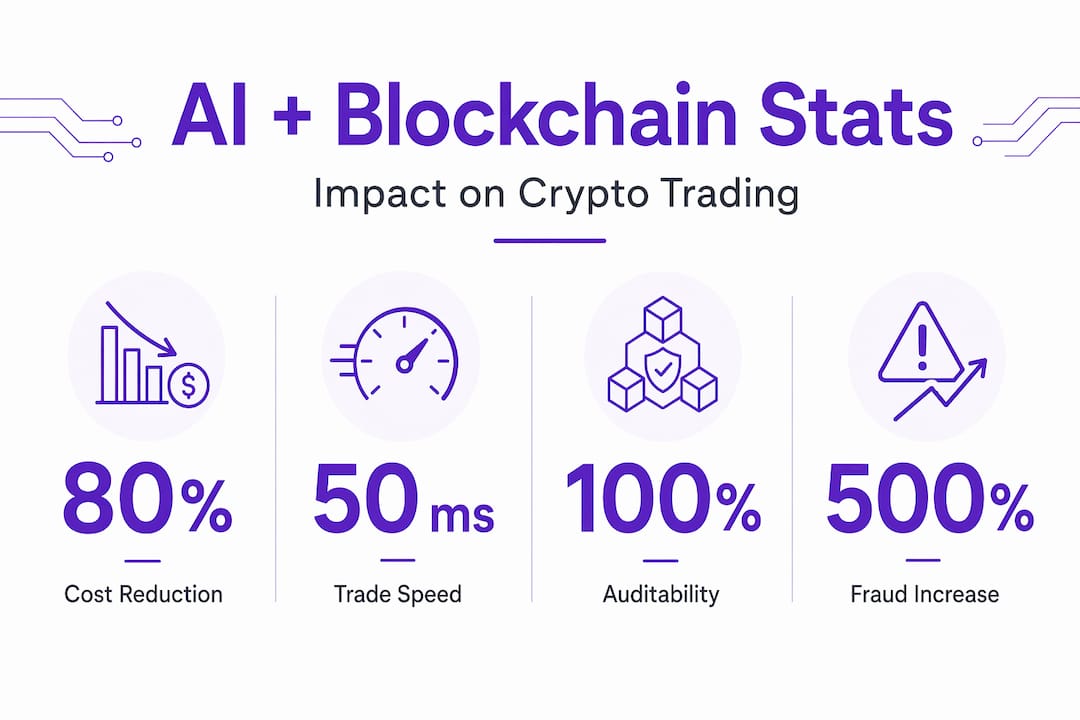
Advanced machine learning systems can process up to 400,000 data points per second with execution speeds under 50 milliseconds, achieving prediction accuracies between 52.9% and 54.1% across standard conditions, and up to 59.5% on high-confidence trade setups. Those accuracy numbers are modest by design. The edge in systematic trading comes from consistency across thousands of trades, not from any single spectacular call.
One insight worth internalizing: microstructure-focused AI models that identify liquidity holes and slippage points consistently outperform models built purely to predict price direction. The market microstructure layer contains real information. Price direction alone is noise most of the time.

Pro Tip: When evaluating an AI trading system, ask which data inputs it uses beyond OHLCV. Systems that incorporate order book depth and on-chain data typically produce more durable signals than those relying on candlestick patterns alone.
Blockchain and AI integration for trust and compliance
AI and blockchain solve fundamentally different problems, which is exactly why their combination creates something neither can achieve alone. AI processes data and generates decisions. Blockchain records those decisions immutably and makes them verifiable by any authorized party. For crypto traders operating under increasing regulatory scrutiny, that combination is not a nice-to-have. It is becoming structural.
The auditability challenge in AI trading is real. When an algorithm places a trade, the reasoning that produced that decision typically lives inside a model that regulators cannot inspect directly. Blockchain solves this by writing decision provenance onto an immutable ledger. Smart contracts then automate execution only when predefined conditions are met, creating a verifiable chain from signal to settlement. This architecture directly supports the transparency demands of frameworks like MiCA in the EU and evolving AI-specific regulations.
| Feature | AI alone | AI with blockchain |
|---|---|---|
| Decision auditability | Limited, model-internal | Immutable on-chain record |
| Regulatory compliance | Manual reporting | Automated, multi-jurisdictional |
| Execution integrity | Dependent on centralized logs | Smart contract enforced |
| Cost efficiency | Varies | Up to 80% cost reduction |
Combining AI and blockchain in tokenized asset management enables up to 80% reduction in operational costs and supports ex-ante compliance checks across regulatory jurisdictions simultaneously. Standards like ERC-3643 allow tokenized securities to embed identity data and jurisdiction-specific rules directly into the asset, so multi-jurisdictional compliance executes automatically rather than through manual review.
Pro Tip: If you run automated strategies at any meaningful scale, look specifically for platforms that maintain on-chain or immutable logs of trade decisions. This becomes significant if you are ever subject to regulatory inquiry or fund audits.
For more on how machine learning shapes crypto automation, the architecture covered in this section connects directly to how modern trading bots are structured internally.
AI in risk management and fraud detection
Risk management is where AI delivers its clearest operational value in crypto. Markets move fast. Position sizing decisions that take a human 30 seconds to calculate can be executed by an AI model in milliseconds, continuously recalibrated as new data arrives. Techniques like Hierarchical Risk Parity let algorithms distribute exposure across assets based on their realized volatility and correlation structure rather than arbitrary allocation rules. The result is a portfolio that adjusts its own risk weighting dynamically, without waiting for a scheduled review.
The fraud detection dimension is more complicated. AI-enabled crypto scam activity has increased by roughly 500% over the past year, driven by generative AI automating phishing, deepfake impersonation, and laundering operations. The same technology that powers legitimate trading automation is being used offensively. That creates a dual reality where AI both introduces and defends against new threat vectors.
Defensive AI in blockchain intelligence platforms flags anomalous transaction patterns, unusual wallet clustering, and suspicious on-chain behavior in real time. For institutional traders and serious retail investors, monitoring these signals through digital asset risk monitoring tools is as important as monitoring price action itself.
On the operational side, the risks of over-automation deserve honest attention:
- Automated systems can amplify losses during market regime changes if override controls are insufficient
- Model degradation occurs silently when market structure shifts and past training data becomes less representative
- Flash crash conditions can trigger cascading liquidations in purely rule-driven systems without circuit breakers
- Correlated bot behavior across exchanges can create synthetic volatility that harms all participants
Operational resilience requires human oversight and redundant controls precisely because automated trading can accelerate losses rapidly during regime changes. AI manages normal conditions well. Humans need to manage the exceptions. Building enterprise-grade risk oversight into any automated strategy is not optional for traders who treat this as a serious operation.
Practical ways traders can use AI algorithms systematically
The impact of AI on crypto investing is best realized through disciplined, systematic application rather than through chasing any single model’s output. Here is a structured approach for putting these tools to work:
- Build with multi-asset correlation data. Strategies that incorporate correlations between crypto, equities, and commodities improve prediction accuracy by approximately 22% and reduce drawdowns by around 31% compared to crypto-only models. Feeding your AI system a richer data diet produces more durable signals.
- Backtest across distinct market regimes, not just recent history. A strategy that performs well in a trending bull market often fails badly in choppy, low-volume conditions. Testing across 2018, 2020, 2022, and 2024 market structures gives you a more honest picture of model robustness.
- Use deep neural network models for return estimation. Deep neural network surrogate models achieve mean prediction accuracy of 68% for asset returns, outperforming traditional time series models by 17%. This makes them appropriate as a layer in a broader signal stack, not as a standalone oracle.
- Define rule-based entry and exit criteria before deployment. Emotion enters the process the moment rules become flexible. Commit to position sizing limits, drawdown thresholds, and stop conditions in writing before any system goes live.
- Monitor model drift continuously. Set up alerts for when your system’s live performance diverges significantly from its backtest profile. That divergence is usually the first signal that market conditions have shifted beyond the model’s training data.
Pro Tip: Treat backtesting as a stress test, not a sales pitch. A model that survives simulated drawdowns of 40% or more and still produces positive expectancy is more trustworthy than one that shows smooth equity curves over cherry-picked time periods.
For more on structuring AI-driven trading frameworks with disciplined risk controls, the principles above translate directly into how systematic bots should be configured.
My take on what AI actually changes in crypto trading
I’ve spent enough time watching traders interact with AI systems to see a consistent pattern: people adopt AI expecting to remove uncertainty from trading, and then feel betrayed when uncertainty remains. That expectation is the problem, not the technology.
What AI genuinely changes is the quality of your process. It removes the latency between signal and execution. It holds your rules when you won’t. It evaluates ten assets simultaneously without fatigue. Those are structural advantages that compound over time in ways that emotional, discretionary trading cannot replicate consistently.
What AI does not change is the fundamental nature of markets. Crypto markets remain reflexive, driven by narrative cycles, liquidity conditions, and macro forces that no model trained on historical data fully captures. The question of whether AI can predict cryptocurrency trends reliably still has the same honest answer: no. It can identify high-probability conditions faster than humans. That is categorically different from prediction.
In my view, the most underappreciated development in this space is the convergence of deep learning in financial markets with blockchain’s auditability layer. The future of credible, institutional-grade crypto trading infrastructure runs on systems where every AI decision is traceable, every compliance requirement is embedded at the asset level, and every risk parameter is enforced by code rather than policy. That architecture is already being built. The traders who understand it structurally, rather than just using it as a black box, will be the ones with durable advantages.
The hard part is not adopting AI. It is building the discipline and operational structure around it that makes AI worth having.
— Grisha
Put AI to work in your trading with Darkbot
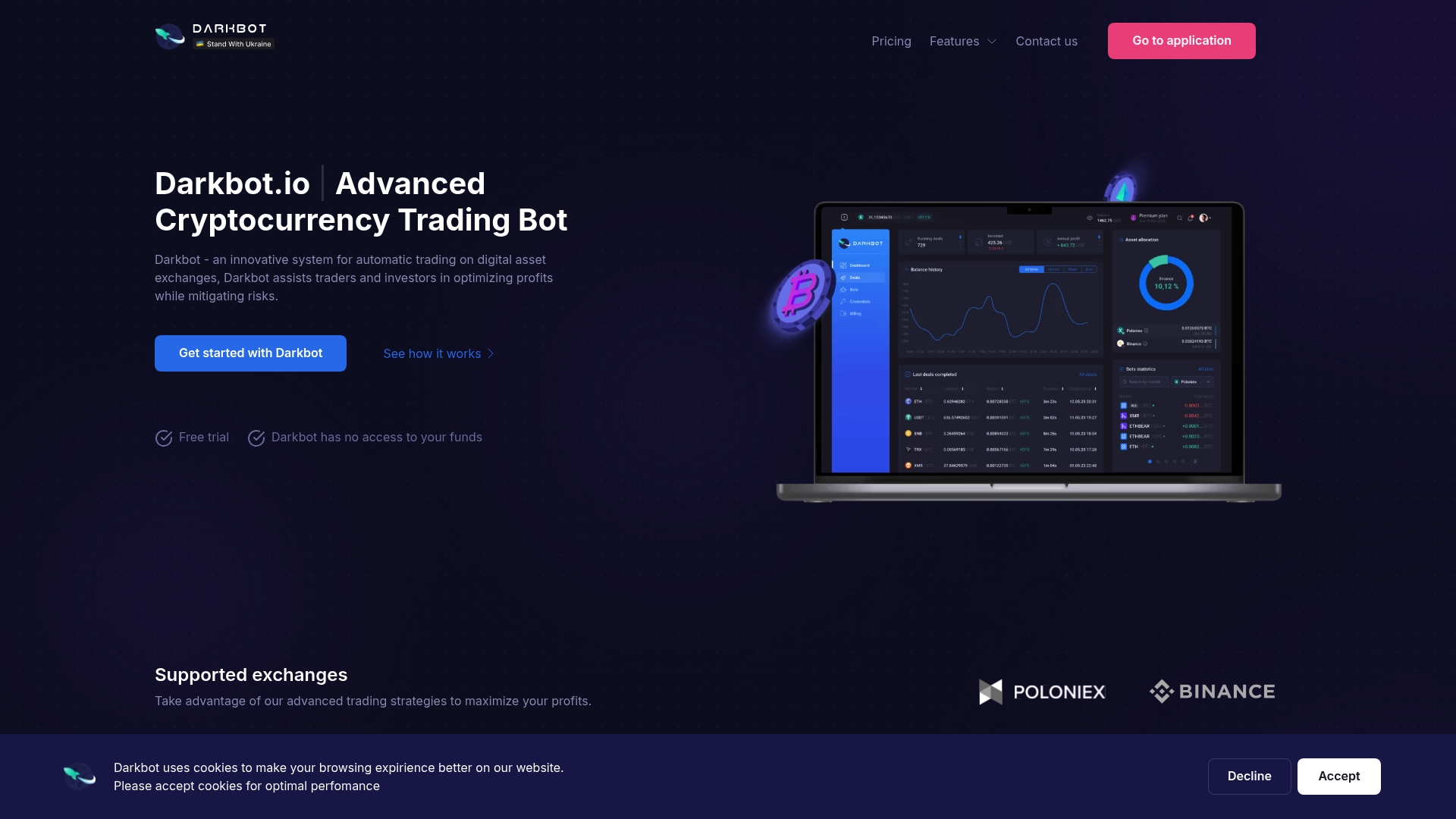
Darkbot is built around the principles this guide covers: systematic execution, rule-based risk controls, and repeatable logic that holds under pressure. The platform’s adaptive AI trading engine supports multiple simultaneous bots across major exchanges, with strategy customization, automated portfolio rebalancing, and real-time analytics that give you full visibility into how your rules are performing. Darkbot’s multi-layered risk management framework enforces position sizing and drawdown limits automatically, so the discipline you set in advance stays in place when markets move fast. If you want to put portfolio management tools behind a structured AI system rather than managing exposure manually, Darkbot’s platform is designed for exactly that workflow.
FAQ
What do AI algorithms actually do in crypto trading?
AI algorithms process large volumes of price, volume, order book, and sentiment data to identify statistical patterns and generate trade signals. They execute rule-based decisions faster and more consistently than manual trading.
Can AI predict cryptocurrency trends reliably?
No. AI models identify high-probability conditions based on historical patterns, but crypto markets are affected by narrative shifts and macro events that training data does not fully capture. Prediction accuracy in leading systems typically ranges from 52% to 59.5%.
How does blockchain and AI integration improve trading transparency?
Blockchain records AI trading decisions as immutable on-chain logs, making them verifiable and auditable. This supports regulatory compliance and removes the opacity that normally surrounds automated decision-making.
What is the biggest risk of using AI in automated crypto trading?
The largest operational risk is model failure during unexpected market regime changes. Without human oversight and circuit breaker controls, automated systems can accelerate losses faster than any manual intervention can contain.
How does multi-asset data improve AI trading performance?
Incorporating cross-asset correlations between crypto, equities, and commodities improves AI prediction accuracy by approximately 22% and reduces portfolio drawdowns by around 31% compared to models using only crypto data.
Recommended

Start trading on Darkbot with ease
Come and explore our crypto trading platform by connecting your free account!
Free plan available • No credit card required