Start Free: Best Grid Trading Bots for Crypto Traders in 2026

Darkbot stands out as the strongest overall pick for traders who want configurable strategies, backtesting, and structured risk control in one platform. Pionex and the exchange-native bots on Binance and OKX suit traders who want minimal setup, while Bitsgap and 3Commas fit those managing positions across several exchanges at once. The right choice depends on how much control you want over grid parameters versus how quickly you want to get running.
TL;DR:
- Darkbot offers advanced customization, backtesting, and risk controls, making it suitable for systematic traders managing multiple strategies across exchanges.
- Exchange-native bots like KuCoin, Bybit, and Gate.io provide quick setup and built-in liquidity but limited configuration options, ideal for beginners.
- Proper API permission setup, including restricted trading rights and no withdrawal access, is crucial for security before connecting any bot.
- Running paper trading and small live tests helps ensure strategy stability and matches expected performance before deploying larger capital.
- Market conditions heavily influence grid bot success, requiring disciplined configuration and regular monitoring to avoid directional risks and drawdowns.
What Are the Best Grid Trading Bots Right Now?
Grid trading bots place a series of buy and sell orders at fixed intervals across a price range, aiming to capture small, repeated profits as an asset oscillates between those levels. That mechanic works best in sideways or choppy markets, and it’s the reason grid bots have become a standard tool for systematic crypto traders rather than a niche feature.
The field breaks into three groups: standalone platforms with deep configuration options, exchange-native bots built directly into a trading venue, and multi-exchange terminals designed for traders juggling several accounts. Here’s how the major names in each group stack up.
Darkbot is an AI-based automation platform built for traders who want more than a basic grid template. It combines API exchange integration, customizable strategy parameters, backtesting, and paper trading with automated rebalancing and real-time analytics. Pricing runs on a tiered subscription model rather than a flat fee, which matters for traders who want to scale usage over time.
Pionex runs its bots natively on its own exchange, so setup is close to instant, since there’s no separate API connection to manage. It suits traders who want a grid bot without configuring external permissions, though the tradeoff is that strategy customization stays limited to what the exchange interface exposes.
3Commas is a cloud-based automation platform that connects to multiple exchanges and offers template strategies through a marketplace. It fits traders who want a starting point they can copy and adjust rather than building a grid from scratch.
Bitsgap manages positions across several exchanges from one dashboard and adds arbitrage tools alongside its grid functionality. Traders who spread capital across venues get a unified view instead of switching between exchange tabs.
Cryptohopper leans on a strategy marketplace and template-based deployment, which lowers the learning curve for traders who want to activate a proven configuration quickly rather than tune every parameter themselves.
KuCoin Trading Bot, Bybit Trading Bot, and Gate.io Trading Bot are each built into their respective exchanges. All three offer grid and DCA options with essentially zero setup friction, since the bot draws on the exchange’s own liquidity and account permissions directly.
Binance offers native grid bots plus a developer API broad enough to support third-party platforms, making it a common backend for traders who prioritize liquidity and pair availability above all else. OKX follows a similar pattern, with native bot tools and API access for external integrations.
Quad Terminal takes a different shape entirely: it’s an independent, multi-exchange terminal built for traders managing several accounts through one unified workflow, rather than a single-exchange bot.
How Should You Compare Grid Trading Bots?
Six criteria separate a bot that fits your trading style from one that creates more work than it saves.
- Pricing model. Subscription tiers versus exchange-bundled free access changes the math depending on how many bots you plan to run simultaneously.
- Exchange and API support. A bot tied to one exchange limits you to that venue’s liquidity; multi-exchange platforms trade that simplicity for broader reach.
- Ease of setup and interface clarity. Exchange-native bots win here, since account permissions are already in place. Standalone platforms require an API connection step first.
- Risk controls. Stop-loss triggers, auto-disable rules, and drawdown limits determine what happens when a market breaks out of its range instead of staying inside it.
- Order execution reliability. Latency and order routing quality affect whether your grid actually fills at the levels you set.
A low-touch trader running one strategy on one exchange values setup speed above all else. A systematic trader running several grids across markets weighs backtesting depth and risk controls more heavily, since the cost of an untested parameter compounds across more capital.
- Check whether the platform requests withdrawal permissions on its API key. It should never need them.
- Confirm a stop-loss or max-drawdown setting exists and can be set before you fund the bot.
- Test with paper trading or a small live allocation before committing full capital.
- Review how the platform documents its own risk management practices before trusting it with API access.
Pro Tip: When generating an API key for any bot, restrict it to trade-only permissions and disable withdrawals entirely. This single setting is the difference between a compromised key costing you a bad trade and one draining your account.
How Do You Set Up a Grid Bot Safely?
Moving from selection to execution follows a consistent sequence regardless of which platform you choose.
- Create an API key with limited scope. Enable trading permissions only, disable withdrawals, and restrict by IP address if the exchange supports it.
- Run paper trading first. Simulate the strategy against live price feeds before risking capital, following the same step-by-step approach Darkbot documents for connecting bots to exchange accounts.
- Set your grid range and grid count. Define the upper and lower price bounds and how many orders fill that range.
- Size your orders relative to allocated capital, not your full account balance.
- Enable risk controls, including a max-drawdown limit and an auto-stop condition.
- Monitor early runs closely, then extend the check-in interval once behavior matches expectations.
An aggressive configuration might span 30% or more with fewer, larger orders. These are starting points for testing, not settings to copy blindly into a live account.
Where Does Darkbot Fit for Grid Trading?
Darkbot combines the pieces that matter most for systematic execution: API exchange integration, strategy customization, backtesting, paper trading, automated rebalancing, and real-time analytics in a single interface. That combination maps directly onto the comparison criteria above, since backtesting and risk controls are exactly what separates a durable configuration from one that only looks good on a chart in hindsight.
On setup and security, Darkbot follows the same permission-scoping principle every serious platform should: trade-only API access, no withdrawal rights, and direct order routing designed to reduce points of failure between decision and execution. The platform’s plan structure spans Free, Standard, Premium, and Enterprise, which lets a trader start with limited features at no cost and move up as strategy complexity grows.
Traders new to automation should start on the free tier and lean on paper trading before allocating real capital. That sequence lets you confirm a grid configuration behaves as expected under current market conditions before it touches actual funds.
How Were These Grid Trading Bots Evaluated?
The products above were assessed against the same six dimensions used throughout this article: pricing structure, exchange and API coverage, setup friction, backtesting and paper trading availability, risk control depth, and execution reliability. This mirrors the evaluation approach used in independent grid bot roundups, which weigh configurability and risk safeguards over marketing claims.
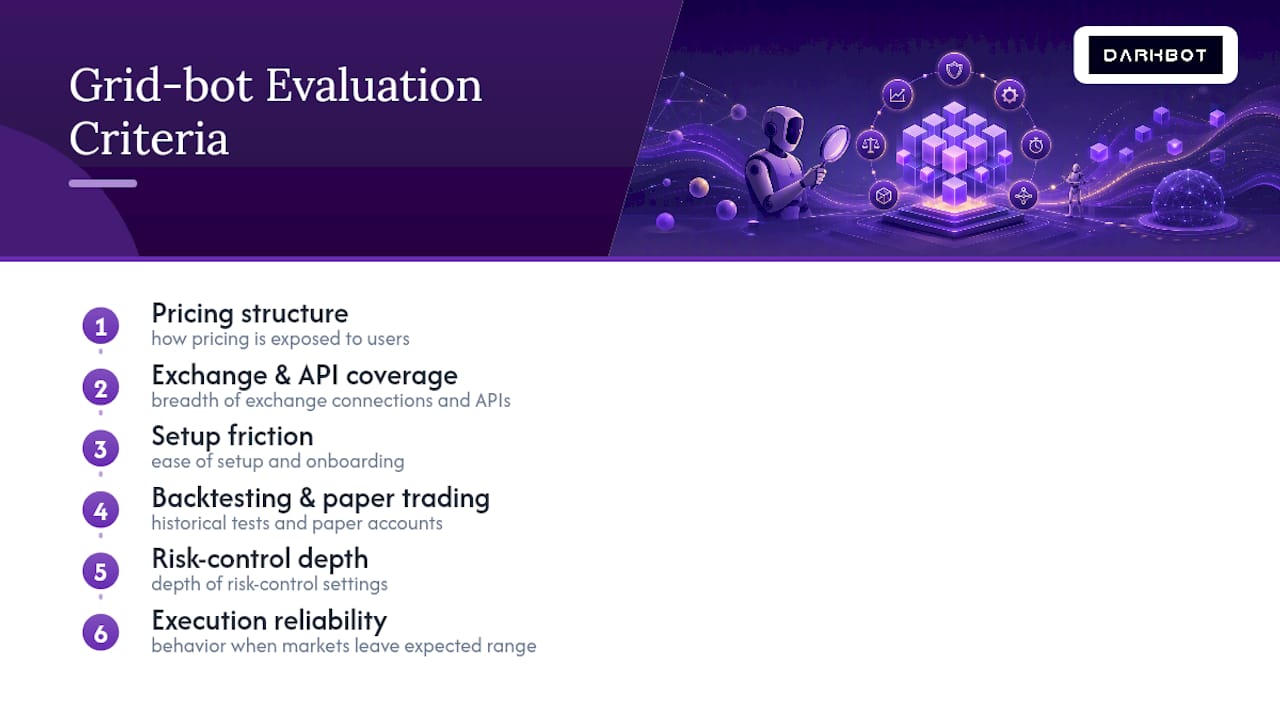
No platform was scored on hypothetical returns or backtested profit figures, since past grid performance in one market condition says little about how the same configuration behaves once volatility or trend direction shifts. Instead, the comparison looked at what each platform actually exposes to the user: which parameters can be adjusted, whether a strategy can be tested against historical data before going live, and what happens automatically if a market moves outside the expected range.
Exchange-native bots were evaluated on how much configuration the host exchange actually exposes versus how much sits fixed. Standalone platforms were evaluated on the breadth of exchange connections and the depth of their risk-control settings. This approach favors transparency over vendor claims, since a feature that isn’t documented or testable in a paper account isn’t a feature a trader can rely on.
What Do Performance Metrics Actually Tell You?
A grid bot’s performance depends on the market regime it runs in, not just its settings. In a range-bound market, a well-configured grid captures repeated small profits as price oscillates between levels. In a strongly trending market, the same grid can accumulate one-sided exposure as price moves outside its range in a single direction, which is a structural risk of the strategy itself rather than a flaw in any specific bot.
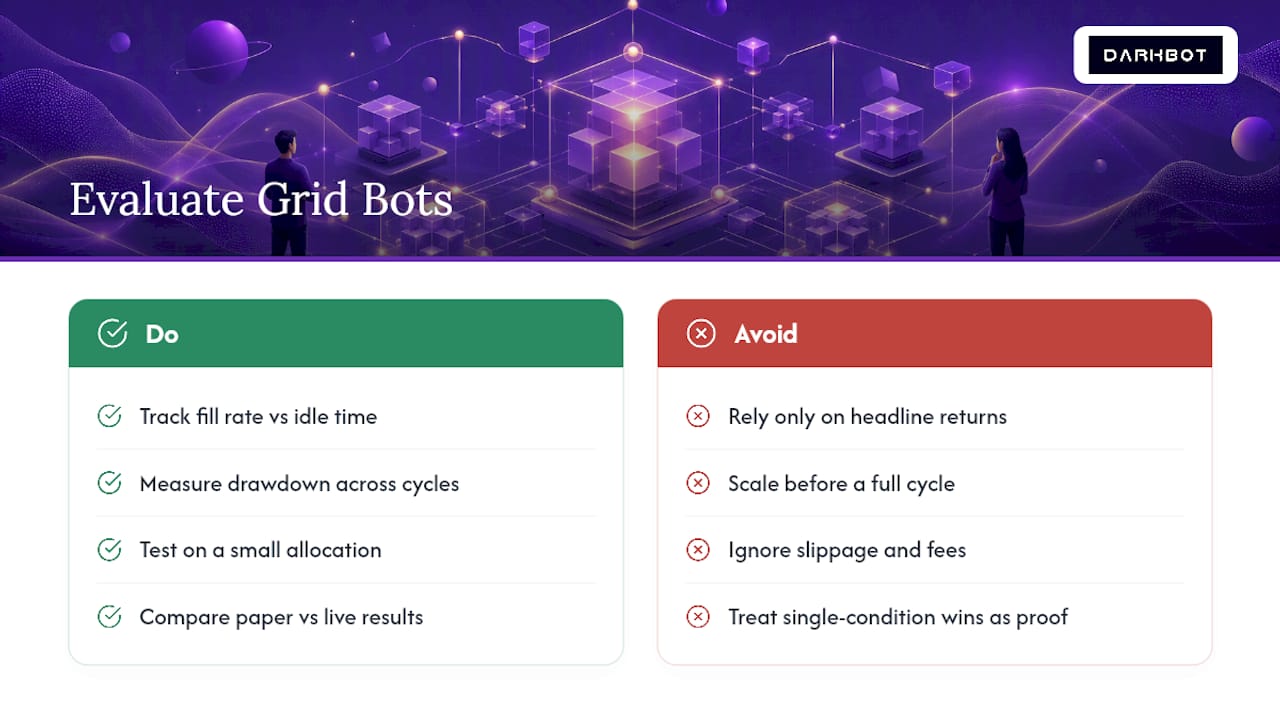
That’s why the useful performance metrics for grid trading aren’t headline return figures. They’re process metrics: how often orders filled versus how often the grid sat idle outside its range, how quickly a stop-loss or auto-disable rule triggered when conditions changed, and how closely a paper-traded result matched live execution once slippage and fees entered the picture.
A realistic way to evaluate any bot before scaling capital is to run it on a small allocation across at least one full market cycle, sideways and trending, then compare fill rates and drawdown against the paper-traded expectation. Consistency between paper and live results is a stronger signal than any single profitable run, since a strategy that only works in one narrow condition isn’t a strategy, it’s a coincidence.
What Security and API Permission Concerns Should You Watch?
Every grid bot connects to your exchange account through an API key, and that connection is the single largest security decision in the entire setup. The standard safeguard is generating a key scoped to trading only, with withdrawal permissions disabled at the exchange level, not just at the bot’s settings screen.
IP whitelisting adds a second layer where the exchange supports it, restricting the key to function only when called from a known server address. This matters more for standalone platforms connecting to multiple exchanges than for exchange-native bots, which never need to expose credentials outside the exchange’s own systems in the first place.
Order routing quality is a related but separate concern. A bot that routes orders directly to the exchange with minimal intermediary steps reduces the surface area for execution errors or delays. Before connecting any bot to a funded account, confirm exactly what permissions the API key request includes, and reject any platform that asks for more access than trading requires.
What Pitfalls Trip Up New Grid Bot Users?
The most common mistake is setting a grid range based on recent price action without accounting for the possibility of a breakout. A grid built around a coin’s last two weeks of sideways movement can leave a trader holding an increasingly lopsided position the moment that pattern breaks.
A second pitfall is oversizing orders relative to allocated capital, which turns a strategy meant to spread risk across many small trades into a concentrated bet on a handful of fills. A third is skipping backtesting and paper trading entirely, treating a bot’s default settings as safe simply because they’re the default.
Ignoring drawdown limits ranks among the costliest errors, since a grid without an auto-stop condition keeps buying into a decline with no mechanism to halt itself. Finally, granting a bot excessive API permissions, particularly withdrawal access, turns a strategy risk into a security risk that has nothing to do with market conditions at all. Each of these is avoidable with the setup checklist covered earlier in this article.
What Do Users and Communities Say About Grid Bots?
Trader communities on forums and social platforms tend to converge on a consistent theme: grid bots reward patience and proper configuration more than they reward chasing the newest platform. Feedback across these communities generally separates into two camps, traders who value exchange-native bots for their simplicity and traders who prefer standalone platforms for their configuration depth and backtesting tools.
Common praise for exchange-native options like those on Binance, OKX, KuCoin, Bybit, and Gate.io centers on low friction, since there’s no separate account to link or API key to manage. Common praise for standalone platforms centers on the ability to test a strategy against historical data before risking capital, a feature many traders say they wish they’d used earlier in their automation experience.
Recurring criticism across both categories points to the same root cause: bots configured with grid ranges too narrow for the asset’s actual volatility, which leads to grids that either fill too fast or sit dormant. That pattern reinforces a point raised earlier in this article: the platform matters less than the discipline applied to setting it up.
How Do Support and Update Frequency Compare?
Exchange-native bots inherit their support structure from the exchange itself, meaning response times and documentation depend on that exchange’s broader customer service infrastructure rather than a dedicated bot team. Standalone platforms typically run separate support channels focused specifically on strategy configuration and troubleshooting, which can mean more specialized help for automation-specific questions.
Update frequency also varies by structure. Exchange-native bots update on the exchange’s own release schedule, often tied to broader platform changes rather than bot-specific improvements. Standalone platforms tend to ship more frequent, feature-specific updates, since automation is their core product rather than one feature among many.
Darkbot offers support alongside its tiered plans, which is available for traders moving from a free tier into more advanced configuration who need guidance on backtesting setup or risk-control parameters. For any platform, checking how recently documentation or release notes were updated is a reasonable proxy for how actively the tool is maintained.
Practical Perspective: Limitations and Realistic Expectations
Grid bots do one thing well: they capture repeated profit in range-bound conditions. They do one thing poorly: they can accumulate directional exposure when a market breaks trend, which is a structural property of the strategy, not a bug in any particular platform. Treating a grid bot as a set-and-forget income source ignores that tradeoff entirely.
The more useful framing is portfolio-level. Size grid positions as one component among several, not as a full allocation, and pair them with diversification across assets and clear stop limits that account for trend risk specifically. Measure results the way any systematic process should be measured: paper-trade first, roll out with a small allocation, and track defined metrics like fill rate and drawdown against the paper-traded baseline before scaling further. Automation reduces manual effort. It does not reduce the need for a disciplined framework around it.
— Grisha
Try Darkbot: Plans, Trial, and Next Steps
Unlike exchange-native bots that lock you into one venue’s liquidity and one venue’s feature set, Darkbot gives you a single platform with backtesting, paper trading, and risk controls that work across supported exchanges rather than inside just one. That configuration depth is exactly what the comparison above shows most exchange-bundled bots lack.
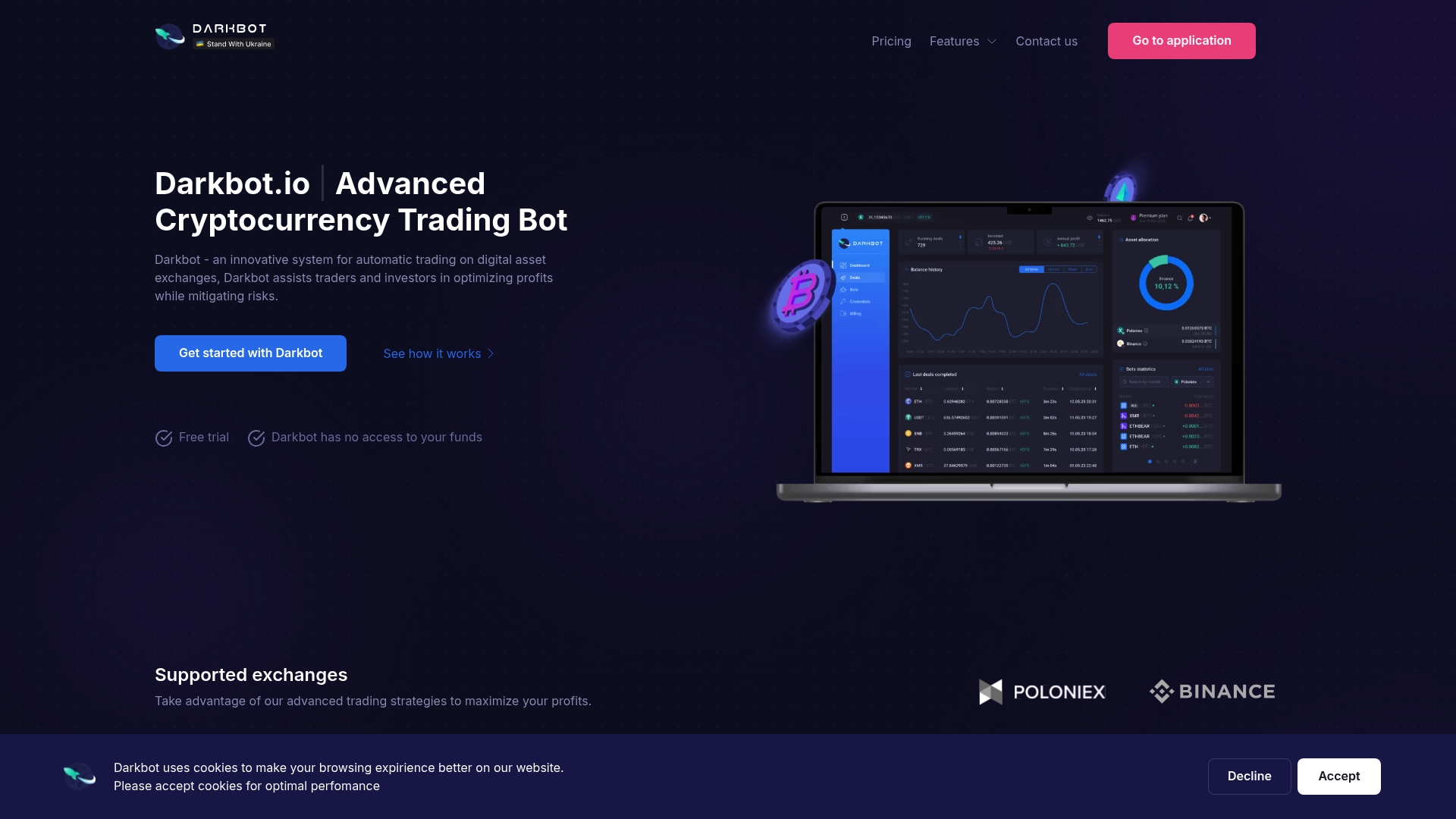
Darkbot’s plan structure includes a Free tier with limited features, a Standard Plan at $12.50 per month, a Premium Plan at $25.00 per month, and an Enterprise tier for larger-scale needs. The recommended first step for anyone new to grid automation is starting on the free tier and running paper trading before committing capital, so a strategy’s behavior is confirmed before it touches a funded account. Personalized support is available throughout onboarding for traders working through backtesting setup or risk-control configuration. Visit the pricing page to compare tiers and start with the free plan.
FAQ
What Are the Most Successful Trading Bots?
There’s no universal “most successful” bot, since outcomes depend heavily on market conditions and how well a strategy’s parameters match them. Platforms that combine configurable grids with backtesting and risk controls, such as Darkbot, tend to give traders more ability to validate a strategy before relying on it.
Is Grid Trading Profitable?
Grid trading can generate repeated small profits in sideways or range-bound markets, but it can also accumulate losses if price trends strongly outside the configured range. Profitability depends on grid range, order sizing, and whether risk controls like stop-loss and auto-disable settings are in place.
Which AI Bot Is Best for Trading?
The best AI-based bot depends on whether you prioritize deep configuration and backtesting or minimal setup friction. Darkbot’s approach centers on AI-driven pattern evaluation for consistent, rule-based execution rather than prediction, paired with backtesting and paper trading to validate strategies before live deployment.
Are Trading Bots Actually Profitable?
Trading bots execute a defined strategy consistently, but consistency in execution doesn’t guarantee profit, since results still depend on market conditions and how well the strategy fits them. Testing a configuration through paper trading and small live allocations before scaling is the most reliable way to judge whether a specific setup performs as expected.
Recommended

Start trading on Darkbot with ease
Come and explore our crypto trading platform by connecting your free account!
Free plan available • No credit card required