Crypto Trading Optimization Steps: 67% Win Rate with AI

Many traders launch AI-driven crypto bots hoping for automated profits but quickly face unexpected losses and security risks when optimization steps are skipped. This guide delivers a practical roadmap to safely optimize AI crypto trading bots, covering essential preparation, stepwise strategy refinement, and strict safety protocols. You’ll learn to confidently deploy adaptive AI bots achieving up to 67% win rates while managing risk effectively.
Key Takeaways
| Point | Details |
|---|---|
| Prerequisites Matter | Secure API keys with trading-only permissions, market knowledge, and backtesting tools form your foundation. |
| Six Core Steps | Connect exchanges securely, customize AI strategies, backtest rigorously, configure risk controls, launch monitored tests, and refine iteratively. |
| Safety is Critical | Enable two-factor authentication, IP whitelisting, and regular API key rotation to slash security risks significantly. |
| Avoid Common Pitfalls | Neglecting oversight, overfitting strategies, and ignoring market shifts can amplify losses by 30% or more. |
| Realistic Expectations | Properly configured AI bots deliver 15-60% annual ROI with controlled drawdowns under 20% when managed actively. |
Prerequisites and Setup Requirements
Before diving into optimization, establish a secure and informed foundation. Start by generating exchange API keys restricted to trading-only permissions, absolutely no withdrawal rights. This single constraint prevents catastrophic fund theft if keys are compromised. Next, activate two-factor authentication and IP whitelisting on every exchange account. API key management with 2FA, IP whitelisting, and no withdrawal permissions reduces security risks in automated crypto trading platforms significantly.
Beyond security, you need foundational market knowledge. Understand how grid trading capitalizes on sideways markets, trend-following strategies ride momentum, and dollar-cost averaging bots smooth entry timing. Familiarize yourself with volatility patterns, liquidity considerations, and exchange fee structures. Access quality historical price data spanning multiple market cycles to validate strategy performance across conditions.
Finally, verify technical compatibility. Confirm your chosen bot setup guide supports your target exchanges via stable API connections. Maintain reliable internet access and secure computing environments to prevent disruptions during live trading.
Pro Tip: Test API key security best practices by creating demo keys first, verifying permissions are locked to trading-only before risking real capital.
Core Optimization Steps for AI-Driven Crypto Trading
With prerequisites met, execute this six-step workflow to maximize AI bot performance while controlling risk.
Step 1: Securely Connect Exchanges
Generate API keys for each target exchange, ensuring trading-only permissions and enabling 2FA. Avoid reusing keys across bots or platforms. Store credentials using encrypted password managers, never plain text files.
Step 2: Choose and Customize Adaptive AI Strategies
Select strategies matching your risk tolerance and market outlook. Grid bots excel in range-bound markets, trend-following captures momentum moves, and dynamic DCA averages entries intelligently. Stepwise implementation starting with API integration, followed by strategy backtesting, risk parameter setup, live testing, and iterative tuning improves optimization success rates. Customize parameters like grid spacing, position sizing, and rebalancing thresholds based on asset volatility.
Step 3: Conduct Rigorous Backtesting
Run walk-forward backtesting to validate strategies across multiple time periods. Backtesting and walk-forward validation are essential to avoid overfitting and optimize trading strategies for real-world application. Split historical data into training and validation sets. Strategies performing well on out-of-sample data prove robustness.
Step 4: Configure Dynamic Risk Controls
Set maximum position sizes as percentage of portfolio, typically 5-10% per trade. Define stop-loss thresholds and daily loss limits to cap drawdowns. AI trading bots incorporate adaptive parameter optimization that adjusts to changing market volatility, enhancing trade execution precision and risk management. Implement trailing stops to lock profits during favorable moves.
Step 5: Launch Monitored Live Testing
Begin with small capital allocations, monitoring real-time performance closely. Track key metrics: win rate, average profit per trade, drawdown depth, and reaction speed to volatility spikes. Compare live results against backtest expectations.
Step 6: Iteratively Refine Strategy Parameters
Markets evolve, requiring ongoing trading strategy optimization steps. Review weekly performance reports. Adjust grid spacing when volatility increases, tighten stop losses during bearish regimes, and pause bots during low-liquidity periods. Follow a systematic step-by-step trading workflow for AI trading strategy optimization aligned with bot strategy optimization guide principles.
| Step | Action | Key Outcome |
|---|---|---|
| 1 | Secure API Integration | Protected access, no withdrawal risk |
| 2 | Strategy Customization | Adaptive parameters for market conditions |
| 3 | Backtesting Validation | Verified performance, reduced overfitting |
| 4 | Risk Control Setup | Controlled drawdowns under 20% |
| 5 | Live Monitoring | Real-time performance validation |
| 6 | Iterative Tuning | Sustained edge as markets shift |
Pro Tip: Focus on adaptive AI bots performance metrics that adjust parameters automatically, reducing manual intervention while maintaining strategy effectiveness across changing volatility regimes.
Safety and Security Best Practices
Automation introduces unique security vulnerabilities. Prioritize safeguards to protect capital and maintain control.
Always generate API keys with trading-only rights, absolutely zero withdrawal permissions. API key management with 2FA, IP whitelisting, and no withdrawal permissions reduces security risks in automated crypto trading platforms significantly. Even if attackers compromise keys, they cannot drain funds.
Activate two-factor authentication on every exchange account and bot platform. Use authenticator apps rather than SMS, which remains vulnerable to SIM swapping attacks. Restrict API access via IP whitelisting, allowing connections only from trusted addresses. This blocks unauthorized bots even if keys leak.
Regularly audit active API keys and rotate them every 60-90 days. Delete unused or legacy keys immediately. Monitor exchange security alerts and bot platform notifications for suspicious activity. If you detect unauthorized access attempts, revoke keys instantly and investigate the breach source.
Avoid trusting bots lacking transparent security features for API management or verified user reviews. Research platform track records thoroughly. Verify proper encryption of stored credentials and secure data transmission protocols.
Pro Tip: Store backup access codes for 2FA in encrypted vaults separate from primary devices. If you lose your phone, you maintain account access without compromising API key security or triggering emergency crypto trading risk management procedures.
Common Mistakes and Troubleshooting
Even experienced traders make optimization errors that damage performance and amplify losses.
Neglecting continuous monitoring can cause losses up to 30% larger due to unchecked adverse trades. Poorly configured AI trading bots can automate losses faster, underscoring the importance of strategy oversight and frequent performance review. Set calendar reminders to review bot performance weekly, examining trade logs for unexpected patterns.
Overfitting strategies during backtesting leads to poor real market results. You optimize parameters perfectly for historical data but capture noise rather than signal. Mitigate by splitting data into training and validation periods. Strategies performing well on unseen validation data prove genuine edge.
Ignoring market regime shifts reduces bot effectiveness dramatically. Grid bots hemorrhage losses during strong trends, trend-followers whipsaw in sideways markets. Regularly adjust parameters or deploy multi-strategy bots that activate appropriate tactics based on detected market conditions. Check troubleshooting trading bots resources when performance degrades unexpectedly.
Underestimating trading fees and slippage erodes profits significantly. Frequent rebalancing on low-liquidity pairs generates excessive costs. Calculate total fees per strategy before deployment, factoring maker/taker rates and expected slippage. Optimize trade frequency to balance opportunity capture against transaction costs. Review risk management and error mitigation frameworks regularly to avoid common AI trading bot mistakes that compound over time.
Expected Outcomes and Performance Metrics
Set realistic expectations to evaluate optimization success accurately and avoid disappointment or overconfidence.
Typical AI bot win rates average around 67% with human oversight. Effective AI trading bots achieve a verified win rate of approximately 67% on trading signals when combined with human oversight and risk controls. This means two-thirds of trades close profitably, though individual profit sizes vary significantly. Not every winning trade delivers equal gains.

Annual ROI ranges realistically between 15% and 60% depending on market conditions, strategy complexity, and risk tolerance. Setting realistic expectations, such as aiming for 15-60% annual ROI, is crucial since claims of extremely high monthly returns are typically scams. Bull markets enable higher returns, bear markets test risk controls. Maintain controlled drawdowns below 10-20% to preserve capital during adverse periods.
Use risk-adjusted returns like Sharpe ratio to measure optimization success beyond raw profit. A strategy returning 40% annually with 5% drawdown outperforms one delivering 50% with 30% drawdown. Monitor portfolio rebalancing improvements, measuring how efficiently bots maintain target allocations across changing market conditions.
Track these key performance benchmarks to evaluate optimization quality objectively.
| Metric | Target Range | Purpose |
|---|---|---|
| Win Rate | 60-70% | Validate signal accuracy |
| Annual ROI | 15-60% | Assess profitability realistically |
| Max Drawdown | Under 20% | Control risk exposure |
| Sharpe Ratio | Above 1.5 | Measure risk-adjusted returns |
| Trade Frequency | Optimized for fees | Balance opportunity and costs |
Alternative Optimization Approaches and Tradeoffs
AI-driven automation isn’t the only path to profitable crypto trading. Compare approaches to choose the best fit for your goals.
AI bots adapt parameters in near real-time based on changing market conditions, capturing opportunities human traders miss. However, they require technical expertise to configure properly and ongoing monitoring to prevent runaway losses. You gain speed and consistency but sacrifice simplicity.
Rule-based bots follow fixed parameters without adaptive learning. They’re simpler to set up and more predictable but lack flexibility during volatile market shifts. Grid bots work beautifully in sideways markets yet hemorrhage losses during strong trends. You gain ease of use but sacrifice adaptability.
Manual trading offers complete control and human intuition but demands constant attention and emotional discipline. You avoid automation risks but face exhaustion and psychological biases. Most traders make impulsive decisions during volatility spikes, undermining long-term profitability.
Consider these tradeoffs when selecting your alternative crypto trading methods optimization approach.
| Approach | Complexity | Adaptability | Time Required | Risk Exposure |
|---|---|---|---|---|
| AI Bots | High | Excellent | Moderate monitoring | Controlled with oversight |
| Rule-Based Bots | Medium | Limited | Low monitoring | Moderate in stable markets |
| Manual Trading | Low | High | Constant attention | High emotional risk |
Optimize Your Crypto Trading with Darkbot AI
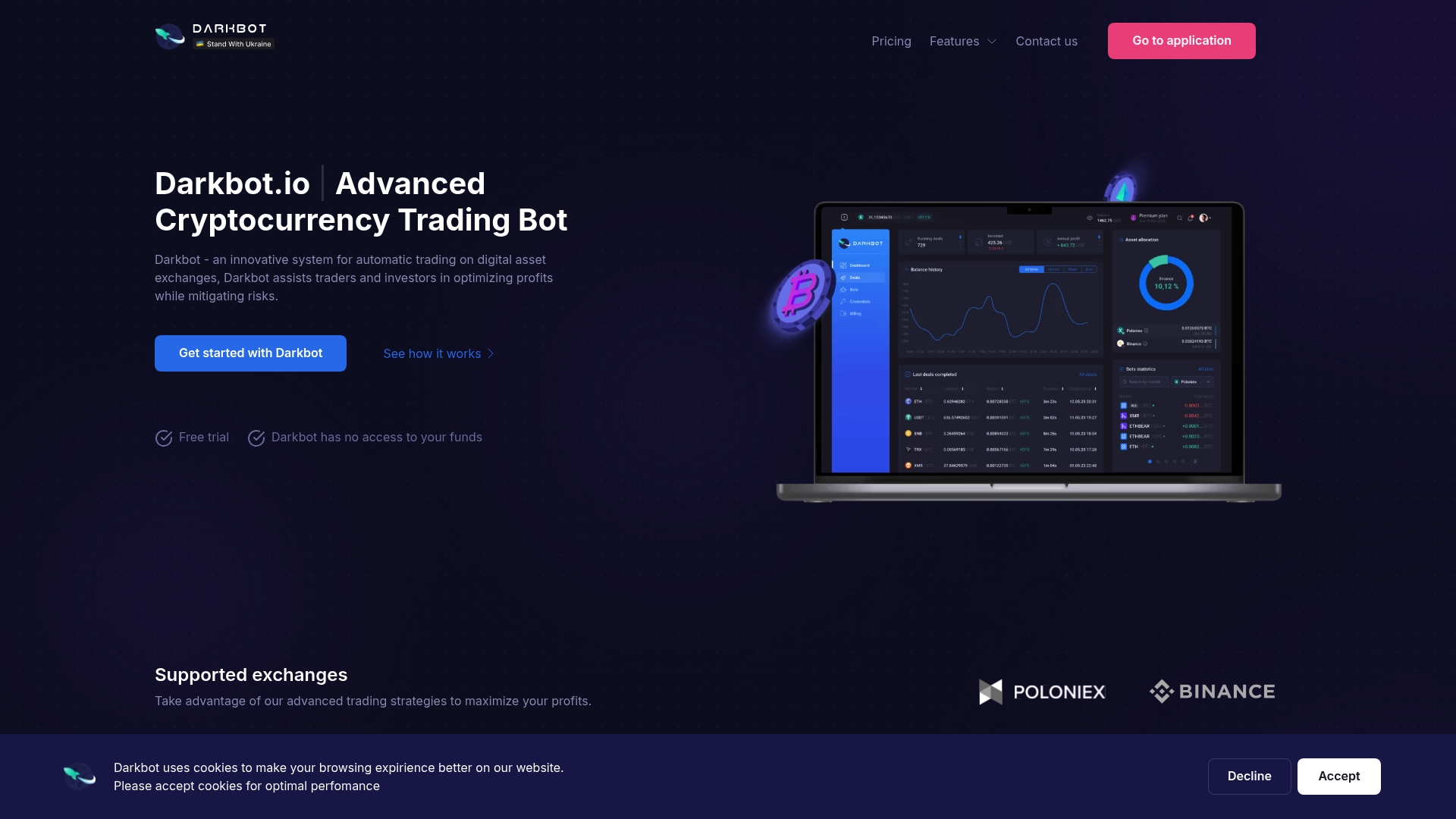
You’ve learned the systematic steps to safely optimize AI-driven crypto trading bots for improved performance and risk control. Darkbot delivers advanced AI trading solutions implementing these exact optimization principles, offering secure API integration and adaptive strategies tailored to volatile crypto markets.
Explore comprehensive trading strategy optimization guide resources and detailed bot setup guide tutorials to maximize your automated trading profits. Join traders leveraging AI-powered crypto trading bot automation to improve efficiency, control risk, and achieve consistent returns across changing market conditions. Start optimizing your strategy today.
Frequently Asked Questions
What safeguards protect my funds when using AI trading bots?
Use API keys restricted to trading-only permissions with zero withdrawal rights, ensuring attackers cannot drain funds even if keys are compromised. Enable two-factor authentication and IP whitelisting on all exchange accounts to block unauthorized access attempts.
How often should I review and adjust my automated crypto strategies?
Review bot performance weekly, examining trade logs and key metrics like win rate and drawdown depth. Adjust parameters immediately when market regimes shift, such as tightening stop losses during bearish periods or pausing bots during low-liquidity events.
Can beginners safely use AI-driven crypto trading bots?
Yes, if you follow systematic setup steps and maintain active oversight. Start with small capital allocations, thoroughly backtest strategies, and gradually increase exposure as you gain confidence. Never deploy bots without understanding their underlying logic and risk controls.
What are key indicators to monitor bot performance effectively?
Track win rate targeting 60-70%, annual ROI realistically between 15-60%, maximum drawdown kept under 20%, and Sharpe ratio above 1.5. Monitor trade frequency relative to fee costs and compare live performance against backtest expectations to detect degradation early.
How do fees and slippage impact automated crypto trading profits?
Trading fees and slippage erode profits significantly, especially with high-frequency strategies on low-liquidity pairs. Calculate total costs before deployment, factoring maker/taker rates and expected slippage. Optimize trade frequency to balance opportunity capture against transaction expenses, ensuring net profitability.
Recommended

Start trading on Darkbot with ease
Come and explore our crypto trading platform by connecting your free account!
Free plan available • No credit card required