Five Component Delta Neutral Bot Architecture for Algorithmic Traders

A delta neutral bot pairs a long spot position with an offsetting short perpetual futures position, keeping the portfolio’s net directional exposure near zero while it collects funding payments, basis premium, or staking yield. Traders deploy them for funding-rate arbitrage, basis capture on dated futures, and hedged staking. None of this is riskless: liquidation, funding flips, and depegs can erase the yield a delta neutral setup was built to harvest.
TL;DR:
- Funding rates can flip sign suddenly, turning expected income into losses and affecting the profitability of delta neutral strategies.
- Proper configuration of notional split, leverage, and rebalancing thresholds is essential to maintain neutrality and avoid turning the strategy into a directional bet.
- Different variants exist, including funding-rate arbitrage, basis trading with futures, hedged staking, and options-based hedging, each with distinct operational risks.
- Market disruptions like auto-deleveraging, depeg events, and slippage can break a delta neutral position if risk controls are not actively managed.
- Using a trusted platform with comprehensive backtesting, monitoring, and risk rules significantly improves the chances of sustaining a profitable delta neutral strategy.
What Is a Delta Neutral Bot and How Does It Work?
Delta measures how much a position’s value moves when the underlying price moves. A spot holding carries a delta of roughly +1; a short perpetual futures contract of matching notional carries a delta near -1. Combine them and the net delta approaches zero, which is the entire premise of a delta neutral strategy in crypto: the return comes from funding, basis, or yield, not from guessing price direction.
Execution mechanics separate a functioning bot from a fragile one. Placing both legs as simultaneous market orders on size works for small notional, but larger positions need slicing to avoid moving the book against themselves. Three execution patterns dominate:
- TWAP (time-weighted average price): splits an order into equal slices over a fixed window, reducing market impact on illiquid pairs.
- Grid execution: ladders limit orders at set intervals, useful when a bot expects to build or unwind a position gradually.
- Market/limit hybrid: fills the primary leg at market for speed, then works the hedge leg with limit orders to shave fees.
Delta does not stay at zero on its own. As spot price moves, the perp leg’s delta shifts too. That drift, driven by gamma in options-based hedges and by simple notional mismatch in spot/perp pairs, is what forces rebalancing. Delta hedging requires ongoing adjustment because a hedge that was neutral an hour ago rarely stays neutral without intervention. A working bot needs continuous monitoring of latency, slippage, and fill rates. A rebalance that arrives 400 milliseconds late on a volatile pair can leave a position meaningfully net long or short for the exact window when it matters most.
Key Parameters to Configure Before You Launch
Every delta neutral bot needs a defined configuration before it touches live capital. Skipping any of these steps is how a market-neutral strategy quietly turns directional.
- Notional sizing and leg split. A 50/50 notional split between spot and perp is the standard starting point. Confirm the split accounts for maintenance margin on the perp leg, not just the raw notional.
- Leverage. Higher leverage frees up capital but shrinks the buffer before liquidation. Most disciplined setups keep perp leverage low, often 2x to 3x, specifically because the strategy’s edge is funding and basis, not amplified directional bets.
- Rebalance thresholds. Set a percent delta drift trigger (commonly 1% to 3% of notional) alongside a time-based check, since a quiet market can still let small drifts compound.
- Stop-loss and margin cushion. Define the margin ratio that triggers an automatic size reduction, separate from the ratio that triggers a full unwind.
- API setup and permissions. Grant trading permissions only, never withdrawal access, and scope keys per exchange account when running the strategy across venues.
Pro Tip: Rebalancing too aggressively can cost more in fees and slippage than the drift it corrects. Model the rebalance cost against the funding or basis income you expect before setting a tight threshold.
Sizing, leverage, and rebalance frequency interact constantly. A wider rebalance band tolerates more drift but reduces trading costs; a tighter band holds neutrality closer but eats into the yield the bot exists to capture. A trading bot configuration checklist helps make sure none of these settings gets left at a platform default.
Which Delta Neutral Strategy Variants Exist?
Not every delta neutral setup looks the same, and the variant you choose depends on the instruments you can access and how much operational complexity you can manage.
- Funding-rate arbitrage. The most common variant: hold spot, short the perp, and collect the funding rate paid by longs to shorts (or vice versa, depending on the sign). Funding rates reset every few hours on most exchanges, and a sudden flip from positive to negative can turn expected income into an expense overnight.
- Basis trading with dated futures. Instead of a perpetual, the short leg is a futures contract with a fixed expiry trading at a premium to spot. The premium narrows to zero at expiry, a known, decaying number, but the position carries roll risk if you extend it into a new contract.
- Hedged staking. Stake a token for yield, then short an equivalent notional in perps to neutralize price exposure. This variant is exposed to depeg risk on liquid staking tokens, which behaves differently from ordinary basis risk.
- Options-based hedging. Uses puts, calls, or combinations to flatten delta instead of a linear short position. Rebalancing frequency depends on gamma exposure and tends to run more often near expiry, as options literature on delta-neutral portfolios explains.
- Curated vaults versus self-managed bots. A third-party vault removes execution overhead but concentrates counterparty and protocol risk in one operator. Self-managed bots trade that convenience for control over parameters and venue diversification.
What Risks Can Break a Delta Neutral Position?
A delta neutral bot that is not actively neutral for even a short window is a directional bet with extra steps. The failure modes below are the ones that show up repeatedly in post-mortems of products marketed as market neutral.
- Auto-deleveraging (ADL) and counterparty risk. When an exchange’s insurance fund is stressed, profitable positions can be force-closed to cover other traders’ losses, breaking the hedge without warning.
- Liquid-staking depeg. Concentrated exposure to a single staking token or custodian has been a recurring cause of outsized losses when a staked token’s peg to its underlying asset slips, since the hedge leg does not move in lockstep with the depegged asset.
- Funding flips. A funding rate that flips sign turns an income stream into a cost, sometimes for extended periods during volatile regimes.
- Slippage and fee drag. Backtested fills rarely match live execution. Demo and testnet environments in particular tend to understate real order-queue latency and slippage, so a strategy that looked profitable in simulation can underperform once live.
- Unregulated venue risk. The CFTC’s guidance on virtual currency trading risk notes that many crypto exchanges operate without the customer protections standard in regulated markets, which amplifies the impact of an outage or an ADL event.
Mitigation is operational, not exotic: keep margin buffers well above minimum maintenance, split notional across more than one exchange rather than concentrating it on one venue, set automated alerts on funding rate and staking spread, and keep a manual override available at all times.
Where to Start Building or Testing One
Developer documentation and open-source bot repositories are the fastest way to see how these parameters translate into actual configuration files. Most public delta neutral bot projects expose their rebalance logic through a config.json or equivalent, with environment variables controlling notional caps, leverage limits, and monitoring intervals, which is worth inspecting even if you end up building your own.
A minimal architecture needs five components: a data layer pulling prices and funding rates, a strategy engine that calculates target delta, an execution adapter that routes orders to each exchange, a risk module enforcing margin and stop rules, and an observability layer logging fills, latency, and drift.
Before any live capital moves, run through this sequence:
- Backtest with exchange-style fee models and realistic fill assumptions, not idealized mid-price fills.
- Paper-trade using the exact API credentials and order routing you intend to run live.
- Deploy a canary with small notional and a working kill-switch before scaling up.
- Track carry versus fees, rebalance cost, and worst intraday drawdown as your core metrics, not just cumulative return.
An automated crypto trading guide covers the broader operational setup if you’re assembling this pipeline from scratch.
Why Discipline Matters More Than the Algorithm

The appeal of a delta neutral bot is that it removes the need to predict price direction. That appeal has a limit: the bot still needs someone watching margin ratios, funding flips, and rebalance costs, because no configuration runs itself indefinitely without drift.
A managed platform earns its place when it gives you transparent logs and configurable risk rules instead of a black box, since the point is disciplined execution, not blind trust in an algorithm. No bot, delta neutral or otherwise, is a guaranteed money machine, and any framing that suggests otherwise deserves skepticism.
— Grisha
Running Delta Neutral Bots on Darkbot
Darkbot gives algorithmic traders the infrastructure this strategy actually requires: multi-exchange API integration to split notional across venues, support for running multiple simultaneous bots, configurable rebalancing rules, and real-time analytics to track drift, fills, and margin health as they happen.
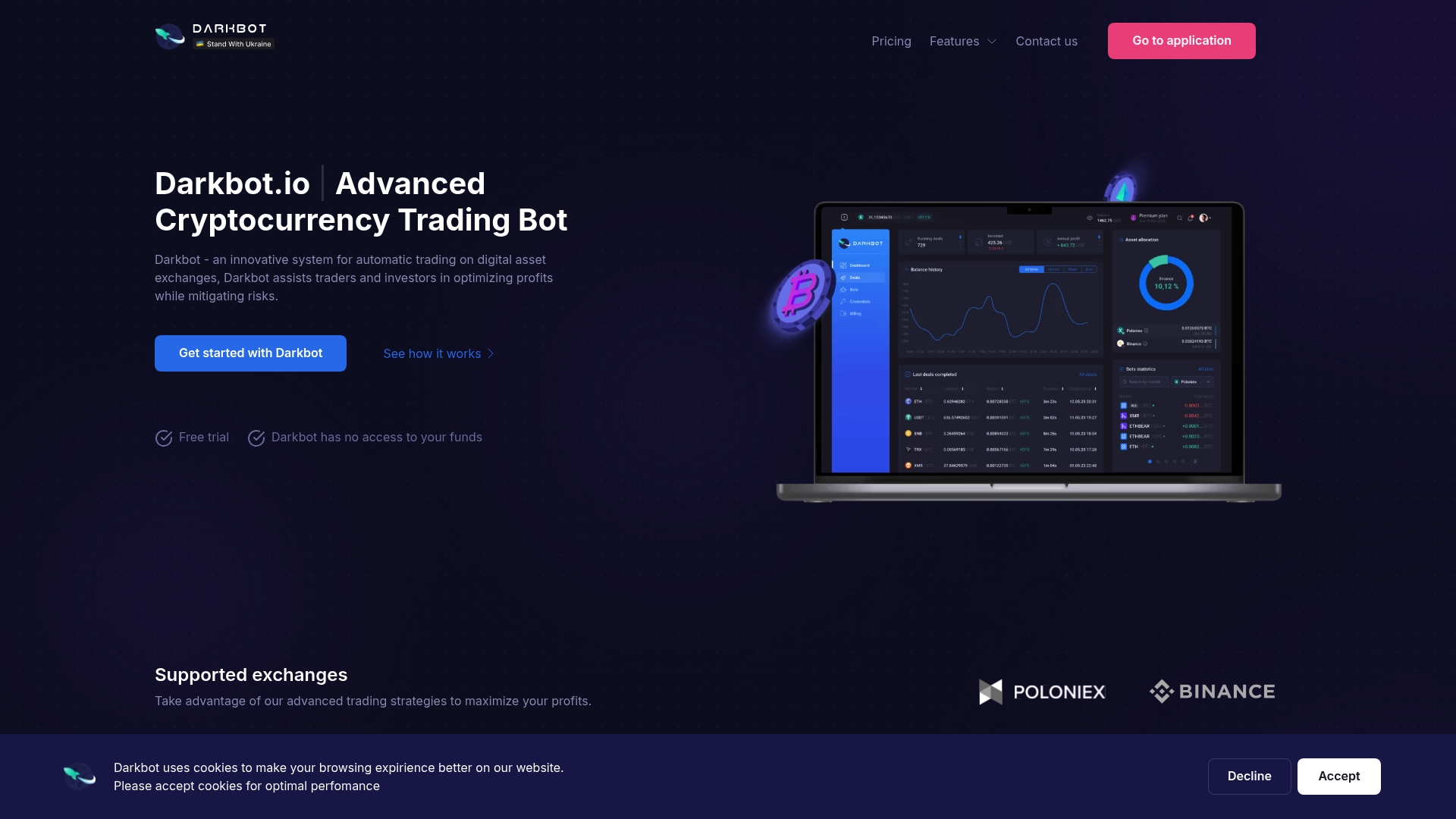
Backtesting and paper trading are built into the platform, so a funding-arbitrage or basis-trade configuration can be tested against historical fills before it touches live capital, addressing the exact gap between simulated and live execution covered above. The Free plan is a practical starting point for testing a delta neutral configuration without commitment, and the Standard Plan at $12.50 per month adds the strategy customization and rebalancing controls that a multi-leg setup depends on. Review the full pricing page and start with a small canary allocation before scaling notional.
Sources
For primary documentation rather than secondhand summaries, review the CFTC’s customer advisory on AI trading bots and its guidance on virtual currency trading risk, along with Coinbase’s explainer on delta hedging.
This article is general information, not a substitute for advice from a qualified financial advisor. Consult a qualified financial professional about your own circumstances before acting on anything here.
- Crypto delta neutral trading strategies (CoinMarketCap Academy)
- What is delta hedging and how does it work in crypto? (Coinbase Learn)
- Basics of algorithmic trading concepts and delta-neutral (Investopedia)
FAQ
Is a Delta-Neutral Strategy Profitable?
It can be, but returns come from funding rates, basis premium, or staking yield rather than price appreciation, and those sources fluctuate or flip sign. Profitability depends heavily on fees, rebalance costs, and avoiding concentrated exposure to a single venue or staking token.
What Is the Most Successful Trading Bot?
There is no single bot that outperforms across all market conditions, and any claim of guaranteed returns is a warning sign the CFTC has explicitly flagged in cases of fraud. A well-configured bot on a platform like Darkbot, tested through backtesting and paper trading before live deployment, is a more realistic goal than chasing a “best” bot.
What Is a Delta-Neutral Trading Strategy?
It is a position structured so the portfolio’s net delta sits near zero, typically by combining a long spot holding with a short perpetual futures or options position of matching notional. The strategy aims to earn funding, basis, or yield while removing most directional price risk.
Are AI Trading Bots Illegal?
AI trading bots themselves are not illegal, but the CFTC has issued advisories warning that bots marketed with guaranteed-return promises are a common fraud pattern. Legitimate platforms describe automation as a tool for disciplined execution and risk management, never as a guarantee of profit.
Recommended

Start trading on Darkbot with ease
Come and explore our crypto trading platform by connecting your free account!
Free plan available • No credit card required