Demark.com Alternatives: Automated Crypto Trading Platforms
TL;DR:
- Automated crypto trading platforms vary by architecture, with options for no-code, multi-exchange, and open-source frameworks. Choosing the right platform depends on whether your focus is on execution speed or portfolio rebalancing, supported by proper backtesting and security features. Starting with cloud-based tools and scaling deliberately ensures reliable, secure trading aligned with your strategy goals.
If you’re searching for demark.com alternatives in the sense of platform-level automated crypto trading, the shortlist breaks down by architecture type. Cloud no-code strategy engines (like those used by 3Commas and Cryptohopper) are the fastest path to live execution. Multi-exchange cloud platforms such as Bitsgap and TradeSanta cover portfolio automation across multiple venues. Exchange-native bot suites (Coinrule’s rule engine, for example) work best when you trade on one or two exchanges. Open-source and self-hosted frameworks suit developers who need custom strategy logic. Institutional backtesting and execution platforms serve hedge funds and algo shops requiring walk-forward analysis and order-level metrics.
U.S. availability is a real filter: not every platform supports all U.S.-accessible exchanges or clears KYC requirements for American users, so verify exchange restrictions before committing to any trial.
- Beginners: Start with a cloud no-code engine. Pre-built strategies, dashboard controls, and paper trading reduce the learning curve.
- Algo developers: Open-source frameworks or institutional backtesting platforms give you the execution logs and order-flow granularity retail templates typically lack.
- Portfolio automators: Multi-exchange cloud platforms with built-in rebalancing are the right fit.
- Institutional users: Dedicated algorithmic execution platforms with Sharpe, max drawdown, and walk-forward reporting belong in your shortlist.
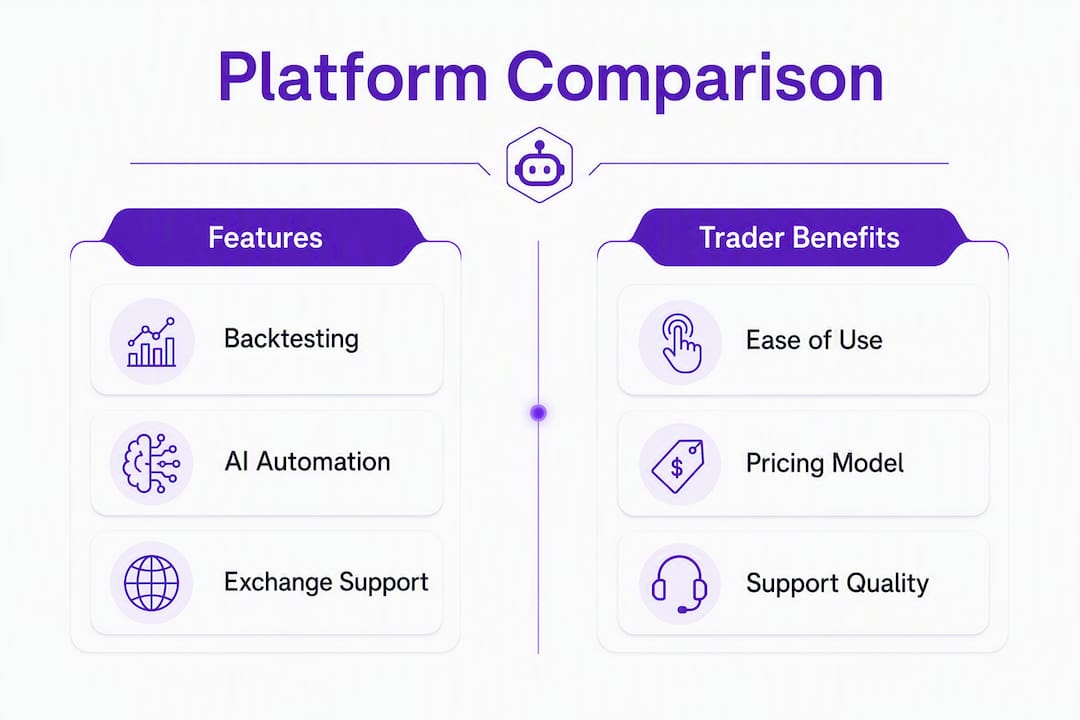
How the top demark.com substitutes compare across key dimensions
| Category | Best for | Pricing shape | Exchanges (breadth) | Backtesting & paper trading | AI/ML automation | Ease of use | API key security | Portfolio rebalancing | Concurrency | U.S. availability |
|---|---|---|---|---|---|---|---|---|---|---|
| Cloud no-code engines | Swing, grid, DCA strategies | Freemium + tiered subscription | High number of supported exchanges | Moderate; paper trading typical | Pre-built signal logic | No-code | Trading-only keys; varies on IP whitelist | Limited | Medium | Generally available |
| Multi-exchange cloud platforms | Portfolio automation, rebalancing | Freemium + subscription | High | Moderate to good | Rule-based + some ML signals | Low-code / no-code | Trading-only keys standard | Strong | Medium–High | Generally available |
| Exchange-native bot suites | Single-exchange rule execution | Free tier + subscription | Low (1–3) | Basic | Rule triggers | No-code | Exchange-managed | Minimal | Low | Depends on exchange |
| Open-source / self-hosted | Custom algo strategies | Free (infra cost) | Varies | Deep; developer-controlled | Fully customizable | Requires coding | Developer-configured | Configurable | High | Full control |
| Institutional backtest / execution | HFT, market making, hedge funds | Enterprise / usage-based | Medium–High | Deep (walk-forward, Sharpe, drawdown) | Advanced ML, order-flow data | Coding required | Enterprise-grade | Full | Very high | Case-by-case |
Pro Tip: The most common failure among new automated traders is category mismatch: choosing a high-frequency execution engine when your actual goal is monthly portfolio rebalancing, or vice versa. Decide whether your primary need is execution speed or portfolio logic before evaluating any platform.
What each platform category actually delivers
Cloud no-code strategy engines
The fastest-growing segment in automated trading, these platforms let you deploy pre-built quantitative strategies without writing code. Speed-to-live is the main advantage; deep customization is the tradeoff.
- Backtesting: usually available but methodology transparency varies — always ask for data sources and walk-forward results
- API shape: REST-based exchange connections; confirm trading-only key permissions are enforced
- Portfolio rebalancing: limited on most; check explicitly
- Concurrency: a small number of simultaneous bots on free tiers, increasing on paid plans
- U.S. availability: most support Coinbase Advanced, Kraken, and Binance.US; verify your pairs
Multi-exchange cloud platforms
Built for traders running strategies across several venues simultaneously. Rebalancing, arbitrage signals, and cross-exchange portfolio views are native features here.
- Backtesting depth: moderate; paper trading modes are standard
- API handling: trading-only keys are the norm; IP whitelisting support varies by vendor
- Portfolio rebalancing: strong, often with threshold-based and calendar-based triggers
- Concurrency: medium to high depending on plan tier
- U.S. note: most support major U.S.-accessible exchanges; confirm KYC requirements
Exchange-native bot suites
Platforms like Coinrule are tightly coupled to a small set of exchanges. Setup is fast and the rule logic is visual, but you’re constrained to whatever pairs and order types that exchange supports.
- Backtesting: basic; paper trading usually available
- Execution quality: limited by exchange API depth; no order-flow granularity
- Portfolio rebalancing: minimal
- Best fit: traders who concentrate on one exchange and want simple if/then automation
Open-source and self-hosted frameworks
Full control over strategy logic, data feeds, and execution infrastructure. Retail template platforms frequently lack the bid/ask depth and order-level metrics that matter for execution-sensitive strategies; self-hosted frameworks let you wire in whatever data you need.
- Backtesting: deep and developer-controlled
- Security: you configure everything, including key storage and network access
- Community support: active forums for major frameworks, but no SLA
- Cost: free software, but infrastructure and maintenance are on you
Institutional backtesting and execution platforms
Designed for hedge funds and systematic trading desks. Walk-forward analysis, Sharpe ratio reporting, max drawdown tracking, and order-level execution logs are standard. Platforms that execute without transparent backtesting warrant extra scrutiny — this category is the benchmark for what transparency should look like.
- Security: enterprise-grade key management and audit logs
- U.S. availability: varies; enterprise agreements often required
- Must-check: confirm the platform does not request withdrawal permissions and supports IP whitelisting
How to choose the right platform for your strategy
Architecture fit is the single highest-impact criterion. An execution-first platform optimizes for fill rates and latency; a portfolio-first platform optimizes for rebalancing logic and multi-asset coordination. Confusing the two wastes weeks of setup time.
Questions to ask before committing:
- Does the platform support paper trading with realistic fill simulation, not just theoretical prices?
- What data sources power the backtest, and is walk-forward analysis available?
- Are API keys restricted to trading-only permissions, with no withdrawal access?
- Does the platform support IP whitelisting for API connections?
- What are the concurrency limits on your target plan?
- What is the uptime SLA or documented reliability history?
- Is the fee structure subscription-based or AUM-based, and how does it scale?
- Which U.S.-accessible exchanges are supported, and are your target pairs available?
- Is there a mobile app, and what controls does it expose?
- What are the support SLAs — ticket response time, live chat availability, dedicated account management?
Red flags to watch for:
- No paper trading mode
- Backtest methodology is undocumented or uses only closing prices
- Platform requests withdrawal permissions on API keys
- No IP whitelisting option
- Your primary exchange is not on the supported list
Minimum settings to validate in a paper run: position sizing rules, hard daily loss limit, stop-loss enforcement, and at least one scenario-based stress test against a historical drawdown period. Prioritize platforms that allow configurable hard stop-loss floors and automated daily loss limits that can instantly halt activity.
Your first 30 days after picking a platform
The first action is connecting exchange API keys with trading-only permissions and enabling IP whitelisting if the platform supports it. Everything else follows from that baseline.
- Days 1–3: Connect API keys (trading-only, no withdrawal access). Enable IP whitelisting. Confirm supported pairs.
- Days 4–17: Run a full paper trading simulation. Target two to four weeks of paper data before touching live capital.
- Day 18: Compare paper performance against your backtest. Significant divergence signals a data or execution assumption problem — investigate before going live.
- Day 19–20: Configure position sizing per trade, hard daily loss limit, and stop-loss parameters. Set concurrency limits conservatively.
- Days 21–25: Launch a small live pilot. Keep capital minimal. Monitor fill rates, slippage, and order rejection rates daily.
- Days 26–30: Review execution metrics weekly. Define rollback triggers — specific drawdown thresholds or fill-rate degradation that automatically pause the bot.
Pro Tip: Scale capital incrementally — not in one step after paper trading. A small live run surfaces slippage and execution mismatches that backtests routinely miss. Review the platform’s changelog and active community threads before each scaling step; breaking API changes are often flagged there first.
For a detailed walkthrough of automating crypto trading workflows, Darkbot’s blog covers the infrastructure and sequencing in depth.

How this shortlist was built
Selection used four filters: architecture fit (execution vs. portfolio), backtest transparency, security controls, and confirmed U.S. availability. Platforms with undocumented backtest methodology or that request withdrawal API permissions were excluded regardless of marketing claims.
Evaluation criteria and weighting:
- Architecture fit to strategy type (highest weight)
- Backtesting depth and methodology transparency
- API key security model (trading-only, IP whitelisting, encryption)
- Exchange breadth and U.S. pair availability
- Concurrency limits relative to strategy needs
- Support quality and community maturity
- Pricing structure and free trial availability
- Mobile app capability
- Platform uptime and update cadence
AI functions as a disciplined execution and probabilistic evaluation tool, not a market direction predictor. Platforms were assessed on whether their AI claims map to execution consistency and rule-driven adaptation rather than return promises.
Darkbot was evaluated against the same criteria. Its architecture covers exchange API integration, backtesting, paper trading, multiple simultaneous bots, portfolio rebalancing, and security controls including trading-only API key handling. For institutional context, see automated trading platforms for hedge funds.
Research drew on independent platform writeups, community forums, and vendor documentation. Sources are listed at the end of this article.
What to expect from customer support across platform types
Support quality varies sharply by category. Cloud no-code platforms aimed at retail traders typically offer ticket-based support with response windows of 24–48 hours, plus knowledge bases and video tutorials. Multi-exchange platforms at higher plan tiers often add live chat. Open-source frameworks rely entirely on community forums and GitHub issue trackers — there is no SLA, and resolution time depends on community activity.
For U.S. traders, time-zone coverage matters. Confirm whether live support operates during U.S. market hours or is concentrated in European or Asian time zones. A platform with strong documentation but slow live support is workable for strategy setup; it becomes a problem during an active execution incident.
Darkbot offers personalized support alongside its platform, which is a meaningful differentiator for traders who want a direct line rather than a forum thread.
Community signals and social proof worth checking
User reviews on independent aggregators (Trustpilot, G2, Reddit’s r/algotrading) give a more reliable signal than vendor-curated testimonials. Look specifically for patterns in negative reviews: recurring complaints about API disconnections, delayed order execution, or unresponsive support during high-volatility periods are more diagnostic than star ratings.
Active Discord or Telegram communities indicate that a platform is maintained and that users are engaged enough to help each other. A community that went quiet six months ago is a platform stability warning. For automation workflow design, community threads are often where real-world execution edge cases surface before they appear in official documentation.
Mobile app availability across platform categories
Most cloud no-code and multi-exchange platforms offer iOS and Android apps, but capability varies. Monitoring dashboards and position overviews are standard. Modifying active strategy parameters or deploying new bots from mobile is less consistent — verify this specifically if you need full control away from a desktop.
Exchange-native bot suites inherit whatever mobile capability the parent exchange provides. Open-source and institutional platforms rarely have dedicated mobile apps; web-based responsive interfaces are the norm.
Platform stability and update cadence
A platform’s update history is a proxy for team activity and reliability. Check the public changelog: regular releases that address exchange API changes (which happen frequently) indicate an actively maintained platform. A changelog with no entries in the past 90 days is a concern, particularly for platforms that depend on third-party exchange APIs that update without notice.
Uptime history is harder to verify independently. Ask vendors for their documented SLA or check community forums for outage reports. Real-time trade analysis tools can supplement platform-native monitoring and give you an independent view of execution quality during live runs.
Key Takeaways
Architecture fit — execution-first versus portfolio-first — is the single criterion that determines whether an automated trading platform will serve your strategy or fight it.
| Point | Details |
|---|---|
| Match architecture to strategy | Execution-first platforms optimize fill rates; portfolio-first platforms optimize rebalancing logic. Confusing the two is the most common failure. |
| Backtest transparency is non-negotiable | Require documented data sources and walk-forward analysis; undocumented backtests are a red flag regardless of claimed returns. |
| API key security baseline | Restrict all API keys to trading-only permissions and enable IP whitelisting before running any live capital. |
| Start cloud, scale deliberately | Begin on a cloud platform for infrastructure reliability; move to self-hosted only when custom strategy logic genuinely requires it. |
| Darkbot as a structured option | Darkbot covers exchange API integration, backtesting, paper trading, simultaneous bots, portfolio rebalancing, and trading-only API key handling in a single subscription platform. |
The category-fit trap most traders walk straight into
The conventional wisdom in automated trading is to chase the platform with the most features or the most impressive AI marketing. That framing is almost always wrong.
Industry analysis consistently identifies category mismatch as the primary failure mode: a trader who needs monthly portfolio rebalancing picks a high-frequency execution engine because it looks more sophisticated, then spends weeks debugging why it doesn’t behave like a portfolio manager. The platform isn’t broken. It’s just the wrong tool.
The AI question is related. Platforms that describe their AI as predictive — as though the system knows where price is going — are either misdescribing their technology or selling something you should be skeptical of. AI in professional execution platforms functions as a consistency mechanism: it applies rules without emotional deviation, evaluates probabilistic patterns across historical data, and adapts parameters within defined risk boundaries. That’s genuinely useful. It’s just not a crystal ball, and treating it as one leads to under-specified risk controls.
Start on a cloud platform and move to self-hosted infrastructure only when a specific technical need — custom data feeds, on-chain integration, proprietary execution logic — makes the operational overhead worth it. Most traders never reach that threshold.
Darkbot covers the brief for U.S. crypto traders
Darkbot is an AI-based crypto automation platform built around systematic execution, portfolio automation, and structured risk controls — not signal delivery or return promises.
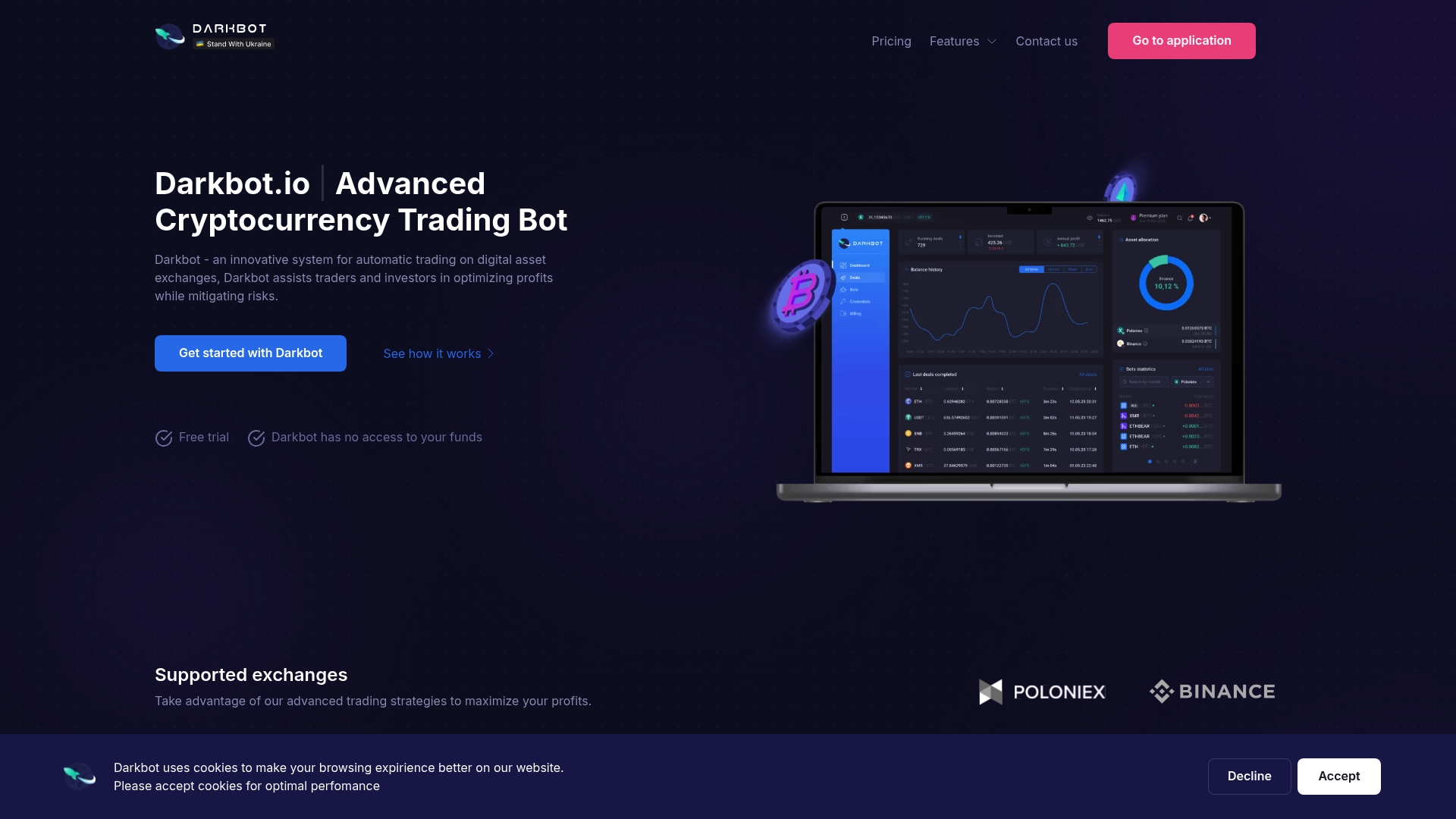
For traders who went through the checklist above and want a platform that checks the architecture-fit, security, and backtesting boxes without enterprise pricing, Darkbot’s free plan is a practical starting point. Core capabilities include exchange API integration with trading-only key handling, backtesting and paper trading, multiple simultaneous bots, automated portfolio rebalancing, and real-time analytics. U.S.-accessible exchanges are supported; the full list is on the exchanges integration page.
Start with the free plan at darkbot.io and run a paper trading session before committing capital.
This article is general information, not financial or investment advice. Verify platform availability, exchange restrictions, and regulatory requirements with the relevant primary sources or a qualified professional before deploying capital.
Useful sources
- How to set up a crypto trading bot — Coin Bureau
- Automation workflow for traders — Scalping Algo
- Best tools for real-time trade analysis — MT4 Copier
- Darkbot exchanges integration page
- Darkbot portfolio management
Recommended

Start trading on Darkbot with ease
Come and explore our crypto trading platform by connecting your free account!
Free plan available • No credit card required