ForexDominion.com Alternatives for Crypto Traders

TL;DR:
- Darkbot offers AI-powered automation, backtesting, and portfolio management in a single platform with security defaults. Traders should verify paper trading, API permissions, and realistic backtesting before live deployment. Systematic strategy definition and validation are crucial for successful automation beyond simple signal-following.
For traders searching for automated cryptocurrency trading platforms, the clearest starting point is Darkbot: it combines AI-driven execution, backtesting, paper trading, multi-exchange API integration, and portfolio management in a single subscription. If your needs differ, the short list below covers the main alternative categories.
Immediate shortlist:
- Darkbot — AI-powered automation with paper trading, portfolio rebalancing, and security-first API defaults; free tier available
- No-code strategy platforms — template-driven bots for traders who want activation without scripting
- Exchange-native bots — grid and DCA tools built directly into major exchanges (Binance, Coinbase)
- Multi-exchange managers — platforms focused on unified portfolio views across several exchanges
Three things worth confirming before you connect any platform to live funds: paper-trading availability on real exchange endpoints, API keys scoped to trading-only permissions, and backtesting that accounts for realistic fees and slippage.
How do these platforms compare on the features that matter?
The table below maps the decision dimensions traders use most. Alternative categories use generic labels rather than brand names.
| Dimension | Darkbot | No-code template platforms | Exchange-native bots | Multi-exchange managers |
|---|---|---|---|---|
| Best for | AI automation + portfolio mgmt | Beginners, low-code setup | Single-exchange grid/DCA | Portfolio aggregation |
| AI / automation | ML-based strategy adaptation, rule engine | Pre-built templates, limited ML | Rule-based only | Varies; often rule-based |
| Supported exchanges | Multiple major exchanges via API | Varies by platform | Exchange-specific | Multiple, read-heavy |
| Backtesting & paper trading | Yes — both included | Backtesting varies; paper trading limited | Rarely available | Rarely available |
| Portfolio mgmt & rebalancing | Yes — automated rebalancing | Limited | No | Core feature |
| Pricing & trial | Free tier + paid plans; 14-day money-back | Free tiers common; paid for advanced | Free (exchange feature) | Free to paid tiers |
| Security (API keys) | Trading-only defaults; documented guidance | Varies; check permissions carefully | Exchange-controlled | Varies; review carefully |
| Ease of onboarding | Guided setup; docs available | Low friction | Minimal setup | Moderate |
| Customer support | Personalized support included | Community-driven, varies | Exchange support only | Varies |
One-line summaries:
- Darkbot — systematic execution platform with built-in risk controls, paper trading, and portfolio management; designed for traders who want disciplined automation rather than manual signal-following.
- No-code platforms — reduce technical friction but still require you to define risk limits and review strategy assumptions before activation.
- Exchange-native bots — convenient for single-exchange grid or DCA strategies; limited outside that scope.
- Multi-exchange managers — useful for portfolio aggregation; execution depth varies widely.
Which platform type fits your trading profile?
- Beginners and no-code traders: A template-driven platform with paper-trading demos is the right entry point. No-code engines lower the activation barrier, but they still require you to set position sizes and exit rules before going live. Darkbot’s free tier and guided onboarding fit this profile.
- Multi-exchange portfolio managers: If you hold assets across several exchanges and want automated rebalancing, prioritize platforms that support portfolio management natively. Darkbot’s rebalancing and multi-exchange API integration address this directly.
- Low-cost or free-bot users: Exchange-native bots (grid, DCA) cost nothing extra and work well for simple accumulation strategies on a single exchange. The tradeoff is minimal configurability and no backtesting.
- Copy-trading and marketplace-style traders: Some platforms offer strategy marketplaces where you subscribe to another trader’s logic. These are convenient but require the same due diligence: review the strategy’s historical drawdown, not just its headline return.
What questions should you ask before choosing a platform?
Core vetting checklist:
- Does it support your exchange, and does it handle spot, futures, or both?
- Does backtesting include realistic fees, slippage, and out-of-sample validation?
- Is paper trading available on real exchange endpoints, not just simulated data?
- Are API keys scoped to trading-only by default, with no withdrawal permissions?
- What are the subscription fees, and are there per-trade or withdrawal charges?
- Is there documented SLA for support, a changelog, and accessible technical docs?
- For custody-adjacent services: is there a proof-of-reserves or independent audit?
- Is the platform available to US users, and does it comply with applicable regulations?
Red flags to walk away from:
- Any platform requesting withdrawal permissions on your API key
- Backtests with no fee or slippage modeling, or no out-of-sample period
- No paper-trading mode before live deployment
- Sparse or missing documentation and no visible changelog
- Marketing that promises specific returns or guaranteed profits
Pro Tip: Before automating any strategy, write out the entry condition, exit condition, and position-sizing rule in plain language. If you cannot explain the logic to someone unfamiliar with the system, the bot will amplify whatever is unclear. Process-oriented strategy design is the discipline that separates systematic traders from gamblers.
Technical checklist for advanced users:
- Confirm API IP whitelisting is supported and configured
- Verify the platform handles exchange rate limits without silent order drops
- Test order rejection handling — does the bot log and alert, or fail silently?
- Confirm reconciliation logs are exportable and timestamped
- Validate that the bot’s fee model matches your exchange’s actual fee schedule
How do AI trading bots actually work, and where do they fail?
AI in trading platforms is primarily a rule-enforcement and probabilistic-evaluation layer. It is not a direction predictor. The bot executes what you define; the ML component evaluates whether current market conditions match patterns seen in historical data, then adjusts position sizing or strategy selection accordingly.
Most platforms combine two components: a signal-generation layer (technical indicators, regime detection, or ML model inference) and an execution engine (order routing, position management, risk controls). No-code platforms wrap these in templates; programmable platforms expose them as configurable scripts.
Common failure modes are worth knowing before you deploy:
- Over-automation: Deploying a bot without defined entry, exit, and sizing rules is the primary cause of failure. The bot will execute the logic you gave it, including its flaws, at machine speed.
- Stale price feeds and rejected orders: Silent failures like stale data and order rejections erode performance without triggering obvious alerts. Logging and daily monitoring are not optional.
- Fee miscalculations: A strategy that looks profitable in backtesting can turn negative once real exchange fees and slippage are applied.
- Bot-type mismatch: Grid bots work in ranging markets; trend-followers need directional momentum; DCA suits accumulation. Applying the wrong architecture to the wrong regime is a common and avoidable error.
Pro Tip: Require human-readable output from any ML component before enabling autonomous strategy changes. If the model’s decision logic cannot be reviewed and validated, treat it as a black box and limit its authority over position sizing.
How do you set up API keys and test safely before going live?
Restrict API keys to trading-only permissions and run an extended paper-trading period before committing capital. That single discipline prevents the most common loss vectors.
Secure onboarding checklist:
- Generate exchange API keys with trading-only permissions; never enable withdrawals
- Enable IP whitelisting to restrict key use to your bot’s server address
- Rotate keys on a defined schedule (quarterly at minimum)
- Run paper trading on the exchange’s real endpoints to surface connectivity issues
- Set initial position-size caps well below your intended live exposure
- Configure alerts for order failures, connectivity drops, and unusual fill prices
- Review logs daily during the first two weeks of live operation
- Establish a manual kill switch procedure before the first live trade executes
Test plan before going live:
- Connectivity test — confirm the bot connects, authenticates, and reads order book data without errors
- Backtest validation — run the strategy over historical data with fees and slippage included; check the out-of-sample period separately
- Paper-trade period — run at least 14 days on real exchange endpoints and document fill rates, latency, and any rejected orders
- Small-stake live trial — fund with a capped amount (no more than a small fraction of intended allocation) and monitor daily
- Daily monitoring checklist — review logs, reconcile positions against exchange records, and confirm no silent failures
Pro Tip: Store API keys in a secrets vault (HashiCorp Vault, AWS Secrets Manager, or equivalent). Plain-text storage in config files or environment variables is a common and preventable exposure vector.
What is the recommended next step for traders ready to act?
Darkbot is the recommended starting point for traders who want AI-enabled automation with portfolio management, paper trading, and security-first defaults in one platform. The free tier lets you evaluate the interface and strategy tooling before committing to a paid plan.
Ordered next steps:
- Sign up for Darkbot’s free tier and connect a paper-trading environment
- Run a documented paper test for at least 14 days; record fills, slippage, and any anomalies
- Validate that your fee model matches actual exchange charges before going live
- Fund a small live pilot with capped exposure; keep the kill switch accessible
Minimal pilot plan:
- Backtest the strategy with fees and slippage on several months of historical data
- Paper trade for 14 days on real exchange endpoints
- Cap live exposure to a defined percentage of your total portfolio during the trial period
- Enable order-failure alerts and a manual kill switch from day one
Key Takeaways
AI-powered crypto trading bots enforce rules and evaluate probabilistic patterns; they do not predict markets, and their output quality depends entirely on the quality of the strategy you define.
| Point | Details |
|---|---|
| AI role is execution, not prediction | Bots enforce your rules consistently; ML evaluates patterns but cannot guarantee direction. |
| Security starts with API scope | Always restrict API keys to trading-only permissions and enable IP whitelisting before connecting any bot. |
| Test before live capital | Run backtesting with fees and slippage, then paper trade at least 14 days on real exchange endpoints. |
| Model fees and slippage explicitly | A strategy profitable in backtesting can turn negative once real exchange costs are applied. |
| Darkbot as starting point | Darkbot combines paper trading, portfolio management, and security-first defaults in a free-tier-accessible platform. |
What most traders underestimate about automation
The gap between a bot that executes and a bot that executes well is almost entirely a function of how precisely the underlying strategy is defined. Most traders who struggle with automated systems did not fail because the technology was wrong. They failed because they handed an underspecified strategy to a machine that had no way to know it was underspecified.
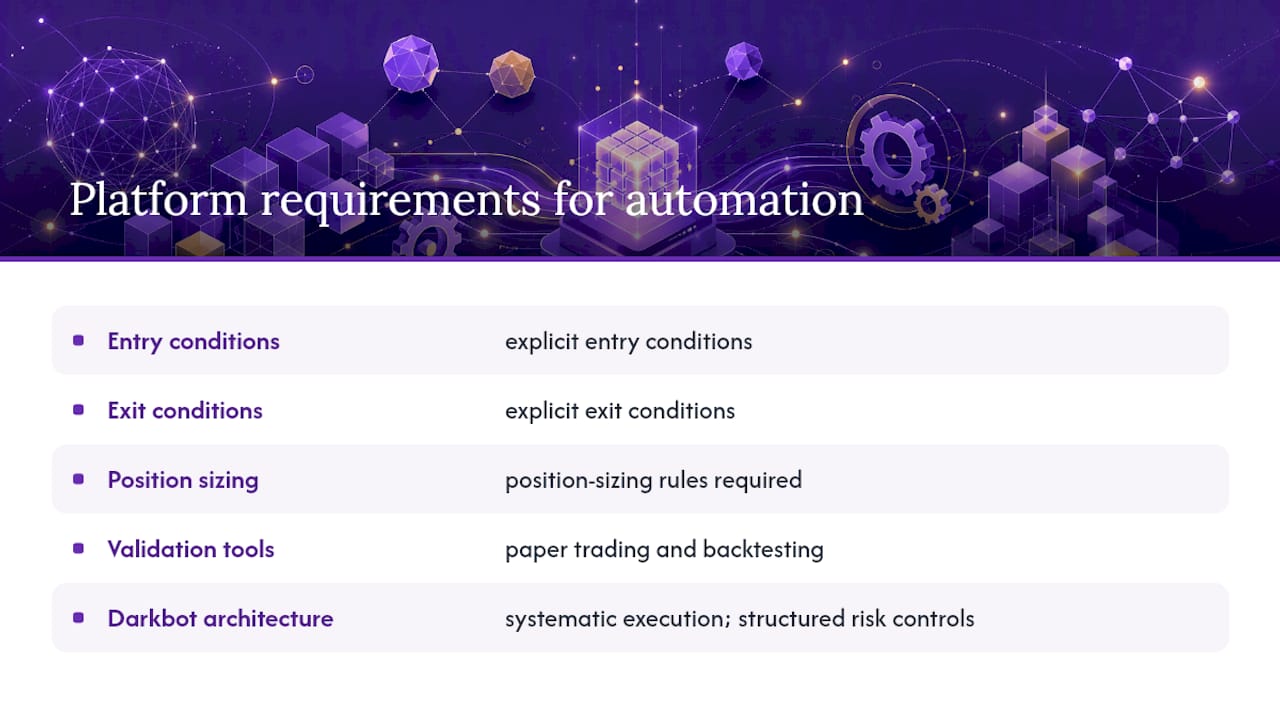
The platforms that matter most are the ones that force you to confront that gap before you go live: they require you to set explicit entry conditions, exit conditions, and position-sizing rules, and they give you paper trading and backtesting tools to validate those rules against real market behavior. That process is where the actual work happens. The AI layer on top of it adds consistency and pattern recognition, but it cannot substitute for the discipline of defining the strategy in the first place.
Darkbot’s architecture reflects that priority: the platform is built around systematic execution and structured risk controls, not around generating signals or promising outcomes. For traders who want to automate seriously, that distinction matters more than any feature list.
Darkbot: structured automation with a free entry point
Most traders evaluating automated crypto platforms spend weeks comparing feature lists before realizing the real differentiator is how a platform handles the moment a strategy fails: does it log the failure, alert you, and stop cleanly, or does it keep executing silently?
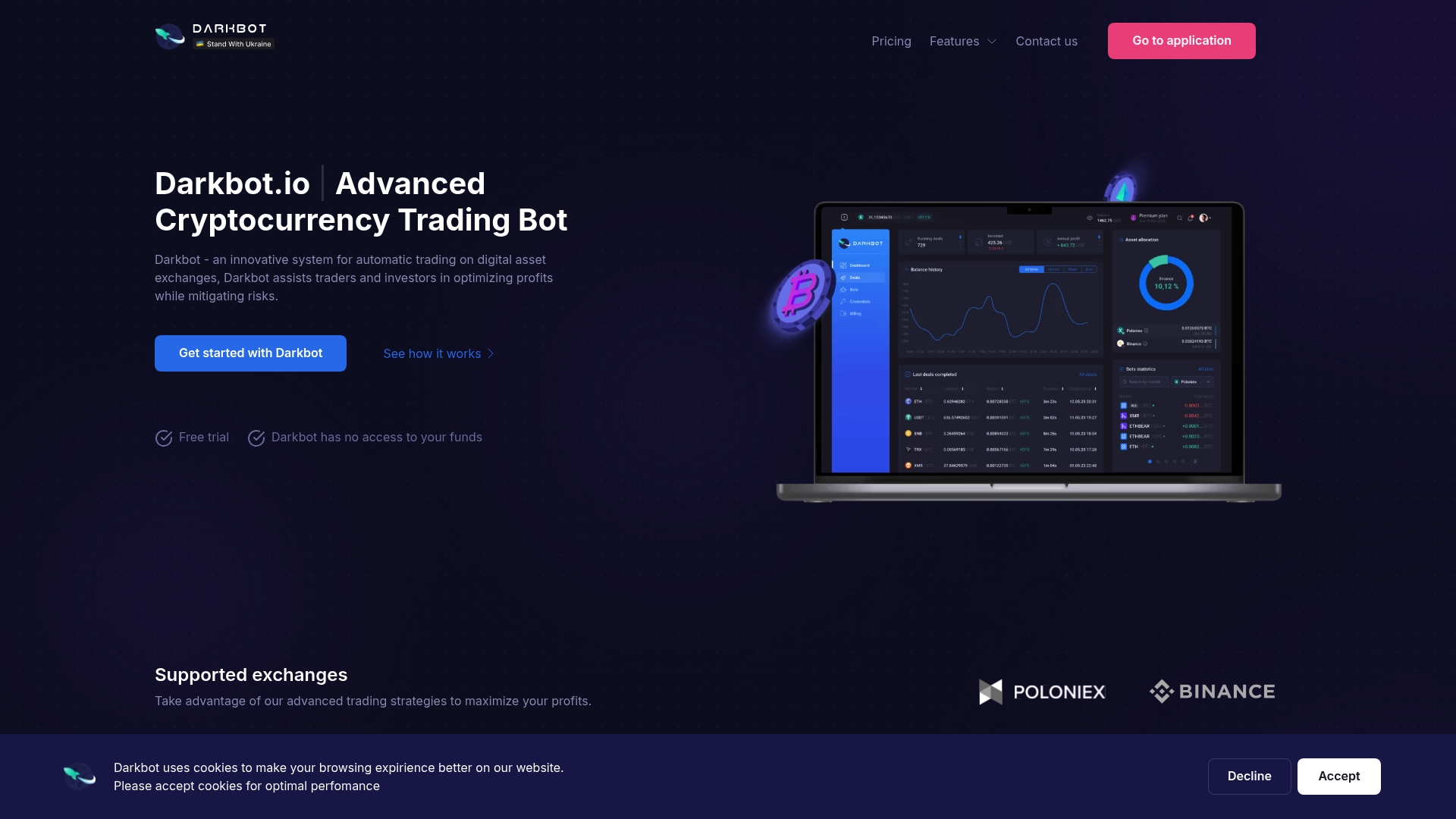
Darkbot is built around that operational discipline. The platform covers exchange API integration, backtesting, paper trading, portfolio management, automated rebalancing, and real-time analytics in a single subscription, with a free tier that lets you test the full workflow before paying. The 14-day money-back guarantee on paid plans removes the commitment risk. Security defaults include trading-only API guidance and documented key-handling practices.
Start with the free tier at darkbot.io, run a paper-trading session, and validate your strategy against real exchange data before committing capital.
Useful sources and documentation
- AI automated trading platforms: The complete guide — covers AI architecture, no-code platform tradeoffs, and what to look for in a bot’s ML layer
- Crypto trading bot mistakes to avoid before going live — detailed breakdown of silent failure modes: stale feeds, fee errors, and rejected orders
- Automated trading checklist: crypto strategies and risk — Darkbot’s deployment checklist covering strategy validation, risk controls, and monitoring setup
- Crypto trading strategy optimization for automation — guidance on defining and refining strategy rules before handing them to an execution engine
Recommended

Start trading on Darkbot with ease
Come and explore our crypto trading platform by connecting your free account!
Free plan available • No credit card required