The Digital Asset Allocation Process for Investors

The digital asset allocation process runs in two stages: first, set a strategic target exposure sized relative to your total-portfolio risk; second, implement that target through custody selection, asset choice, and documented rebalancing rules. According to investor.gov, rebalancing is what prevents any single asset class from dominating a portfolio as growth rates diverge. Index research commonly cites the 2–7% Bitcoin allocation zone as a practical starting heuristic for improving risk-adjusted returns within a traditional portfolio. Darkbot is one platform built to handle the execution and rebalancing side of that process automatically.
One terminology note worth making early: the CFA Institute flags a common confusion between “digital asset management” (enterprise file and media systems) and “digital asset allocation” (portfolio construction). This article is about the latter.
What does the digital asset allocation process look like end to end?
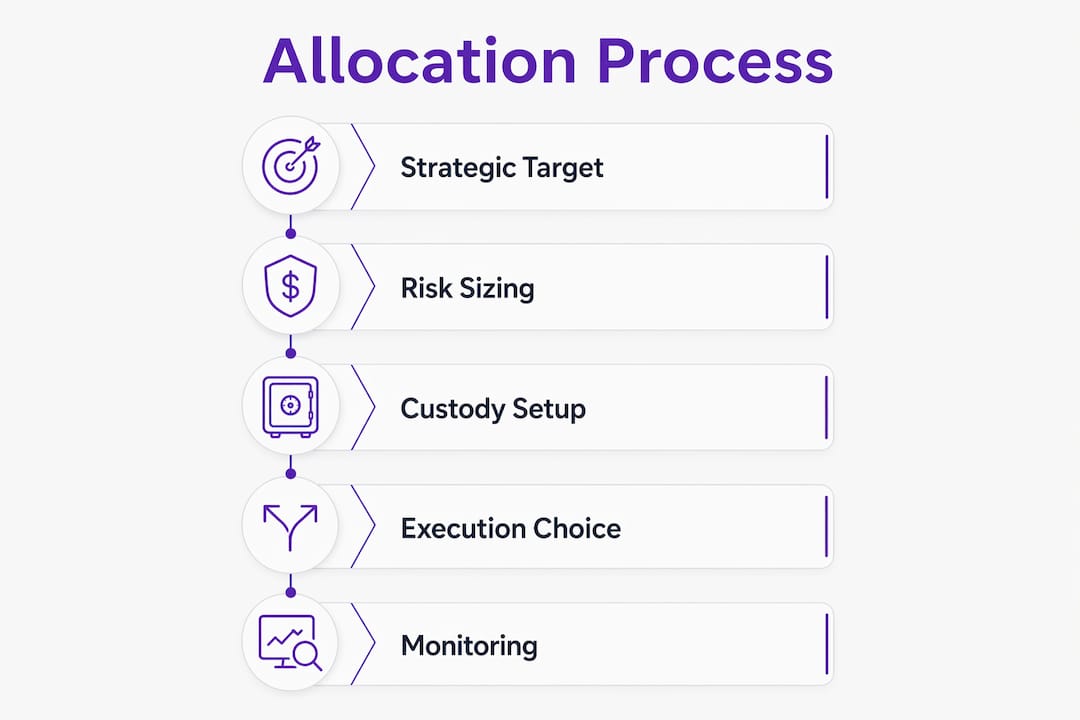
The sequence has five decision points, and the order matters. Strategy comes before implementation because sizing a position without knowing your risk budget is how allocations go wrong under stress.
- Define objectives and constraints. Set your return target, time horizon, liquidity needs, and maximum tolerable drawdown. A financial goal timeline is a useful starting frame here.
- Choose an allocation framework. Decide whether crypto plays a growth-satellite, diversifier, or liquidity role in the broader portfolio.
- Select custody and execution path. Determine where assets are held and how trades are routed.
- Set rebalancing rules. Document the trigger type, band widths, and tax-aware exception logic before going live.
- Operationalize monitoring and reporting. Define KPIs, alert thresholds, and a reporting cadence.
Each step feeds the next. Skipping step four, for instance, means your allocation drifts silently until a volatility event forces a reactive decision.
How do you size a crypto allocation using a risk-first method?
Weight alone is a poor guide. A 5% nominal allocation to Bitcoin can contribute 20–30% of total portfolio variance depending on correlation regimes. Franklin Templeton’s institutional research recommends integrating digital assets into the portfolio benchmark and sizing them with a risk-forward lens rather than treating crypto as a standalone bet.

The practical approach: measure the marginal contribution to portfolio variance when you add a crypto position, then size until that marginal contribution stays within your stated risk budget.
Two short scenarios:
| Investor Profile | Total Portfolio | Target Crypto Sleeve | Rationale |
|---|---|---|---|
| Conservative | balanced (60/40) | 2–7% | Limits crypto’s variance contribution; BTC only |
| Growth-oriented | equity-heavy | 2–7% | Higher risk tolerance; BTC/ETH core plus small thematic satellite |
Role-based mapping helps govern this further. Stablecoins fill the liquidity role, tokenized fixed income covers lower-volatility yield, BTC and ETH serve as the core, and DeFi or thematic tokens act as growth satellites. Back-tested institutional models showed that small crypto sleeves introduced with systematic rebalancing improved Sharpe and Sortino ratios while keeping incremental drawdowns manageable.
What execution choices do you need to make before going live?
Custody models
Three options dominate in the U.S., each with distinct trade-offs:
- Self-custody (hardware wallet, multi-sig): full control, no counterparty risk, but you own key management and disaster recovery entirely.
- Custodial exchange accounts (Coinbase, Kraken, etc.): liquid, tax-reporting integrations available, but subject to exchange risk and withdrawal limits.
- Insured institutional custody (Coinbase Custody, BitGo, Anchorage Digital): suited for larger allocations; provides SOC 2 compliance and insurance coverage, at higher cost.
Asset selection checklist
Before adding any token to the sleeve, verify:
- Sufficient daily liquidity (can you exit a full position in one day without moving the market?)
- Market capitalization and on-chain activity trends
- Regulatory clarity under current U.S. SEC and CFTC guidance
- Taxable event profile (staking rewards, DeFi interactions, and token swaps all trigger reportable events)
U.S. tax and recordkeeping
The IRS treats crypto as property. Every disposal, swap, or staking reward is a taxable event. From day one, maintain: cost basis per lot (FIFO or specific identification), chain transaction receipts, staking reward logs with fair-market value at receipt, and transfer histories between wallets and exchanges. Tax software integrations (CoinTracker, Koinly, TaxBit) can automate much of this, but the underlying records must exist.
Which rebalancing approach works best for a crypto portfolio?
Three trigger styles exist, and they are not equally suited to crypto’s volatility profile.
Time-based (e.g., quarterly): predictable, aligns with reporting cycles, but can force trades at poor prices and generate unnecessary taxable events in high-volatility periods.
Band/threshold-based (e.g., rebalance when any asset moves ±5–20% outside its target weight): practitioners widely prefer this for crypto because it triggers only when drift is meaningful, reducing fee drag and taxable events.
Volatility/drawdown triggers: rebalance when realized volatility exceeds a threshold or when a position hits a predefined drawdown level. Useful as a risk-control layer on top of band triggers.
Two rule templates worth documenting:
Tax-aware rule: Rebalance when any asset drifts more than 10% outside its target weight. Before executing, check whether the position is short-term or long-term for capital gains purposes. Defer the trade by up to 30 days if crossing the long-term threshold is within reach.
Liquidity-aware rule: Rebalance core positions (BTC/ETH) via band triggers. For illiquid satellite tokens, set a wider band (±15–20%) and require a minimum trade size to justify fees.
Pro Tip: Set your rebalancing bands before you fund the account. Deciding band widths during a drawdown introduces emotional bias into what should be a mechanical rule.
For a deeper look at band mechanics, crypto rebalancing mechanics covers the operational detail.
What should you complete before committing capital?
The operational backbone determines whether your thesis survives a stress event. Run through this checklist before funding:
- Custody proof-of-control test: Send a small test transaction to and from each wallet or custodian. Confirm withdrawal limits and settlement times.
- KYC/AML review: Verify all exchange accounts are fully verified; institutional custody agreements are signed and countersigned.
- Tax-accounting plan: Confirm cost-basis method (FIFO vs. specific identification) with your CPA before the first trade.
- Multi-signature or institutional routing: For allocations above a personal risk threshold, route to multi-sig or institutional custody rather than a single-key wallet.
- Disaster recovery: Document seed phrase storage, key recovery procedures, and a named successor or executor who can access the plan.
- Minimum recordkeeping: Cost basis per lot, chain receipts, staking reward logs, and transfer histories.
Pro Tip: Structure custody as a liquidity ladder. Keep core BTC/ETH positions in fully liquid custodial or self-custody arrangements. Place satellite holdings with longer settlement profiles in separate custody, so a forced sale of illiquid assets never becomes necessary to meet a short-term cash need.
How do you monitor a live allocation?
Practical KPIs to track on at least a weekly basis:
- Portfolio weight drift per asset vs. target
- Realized and unrealized P&L by position
- Marginal contribution to total portfolio volatility (recalculate monthly)
- Liquidity buffer as a percentage of total crypto sleeve
- Open orders and failed withdrawal counts
Alert examples worth configuring: BTC weight exceeds X% of the crypto sleeve; any custody transfer pending longer than Y hours; realized volatility on any single token exceeds a 30-day rolling threshold.
Quarterly stress tests should cover three scenarios: an extreme drawdown (40–60% crypto sleeve decline), an exchange connectivity failure (can you access funds via an alternative path?), and a staking slashing event on any yield-bearing position. Pre-plan the response to each before it happens. Smart automation for risk controls can handle alert routing and some automated responses.
What do concrete allocation frameworks look like?
| Framework | BTC | ETH | Stablecoins | Thematic/Satellites | Rebalancing Rule |
|---|---|---|---|---|---|
| Conservative | a small BTC portion | none | a small stablecoin portion | none | Quarterly + moderate band |
| Balanced | a moderate BTC portion | a small ETH portion | a small stablecoin portion | a small satellite allocation | Quarterly + tighter band |
| Growth-oriented | a larger BTC portion | a larger ETH portion | a small stablecoin portion | a modest satellite allocation | Monthly check + tight band |
All percentages are expressed as a share of total portfolio value. Per-token caps matter: even in the growth framework, no single satellite token should exceed 1% of total portfolio value, because a small nominal weight can still dominate risk contribution when volatility is high.
For the conservative framework, a quarterly review with a ±10% band is sufficient. The balanced framework benefits from a tighter ±7% band given the additional ETH exposure. The growth framework warrants monthly monitoring and a ±5% band, with explicit exception rules for any satellite token that becomes illiquid.
How does automation fit the allocation process?
Automation is most valuable for execution and monitoring. It is least appropriate for thesis changes and tax elections, which require human judgment.
Features to evaluate in any automation platform:
- Exchange API support across major U.S.-accessible venues
- Portfolio-level rebalancing with configurable band triggers
- Backtesting and paper-trading (dry-run) mode to validate rules before going live
- Custody-safe order routing that avoids over-concentration in a single exchange
- Audit logs for tax and compliance recordkeeping
What to automate: rebalancing triggers, order slicing to minimize slippage, and monitoring alerts. What to keep manual: changes to the strategic target, cost-basis method elections, and decisions about adding new asset classes.
Darkbot is built around this division. Its portfolio management features include configurable rebalancing bands, multi-exchange API integration, and audit logs. The platform supports backtesting and a paper-trading mode, so you can validate your rebalancing rules against historical data before committing real capital. For disciplined execution without manual order management, it covers the operational requirements described throughout this guide.
Key Takeaways
A disciplined digital asset allocation process requires strategy before implementation, documented rebalancing rules, and an operational backbone in place before any capital is committed.
| Point | Details |
|---|---|
| Two-stage process | Set strategic targets first, then implement custody, assets, and rebalancing rules. |
| Risk-first sizing | Measure marginal variance contribution, not just nominal weight; the 2–7% Bitcoin zone is a common institutional starting heuristic. |
| Band-based rebalancing | Threshold triggers (±5–20%) suit crypto better than fixed-time schedules for managing fees and taxable events. |
| Operational backbone | Document custody tests, cost-basis method, and disaster recovery before funding the account. |
| Darkbot for execution | Darkbot’s portfolio rebalancing, API integration, and audit logs support disciplined automated execution of the process described here. |
The case for process discipline over market conviction
Most allocation mistakes are not thesis mistakes. They are process mistakes: an allocation sized by gut rather than risk contribution, a rebalancing rule that was never written down, a custody arrangement that could not handle a withdrawal request during a volatile weekend. The investment thesis can be directionally correct and still produce poor outcomes if the operational layer is absent.
The 2–7% heuristic is a starting point, not a destination. What actually determines whether a crypto sleeve adds value is whether the rebalancing rules are consistently followed, whether the tax plan was set before the first trade, and whether the monitoring cadence catches drift before it becomes a problem. Automation handles the consistency part. The judgment calls, including when to revise the thesis and how to handle tax elections, still belong to the investor.
Validate your operational readiness before committing capital. The checklist in this guide is a reasonable minimum.
Darkbot handles the execution layer so you can focus on the strategy
Sizing a crypto allocation correctly and writing down rebalancing rules is the hard intellectual work. Executing those rules consistently, across multiple exchanges, without missing a trigger or generating an unnecessary taxable event, is where most manual processes break down.
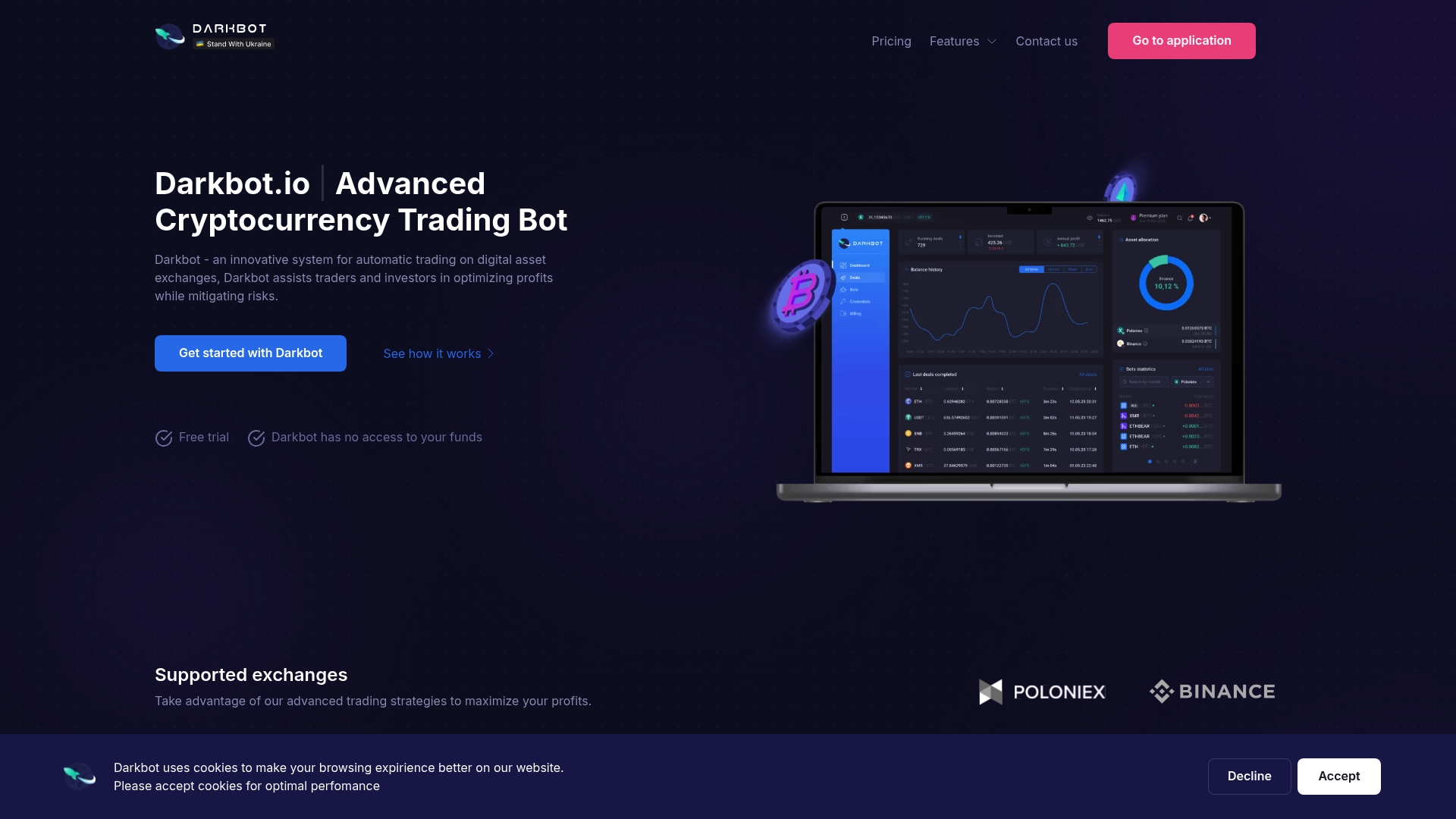
Darkbot is built for that execution layer. The platform connects to major U.S.-accessible exchanges via API, applies your configured rebalancing bands automatically, and maintains audit logs that simplify tax reporting. Before committing real capital, you can run your rules in paper-trading mode to confirm the logic behaves as intended. Pricing includes a free tier and a 14-day money-back guarantee on paid plans, so testing the operational flow carries no upfront commitment.
Start with the Darkbot platform to evaluate whether automated execution fits your allocation process.
Useful sources for further reading
The following sources informed the recommendations in this guide. For personalized tax advice, consult a CPA or tax attorney familiar with U.S. cryptocurrency reporting requirements.
- Investor.gov: Beginner’s Guide to Asset Allocation — foundational two-stage allocation and rebalancing framework; supports the process overview section.
- CFA Institute: Principles of Asset Allocation — terminology clarity on digital asset allocation vs. digital asset management.
- Franklin Templeton: Intuitive Framework for Incorporating Digital Assets — risk-forward sizing and benchmark integration methodology.
- Blockchain Council: Digital Asset Portfolio Construction, Allocation & Rebalancing — role-based frameworks, rebalancing mechanics, and the 2–7% heuristic.
- Blockchain Council: Digital Asset Investment Strategies — band-trigger rationale and tax-aware exception rules.
- 21Shares: Managing Digital Assets in Client Portfolios — back-tested evidence on risk-adjusted outcomes with systematic rebalancing.
- Ledgerstone: Designing a Digital Asset Allocation — operational backbone guidance and liquidity ladder concept.
- Darkbot Help and Docs — platform-specific operational steps for automated rebalancing and portfolio management.
This article is general information, not legal, tax, or investment advice. Verify current IRS guidance and exchange regulations with a qualified professional before making allocation decisions.
Recommended

Start trading on Darkbot with ease
Come and explore our crypto trading platform by connecting your free account!
Free plan available • No credit card required