Automated Profit-Taking Strategy: A Crypto Trader's Guide
TL;DR:
- Automated profit-taking strategies utilize rule-based algorithms to lock in gains at predefined levels without manual input.
- Proper setup involves pairing a take-profit order with a stop-loss, testing in paper trading, and adjusting parameters for market conditions.
An automated profit-taking strategy is a rule-driven algorithm or bot that closes part or all of a position when predefined conditions are met, locking in gains without requiring manual input. The logic is reactive, not predictive: when price hits your target, the order fires. A take-profit order is technically a limit order that closes a position at a specified price, and it works best when paired with a stop-loss to define the trade’s full risk-to-reward profile.
Before going live, the most practical first step is to configure a conservative take-profit plus stop-loss pair on a small position and run it through paper trading for at least one complete market cycle. Crypto markets run 24/7, move fast, and can gap sharply on thin liquidity, which means manual exits are often too slow or too emotional to be reliable. Automation solves the execution problem; sound design solves everything else.
- Set a take-profit target at a level supported by your technical analysis.
- Pair it with a stop-loss to define maximum acceptable loss on the trade.
- Size the position small enough that a full loss is tolerable.
- Paper-trade the setup for several weeks before committing real capital.
Pro Tip: Start with a balanced risk-to-reward ratio as a baseline, for example, risking a smaller percentage of your entry price aiming for about double the reward. Adjust only after backtesting confirms the ratio fits your asset and timeframe.
What types of automated profit-taking strategies should you know?
Strategy choice depends on market structure, your holding period, and how much of a move you want to capture. There is no single best template, but each type has a clear use case.
Fixed take-profit (single limit order) closes the entire position at one predetermined price. It suits short-term trades with a clear technical target, such as a resistance level or a Fibonacci extension. The advantage is simplicity; the drawback is that a strong trend continuation leaves money on the table.
Partial exits and laddering split the position into tranches and close each at a higher level. A swing trader might exit 40% at the first target, 40% at the second, and let the final 20% run with a trailing stop. This approach balances locking in gains against staying exposed to extended moves.
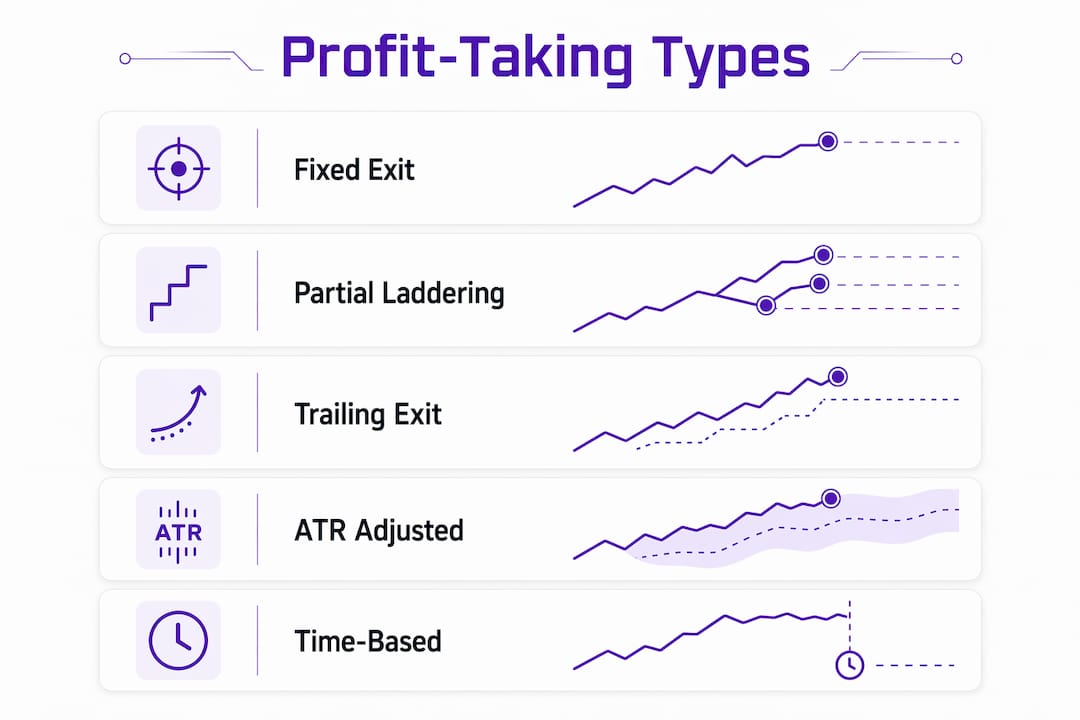
Trailing take-profit sets a dynamic exit that follows price upward by a fixed percentage or pip distance, then triggers only after price reverses by that distance. Trailing take-profit executes only after the position moves in the trader’s favor and the trailing distance is later breached, which makes it well-suited to trending markets where the final target is uncertain.
ATR-adjusted trailing exits replace the fixed trailing distance with a multiple of the Average True Range, so the exit distance widens automatically in volatile conditions and tightens when volatility compresses. For crypto altcoins with irregular volatility, this adaptation reduces premature exits during normal noise.
Time-based exits close the position after a set number of hours or candles regardless of price. Event-driven traders use this to avoid overnight or weekend exposure when a catalyst has already played out.
Indicator-based exits tie the close to a signal condition: an EMA cross, an RSI reading above 70, or a MACD histogram flip. These combine signal logic with profit-taking and work well when a strategy already uses indicator entries.
Pro Tip: For volatile altcoins, prefer ATR-adjusted trailing exits over fixed-percentage trailing stops. A fixed 3% trail that works on BTC may trigger on normal noise for a low-cap token with a 10% daily ATR.
Two short examples
-
BTC swing trade with laddered exits. Entry at $62,000. First exit: 50% of position at $65,100 (5% gain). Second exit: 30% at $68,200 (10% gain). Remaining 20% trails with a 4% ATR-based stop. This structure captures the high-probability first target while keeping partial exposure to a larger move.
-
Short-term scalp with fixed TP. Entry at $2,400 on ETH. Take-profit at $2,448 (2% gain). Stop-loss at $2,376 (1% loss). Full position exits at the first target. Clean, fast, and easy to backtest across hundreds of trades.
How does automated profit-taking actually execute?
Understanding the mechanics between your strategy logic and the exchange matching engine prevents costly surprises.
Order types in practice
A limit take-profit places a resting sell order at your target price. It fills at that price or better, but it can miss the fill entirely if price touches the level and reverses before the order matches. A conditional limit (sometimes called a stop-limit) activates a limit order only after a trigger price is reached. An OCO (one-cancels-other) pairs a take-profit limit with a stop-loss stop-limit; when one fills, the exchange cancels the other automatically. A market exit fallback forces a fill at any available price and is useful when speed matters more than price precision, though slippage is guaranteed.
API execution and exchange mechanics
Bots communicate with exchanges via REST or WebSocket APIs using authenticated API keys. Every request carries a signature tied to the key, and exchanges enforce rate limits, typically measured in requests per second or per minute. Exceeding those limits causes rejected orders, which a well-built bot handles with retry logic and exponential backoff.
Order book depth determines slippage. A 0.5 BTC limit order in a deep market fills cleanly; the same order in a thin altcoin market may consume several price levels and average a worse fill than expected. Partial fills are common: the exchange may match 60% of your order immediately and queue the rest. On perpetual futures, autosell tools are especially critical because leverage magnifies adverse moves and positions have no natural expiry to force a close.
Maker/taker fee structures reward limit orders (maker) with lower fees than market orders (taker). Placing your take-profit as a limit order rather than a market order typically saves fees and reduces slippage simultaneously, though it introduces fill uncertainty.
Pro Tip: Avoid placing aggressive market exits during low-liquidity windows, such as late Sunday UTC on smaller altcoin pairs. Spread widens, slippage increases, and a market order can fill several percent below your intended exit price.
How do you design, backtest, and tune a profit-taking strategy?
Moving from a hypothesis to a reliable live rule requires a structured sequence. Skipping steps, especially backtesting and paper trading, is the most common reason automated strategies underperform their design.
- Define the goal. Specify what the strategy is trying to capture: a fixed percentage gain, a trend continuation, or a volatility spike exit.
- Choose take-profit logic. Select the exit type (fixed, trailing, indicator-based) that matches the market structure you expect.
- Pair with stop-loss and position-sizing rules. Every take-profit needs a defined maximum loss and a position size that keeps total risk within your portfolio limit. Systematic risk management in crypto starts here.
- Select datasets and timeframes. Use at least two years of data covering different market regimes: a bull run, a bear phase, and a sideways period.
- Backtest with realistic assumptions. Good backtests simulate exchange mechanics and transaction costs; otherwise results are likely to overstate live performance. Include maker/taker fees, estimated slippage per trade, and partial fill behavior.
- Walk-forward test. Optimize on one data window, then validate on an out-of-sample period. Repeat across multiple windows to check whether the parameter set holds.
- Paper-trade. Run the validated parameters in a live market environment without real capital for at least two to four weeks.
- Set monitoring and alerting. Define what constitutes abnormal behavior (fill rate drops, drawdown exceeds threshold) and configure alerts before going live.
Backtest metrics to collect
| Metric | What it measures | Why it matters |
|---|---|---|
| Win rate | Percentage of trades that close at take-profit | Context for expectancy; high win rate alone is insufficient |
| Average return per trade | Mean gain/loss per closed trade net of fees | Indicates edge size after costs |
| Maximum drawdown | Largest peak-to-trough equity decline | Stress-tests position sizing and stop-loss placement |
| Expectancy | (Win rate × avg win) minus (loss rate × avg loss) | Single number summarizing whether the strategy has positive edge |
| Slippage impact | Difference between theoretical and simulated fill prices | Reveals whether the strategy survives realistic execution |
Pro Tip: Limit parameter permutations during optimization. If a strategy only works within a narrow band of one specific parameter, it is almost certainly overfit. Prefer parameter families where performance degrades gradually as you move away from the optimum, not sharply.
What are the main risks of automated profit-taking and how do you reduce them?
Automation shifts risk from execution to strategy design and operational setup. The failure modes are different from manual trading, not fewer.
Operational risks
- API key compromise: Use least-privilege keys (trade-only, no withdrawal permissions), restrict to a specific IP allowlist, and rotate keys on a scheduled basis.
- Bot errors and missed orders: Implement order confirmation reconciliation; if the expected fill confirmation does not arrive within a timeout window, trigger an alert.
- Rate limit breaches: Build exponential backoff and retry logic; log all rejected requests for review.
Market risks
Low liquidity, flash crashes, and exchange outages can all cause exits to miss or fill at severely worse prices. Limit orders reduce slippage but introduce fill uncertainty. Size positions relative to order book depth: a position that represents more than a small fraction of the visible bid/ask at your target level will move the market against you on exit. On leveraged perpetuals, small adverse moves can rapidly liquidate positions, making disciplined stop-loss placement non-negotiable.

Design risks
Static parameters in a shifting regime are a common source of underperformance. A trailing distance calibrated during a low-volatility period will trigger prematurely when volatility expands. Automated trading systems require careful monitoring; failing to adjust parameters when markets change can cause poor outcomes. Schedule a parameter review at least monthly, or whenever 30-day realized volatility shifts materially.
Behavioral risk
The “set-and-forget” trap is real. Automation removes execution emotion but can create complacency about strategy maintenance. Set calendar reminders for periodic reviews and configure automated alerts for performance drift, unusual drawdown, or fill rate anomalies.
Pro Tip: The pros and cons of automated trading include consistent execution and emotion reduction, but also missed upside and over-optimization risk. Treat automation as a system that requires maintenance, not a passive income machine.
What do practical automated profit-taking setups look like?
Three concrete configurations cover most retail crypto use cases.
Setup A: Short-term scalp (fixed TP + tight SL)
- Entry: market or limit at a technical level (e.g., breakout confirmation).
- Take-profit: 2% above entry as a limit order.
- Stop-loss: 1% below entry (1:2 risk-to-reward).
- Position size: 2% of portfolio at risk per trade.
- Expected cadence: multiple trades per day on liquid pairs (BTC, ETH).
Setup B: Swing-trade laddered partial exits
- Entry: limit order at a pullback level within an uptrend.
- First exit: 40% of position at 5% gain.
- Second exit: 40% at 10% gain.
- Remaining 20%: trailing stop at 3% below highest close since entry.
- Stop-loss on full position: 3% below entry.
- Expected cadence: one to three trades per week.
Setup C: ATR-adjusted trailing take-profit for volatile altcoins
- Entry: confirmed momentum signal on a 4-hour chart.
- Trailing distance: 2× 14-period ATR at time of entry.
- Stop-loss: 1.5× ATR below entry.
- Position size: reduced to 1% of portfolio at risk (higher volatility).
- Expected cadence: one to two trades per week; wider swings, larger per-trade targets.
Worked example for Setup B. Entry: $3,000 on ETH, 1 ETH position. First exit at $3,150 (5%): sell 0.4 ETH, realize $60 gain. Second exit at $3,300 (10%): sell 0.4 ETH, realize $120 gain. Remaining 0.2 ETH trails; if price peaks at $3,500 and then drops 3% to $3,395, the trailing stop fires. Realized gain on final tranche: $79. Total realized gain: $259 on a $3,000 position, with defined risk throughout.
Trailing take-profit pseudo-code
highest_price = entry_price
trailing_distance = entry_ATR * 2

on each price update:
    if current_price > highest_price:
        highest_price = current_price
    trailing_stop_level = highest_price - trailing_distance
    if current_price <= trailing_stop_level:
        execute_exit(order_type="limit", price=trailing_stop_level)
        break
Pro Tip: For low-liquidity altcoins, use limit orders for exits rather than market orders. A market exit on a thin pair can fill 5–10% below your trailing stop trigger price, erasing a significant portion of the captured gain.
How do you implement a profit-taking strategy on Darkbot?
Darkbot maps directly to the strategy elements covered above: take-profit rules, partial exits, ATR-based trailing parameters, paper trading, backtesting, multi-exchange API integration, and portfolio rebalancing. The automated trading checklist below covers the full deployment sequence.
Step-by-step setup
- Connect your exchange API. Generate a trade-only API key with no withdrawal permissions. Add your IP address to the exchange allowlist. Paste the key into Darkbot’s integration panel.
- Configure strategy parameters. Set your take-profit type (fixed, laddered, or ATR trailing), define stop-loss levels, and specify position sizing rules.
- Run a backtest. Use Darkbot’s backtesting module with realistic fee and slippage assumptions. Review the metrics table from Section 4: win rate, expectancy, max drawdown, and slippage impact.
- Enable paper trading. Run the validated parameters in Darkbot’s paper trading mode for at least two weeks across varying market conditions.
- Set live safety limits. Configure maximum daily drawdown cutoffs and automated alerts for fill anomalies or performance drift before switching to live capital.
- Monitor and review. Check bot performance weekly. Schedule a full parameter review monthly or after any major volatility regime shift.
-
Darkbot supports multiple simultaneous bots, so you can run Setup A on BTC and Setup C on an altcoin concurrently without manual switching.
-
Real-time analytics let you track fill rates, realized gains per strategy, and portfolio-level exposure in one dashboard.
-
Darkbot’s portfolio rebalancing features integrate profit-taking with broader position management, so gains from closed trades can be reallocated automatically according to your target weights.
Pro Tip: Paper-trade a single strategy on one market for one full market cycle before adding complexity. A market cycle on a 4-hour chart is roughly two to four weeks of varied price action. Resist the urge to run five strategies simultaneously from day one.
What does it cost and how long does it take to go live?
Cost categories
- Exchange fees: Maker fees typically range from low fractions of a percent per trade; taker fees run slightly higher. These compound across many trades and must be included in your backtest assumptions.
- Slippage: Varies by pair liquidity and order size. Budget 0.05%–0.3% per trade for liquid pairs; more for altcoins.
- Historical data: Many exchanges provide free OHLCV data via API. Paid data services add cost for tick-level or cross-exchange datasets.
- Bot subscription: Darkbot offers a free plan with limited features, plus standard and premium tiers for traders who need multiple simultaneous bots and advanced strategy parameters.
- Operational costs: Time for monitoring, parameter reviews, and occasional manual intervention.
Timeline phases
- Design and parameter selection: 1–3 days for a straightforward fixed or trailing TP strategy.
- Backtesting and walk-forward testing: 1–2 weeks, longer if you are testing across multiple assets or timeframes.
- Paper trading and tuning: 2–6 weeks. Complex strategies with multiple exit ladders or cross-exchange logic take longer to validate.
- Live rollout: 1–2 days incremental, starting with minimum position sizes.
A small retail trader running a single BTC swing strategy on Darkbot’s standard plan, paying typical exchange maker fees, can realistically complete the full cycle from design to live in three to six weeks. The main driver of longer timelines is paper-trading duration: cutting it short is the most common reason live performance diverges from backtest results.
Key Takeaways
An automated profit-taking strategy only delivers consistent results when it is built on realistic backtests, paired with a stop-loss, and reviewed regularly as market conditions shift.
| Point | Details |
|---|---|
| Define rules before deploying | Specify take-profit type, stop-loss level, and position size before any live capital is at risk. |
| Backtest with real costs | Include maker/taker fees, slippage, and partial fills; optimistic assumptions produce misleading results. |
| Pair TP with stop-loss always | A take-profit without a stop-loss leaves downside unlimited; the pair defines the trade’s full risk-to-reward. |
| Monitor and update regularly | Static parameters in a shifting volatility regime cause drift; schedule monthly reviews and configure automated alerts. |
| Darkbot for implementation | Darkbot provides backtesting, paper trading, ATR trailing, partial exits, and multi-exchange API integration in one platform. |
Why automation requires more discipline, not less
The most persistent misconception about automated profit-taking is that it reduces the work required to trade well. It does not. Automation removes execution emotion and enforces consistency, but it transfers the cognitive load from real-time decisions to upfront design and ongoing maintenance. A poorly designed automated strategy executes its mistakes faster and more reliably than a human would.
Three things matter more than most guides acknowledge. First, review cadence is not optional. Markets shift regimes, and a trailing distance that worked in a trending quarter will underperform in a choppy one. Monthly reviews are a minimum; after any significant volatility event, review immediately. Second, over-optimization is the most common design failure. A strategy that only works with one specific parameter combination across one specific historical window is not a strategy; it is a coincidence. Prefer parameter ranges that show stable performance across multiple lookback windows. Third, paper-trade results are directional, not predictive. They tell you whether the logic is sound and whether fills are roughly as expected. They do not guarantee live performance, because live markets have microstructure effects, latency, and liquidity conditions that paper trading approximates but never fully replicates.
The gap between a well-designed automated strategy and a profitable one is almost always in the maintenance, not the initial setup.
Darkbot gives you a structured path from strategy to live execution
Traders who have worked through the design and backtesting process in this guide need a platform that matches that level of rigor. Darkbot is built for exactly that: systematic execution, not signal chasing. The strategy builder supports fixed take-profit, laddered partial exits, and ATR-adjusted trailing stops. The backtesting module runs against historical exchange data with configurable fee and slippage assumptions. Paper trading lets you validate parameters in live market conditions before any real capital is committed.
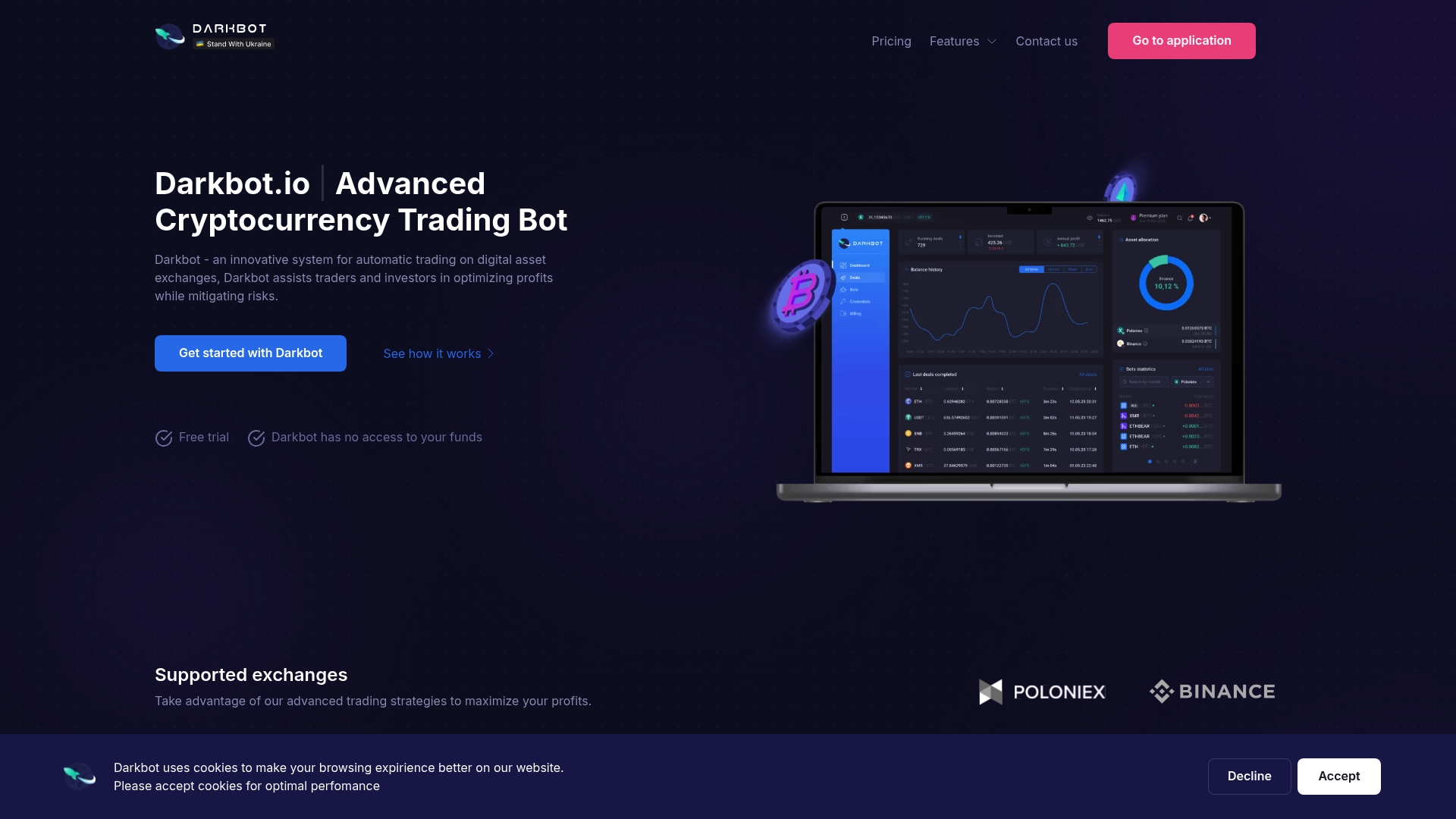
Operationally, Darkbot connects to major exchanges via least-privilege API keys, monitors fill rates and portfolio exposure in real time, and sends automated alerts when performance drifts outside defined bounds. The portfolio management layer integrates profit-taking with rebalancing, so closed-trade proceeds can be reallocated according to your target weights without manual intervention. A free plan is available for traders who want to explore the platform before committing to a paid tier. To get started, connect your exchange API on Darkbot, configure a single strategy, and run it in paper trading mode for two weeks.
Useful sources
- Take-Profit Order (TP): How to Maximize Profits in Trading — Investopedia: The primary definition of take-profit orders, risk-to-reward mechanics, and how they pair with stop-loss orders.
- What Are Take-Profit and Stop-Loss Orders? — IG International: Practical explainer on how both order types work together and their advantages and limitations.
- The Pros and Cons of Automated Profit Taking — StockBrokerReview: Balanced overview of execution benefits, over-optimization risk, and the monitoring requirements of automated systems.
- What Are Take-Profit and Stop-Loss Orders? Auto-Selling for Perpetual Futures — Kalshi: Explains why autosell tools are especially critical on leveraged perpetual futures contracts.
- What Is Backtesting in Trading: A 2026 Guide — Funding Optimal: Best practices for building realistic backtests, including fee, slippage, and partial fill simulation.
- Automated Trading Strategies: How It Works — IT Craft: Covers the standard workflow from strategy formulation through backtesting and live deployment.
This article is general information for educational purposes, not financial or investment advice. Confirm current exchange rules, fee structures, and regulatory requirements with the relevant primary sources or a qualified professional before deploying any live trading strategy.
Recommended

Start trading on Darkbot with ease
Come and explore our crypto trading platform by connecting your free account!
Free plan available • No credit card required