Crypto Portfolio Checklist: Build and Manage Smarter

TL;DR:
- A crypto portfolio checklist provides a structured framework for goal-setting, diversification, rebalancing, custody, and risk management. Following it helps mitigate volatility, emotional trading, and security risks, ensuring disciplined investment practices. Automated tools like Darkbot can streamline execution, maintaining consistent adherence to these core principles.
A crypto portfolio checklist is a structured framework that guides investors through every critical decision in building and managing a digital asset portfolio. Without one, volatility and emotional trading erode even well-researched positions. Tools like CoinGecko Portfolio, Delta, and hardware wallets from Ledger and Trezor are part of the broader ecosystem, but the checklist itself is the logic layer that connects them. A complete checklist covers goal-setting, diversified exposure, periodic rebalancing, and secure custody controls.
1. Set clear investment goals and risk limits
The first item on any crypto investment checklist is defining what you are actually trying to achieve. Without a stated objective, every market move becomes a reason to act. Goals fall into three categories: capital accumulation (growing total value over time), capital preservation (protecting existing wealth), and income generation (earning yield through staking or lending).

Risk tolerance is the second variable. Your investment horizon determines how much short-term drawdown you can absorb without abandoning your strategy. A five-year horizon allows for higher exposure to volatile altcoins. A 12-month horizon demands a more conservative allocation weighted toward Bitcoin and stablecoins.
EY’s six-pillar framework for token due diligence identifies reputational, technical, financial, legal, cybersecurity, and auditability risks as distinct dimensions. Applying these pillars to your goal-setting process forces you to think beyond price. A token may look financially attractive but carry unacceptable legal or cybersecurity risk for your profile.
Use these questions to anchor your risk assessment:
- What is my target return over 12, 24, and 60 months?
- What percentage loss can I absorb without changing my strategy?
- Do I have liquidity needs that require holding stablecoins or cash equivalents?
- Am I comfortable with self-custody, or do I need exchange-based custody?
Pro Tip: Write your risk limits as hard numbers before you buy a single asset. “I will not allocate more than 10% to any single altcoin” is a rule. “I prefer less risky assets” is not.
2. Build a diversified portfolio across asset categories
Asset allocation is the primary determinant of portfolio outcomes. The right mix depends on your risk tolerance and investment duration, not on market sentiment or social media momentum.
Crypto assets fall into five core categories:
- Bitcoin (BTC): The highest liquidity, longest track record, and lowest correlation to altcoin volatility. Serves as the portfolio anchor.
- Ethereum (ETH): Broad ecosystem exposure through DeFi, NFTs, and Layer 2 protocols. Higher volatility than Bitcoin but with stronger utility fundamentals.
- Altcoins: Higher growth potential and higher risk. Includes Layer 1 competitors, DeFi tokens, and sector-specific projects.
- Stablecoins: USDC and USDT provide liquidity buffers and reduce drawdown exposure during bear markets.
- Tokenized assets: Emerging category including tokenized real estate and commodities. Adds cross-asset diversification.
A common starting allocation for a moderate-risk profile is 50% Bitcoin, 30% Ethereum, and 20% split across altcoins and stablecoins. Aggressive profiles shift more toward altcoins. Conservative profiles increase stablecoin weight.
| Asset category | Conservative | Moderate | Aggressive |
|---|---|---|---|
| Bitcoin | 60% | 50% | 30% |
| Ethereum | 20% | 30% | 30% |
| Altcoins | 5% | 10% | 30% |
| Stablecoins | 15% | 10% | 10% |
Stablecoin risk deserves specific attention. Reserve transparency and redemption mechanics matter as much as peg stability. A stablecoin that maintains its dollar peg but reduces reserve disclosure frequency is signaling rising risk. Monitor reserve reports routinely, not just during market stress.
Cross-asset correlations also shift during market cycles. In bull markets, altcoins often move independently of Bitcoin. In sharp corrections, correlations compress and most assets fall together. Your diversification strategy must account for this compression, not assume permanent independence.
3. Schedule periodic reviews and rebalancing triggers
Portfolio drift is the silent risk in any digital asset checklist. Bitcoin appreciates 40% while your altcoin positions stagnate, and suddenly your target allocation is meaningless. Rebalancing restores your intended risk exposure.
Two rebalancing methods exist: calendar-based and threshold-based. Calendar rebalancing runs on a fixed schedule, monthly, quarterly, or annually. Threshold rebalancing triggers a review only when an asset drifts beyond a set percentage from its target weight.
The best practice combines both: a quarterly calendar review plus a ±5% drift trigger. This approach catches significant allocation shifts without generating unnecessary trades. Trades occur only when assets move meaningfully from target weights, which reduces fees and taxable events.
Follow these steps at each review:
- Pull current holdings from your crypto asset tracker (CoinStats, CoinTracker, or Delta).
- Calculate each asset’s current weight as a percentage of total portfolio value.
- Compare current weights against your target allocation.
- Identify assets that have drifted beyond your threshold.
- Decide whether to rebalance by selling overweight positions, deploying new capital into underweight ones, or both.
- Execute trades and record every transaction with date, price, and rationale.
- Update your tracker and set the next review date.
Rebalancing checklists fail most often when investors skip the execution logic. Defining whether you rebalance by selling or by directing new contributions into underweight assets matters for both tax efficiency and discipline. Selling triggers taxable events. Directing new capital does not. Document your chosen method before you need it.
| Rebalancing method | Frequency | Tax impact | Best for |
|---|---|---|---|
| Calendar only | Monthly or quarterly | Moderate | Predictable schedules |
| Threshold only | As needed | Lower | Low-activity portfolios |
| Combined approach | Quarterly + ±5% drift | Lowest | Most investors |
Pro Tip: Use a portfolio rebalancing tool that logs every trade automatically. Manual spreadsheets work, but they depend on you remembering to update them after every transaction.
4. Secure your assets with proper custody controls
Self-custody gives you full control over your assets. It also gives you full responsibility for protecting them. The most common failure in self-custody is not a hack. It is losing access to a seed phrase.
Hardware wallet best practices require storing seed phrases in physically separate locations from the device itself. If both are in the same location and that location is compromised by fire, theft, or flood, recovery becomes impossible. Store the hardware wallet in one location and the written seed phrase in a second, secured location.
Additional custody controls for your digital asset checklist:
- Verify every transaction address on the hardware wallet display, not just on your computer screen. Malware can alter clipboard addresses.
- Test your backup recovery process at least once per year. Knowing your seed phrase is stored correctly is not the same as confirming it works.
- Use separate wallets for active trading and long-term storage. Do not expose cold storage to frequent transactions.
- For exchange-held assets, enable two-factor authentication using an authenticator app, not SMS.
Performance tracking via spreadsheets or apps like CoinGecko Portfolio and Delta covers entry prices, current values, and realized gains. This data serves two purposes: it informs strategy evaluation and satisfies tax reporting requirements. Apps like TradeZella add a layer of structured trade journaling that helps identify patterns in your decision-making over time.
Pro Tip: Treat your seed phrase like a legal document. Laminated paper stored in a fireproof safe is a reasonable minimum. Metal backup plates are better for long-term storage.
5. Apply advanced risk frameworks to token due diligence
Price volatility is the most visible risk in crypto. It is not the most dangerous one. Governance failures, smart contract exploits, and regulatory actions have caused larger permanent losses than market corrections.
EY’s six-pillar risk framework separates risk into reputational, technical, financial, legal, cybersecurity, and auditability dimensions. Each pillar surfaces blind spots that a simple price chart cannot reveal. A token with strong price momentum may carry unresolved legal exposure or an unaudited smart contract.
OpenZeppelin’s technical risk framework evaluates blockchain networks on maturity, resilience, governance, sustainability, and adoption. It uses public documentation and on-chain audit records to produce reproducible risk assessments. This approach improves checklist reliability because it relies on verifiable evidence, not analyst opinion.
Apply these frameworks to every new token before adding it to your portfolio:
- Review available smart contract audits from firms like Certik, Trail of Bits, or Quantstamp.
- Check governance structure: who controls protocol upgrades and treasury funds?
- Assess legal status in your jurisdiction before taking a position.
- Evaluate the team’s track record and whether key personnel are publicly identifiable.
- Monitor on-chain activity for unusual transaction patterns or large wallet concentration.
Integrating these checks into your crypto risk assessment workflow converts due diligence from a one-time event into a repeatable process. That repeatability is what separates disciplined portfolio management from speculation.
Key takeaways
A disciplined crypto portfolio checklist requires goal-setting, diversified allocation, threshold-based rebalancing, secure custody, and multi-dimensional risk assessment to manage volatility and protect capital.
| Point | Details |
|---|---|
| Define goals before allocating | Set target returns and maximum loss limits as hard numbers before buying any asset. |
| Diversify across five asset types | Spread exposure across Bitcoin, Ethereum, altcoins, stablecoins, and tokenized assets. |
| Combine rebalancing methods | Use quarterly calendar reviews plus a ±5% drift trigger to minimize fees and tax events. |
| Separate seed phrase from device | Store hardware wallet and seed phrase in physically different locations to prevent single-point loss. |
| Apply multi-pillar risk assessment | Evaluate every token across technical, legal, cybersecurity, and governance dimensions, not just price. |
Why most crypto investors skip the checklist (and pay for it)
I have watched investors with genuinely good market instincts lose significant capital not because they picked the wrong assets, but because they had no system for managing what they already owned. They bought Bitcoin and Ethereum at reasonable prices, added a few altcoins during a bull run, and then never looked at their allocation again. By the time the market corrected, their portfolio had drifted from a moderate-risk structure into something far more aggressive than they intended.
The checklist is not interesting. That is exactly why it works. It removes the decision from the moment of market stress and replaces it with a pre-committed rule. When Bitcoin drops 30% in a week, you do not decide whether to rebalance. You check your threshold, and you follow the rule you wrote when you were thinking clearly.
The security piece is where I see the most avoidable damage. Investors spend hours researching token fundamentals and then store their seed phrase in a notes app on their phone. The risk of single-point failure in seed phrase storage is not theoretical. It has ended portfolios that took years to build.
My honest recommendation: automate as much of the checklist as your setup allows. Automated rebalancing removes the temptation to delay. Automated tracking removes the excuse of not knowing your current allocation. The goal is to make disciplined behavior the path of least resistance, not the path that requires the most willpower.
— Grisha
How Darkbot supports your portfolio management process
Managing a crypto portfolio checklist manually is possible. It is also time-consuming and prone to the exact emotional interference the checklist is designed to prevent.
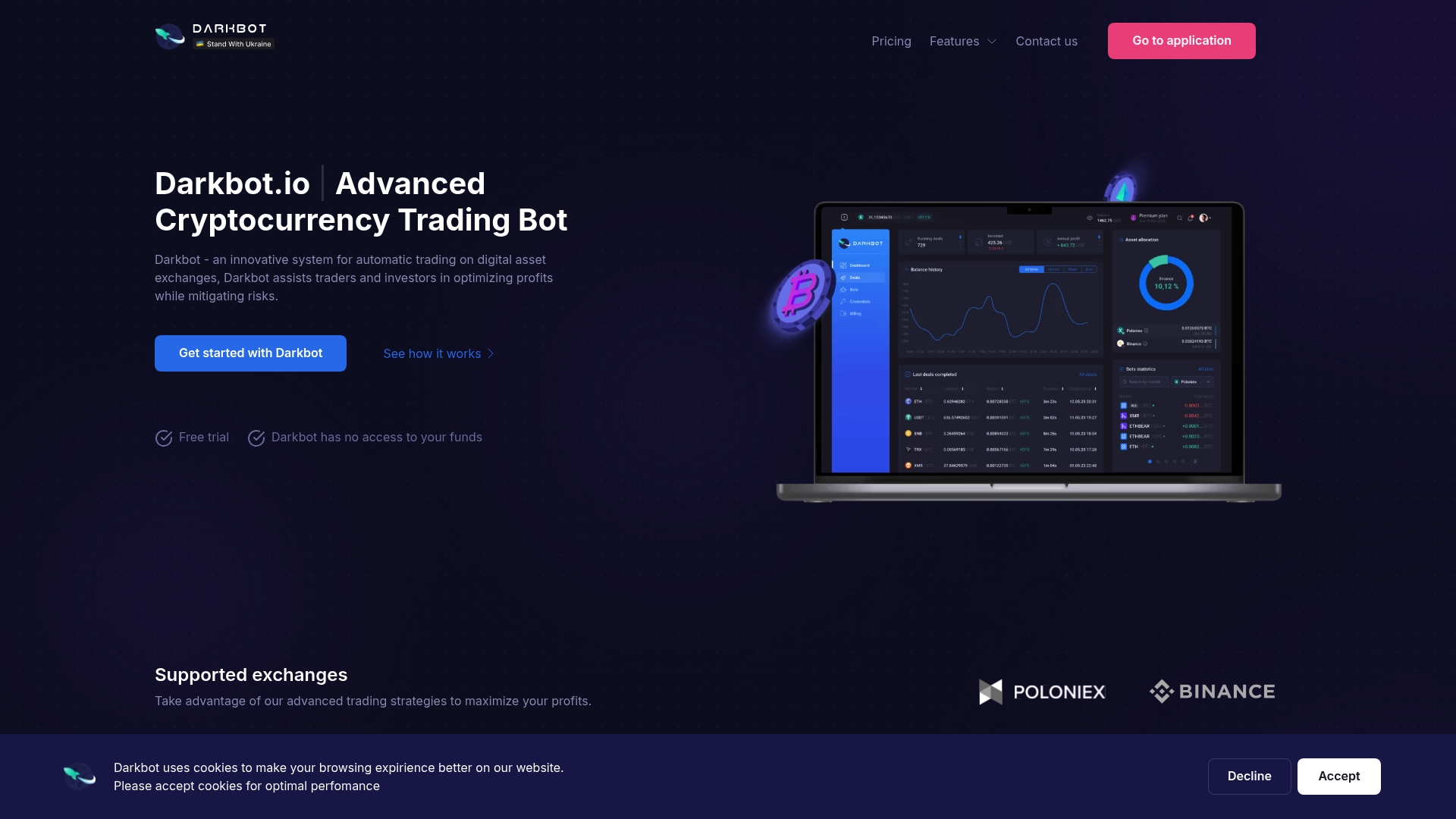
Darkbot is an AI-driven trading automation platform built around systematic execution and rule-based portfolio management. Its portfolio management tools automate rebalancing triggers, track allocation drift in real time, and apply consistent risk parameters across multiple exchanges via API integration. The platform supports both novice and experienced investors with configurable strategy settings and real-time analytics dashboards. If you are building a disciplined investment process and want automation to enforce it, explore Darkbot’s full capabilities to see how systematic execution fits your workflow.
FAQ
What is a crypto portfolio checklist?
A crypto portfolio checklist is a structured framework covering goal-setting, asset allocation, rebalancing schedules, custody controls, and risk assessment. It replaces ad hoc decisions with pre-committed rules to manage volatility and emotional trading.
How often should I rebalance my crypto portfolio?
The most effective approach combines a quarterly calendar review with a ±5% drift threshold trigger. This reduces unnecessary trades while keeping your allocation aligned with your target risk profile.
What is the safest way to store crypto assets?
Self-custody using a hardware wallet from Ledger or Trezor is the most secure option. Store the seed phrase in a physically separate location from the device, and test your backup recovery process at least once per year.
How do I assess risk beyond price volatility?
Apply EY’s six-pillar framework, which evaluates reputational, technical, financial, legal, cybersecurity, and auditability risk dimensions. OpenZeppelin’s technical framework adds blockchain-specific maturity and governance assessment using on-chain data.
What allocation is right for a moderate-risk crypto portfolio?
A common moderate-risk structure is 50% Bitcoin, 30% Ethereum, 10% altcoins, and 10% stablecoins. Adjust these weights based on your investment horizon and the specific risk profile of each asset you hold.
Recommended

Start trading on Darkbot with ease
Come and explore our crypto trading platform by connecting your free account!
Free plan available • No credit card required