Risk Management Checklist 2025 for AI Crypto Bots
TL;DR:
- Operators must implement eight audit-ready controls like stop-loss rules, leverage caps, and staged deployment testing before launching crypto trading bots to mitigate distinct failure modes. Maintaining a centralized risk register, enforcing parameter locking, and conducting continuous monitoring ensure compliance with increasing US regulatory scrutiny. Regular testing, human oversight, and strict third-party risk management are essential for a defensible and operationally sound AI crypto trading framework.
Every AI crypto trading bot operator needs eight audit-ready controls in place before going live: stop-loss rules, position-sizing limits, max-drawdown thresholds, leverage caps, a centralized risk register, API least-privilege enforcement, staged deployment testing with signed artifacts, and automated kill switches. Each one addresses a distinct failure mode. Together, they form the minimum defensible framework for US-based operators facing increasing regulatory scrutiny.
- Stop-loss per position: Caps the loss on any single trade; prevents a runaway position from cascading.
- Position-sizing limits: Constrains allocation per asset or strategy as a percentage of net asset value (NAV).
- Max-drawdown threshold: Triggers a hard stop when portfolio drawdown exceeds a defined NAV percentage.
- Leverage caps: Enforces maximum leverage per strategy; blocks margin amplification beyond approved levels.
- Centralized risk register: Single source of truth for all controls, incidents, and remediation evidence.
- API least-privilege: Restricts exchange API keys to trading-only scope; no withdrawal permissions.
- Staged deployment testing: Backtest → paper → canary → full, with signed artifacts at each gate.
- Automated kill switch: Pauses all strategies and blocks new orders on a defined emergency trigger.
Audit evidence for each control lives in the risk register as a dated entry with a control owner, configuration value, and last-verified timestamp.
Risk Management Checklist 2025: Controls, Policies, and Verification Tests
| Control | Policy one-liner | Immediate test | Required audit artifact |
|---|---|---|---|
| Stop-loss | Every position carries a hard stop at a pre-set loss percentage of NAV | Inject a simulated price shock in paper mode; confirm order fires and event ID logs | Signed configuration record + paper-trade log |
| Position sizing | No single position exceeds the approved NAV percentage | Review live allocations against the limit table; flag any breach | Position-limit policy doc + current allocation snapshot |
| Max-drawdown hard stop | Strategy halts automatically when portfolio drawdown hits the defined threshold | Simulate drawdown breach in sandbox; verify halt and alert fire | Drawdown-threshold config + test report |
| Leverage cap | Leverage per strategy is capped at the approved multiplier; bot cannot override | Attempt to set leverage above cap via API; confirm rejection | Leverage policy + API rejection log |
| Centralized risk register | All risks, controls, and incidents are logged in one system with owner and date | Audit three random entries for completeness and timestamps | Risk register export |
| API least-privilege | Keys are scoped to read + trade only; withdrawal permission is blocked | Attempt a withdrawal call with the active key; confirm rejection | API permission audit log |
| Vendor attestations | Each exchange and cloud provider holds appropriate current security attestations. | Pull vendor status pages and attestation docs; record retrieval date | Vendor attestation file |
| Staged deployment | No strategy reaches production without passing all four deployment gates | Review the last deployment manifest for all four sign-offs | Deployment manifest + approval signatures |
| Kill switch | Emergency stop halts all strategies and blocks new orders within 60 seconds | Trigger kill switch in staging; measure elapsed time to full halt | Kill-switch test report with timestamp |
Pro Tip: Run the simulated price shock and kill-switch tests on a quarterly schedule, not just at deployment. Log each test result in the risk register with a unique event ID so auditors can trace the full test history.
What Bot-Specific Governance Actually Requires
AI enforces discipline; humans must set the appetite and approve every change. That principle translates directly into a role matrix.
- Strategy author: Designs logic, sets initial parameter values, documents rationale in the risk register.
- Risk owner: Reviews and approves parameter values against the risk appetite policy; signs off before any production change.
- Deployment approver: Confirms all staged-testing artifacts are present and signs the production deployment manifest.
- On-call responder: Monitors live alerts, executes the kill switch if an emergency tier alert fires, and logs the event within 30 minutes.
Parameter locking is non-negotiable for three values: stop-loss percentage, max-position-size, and withdrawal permissions. These must be enforced at the API level, not just in the bot’s configuration file, because a misconfigured update could otherwise override them silently.
Pro Tip: Enforce parameter locking through version-controlled configuration files with protected branches. Require a pull-request approval from the risk owner before any change to locked parameters merges. Tag each approved config with a semantic version and record the tag in the risk register.

Human-in-the-loop governance also means pre-deployment approvals are mandatory, not optional. A bot that can self-deploy a strategy update without a human sign-off has effectively removed the risk owner from the chain. Post-event reviews, completed within 48 hours of any emergency stop, close the loop and feed lessons back into the risk register. For a deeper look at how human judgment and AI automation divide responsibilities, the role of AI in crypto trading is worth reviewing.
How to Evaluate Third-Party and Exchange Integration Risk
Vendor and exchange risk is operational risk for traders. An exchange outage or a compromised API key is not an abstract IT problem; it directly stops or corrupts live trading.
Checklist for every exchange and vendor integration: Confirm API keys are scoped to least-privilege (read + trade, no withdrawals). Enable IP whitelisting to restrict calls to known server addresses. Rotate credentials on a defined schedule, at minimum quarterly. Require MFA for all console and dashboard access. Obtain and file current SOC 2 or equivalent attestations. Document SLA uptime commitments and incident-disclosure timelines. Map each dependency (exchange, price oracle, order router, cloud host) in the risk register with a link to its status monitor and runbook.
For immediate operational validation: test each API key’s scope in a sandbox by attempting a withdrawal call and confirming rejection. Pull each vendor’s status API and record the response in the risk register. If a vendor cannot provide a current security attestation, that gap is itself a risk register entry requiring a remediation plan.
Testing and Staged Deployment: Backtest Through Full Production
A reproducible deployment follows four gates. Skipping any one of them removes the audit trail that regulators and internal reviewers expect.
- Backtest: Run strategy logic against a defined historical dataset with a fixed random seed. Measure Sharpe ratio stability, max drawdown, and win rate. Minimum acceptance: no high-severity exceptions; drawdown within policy limits across the full dataset period.
- Paper trading: Execute the strategy in live market conditions with simulated capital. Run for a sufficient period to evaluate performance. Measure execution latency, order rejection rate, and P&L deviation from backtest expectations.
- Canary deployment: Deploy to a small capital allocation (typically 5–10% of intended production size). Monitor for several days. Automated cutoff triggers: if realized volatility breaches the policy threshold or drawdown hits the canary limit, the deployment halts automatically.
- Full production: Deploy after the deployment approver signs the production manifest. All prior artifacts must be on file.
| Metric | Threshold | Evidence type |
|---|---|---|
| Max drawdown (backtest) | Within approved NAV percentage | Backtest report with dataset ID |
| Order rejection rate (paper) | Below 2% | Paper-trade log |
| Execution latency (paper) | Within exchange SLA | Latency log |
| Canary drawdown | Below canary limit | Canary runbook + watchlist |
| Deployment approval | All four sign-offs present | Signed deployment manifest |
Model drift is a common failure mode: a bot that passed backtesting six months ago may perform differently against current high-volatility data. Schedule re-validation against recent market samples at least quarterly, and log each re-test in the risk register. For detailed guidance on backtesting and deployment controls, Darkbot’s coverage of algorithmic trading controls covers the technical specifics.
Continuous Monitoring, Alerts, and Automated Fail-Safes
Continuous, automated monitoring feeding live data into the risk register is the standard for 2025. Static annual reviews no longer satisfy either operational or regulatory expectations.
- Real-time KRIs to monitor: execution latency, order rejection rate, realized P&L vs. expected, position skew vs. policy limits, and API error rates.
- Alert tiers:
- Info: Deviation within tolerance; logged automatically, no human action required.
- Action: Deviation approaching threshold; on-call responder notified within 5 minutes.
- Emergency: Threshold breached; automated response fires immediately: strategy paused, new orders blocked, on-call responder paged.
- Circuit-breaker examples: time-based pause after N consecutive rejected orders; drawdown-based hard stop at the policy threshold; exchange-disconnect response that halts the strategy and logs the disconnect event; API anomaly detection that flags unusual call patterns.
Retain all telemetry for an appropriate audit retention period. Feed alert events directly into the centralized risk register with timestamps and event IDs so the full monitoring history is available for audit. The key risks in automated trading article covers common monitoring gaps worth reviewing alongside this section.
Incident Response, Remediation Logs, and US Regulatory Documentation
Minimum audit evidence for US regulatory readiness: a centralized risk register entry with event ID and timeline; a signed remediation plan with owner and due date; vendor notification records where applicable; and full log retention for the duration required by applicable regulations. Pre-approved remediation templates cut response time significantly — draft them before an incident occurs.
A structured incident playbook follows five steps: detection (automated alert fires, event ID assigned), containment (kill switch or manual halt executed within 60 minutes), eradication (root cause identified and documented), recovery (strategy re-enabled after risk owner sign-off), and post-incident review (completed within 48 hours, findings logged in the risk register).
- Detection: Alert fires; on-call responder acknowledges within 15 minutes.
- Containment: Strategy halted; positions reviewed; vendor notified if exchange-side issue.
- Eradication: Root cause documented in risk register; remediation plan signed.
- Recovery: Risk owner approves re-enablement; deployment manifest updated.
- Post-incident review: Lessons logged; controls updated if gaps identified.
30/60/90-Day Rollout Plan and Cost Considerations
Small-team priority order: API least-privilege enforcement first, then centralized logging, then one reliable automated kill switch. Those three controls address the highest-probability failure modes and produce immediate audit evidence before the broader program is complete.
Days 1–30: Set up the centralized risk register. Enforce API least-privilege on all active exchange connections. Document existing stop-loss and position-sizing configurations. Assign role matrix owners.
Days 31–60: Implement staged deployment gates for any new strategy. Build monitoring pipelines and configure alert tiers. Complete vendor attestation collection. Run the first kill-switch test and log results.
Days 61–90: Complete incident playbook documentation. Run a full canary deployment for at least one strategy. Conduct the first quarterly model re-validation. Review the risk register for completeness and close any open remediation items.
Cost buckets vary by team size and tooling choices. A DIY internal approach using open-source logging and a spreadsheet-based risk register carries primarily engineering labor costs. A mixed approach adding a risk management framework tool or GRC platform adds software licensing. A fully managed or consulting-led approach is the highest cost but compresses the timeline. For most small trading operations, the DIY approach for the first 30 days is sufficient to establish the audit baseline.
What US Regulations Apply to Crypto Trading Bots in 2026
The SEC and CFTC both assert jurisdiction over aspects of automated crypto trading, depending on the assets traded and the structure of the operation. Operators trading tokens the SEC classifies as securities face registration and disclosure obligations. CFTC oversight applies to crypto derivatives and futures. Neither agency has issued a single unified rulebook for AI trading bots, but both expect documented controls, audit trails, and evidence of human oversight. The IT risk assessment checklist framework covering access control, compliance, and data protection aligns with the documentation standards both agencies reference in enforcement actions.
This article is general information, not legal or compliance advice. Confirm current regulatory requirements with a qualified attorney or compliance professional for your specific situation.
Data Privacy and Protection for Automated Trading Systems
Automated trading systems handle API credentials, account data, and trading history. At minimum: encrypt credentials at rest and in transit, apply role-based access to all system components, and log every access event. For US operators, state-level privacy laws (including California’s CCPA) may apply depending on user data collected. Store only the data the system needs to function, and define a retention and deletion policy in the risk register.
Cybersecurity Audits and Penetration Testing Schedules
Schedule a full cybersecurity audit at least annually, with penetration testing covering API endpoints, authentication flows, and data storage. After any significant infrastructure change, run a targeted test before returning to production. Log audit findings and remediation status in the centralized risk register. The IT risk assessment checklist for 2025 identifies network security, access control, and application security as primary focus areas for trading system audits.
Training Requirements for Personnel Managing AI Trading Bots
Anyone in the role matrix (strategy author, risk owner, deployment approver, on-call responder) needs documented training on the risk framework, the incident playbook, and the kill-switch procedure. Formal certifications (CISM, CRISC, or equivalent) are appropriate for risk owners at larger operations. For smaller teams, internal training records with completion dates and sign-offs satisfy the audit requirement. Refresh training annually or after any significant policy change.
Keeping Risk Controls Current as Markets and Regulations Evolve
Risk controls decay. A stop-loss percentage calibrated to 2023 volatility may be too wide or too narrow for current conditions. Review all parameter values against recent market data at least quarterly. Monitor SEC and CFTC guidance releases and update the compliance section of the risk register when new guidance is issued. Assign a named owner to each control with a scheduled review date, and treat overdue reviews as open risk register items requiring escalation.
Key Takeaways
A defensible risk program for AI crypto trading bots requires a centralized risk register, immutable critical parameters, API least-privilege, staged testing with signed artifacts, and automated emergency stops — all maintained continuously, not set once and forgotten.
| Point | Details |
|---|---|
| Centralized risk register | Every control, incident, and remediation action needs a single dated, owned entry for audit readiness. |
| Immutable critical parameters | Stop-loss, max-position-size, and withdrawal permissions must be locked at the API level, not just in config files. |
| API least-privilege | Keys scoped to read and trade only, with IP whitelisting and quarterly rotation, reduce the attack surface materially. |
| Staged deployment artifacts | All four gates (backtest, paper, canary, full) require signed artifacts before production approval. |
| Darkbot platform fit | Darkbot’s API integration, backtesting, paper trading, and automated controls map directly to this checklist’s core requirements. |
The Part Most Operators Get Wrong
The checklist items above are not controversial. Every serious operator knows stop-losses and position limits matter. What most get wrong is treating the risk register as a compliance artifact rather than an operational tool.
A risk register that gets updated once a quarter, right before an audit, is not a risk register. It is a document that describes what the controls were supposed to be. The gap between that document and what the system actually did is where incidents live. The operators who avoid the worst outcomes are the ones who feed live telemetry into the register automatically, so the record of what happened and the record of what was supposed to happen are the same document.
The second underestimated point: parameter locking is only as strong as the deployment pipeline. If a developer can push a config change that overrides a locked parameter without a risk-owner approval, the lock is cosmetic. Version control with protected branches and a mandatory pull-request review from the risk owner is the actual control. The config file is just evidence that the control exists.
Darkbot Supports This Checklist Directly
Traders who want the checklist controls built into their trading infrastructure rather than bolted on afterward will find that Darkbot’s architecture maps closely to these requirements. API integration uses least-privilege key management. Backtesting and paper trading produce the logs that satisfy staged-deployment artifact requirements. Automated risk controls, including configurable stop-loss and position-sizing parameters, are part of the core platform. Portfolio-level monitoring provides the real-time telemetry the continuous-monitoring section describes.
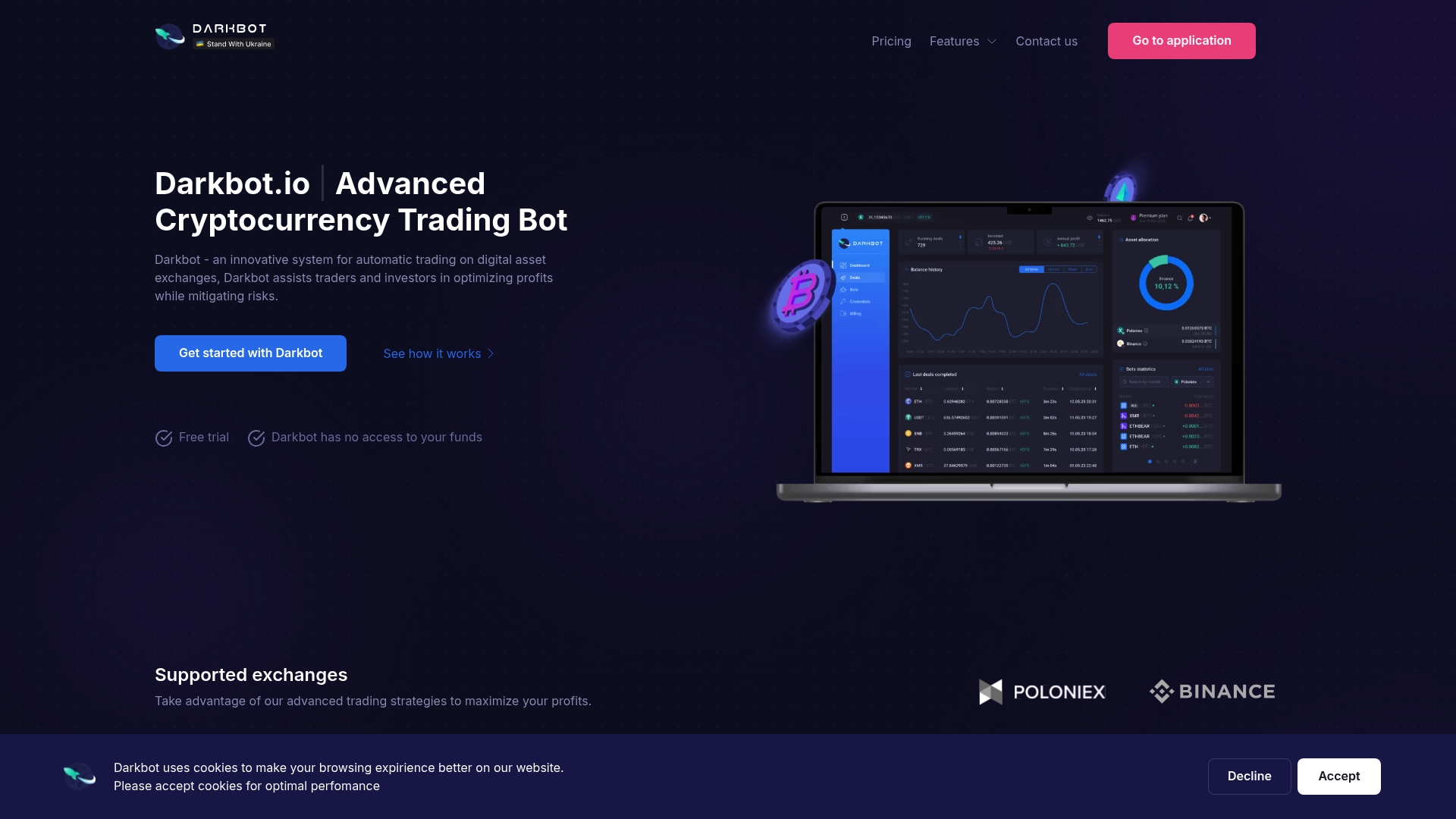
For traders evaluating how a platform fits their risk management in crypto trading framework, the Darkbot main platform page and the portfolio management page cover the specific features in detail. The free tier is a practical starting point for validating paper-trading logs and API configuration before committing to a full deployment.
Useful Sources and Further Reading
How these sources map to the checklist: The NIST framework and IT risk assessment guides underpin the continuous monitoring and control-mapping sections. Vendor risk guidance informs the third-party checklist. The risk reporting reference supports audit-evidence and register documentation requirements.
- IT Risk Assessment Guide 2025 — Timspark: continuous monitoring, model drift, and iterative risk processes.
- IT Risk Assessment Checklist 2025 — LomaTechnology: technical controls covering network, access, data protection, and application security.
- Third-Party Risk Assessment Guide — KodiakHub: vendor due diligence, exchange API security, and dependency mapping.
- Vendor Risk Management Software — KodiakHub: centralized documentation and US regulatory evidence requirements.
- Risk Management Software — Onspring: GRC platforms, centralized registers, and NIST/ISO framework mapping.
- Risk Reporting Checklist for Finance Executives — CorpHedge: audit-ready reporting and risk-register documentation best practices.
Recommended

Start trading on Darkbot with ease
Come and explore our crypto trading platform by connecting your free account!
Free plan available • No credit card required