How trading algorithms work: strategies, risks, and automation

TL;DR:
- Over 92% of retail trading algorithms lose money in live markets without proper risk controls.
- Success depends on execution quality, regime awareness, and implementing advanced automation techniques.
- Machine learning models offer adaptive potential but require thorough out-of-sample testing to avoid overfitting.
Roughly 92% of retail trading algorithms lose money in live markets, despite looking brilliant on paper. That number should stop every serious trader cold. Automated trading is genuinely powerful, but only when you understand what separates the profitable minority from the crowd running the same copied strategies with no risk controls. This article cuts through the hype to explain exactly how trading algorithms work, which types suit which market conditions, where most traders go wrong, and how to use machine learning and smart automation in ways that actually hold up when markets get ugly.
Key Takeaways
| Point | Details |
|---|---|
| Automation is not a shortcut | Most trading algorithms lose money unless paired with solid strategy and risk controls. |
| Strategy fit is crucial | Choose the right algorithm type based on market conditions and your objectives. |
| Risk management prevents disasters | Dynamic sizing, loss limits, and regime detection help protect your capital. |
| Machine learning adds edge, but beware | ML can improve returns, but only with proper training and testing to avoid overfitting. |
| Execution matters more than signals | Focusing on how you trade and when to sit out beats chasing complex indicators. |
What are trading algorithms and how do they work?
A trading algorithm is a set of coded instructions that tells a system when to buy or sell an asset based on predefined criteria. In crypto markets, those criteria can range from simple price thresholds to complex statistical signals derived from order book data. The algorithm watches the market continuously, calculates whether conditions match its rules, and executes trades without waiting for human approval. Speed is one major advantage: a well-built algorithm can react to a price change in milliseconds, far faster than any human trader clicking a mouse.
The goal is not just speed, though. Algorithms also remove emotional decision-making. Fear and greed are the two biggest account-killers in volatile markets. When Bitcoin drops 15% in an hour, a human trader panics. An algorithm follows its rules. That consistency, when the strategy itself is sound, is where the real edge lives.
Under the hood, common trading algorithm strategies span a wide range of mathematical approaches. Here is a quick overview of the main categories you will encounter:
- Trend following: Algorithms that identify sustained directional moves and ride them using indicators like moving averages or MACD.
- Arbitrage: Systems that spot price differences for the same asset across two or more exchanges and profit from closing that gap.
- Mean reversion: Strategies that bet prices will return to a statistical average after straying too far in either direction.
- Market making: Algorithms that simultaneously post buy and sell orders to collect the bid-ask spread while providing liquidity.
- Scalping: High-frequency systems designed to capture tiny price movements many dozens of times per day.
- High-frequency trading (HFT): Ultra-fast execution that exploits micro-second price dislocations, typically requiring co-location with exchange servers.
As applied across crypto markets, these methodologies each carry different risk profiles, capital requirements, and market condition dependencies. Understanding them at this level is the first step toward using trading algorithms in crypto intelligently rather than blindly.
“An algorithm is only as profitable as the quality of its design, the realism of its testing, and the discipline of its risk controls. Code does not fix a bad strategy.”
Types of trading algorithms used in crypto
With the foundation in place, let’s look at how each algorithm type actually behaves in practice and which market environments each one fits best.
Trend following, arbitrage, mean reversion, and related strategies each have a distinct mechanical logic. The table below gives you a fast comparison:
| Algorithm type | Core logic | Best market condition | Key risk |
|---|---|---|---|
| Trend following | Ride sustained directional moves | Trending, low chop | Whipsaws in sideways markets |
| Arbitrage | Exploit cross-exchange price gaps | Any, but fast execution required | Latency and exchange fees erode edge |
| Mean reversion | Fade extreme price moves | Range-bound markets | Trend continuation destroys the trade |
| Market making | Post bids and asks to collect spread | High-volume, stable pairs | Inventory risk during sharp moves |
| Scalping | Capture micro fluctuations repeatedly | Liquid, volatile intraday sessions | High fee drag, slippage accumulation |
| HFT | Exploit micro-second price dislocations | Deep liquidity venues | Infrastructure cost and regulatory exposure |
Here is a numbered breakdown of how to think about matching types of trading bots to actual market conditions:
- Trending market (strong directional move): Trend-following strategies using moving average crossovers or MACD signals tend to perform best. The algorithm enters early and holds while momentum persists.
- Range-bound market (price bouncing between levels): Mean reversion strategies shine here. The algorithm buys near the lower bound and sells near the upper bound repeatedly.
- Fragmented liquidity across exchanges: Arbitrage bots can profit when the same asset trades at different prices on Binance versus Coinbase, for example. Speed is everything.
- High-volume, stable pairs like BTC/USDT: Market-making algorithms post tight spreads and collect the difference. They need deep order books and stable conditions to avoid inventory buildup on one side.
- Volatile intraday sessions: Scalping algorithms work well when price oscillates frequently. The risk is that transaction costs eat profits if spread and fees are not managed precisely.
Pro Tip: Do not run a mean-reversion algorithm during a strong trend. It will keep “buying the dip” on a coin that keeps falling. Before deploying any strategy, check whether the current market regime actually matches the algorithm’s design logic.
Key risks and common pitfalls of trading algorithms
Knowing the strategy types is one thing. Knowing what kills them is more important for your account balance.

The most dangerous trap is a convincing backtest. A backtest is a simulation of how an algorithm would have performed on historical data. The problem is that backtesting pitfalls like overfitting, ignoring slippage, and excluding fees create a version of your strategy that looks far better than anything you will ever see in a live account. Overfitting means you have tuned your algorithm’s parameters so tightly to past data that it has essentially memorized the historical price action instead of learning a repeatable edge.
Here is a realistic list of the most common algorithm killers:
- Overfitting: Too many parameters optimized on historical data, resulting in a strategy that fails immediately on new data.
- Slippage: The difference between the price you expected and the price you actually filled at. In fast-moving crypto markets, this can be substantial.
- Latency: The time between your algorithm sending an order and the exchange confirming it. Even a 200-millisecond delay can turn a profitable trade into a losing one.
- Transaction fees: Ignored in most amateur backtests. For scalping strategies, fees can eliminate the entire theoretical edge.
- Regime blindness: Using a strategy designed for one market condition in a completely different environment.
“The edge cases that destroy algorithms are not rare. Flash crashes, liquidity crises, and cascade liquidations happen regularly in crypto. An unprepared algorithm will not survive them.”
Smart algorithmic backtesting means modeling the real world, not the ideal one. Use realistic fill assumptions, include fees at every level, and simulate latency. Better still, use walk-forward analysis, which tests the algorithm on rolling out-of-sample periods rather than one big historical dataset. This is a far more honest picture of live performance.
Pro Tip: Set your backtest to assume you always fill at the worst end of the spread, not the midpoint. If the strategy is still profitable under those conditions, it has a real chance of working live. If it only works at best-case prices, it will bleed money from day one. Pair this approach with a review of how avoiding common trading pitfalls in automation can dramatically improve your long-term outcomes.
Risk management and advanced techniques
Surviving in algorithmic trading long enough to compound gains requires protecting your capital as aggressively as you pursue returns. The following framework covers the core controls every serious algorithmic trader should implement.

Dynamic position sizing is the practice of adjusting how much capital you risk per trade based on current account size and volatility conditions. The standard rule is to risk no more than 1 to 2% of total equity on any single trade. When your account grows, position size scales up. When drawdowns hit, position size scales down automatically.
Here are the five most impactful risk management automation techniques, ranked by how much they protect you in adverse conditions:
- Dynamic position sizing: Scales exposure based on current equity and volatility, preventing oversized bets during drawdown periods.
- ATR-based trailing stops: Uses the Average True Range (ATR, a measure of recent volatility) to set exit points that adapt to market conditions rather than fixed percentages.
- Daily loss limits: Hard stops that shut down trading for the day once cumulative losses reach a set threshold, preventing a bad strategy day from becoming a catastrophic one.
- Regime detection: Systems that monitor volatility, volume, and order book depth to determine whether current conditions match the algorithm’s intended environment.
- Strategy diversification: Running multiple uncorrelated strategies simultaneously so that a drawdown in one does not drag the whole portfolio down.
The data supports this layered approach. Implementing position sizing, trailing stops, and loss limits as a combined framework materially reduces drawdown depth and improves risk-adjusted returns.
| Risk control | Protection level | Implementation complexity |
|---|---|---|
| Dynamic position sizing | High | Medium |
| ATR trailing stops | High | Medium |
| Daily loss limits | Very high | Low |
| Regime detection | Very high | High |
| Strategy diversification | High | Medium |
Pro Tip: Diversify across strategies, not just across assets. Two trend-following strategies on different coins are still correlated because they both fail in the same choppy market. Mix trend following with mean reversion to reduce portfolio-level correlation and smooth out equity curves. You can explore this further by reviewing trading bot risk controls designed for active crypto environments.
Machine learning and smart automation in trading algorithms
Rule-based algorithms follow static logic. Machine learning (ML) algorithms learn and adapt. That distinction matters enormously in a market that evolves as rapidly as crypto does.
The most widely used ML models in trading fall into two categories. First, sequence models like LSTM (Long Short-Term Memory) and GRU (Gated Recurrent Unit) are neural networks designed to identify patterns across time-series data like price history and volume. Second, reinforcement learning (RL) agents like SAC (Soft Actor-Critic) and Rainbow DQN learn optimal trading actions by repeatedly interacting with a simulated market environment and optimizing for a reward signal.
Here is what the research actually shows:
- LSTM and GRU models have demonstrated Sharpe ratios between 1 and 4 in backtests, outperforming simple buy-and-hold strategies on crypto datasets.
- SAC and Rainbow DQN agents have posted impressive theoretical returns in simulated environments.
- Overfitting remains the critical failure point for nearly every ML trading system that transitions from backtest to live trading.
Hybrid ML and RL approaches that combine gradient-boosted regression trees (GBRT) with RL agents have shown return improvements of 37 to 152%, but only when trained with curriculum learning to prevent the model from memorizing the training data.
The gap between theoretical and live performance is where most ML trading projects collapse. A model that learns patterns from 2021 bull-market data and gets deployed in a 2023 bear market has learned the wrong lessons entirely. Regime adaptation is not optional for machine learning in trading. It is the difference between a live edge and an expensive experiment.
Pro Tip: Before going live with any ML model, run at least six months of forward testing on unseen data. If performance degrades significantly compared to the backtest, the model has overfit. Simplify before deploying. This principle connects directly to crypto automation explained in practical deployment contexts, and it is why understanding the impact of ML in crypto requires looking at live results, not just paper trades.
Why smart execution and regime awareness matter more than chasing signals
Here is something you will not read in most algorithmic trading guides: the signal is rarely where the edge actually lives.
Traders obsess over finding the perfect indicator or proprietary signal. But the consistently profitable minority focuses on something less exciting and far more impactful: how cleanly the trade executes, and whether the strategy is running in the market regime it was designed for. According to BIS research on execution quality, alpha increasingly comes from execution efficiency and regime awareness rather than signal discovery alone.
In practical terms, this means understanding your order book (DOM awareness), modeling realistic slippage in every backtest, and having the discipline to sit out when market conditions shift. An arbitrage algorithm running during low-liquidity hours will not just underperform. It will lose money to wider spreads and failed fills. A trend-following system running in a choppy, sideways market will get whipsawed repeatedly.
The practical answer is simple but uncomfortable: sometimes the best trade your algorithm can make is no trade at all. Building regime detection in trading into your system so it pauses during hostile conditions is more valuable than any signal refinement you could spend months optimizing. Regulatory changes, margin requirement shifts, and sudden liquidity drains are all real risks that no signal can predict. Execution discipline and regime awareness are your actual defense.
Power your crypto trading with advanced automation
If this article showed you anything, it is that the gap between a trading algorithm that loses and one that consistently performs comes down to execution, risk controls, and smart automation. Those are exactly the capabilities built into AI-powered crypto trading on the Darkbot platform.
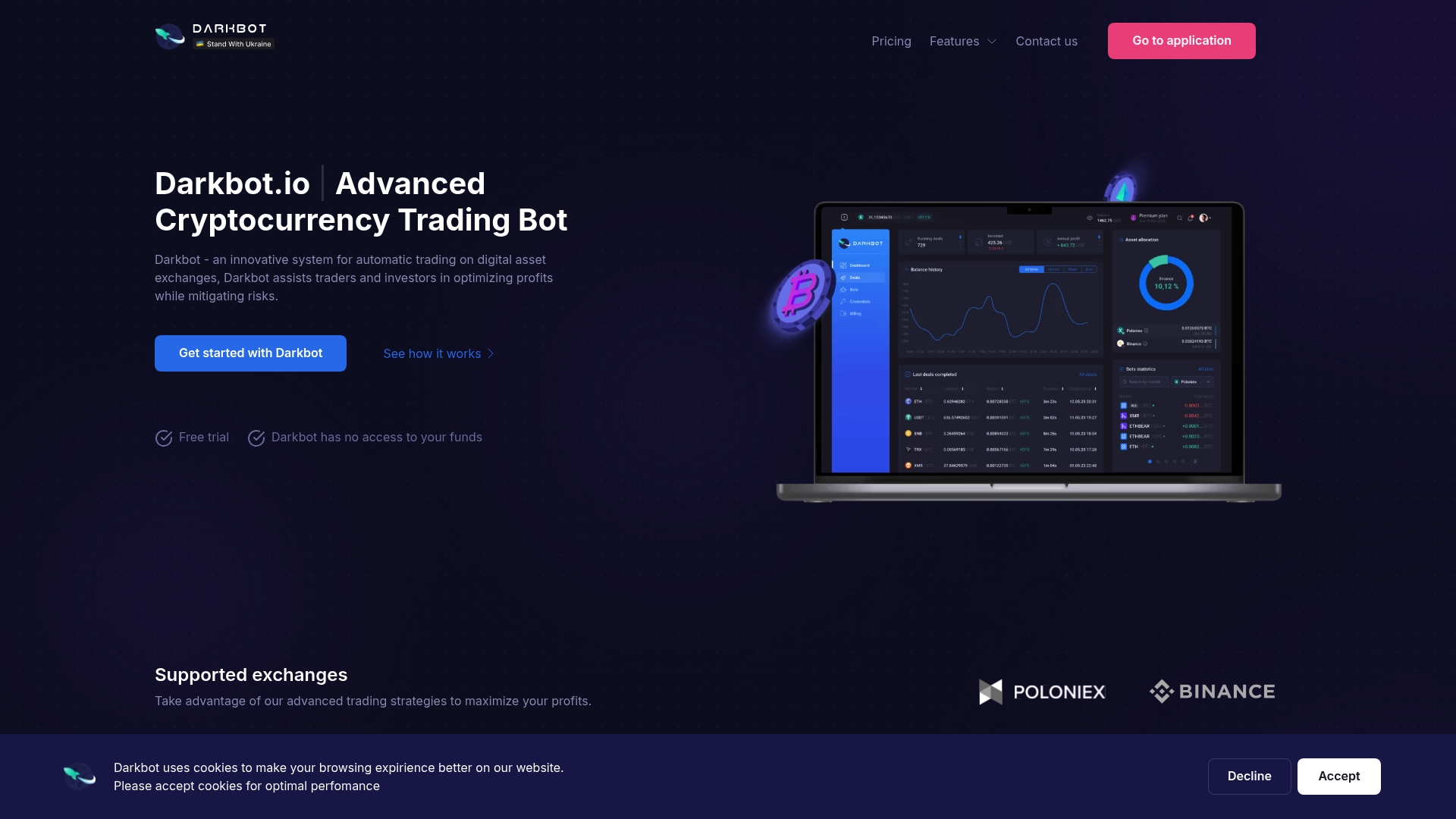
Darkbot gives you access to machine learning tools for crypto trading that are designed for real-world conditions, not just clean backtests. You can implement dynamic position sizing, ATR-based stops, daily loss limits, and regime detection without building everything from scratch. The platform also handles automated portfolio management, so rebalancing and risk controls run continuously, even while you sleep. Whether you are running your first bot or managing a multi-strategy portfolio, Darkbot makes sophisticated algorithmic trading accessible and secure.
Frequently asked questions
Do trading algorithms guarantee profits?
No, trading algorithms do not guarantee profits. In fact, 92% of retail trading algorithms lose money in live markets without proper risk management and realistic execution modeling.
What is the safest way to use trading algorithms?
Combine dynamic position sizing, trailing stops, and daily loss limits with robust backtesting that models real slippage, fees, and latency to manage potential losses effectively.
How does machine learning improve trading algorithms?
Machine learning enables adaptive strategies that can outperform static rules, with ML models achieving Sharpe ratios above 1 in backtests, but only when overfitting is controlled and out-of-sample testing is thorough.
What causes algorithmic trading to fail in volatile markets?
Most failures trace back to overfitting, ignored slippage and fees, regime blindness, and edge cases like liquidity crises or flash crashes that the algorithm was never designed to handle.
Recommended

Start trading on Darkbot with ease
Come and explore our crypto trading platform by connecting your free account!
Free plan available • No credit card required