Managing Trading Risk Workflow for Crypto Traders
TL;DR:
- Managing trading risk involves predefined limits and automated controls to prevent losses and ensure consistent execution. Traders often fail because they treat risk management as an afterthought rather than a core process, risking larger losses during volatile markets. Automation enforces strict compliance with risk rules, helping traders avoid emotional mistakes and protect their accounts over time.
Managing trading risk workflow is defined as the structured process of applying predefined risk limits, automated controls, and systematic assessment to limit losses and maintain consistent execution in cryptocurrency markets. 70–80% of retail traders lose money over time, and the primary cause is the absence of a pre-defined risk framework. That number is not a market problem. It is a process problem. Professional traders address it by building workflows that enforce rules before emotion has a chance to intervene. The industry standard framework includes per-trade risk limits of 1–2%, a daily loss cap of 3%, and a portfolio heat ceiling of 6%. These are not suggestions. They are the structural foundation of any durable trading operation.
What are the essential components of a trading risk workflow?
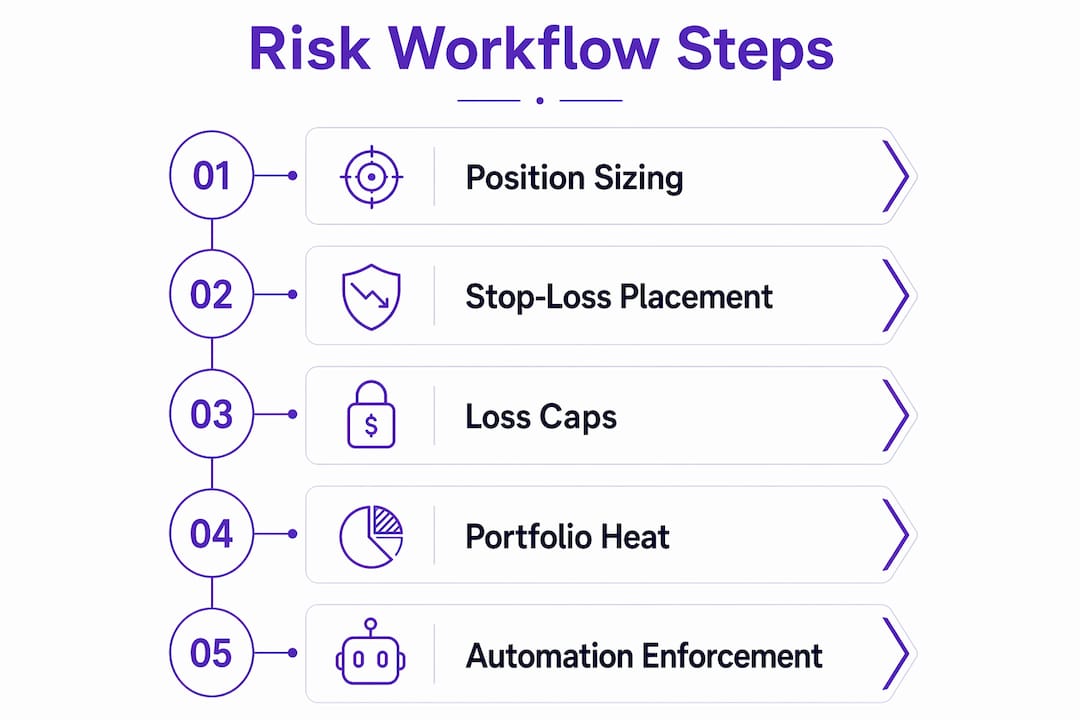
A trading risk workflow is built on four interlocking controls: position sizing, stop-loss placement, loss caps, and portfolio heat limits. Each layer addresses a different failure mode. Together, they prevent any single trade or session from causing irreversible damage to a trading account.
Position sizing and per-trade risk limits
Position sizing is the calculation that determines how much capital to commit to any single trade. The standard position sizing formula is: account equity multiplied by risk percentage, divided by the distance between entry price and stop-loss price. Applying a 1–2% per-trade risk limit means a $10,000 account risks no more than $100–$200 on any single position. This keeps a long losing streak from becoming a capital crisis.

Stop-loss placement aligned with market structure
Stop-loss orders must be placed at technical invalidation points, not at arbitrary distances from entry. Effective stop placement uses prior swing lows, order blocks, or structural levels where the original trade thesis no longer holds. A stop set at a round number or a fixed percentage ignores market context and produces unnecessary losses. Structure-based stops reduce the frequency of being stopped out by normal price noise.
Daily and weekly loss caps
Professional risk management enforces a daily loss cap of 3% and a weekly loss cap of 5–6%. When either threshold is breached, trading stops for that period. This rule prevents the compounding effect of chasing losses, which is the single most common cause of account blow-ups among retail traders.
- Per-trade risk: 1–2% of account equity
- Daily loss cap: 3% of account equity
- Weekly loss cap: 5–6% of account equity
- Portfolio heat ceiling: 6% total equity at risk across all open positions
- Correlation check: avoid stacking positions in assets that move together
Pro Tip: Write your risk limits as a one-page policy document before each trading session. A written rule is harder to negotiate with yourself under pressure than a mental note.
A written risk policy is a set of hard numerical rules decided when markets are closed and emotions are neutral. Traders who write these rules down before sessions maintain execution discipline during volatile periods. Those who rely on memory tend to renegotiate the rules mid-trade.
How can automation enhance risk management in cryptocurrency trading workflows?
Automation removes the gap between knowing a rule and following it. The human brain under financial stress defaults to hope-based decisions. An automated system does not. For crypto traders operating across 24-hour markets, automation is not a convenience. It is a structural requirement for consistent rule enforcement.
-
Pre-trade risk gates. Automated checks verify that each proposed trade falls within position size limits, daily loss caps, and portfolio heat thresholds before execution. If any parameter is breached, the trade is blocked. This is the digital equivalent of a compliance officer reviewing every order.
-
Kill switches. Hard-coded kill switches block all new trade placements when risk parameters are exceeded, particularly during high-volatility periods. These are non-negotiable automated stops that prevent account blow-ups when markets move against multiple positions simultaneously.
-
Automated stop-loss triggers. Rather than relying on a trader to manually close a losing position, automated systems execute stop-loss orders at pre-set structural levels. This eliminates the “I’ll give it a little more room” rationalization that turns manageable losses into large ones.
-
Segregated workflow environments. Separating analysis, execution, and review into distinct digital environments reduces impulsive decisions. A trader who analyzes on one screen and executes on another is less likely to act on a momentary impulse. This structural separation is a proven professional practice.
-
AI-driven pattern evaluation. AI systems evaluate probabilistic patterns across large datasets to flag when market conditions deviate from a strategy’s historical operating range. This is not prediction. It is a systematic signal that current conditions may require reduced position sizing or a pause in execution.
Pro Tip: Set your kill switch threshold at your weekly loss cap, not your daily cap. This gives the system a wider buffer while still preventing catastrophic drawdowns.
Platforms built for automated risk management in crypto integrate these controls into a single execution layer. The result is a workflow where rules are enforced by the system, not by willpower. That distinction matters most during the sessions when markets are moving fastest.
What are best practices for continuous risk assessment and workflow optimization?
A risk workflow is not a static document. Markets change, volatility regimes shift, and a trader’s account size changes with performance. Continuous assessment keeps the workflow calibrated to current conditions rather than past assumptions.
Trade journaling focused on rule adherence
A trade journal’s primary function is not to record profits and losses. Its primary function is to record whether the trader followed the risk framework on every trade. Entries should note position size versus the rule, stop placement versus the structural level, and whether the daily cap was respected. Patterns of rule deviation reveal where the workflow breaks down under pressure.
Drawdown management and recovery protocols
Drawdowns above 15–20% from peak equity require a full trading halt. The recovery process involves paper trading with rigorous data review until positive expectancy is reestablished. Returning to live trading before rebuilding a tested edge compounds the drawdown. This is math, not a judgment about the trader’s ability.
Aligning risk tolerance with risk capacity
Risk tolerance is emotional and subjective. Risk capacity is quantitative. A trader may feel comfortable risking 5% per trade but only have the mathematical capacity to sustain a 1% per-trade rule given their account size and win rate. Professional traders align both. Misalignment between the two is the root cause of oversized positions during losing streaks.
Volatility-adjusted position sizing
Position sizes should shrink when market volatility rises. The Average True Range (ATR) indicator measures recent price movement and provides a data-driven basis for adjusting stop distances and position sizes. A wider ATR means a wider stop, which means a smaller position to keep the dollar risk constant. This single adjustment prevents the common mistake of holding full-size positions during high-volatility periods.
| Review Area | Frequency | Key Metric |
|---|---|---|
| Trade journal adherence | After every session | Rule compliance rate |
| Drawdown vs. cap | Weekly | Peak-to-trough percentage |
| Position sizing accuracy | Weekly | Actual vs. formula-derived size |
| Portfolio heat | Daily | Total equity at risk across open positions |
| ATR-adjusted stops | Per trade | Stop distance vs. current ATR |
What are common pitfalls in managing trading risk workflows?
Most workflow failures are not caused by bad market analysis. They are caused by predictable process errors that repeat across traders at every experience level. Identifying these errors in advance is the most direct path to avoiding them.
-
Confusing risk tolerance with risk capacity. A trader who feels comfortable with large positions but lacks the account depth to absorb a losing streak will blow up. The position sizing formula, not gut feeling, determines the correct size.
-
Failing to enforce daily and weekly loss caps. The cap only works if it stops trading. Traders who “just take one more trade” after hitting the daily limit consistently turn a manageable loss day into a damaging one.
-
Allowing emotional overrides during volatility. High-volatility sessions create the strongest impulse to deviate from written rules. This is precisely when the rules matter most. A written risk policy decided before the session removes the in-the-moment negotiation.
-
Neglecting to separate analysis and execution environments. Mixing analysis and execution on the same screen increases impulsive trading. Traders who see a setup forming while managing an open position are more likely to enter without completing a full risk check.
-
Ignoring portfolio heat and correlation. Holding five positions in correlated assets is not diversification. If Bitcoin drops sharply, correlated altcoins typically follow. Portfolio heat above 6% in correlated positions creates compounding exposure that a single-trade risk limit cannot protect against.
“The risk framework is not a suggestion you follow when it’s convenient. It is the only thing standing between a bad week and a blown account. Every deviation, no matter how small, teaches your brain that the rules are negotiable. They are not.”
Understanding compliance standards in adjacent financial domains, such as payment compliance frameworks, reinforces why hard numerical rules and non-negotiable enforcement thresholds are the professional standard across all regulated financial activity.
Key Takeaways
A disciplined trading risk workflow requires predefined numerical limits, automated enforcement, and regular review to preserve capital and maintain consistent execution across volatile crypto markets.
| Point | Details |
|---|---|
| Enforce per-trade risk limits | Risk no more than 1–2% of account equity per trade using the position sizing formula. |
| Apply layered loss caps | Set daily caps at 3% and weekly caps at 5–6%; halt trading immediately when either is breached. |
| Automate rule enforcement | Use kill switches and pre-trade gates to block trades that breach risk parameters before execution. |
| Review adherence, not just results | Journal rule compliance after every session, not just profit and loss figures. |
| Halt and rebuild after deep drawdowns | Stop live trading at 15–20% drawdown and return only after reestablishing positive expectancy through paper trading. |
Why I think most traders have the risk workflow problem backwards
Most traders treat risk management as a filter applied after they find a trade they want to take. They identify the setup, get excited about the potential, and then check whether it fits the risk rules. That sequence is backwards, and it explains why the rules get bent so often.
The correct sequence starts with the risk framework. Before a session opens, the position size limit, the daily cap, and the portfolio heat ceiling are already set. The only question a trade needs to answer is whether it fits within those parameters. If it does not fit, it does not exist as a trade. This reframe changes the entire psychology of the session.
Automation enforces this sequence mechanically. When a system checks risk parameters before allowing execution, the trader cannot skip the step. That is the real value of automated trading workflows. Not speed. Not sophistication. Sequence enforcement.
Drawdowns are the other area where I see traders consistently misread the situation. A 15% drawdown is not a signal to trade harder to recover. It is a signal that something in the strategy or the execution has broken down. The math of recovery is brutal: a 20% loss requires a 25% gain just to return to breakeven. Halting, reviewing, and rebuilding is not giving up. It is the only rational response.
The traders who survive long enough to compound returns are not the ones with the best setups. They are the ones who treat every rule in their risk framework as non-negotiable, every session, regardless of how confident they feel.
— Grisha
Darkbot and automated risk workflow execution
Traders who build sound risk frameworks still face one persistent challenge: enforcing those rules in real time, across multiple positions, on a 24-hour market.
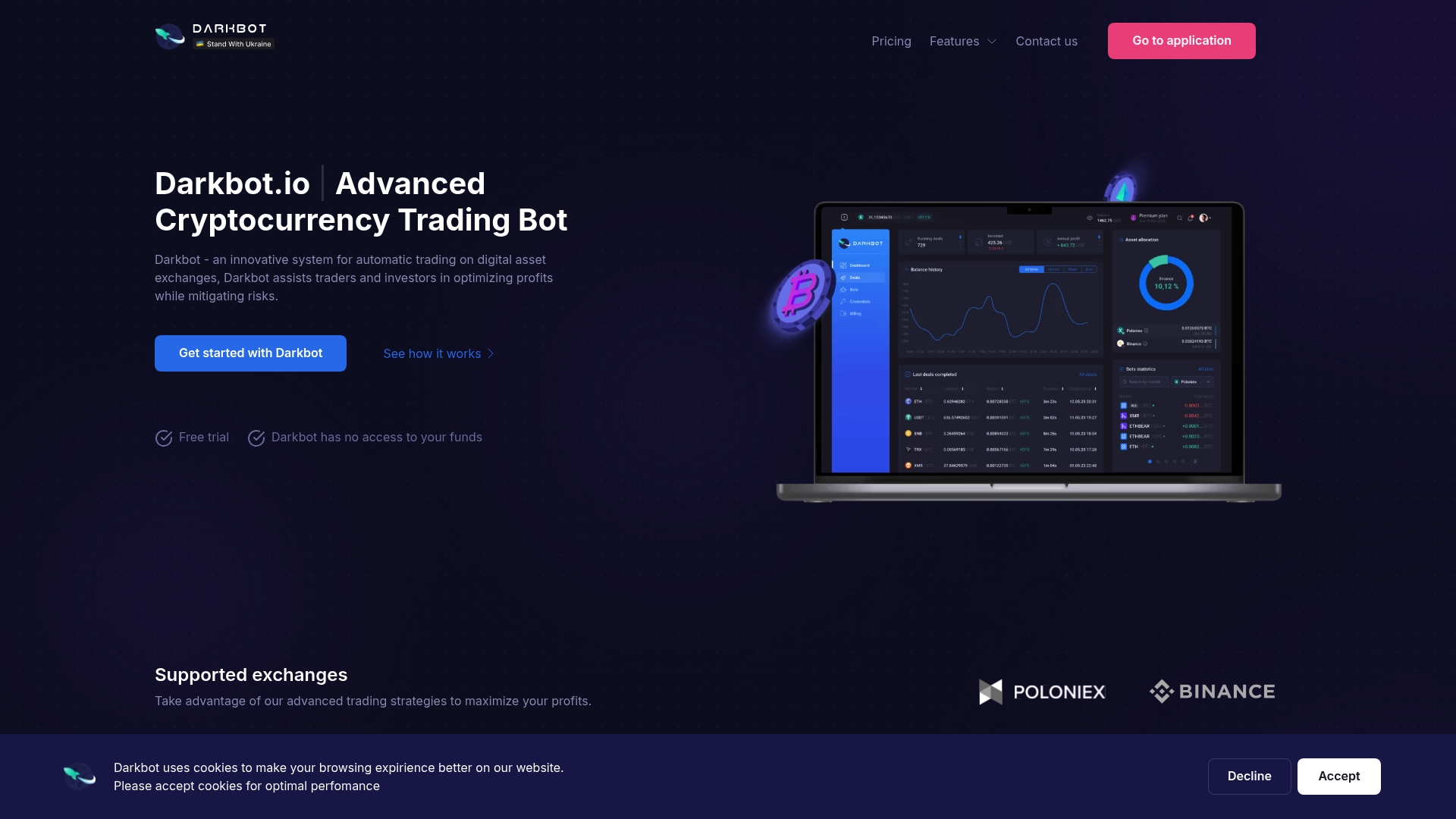
Darkbot is an AI-driven crypto trading automation platform built to handle exactly that execution layer. It enforces position sizing rules, automated stop-loss triggers, and portfolio heat controls across multiple supported exchanges without requiring manual intervention on every trade. The AI layer evaluates probabilistic patterns to flag when market conditions fall outside a strategy’s normal operating range, prompting rule-based adaptation rather than emotional reaction. For traders who have built a risk framework and need a system that follows it consistently, Darkbot’s automation platform provides the infrastructure to run that framework at scale.
FAQ
What is a trading risk workflow?
A trading risk workflow is a structured process that applies predefined risk limits, automated controls, and systematic review to manage losses and maintain consistent execution. It includes position sizing rules, stop-loss policies, daily loss caps, and portfolio heat limits.
What per-trade risk limit do professional traders use?
Professional traders risk 1–2% of account equity per trade. This limit, combined with a daily loss cap of 3% and a weekly cap of 5–6%, prevents any single session or trade from causing irreversible account damage.
How does automation improve risk management in crypto trading?
Automation enforces risk rules before execution through pre-trade gates and kill switches, removing the possibility of emotional overrides. It also executes stop-loss orders at pre-set levels without requiring manual intervention during fast-moving markets.
When should a trader halt trading due to drawdown?
A trader should halt live trading when the account reaches a 15–20% peak-to-trough drawdown. Recovery requires paper trading and rigorous data review before returning to live execution with real capital.
What is portfolio heat and why does it matter?
Portfolio heat is the total percentage of account equity at risk across all open positions simultaneously. Keeping portfolio heat below 6% prevents correlated positions from compounding losses beyond what any single trade’s risk limit would suggest.
Recommended

Start trading on Darkbot with ease
Come and explore our crypto trading platform by connecting your free account!
Free plan available • No credit card required