Crypto Risk Management Workflow: A Trader's 2026 Guide
TL;DR:
- A crypto risk management workflow involves systematic processes to identify, assess, and control risks in trading and investments. It emphasizes the importance of portfolio structure, on-chain monitoring, and documented governance rules to withstand volatile markets. Implementing continuous monitoring and automation tools enhances risk control and reduces human error during market swings.
A crypto risk management workflow is a systematic process that identifies, assesses, and controls risks across cryptocurrency trading and investment. Unlike traditional finance, blockchain markets operate 24 hours a day, seven days a week, with price swings that can erase 70–80% of portfolio value within months. Traders who apply structured frameworks, such as those aligned with ISO 31000 or COSO ERM standards, treat risk control as a repeatable process rather than a reactive response. This guide walks through the core components, execution phases, and common pitfalls of a crypto risk management workflow, with practical steps you can apply immediately.
What does a crypto risk management workflow include?
A crypto risk management workflow covers three distinct layers: portfolio structure, on-chain monitoring, and governance policy. Each layer addresses a different category of risk, and all three must work together for the framework to hold under real market pressure.
Portfolio structure: the three-layer model
The most widely adopted portfolio structure divides crypto holdings into three tiers. Experts recommend a core layer of 50–70% in BTC and ETH, a satellite layer of 20–35% in Layer 1 and Layer 2 assets, and a high-risk layer capped at 0–15% for speculative positions. Each satellite position should stay within 10–15% of total crypto capital to limit drawdown exposure. Bear markets have historically caused 70–80% drawdowns lasting up to 18 months, which means a poorly structured portfolio can take years to recover without a disciplined allocation model.

On-chain monitoring and blockchain analytics
Blockchain analytics tools trace fund flows across multiple wallets and transaction hops. Traditional compliance systems cannot adequately assess crypto risk because they lack wallet-level, on-chain transaction traceability. Cross-chain laundering uses multiple wallets and chains to obscure fund origins, which creates indirect exposure risks that standard auditing misses entirely. Any serious blockchain risk management framework must include real-time analytics that flag suspicious wallet interactions before they affect your positions.
Governance policy and documented theses
Every workflow needs a written governance policy that defines position limits, rebalancing triggers, and exit conditions. Without documented investment theses and exit strategies, traders make decisions based on emotion rather than pre-set rules. This is where most retail traders fail: they build positions without defining the conditions under which they will exit.
| Component | Function | Example standard or tool |
|---|---|---|
| Portfolio allocation model | Limits concentration risk | Three-layer BTC/ETH/alt structure |
| Blockchain analytics | Traces on-chain fund flows | Wallet-level transaction tracing |
| Governance policy | Sets rules for entries, exits, and limits | ISO 31000, COSO ERM |
| Stablecoin buffer | Provides liquidity and psychological stability | 10–15% stablecoin reserve |
| Continuous monitoring | Replaces periodic audits | 24/7 validator and smart contract tracking |
Pro Tip: Build your governance policy before you place a single trade. A written rule you set in a calm moment will outperform a judgment call made during a 30% drawdown.
How do you execute a crypto risk management workflow step by step?
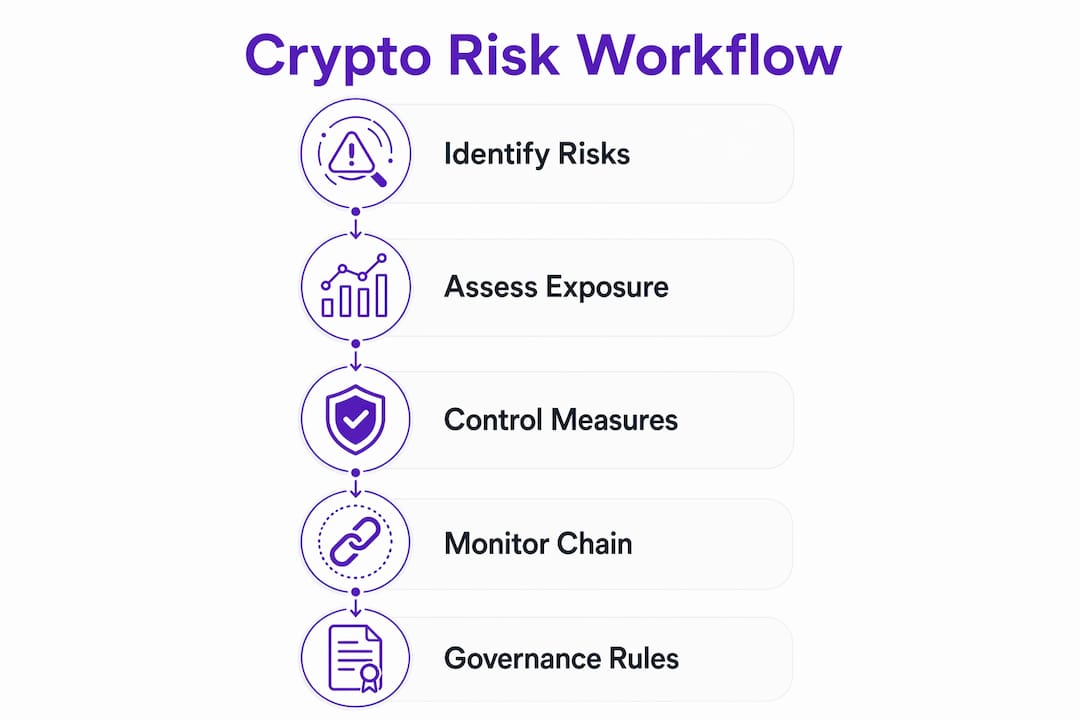
Institutional crypto risk management frameworks span 24 weeks across four phases: governance setup, risk assessment, control deployment, and continuous monitoring. This timeline aligns with ISO 31000 and COSO ERM standards. Traders can compress the timeline, but skipping phases creates gaps that surface during volatile periods.
Phase 1: Governance and policy setup (weeks 1–4)
- Define your risk tolerance in writing. State the maximum percentage of capital you are willing to lose per trade, per week, and per market cycle.
- Set position size limits for each portfolio layer. Cap satellite positions at 10–15% of total crypto capital.
- Document entry and exit conditions for every asset class you intend to hold.
- Assign review responsibilities. If you trade alone, schedule a fixed weekly review time.
Phase 2: Risk assessment with on-chain analytics (weeks 5–10)
- Map all current wallet exposures. Identify any indirect connections to flagged addresses using blockchain analytics.
- Assess smart contract risk for any DeFi positions. DeFi failures often stem from the interplay of oracle risk, governance risk, and composability risk across multiple protocols.
- Score each position by liquidity risk, counterparty risk, and regulatory exposure.
- Review your stablecoin allocation. Adjust toward the higher end of the 10–15% range if market sentiment indicators show extreme greed.
Phase 3: Control deployment (weeks 11–18)
- Implement preventative controls: hard position caps, automated stop-loss orders, and API-level trading limits.
- Add compensating controls: reconciliation procedures that catch errors before they compound. Blockchain immutability means error correction is near impossible after a transaction confirms, so prevention is the only viable strategy.
- Test all automated controls under simulated market stress before going live.
Phase 4: Continuous monitoring (weeks 19–24 and ongoing)
- Replace periodic audits with continuous monitoring of validator behavior and smart contract execution.
- Set threshold alerts for portfolio drift, unusual wallet activity, and liquidity changes.
- Review governance policy quarterly and after any major market event.
How to manage portfolio risk with rebalancing and position sizing
Rebalancing is the mechanical act of returning your portfolio to its target allocation. Done correctly, it forces you to sell high and buy low without requiring a market prediction. Done incorrectly, it generates unnecessary transaction costs and taxable events.
Hybrid rebalancing that combines quarterly reviews with threshold triggers outperforms fixed weekly or monthly schedules. Threshold triggers set at ±5–10% prompt a rebalance only when a position drifts meaningfully from its target weight. This approach reduces transaction frequency while keeping the portfolio aligned with its risk parameters.
Stablecoin reserves serve a dual purpose. Maintaining 10–15% in stablecoins buffers volatile market moves and provides liquidity for opportunistic purchases when prices fall sharply. During periods of extreme market greed, raising the stablecoin allocation above 15% reduces overall portfolio risk without requiring you to exit core positions entirely.
Pro Tip: Use the Crypto Fear & Greed Index as a mechanical input for adjusting your stablecoin allocation. When the index reads above 80, move toward the top of your stablecoin range. When it reads below 20, deploy that reserve into core assets.
The psychological dimension of cash reserves is underappreciated. Experienced investors hold 10–15% cash reserves specifically to shift their psychological posture from seller to buyer during market drops. That reserve is a risk management tool, not idle capital. Traders without a cash buffer are forced to sell existing positions to fund new ones, which locks in losses at the worst possible moment.
Common mistakes in this phase include:
- Rebalancing weekly, which generates excessive fees and taxable events without improving risk control
- Ignoring the documented investment thesis when deciding whether to rebalance or exit
- Treating stablecoin allocation as a fixed number rather than a dynamic risk signal
- Failing to account for gas fees and exchange spreads when calculating rebalancing costs
What are the common challenges in implementing a crypto risk management workflow?
The most persistent challenge is the irreversibility of blockchain transactions. Ledger immutability means that once a transaction confirms, correcting an error requires a new transaction, not a reversal. This makes pre-trade reconciliation and error-handling procedures non-negotiable, not optional.
Overtrading is the second major failure point. Market volatility creates constant signals that feel like opportunities. Without a written governance policy, traders respond to noise rather than signal, accumulating positions that violate their own risk parameters. The solution is mechanical: automate execution rules so that position sizing and entry conditions are enforced by the system, not by judgment in the moment.
Continuous monitoring of validator behavior and smart contract execution replaces static periodic audits, adapting to blockchain’s 24/7 operation. A quarterly audit schedule leaves 89 days of unmonitored risk between reviews.
Indirect exposure through multi-hop wallet connections is a risk that most traders do not account for. Blockchain analytics enables tracing fund flows across multiple wallets and hops, which is critical for identifying exposure to flagged addresses several steps removed from your own wallet. Traditional compliance tools do not perform this analysis. Traders with DeFi positions face additional exposure through protocol composability: a failure in one protocol can cascade through interconnected contracts, affecting positions you did not consider at risk. You can read more about crypto risk fundamentals to understand how derivatives fit into this picture.
For broader context on how investment risk management principles apply across asset classes, the frameworks share more common ground than most crypto-focused traders expect.
Key Takeaways
A structured crypto risk management workflow requires portfolio allocation discipline, continuous on-chain monitoring, and documented governance rules that remove emotion from execution decisions.
| Point | Details |
|---|---|
| Three-layer portfolio model | Allocate 50–70% to core assets, 20–35% to satellites, and cap high-risk positions at 15%. |
| Hybrid rebalancing | Combine quarterly reviews with ±5–10% threshold triggers to reduce costs and maintain alignment. |
| Stablecoin buffer | Hold 10–15% in stablecoins as a dynamic risk tool, adjusting based on market sentiment signals. |
| Prevention over correction | Blockchain immutability makes error correction near impossible; strong pre-trade controls are the only defense. |
| Continuous monitoring | Replace periodic audits with 24/7 tracking of smart contracts, validators, and wallet-level exposures. |
Why I think most traders underestimate the governance layer
Most traders spend their time on portfolio allocation and almost none on governance. That is the wrong priority order. Allocation decisions are reversible. Governance failures compound.
The traders I have seen weather severe drawdowns share one trait: they wrote down their rules before the market tested them. They knew exactly what percentage loss would trigger a position review, which conditions would force an exit, and how much cash they would keep in reserve at all times. When the market moved against them, they executed the plan. They did not deliberate.
The shift from periodic audits to continuous monitoring is the single most important structural change blockchain forces on traditional risk frameworks. A quarterly review schedule made sense when markets closed on weekends. It makes no sense when your positions are exposed to protocol exploits, validator failures, and liquidity crises at 3:00 AM on a Sunday. The smart automation approach to risk management exists precisely because human attention is not continuous, but market risk is.
I also think the psychological function of cash reserves is systematically undervalued in technical risk discussions. The math of a 10–15% stablecoin buffer is straightforward. The behavioral effect is harder to quantify but arguably more important. A trader with dry powder does not panic-sell core positions during a 40% correction. A trader with 100% deployment does. That difference in behavior, repeated across multiple market cycles, produces meaningfully different outcomes.
— Grisha
How Darkbot supports your risk management process
Traders who build a sound risk management framework still face one persistent problem: consistent execution. Rules written in a calm moment are easy to break in a volatile one.
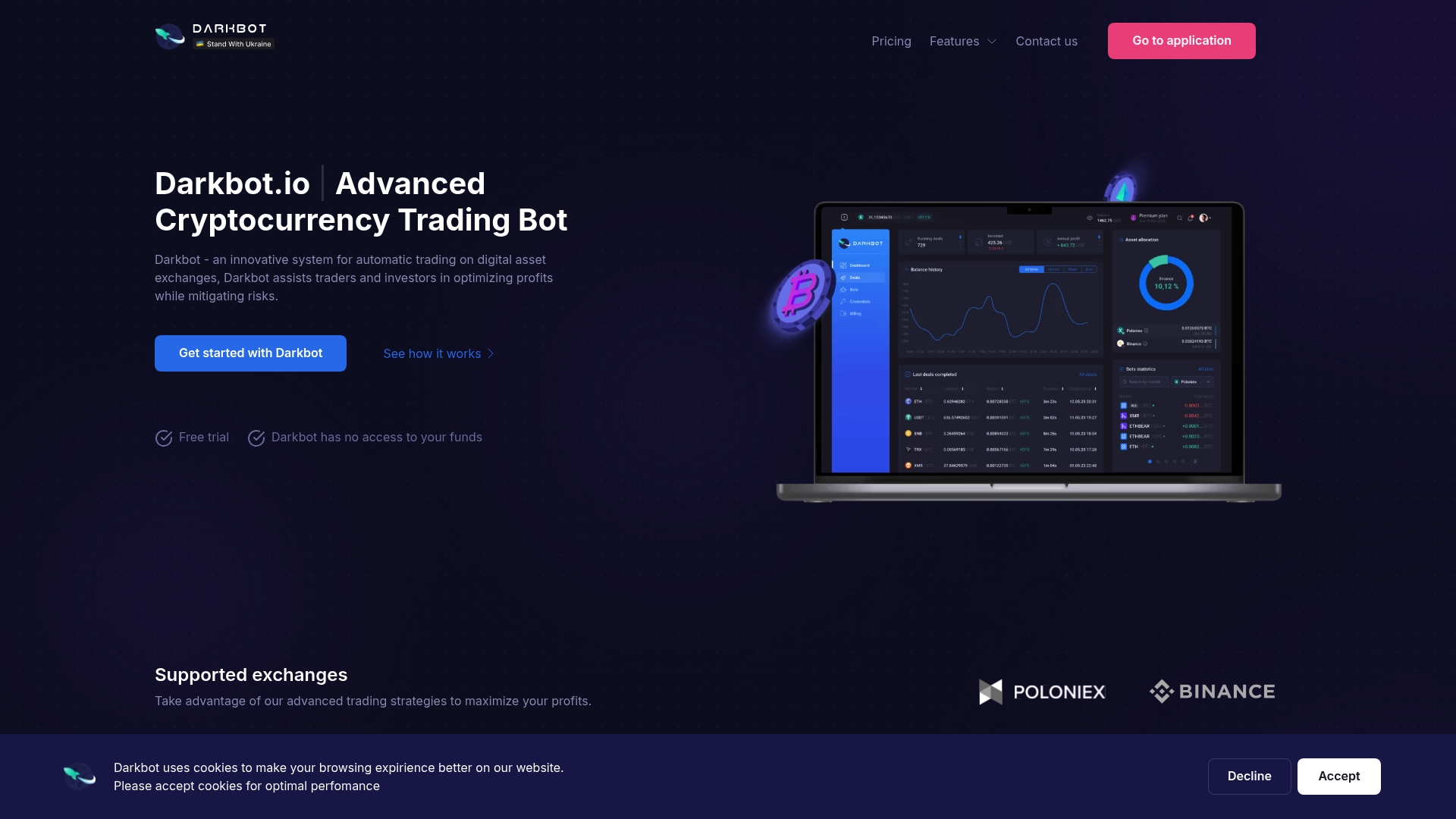
Darkbot is an AI-powered trading automation platform built around systematic execution and rule-driven decision frameworks. It connects to multiple exchanges through API integration, giving traders centralized control over positions across platforms without manual intervention. The AI functions as a consistency engine: it applies your pre-set rules without deviation, regardless of market conditions. Darkbot also supports automated portfolio rebalancing with configurable thresholds, which maps directly to the hybrid rebalancing approach described in this guide. For traders who want their risk framework to run as designed rather than as improvised, Darkbot provides the execution layer that makes that possible.
FAQ
What is a crypto risk management workflow?
A crypto risk management workflow is a structured process for identifying, assessing, and controlling risks in cryptocurrency trading and investment. It typically covers portfolio allocation, on-chain monitoring, governance policy, and continuous review cycles.
How does blockchain risk management differ from traditional risk management?
Blockchain risk management requires wallet-level transaction tracing, continuous 24/7 monitoring, and prevention-focused controls because blockchain immutability makes post-transaction error correction near impossible. Traditional frameworks rely on periodic audits and reversible transactions, which do not apply to on-chain activity.
What percentage should I hold in stablecoins for risk mitigation?
Holding 10–15% in stablecoins provides a buffer against volatile market moves and preserves liquidity for opportunistic purchases. Raising that allocation above 15% during periods of extreme market greed reduces overall portfolio risk without requiring a full exit from core positions.
How often should I rebalance my crypto portfolio?
Quarterly rebalancing combined with threshold triggers set at ±5–10% outperforms fixed weekly or monthly schedules. This approach reduces transaction costs and taxable events while keeping the portfolio aligned with its target risk parameters.
What is the biggest risk in DeFi positions?
The biggest risk in DeFi is composability failure, where a vulnerability in one protocol cascades through interconnected contracts. Monitoring oracle risk, governance risk, and composability risk across all active protocols is the standard approach to managing this exposure.
Recommended

Start trading on Darkbot with ease
Come and explore our crypto trading platform by connecting your free account!
Free plan available • No credit card required