Avoid Slippage: 7 Crypto Order Types Traders Use for Bot Automation

Seven order types cover almost every situation a crypto trader will face: market, limit, stop-market, stop-limit, take-profit/stop-loss pairs (OCO or bracket), trailing stops, and scheduled execution tools like TWAP or VWAP. For most retail trades, the practical default is simple: use limit orders to enter, market orders only for urgent exits on liquid pairs, and always attach a stop-loss or bracket when you can’t watch the position. Liquidity and exchange support, not personal preference, usually decide which of these you can actually use.
TL;DR:
- Market orders are suitable for quick exits or small trades on liquid pairs, but can suffer from slippage on large orders or thin books.
- Limit orders provide price control and often incur lower fees, especially when set as maker orders, but may never fill if the market doesn’t reach your price.
- Stop-market orders guarantee an exit but may fill at worse prices during gaps, while stop-limit orders give price certainty but risk remaining unfilled in fast-moving markets.
- Algorithmic execution tools like TWAP, VWAP, or iceberg orders are mainly relevant for large trades exceeding market depth, typically for institutional-sized orders.
- Venue support varies: centralized exchanges usually support all advanced orders, whereas decentralized exchanges primarily handle swaps with slippage limits, affecting order choice.
What Are Market Orders and When Do They Make Sense?
A market order tells the exchange to fill your trade immediately at whatever price is available. It’s a taker order, meaning you accept the current order book price rather than setting your own, and there’s no price guarantee attached to it, as Coinbase’s order type documentation explains.
That speed has a cost. Say you want to buy $50,000 of a token with only $30,000 sitting at the best ask price. The remaining $20,000 fills at progressively worse prices as your order eats through the book. That’s slippage, and it gets worse fast on thin order books. A large order might also fill in pieces across several price levels rather than one clean transaction, and each fill typically carries a taker fee, which exchanges price higher than maker fees to compensate market makers for providing liquidity.
Market orders earn their place when speed matters more than price. Exiting a losing position during a fast move, buying a small size on a deep, high-volume pair, or closing a leveraged position before a margin call are all reasonable uses. Avoid them for large buys on thin books or for entering leveraged positions where a few percent of slippage can meaningfully change your risk. On those trades, the price you didn’t get is often the difference between a fine trade and a bad one.
How Do Limit Orders Give You Price Control?
A limit order only fills at your specified price or better, which means you trade certainty of price for the risk that it never fills at all. Miss the market, and your order just sits there.
That tradeoff comes with a fee benefit. Because a limit order rests on the book and adds liquidity rather than removing it, it usually qualifies as a maker order, and Coinbase notes maker orders often carry lower fees than taker orders. Some exchanges let you flag an order “post-only,” which cancels the order instead of letting it execute as a taker fill, guaranteeing you capture the maker rate.
Time-in-force settings change how long and how completely a limit order stays active:
- GTC (Good-Till-Canceled): stays open until filled or manually canceled. This is the retail default, and crypto venues lean on it heavily since markets trade around the clock, unlike stock exchanges with fixed sessions, as Tastytrade’s help documentation points out.
- IOC (Immediate-or-Cancel): fills whatever is available right now, cancels the rest.
- FOK (Fill-or-Kill): fills the entire order immediately or cancels it completely.
- GTD (Good-Till-Date): cancels automatically at a set time if unfilled.
Picture setting a post-only limit buy slightly below the current bid on a coin you want to accumulate. If the price dips to your level, you get filled at the maker rate. If it doesn’t, you’ve lost nothing but time.
Stop-Market vs. Stop-Limit: What’s the Real Difference?
Both order types wait for a trigger price before acting, but what happens after the trigger is where they diverge sharply.
A stop-market order sits dormant until the price crosses your trigger, then converts instantly into a market order. Set a stop-market sell at $58,000 on a position bought at $62,000, and the moment price touches $58,000, it dumps at whatever the market will pay. A stop-limit order does the same triggering but converts into a limit order instead, so you might set a trigger at $58,000 with a limit price of $57,800. That guarantees you won’t sell below $57,800, but if the price gaps straight through that zone during a crash, your order never fills.
That’s the core tradeoff Koinly’s breakdown of crypto order types highlights: stop-market guarantees you get out; stop-limit guarantees the price you get out at, but not that you’ll get out at all.
For placement, structure beats round numbers. Set stops beyond a clear support or resistance level rather than at a psychologically tidy price like $60,000, where clustered stop orders make that zone a magnet for brief wicks. Sizing the position so that distance corresponds to an acceptable dollar risk, often capped around 1% of account equity, keeps a single stop-out from doing real damage. Darkbot’s risk checklist on the 1-2% rule walks through that sizing logic in more detail.
How Do You Automate Profit-Taking and Downside Protection?
Take-profit and trailing stop orders let you define an exit plan the moment you enter a trade, instead of deciding under pressure while the position is moving against you.
A take-profit order is a limit order that closes your position once the price reaches a target you’re happy with. A trailing stop works differently: instead of a fixed trigger price, it maintains a set distance (a percentage or dollar amount) behind the current market price, and that distance only moves in your favor. If price rises, the trailing stop rises with it; if price falls, the stop stays put and eventually triggers.
Most exchanges let you combine these into a single automated construct rather than managing two separate orders:
- OCO (One-Cancels-the-Other): pairs a take-profit and a stop-loss on an existing position; whichever triggers first cancels the other, which Coinbase describes as a standard way to bracket a position with defined upside and downside.
- Bracket orders: automatically attach a take-profit and stop-loss the moment your entry order fills, so the exit plan exists before you’ve even confirmed the position opened.
- Trailing stops: best suited to trending markets, since they lock in gains progressively without capping the upside at a fixed target.
Volatility is where these constructs can fail. A flash crash or a sudden gap can blow through a stop-limit price entirely, leaving the position open when you needed it closed. Using stop-market rather than stop-limit for the protective leg reduces that risk, accepting price uncertainty in exchange for actual execution. As a practical default, use a bracket order on a new position, switch to OCO when managing an existing one passively, and reserve trailing stops for positions you’re actively riding in a trend.
When Should You Use TWAP, VWAP, or Iceberg Orders?
Once an order’s size starts to exceed the liquidity visible on the book, execution quality becomes the priority, and that’s where algorithmic order types take over from simple market or limit orders.
TWAP (Time-Weighted Average Price) and VWAP (Volume-Weighted Average Price) both split a large order into smaller pieces executed over a defined window, aiming to match the average price over that period rather than pushing through the book in one shot. Coinbase Prime’s documentation notes that TWAP orders require a start time and expiry time, and exchanges often enforce a minimum notional value per time bucket, since executing too small a slice too frequently isn’t worth the overhead.
Iceberg orders take a different approach to the same problem: they show only a small visible portion of a much larger order on the book, refilling that visible slice as it fills, so the rest of the market never sees the true size. Peg orders passively track a reference price (often the best bid or ask) without ever crossing the spread, prioritizing a good fill over a fast one.
None of this matters for a typical retail trade. These tools earn their place when your order size materially exceeds the depth you can see on the book, the kind of situation institutions face regularly and active retail traders occasionally do during low-liquidity windows.
Why Do CEX and DEX Venues Support Different Order Types?
Order types aren’t universal. What you can actually place depends entirely on the venue’s underlying architecture, and that catches a lot of traders off guard when they move between platforms.
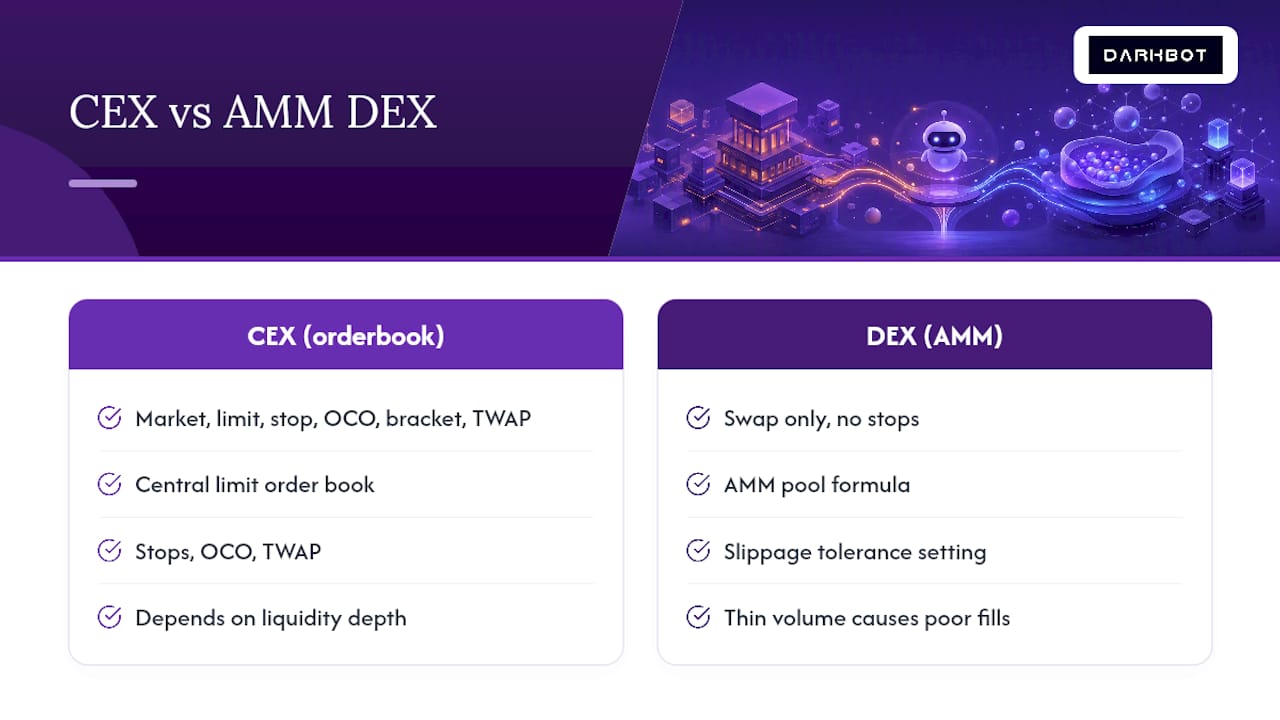
Centralized exchanges running a traditional order book (a CLOB, or central limit order book) can support the full range: market, limit, stop-market, stop-limit, OCO, bracket, and TWAP/VWAP scheduling. Automated market maker DEXs work differently. They price trades against a liquidity pool formula rather than matching buyers and sellers directly, so they typically only support a swap with a slippage tolerance setting, not native stop-loss or OCO functionality, according to MetaMask’s explainer on crypto order types.
Liquidity is the other binding constraint, often more limiting than the order type itself. A stop order on a pair with thin 24-hour volume can trigger on a brief wick and fill far worse than expected, since there’s no depth to absorb it cleanly. Practitioners generally treat pairs with 24-hour volume in the rough $5 million to $10 million range as a floor for reliable execution at retail size; below that, both limit and stop orders become unreliable. Perpetual futures venues add another wrinkle, since they commonly default protective stops to stop-market rather than stop-limit, prioritizing guaranteed exit over guaranteed price given how fast leveraged positions can move.
How Do You Choose the Right Order Type for a Trade?
Running through the same short checklist before every trade removes most of the guesswork about which order type fits.
- Define the objective. Are you optimizing for speed, price precision, or hands-off automation? That answer alone rules out most of the wrong choices.
- Check venue support and liquidity. Confirm the exchange supports the order type you want, then compare your order size against visible book depth and 24-hour volume for that pair.
- Pick the order family. Use market orders for urgent fills on liquid pairs, limit orders when price matters more than timing, stop-market when you need a guaranteed exit, and stop-limit when you need price control and conditions are calm enough to expect a fill.
- Set time-in-force and size the position. Match GTC, IOC, FOK, or GTD to how long you want the order live, and attach an OCO or bracket order whenever you won’t be watching the position closely.
- Test before scaling. Confirm the logic with paper trading or a small live order before committing full size, and move to TWAP or VWAP execution once your notional value starts to exceed what the book can comfortably absorb.
Pro Tip: *Never place a stop at a round number like $50,000 or $3,000. Clustered stops at obvious levels are exactly where brief price wicks tend to hunt for liquidity.
Darkbot’s breakdown of beginner-friendly trading strategies walks through how these order choices play out across a few common setups.
How Do Automation Platforms Handle Order Logic Safely?
Automation platforms execute these order types by connecting to an exchange through an API key, then chaining orders programmatically: placing an entry, attaching a bracket for take-profit and stop-loss, or scheduling TWAP-style slices to fill a large position over time while monitoring slippage against a defined threshold. The AI component in a platform like this isn’t forecasting price. It’s evaluating patterns against rules you’ve set and adapting execution within those boundaries, a distinction worth holding onto whenever “AI trading” claims start sounding like predictions.
What separates a trustworthy setup from a risky one is what safeguards sit underneath the automation:
- A backtesting history against past market data before any strategy runs live.
- A paper trading mode to test logic with simulated funds first.
- API error handling that stops execution cleanly instead of failing silently.
- Position sizing controls tied to account risk, not just raw order size.
- Configurable slippage thresholds that cancel or adjust an order rather than force a fill.
This structure applies across exchange integrations, strategy customization tools, and tiered plans, giving traders a framework for chaining these order types without needing to build the execution logic from scratch. Darkbot’s guide to automating crypto trading covers how the scheduling and monitoring pieces fit together.
Keep Order Selection Simple and Rule-Driven
The order types that matter most in practice are the boring ones: limit entries, bracket exits, and TWAP execution once size outgrows the book. Liquidity, not order-type sophistication, is what actually limits execution quality on most trades.
Resist the pull toward exotic order constructs before you’ve mastered the basics. Paper-test any new automation logic before it touches real capital, and treat repeatable process as more valuable than a clever setup you can’t reliably reproduce.
— Grisha
Automating Order Execution With Darkbot
Manually managing brackets, trailing stops, and scheduled execution across multiple positions gets difficult fast, especially once you’re running several strategies or watching more than one exchange at a time. Darkbot approaches that problem through API-based automation rather than manual order entry: connect an exchange account, define entry and exit logic including bracket and OCO structures, and let the platform execute according to those rules while you monitor performance through real-time analytics.
The platform supports backtesting against historical data and a paper trading mode, so a strategy involving stop placement, trailing exits, or scheduled slicing can be validated before it runs with real funds. Plans range from a free entry tier to standard and premium subscriptions, each backed by a 14-day money-back guarantee. If the order-type logic covered here is something you’d rather automate than execute by hand, you can review Darkbot’s plans and exchange integrations and connect an exchange account to start testing a strategy in paper mode.
Where to Read More on Order Mechanics
For deeper reading on the mechanics covered here, Coinbase’s order type guide explains maker/taker logic in detail, MetaMask’s explainer covers CEX versus DEX order support, and Coinbase Prime’s documentation details TWAP and VWAP parameters for larger executions. Readers weighing custody and risk beyond execution mechanics may also find Dilendorf’s overview of crypto asset protection strategies useful supplementary context.
This article is general information, not a substitute for advice from a qualified financial advisor. Consult a qualified financial professional about your own circumstances before acting on anything here.
Sources
- Understanding the order types | Coinbase Help
- Crypto order types: market, limit, stop loss, take profit | MetaMask
- Order Types | Coinbase Prime docs
- What are the Different Crypto Order Types? | Koinly
FAQ
What Are the Different Types of Crypto Orders?
The main categories are market orders, limit orders, stop-market and stop-limit orders, take-profit orders, trailing stops, OCO and bracket combinations, and algorithmic execution types like TWAP and VWAP for large orders.
What Are the Four Main Types of Cryptocurrency Orders?
Most traders build around four core types: market orders for immediate execution, limit orders for price control, stop orders for triggered exits, and combined risk orders like OCO or bracket setups that automate both profit-taking and loss protection.
What’s the Difference Between a Stop-Market and a Stop-Limit Order?
A stop-market order triggers into a market order, guaranteeing execution but not the price you get. A stop-limit order triggers into a limit order, guaranteeing your price but risking no fill at all if the market gaps past it.
Do All Crypto Exchanges Support the Same Order Types?
No. Centralized exchanges with order books typically support the full range, including stops, OCO, and TWAP, while AMM-based decentralized exchanges usually only support swaps with a slippage tolerance setting.
Can Automation Handle These Order Types for Me?
Platforms like Darkbot connect to exchanges through API keys and can chain entry, bracket, and scheduled execution logic according to rules you define, with backtesting and paper trading available to validate the setup before it runs live.
Recommended

Start trading on Darkbot with ease
Come and explore our crypto trading platform by connecting your free account!
Free plan available • No credit card required