Role of Technology in Trading: 2026 Guide for Investors
TL;DR:
- Technology automates trading execution, processes market data, and enforces risk controls beyond human capabilities. AI-driven systems now account for over 89% of global trading volume, shaping efficient, scalable, and consistent markets. Human oversight remains essential for strategy management, handling regime changes, and ensuring reliability in automated trading.
The role of technology in trading is defined by its capacity to automate order execution, process market data at scale, and enforce risk controls with a consistency no human trader can match. Algorithmic systems now facilitate approximately 89% of global trading volume as of Q1 2026. That figure means the majority of price discovery, liquidity provision, and order routing in modern markets runs through code, not human judgment. For traders and investors in cryptocurrency and traditional financial markets, understanding how these systems work is no longer optional. It is the foundation of any serious trading practice.
How does the role of technology in trading shape execution?
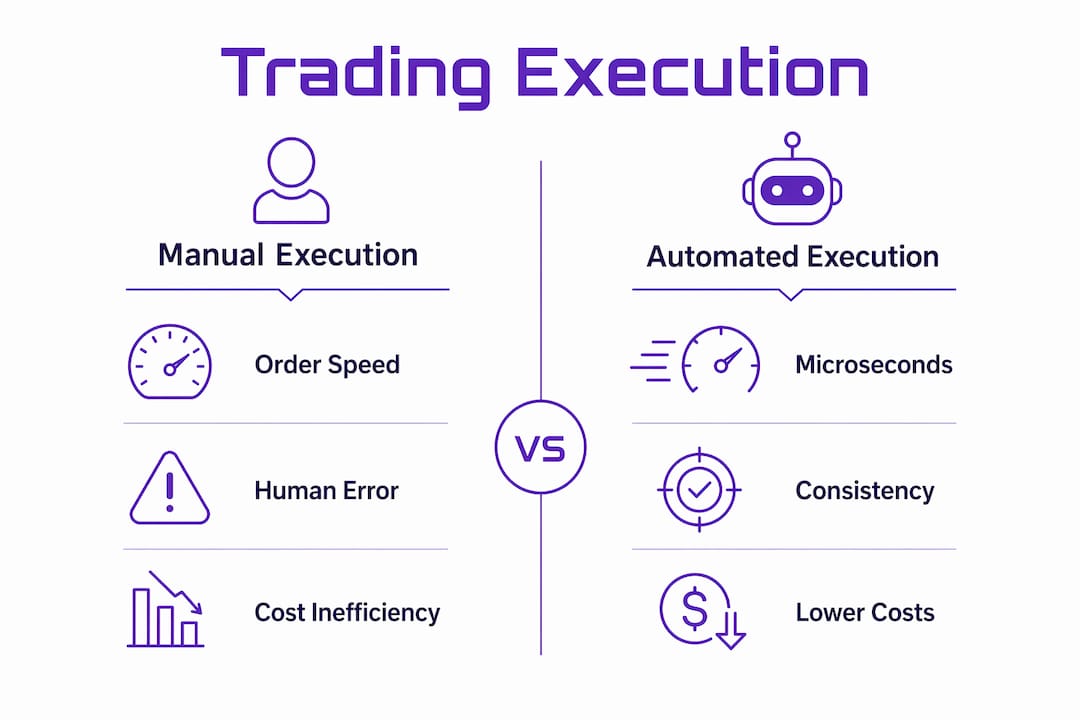
Automated trading systems reduce execution costs by removing the latency and inconsistency that come with manual order entry. A human trader placing a market order during a volatile session faces slippage, hesitation, and cognitive load. An algorithm faces none of those. It routes the order in microseconds, slices large positions into smaller tranches to minimize market impact, and adjusts in real time based on pre-defined rules.
The scale of this shift is visible across asset classes. Over two-thirds of U.S. Treasury trading and nearly 50% of investment-grade corporate bond trading now occur electronically. Proprietary technology processes millions of dealer quotes daily to identify the best available liquidity. That infrastructure did not exist 20 years ago. It is now the baseline for institutional participation.
The table below contrasts automated and manual execution across the metrics that matter most to active traders.
| Metric | Manual Execution | Automated Execution |
|---|---|---|
| Order speed | Seconds to minutes | Microseconds to milliseconds |
| Slippage risk | High during volatility | Reduced through order slicing |
| Consistency | Variable by trader state | Rule-bound and repeatable |
| Scalability | Limited by attention | Handles thousands of orders simultaneously |
| Error rate | Subject to fat-finger risk | Controlled by pre-trade validation logic |
Pro Tip: If you are building an automated strategy, test your execution logic on a paper trading environment first. Slippage assumptions in backtests often underestimate real-world fill costs, especially in low-liquidity crypto pairs.
Over 70% of institutional equity volume on major U.S. exchanges flows through algorithmic execution systems. That concentration means retail traders who rely on manual execution are operating at a structural speed disadvantage. Closing that gap requires adopting digital trading tools that automate at least the execution layer, even if strategy decisions remain human-driven.
What role does AI play in strategy development and analysis?
Artificial intelligence, specifically machine learning and natural language processing, has moved from experimental to operational in institutional trading. AI processes earnings call transcripts, news feeds, and social sentiment data to extract signals that traditional quantitative models cannot capture. The result is a broader information base feeding into strategy decisions.
The performance data supports this shift. Machine learning strategies in hedge funds outperformed traditional quant funds by an average of 2.4 percentage points during 2024–2025. That gap reflects AI’s ability to identify non-linear patterns across large datasets, not just follow pre-programmed rules. Equity hedge ML return spreads reached 3.16% monthly during the same period.
AI capabilities in trading strategy currently include:
- Pattern recognition across price, volume, and order flow data at speeds no analyst can replicate
- Sentiment analysis of earnings calls, regulatory filings, and news using large language models
- Reinforcement learning to adapt strategy parameters based on changing market conditions
- Portfolio construction using correlation matrices updated in real time
- Anomaly detection to flag unusual market behavior before it becomes a risk event
The limitations are equally real. AI models struggle with adversarial awareness and consistent expected value maximization in complex market conditions. Large language models misread sequential probabilistic updates and fail to model realistic competitor behavior. This means AI is a strong pattern-matching tool but a weak strategic reasoner.
Pro Tip: When evaluating an AI trading strategy, ask specifically how it handles regime changes. A model trained on 2021 crypto bull market data will behave unpredictably in a sideways or bear market. Regime detection logic is not optional.
AI trading is best understood as a tool that augments human decision-making, not one that replaces it. Multi-step reasoning and contextual judgment in uncertain conditions still require a human in the loop. The most effective setups use AI for execution and monitoring while humans govern strategy parameters and override conditions.
How does technology enhance risk management in modern trading?
Technology transforms risk management from a periodic review process into a continuous, real-time function. AI models monitor correlated positions across a portfolio, calculate value-at-risk dynamically, and adjust position limits without waiting for an end-of-day report. That speed matters most during market stress, when conditions change faster than any manual process can track.
The table below compares traditional and AI-enhanced risk management approaches.
| Risk Function | Traditional Approach | AI-Enhanced Approach |
|---|---|---|
| Position monitoring | End-of-day review | Continuous real-time tracking |
| Correlation analysis | Static periodic calculation | Dynamic, updated on each tick |
| Drawdown response | Manual intervention | Automated kill-switch triggers |
| Liquidity assessment | Historical averages | Live order book depth analysis |
| Limit adjustment | Rule-based, static | Adaptive based on volatility regime |
AI-driven markets can create conditional liquidity gaps where algorithms retract or sell simultaneously under stress. When multiple systems trained on similar data react to the same signal, the result is rapid order withdrawal and accelerated price moves. This is not a theoretical risk. It is a structural feature of markets where algorithmic participation is concentrated.
Kill-switch systems and fail-closed architectures address this directly. A kill-switch halts all order activity when a pre-defined loss threshold or anomaly condition is triggered. Fail-closed means the system defaults to no activity rather than continued execution when a component fails. Continuous model recalibration, rigorous backtesting, and kill-switch architectures are the operational baseline for any reliable AI trading system. These are not advanced features. They are minimum requirements.
For crypto traders specifically, smart automation in risk management provides the same real-time oversight that institutional desks use, applied to the 24/7 structure of digital asset markets.
How does technology impact cryptocurrency trading specifically?
Cryptocurrency markets present a distinct set of conditions: continuous operation across time zones, high volatility relative to traditional assets, and fragmented liquidity across dozens of exchanges. Technology is not just useful in this environment. It is the only practical way to manage these conditions systematically.
Retail adoption of AI-powered trading tools grew by over 340% between 2022 and 2025, with the strongest growth among traders aged 25–40 managing accounts between $10,000 and $100,000. The U.S. AI trading platform market surpassed $4.2 billion in 2026. That growth reflects a structural shift: retail traders are adopting the same systematic execution frameworks that institutional desks have used for years.
Technology delivers specific advantages in crypto trading that manual approaches cannot replicate:
- 24/7 execution without fatigue or attention gaps across global time zones
- Multi-exchange arbitrage by routing orders across platforms like Binance, Coinbase, and Kraken simultaneously
- Automated rebalancing to maintain target portfolio allocations as prices shift
- Volatility-adjusted position sizing that reduces exposure during high-uncertainty periods
- Real-time analytics on portfolio performance, drawdown, and correlation across assets
The role of AI in cryptocurrency trading extends beyond execution. AI models analyze on-chain data, funding rates, and exchange flow metrics that have no equivalent in traditional markets. These signals require automated ingestion and processing. No manual workflow handles them at the speed and scale required.
Algorithmic trading in crypto also enforces discipline that emotional trading erodes. A strategy with defined entry rules, position limits, and exit conditions executes the same way at 3 a.m. on a Sunday as it does during peak market hours. That consistency is the core value proposition of automation in volatile markets.
Key takeaways
Technology defines modern trading by automating execution, enabling AI-driven analysis, and enforcing real-time risk controls that manual processes cannot match at scale.
| Point | Details |
|---|---|
| Algorithmic dominance | Automated systems handle approximately 89% of global trading volume as of Q1 2026. |
| AI strategy edge | Machine learning strategies outperformed traditional quant funds by 2.4 percentage points in 2024–2025. |
| Risk management shift | AI enables continuous position monitoring and automated kill-switches, replacing periodic manual review. |
| Crypto adoption surge | Retail AI trading tool adoption grew over 340% between 2022 and 2025 in cryptocurrency markets. |
| Human oversight remains critical | AI handles execution and monitoring; human judgment governs strategy, limits, and override conditions. |
Where i think most traders get this wrong
Most traders treat technology as a shortcut. They deploy an automated system, assume it will handle complexity, and reduce their own engagement with the strategy. That is the wrong mental model.
The traders I have seen use technology most effectively treat it as a precision instrument, not a replacement for thinking. They spend more time on model design and recalibration after automation, not less. They understand that human oversight in AI trading is not a limitation of the technology. It is a deliberate design choice that makes the system more reliable.
The other mistake is ignoring algorithmic crowding. When many systems use similar signals and similar logic, they create correlated behavior that amplifies volatility. Traders who rely on overfitting and algorithmic crowding warnings as abstract theory, rather than operational risk, tend to discover the problem during a flash crash rather than before one.
My practical advice: treat your trading technology stack the way a pilot treats an autopilot system. It handles routine execution with precision. You remain responsible for the flight plan, the weather assessment, and the decision to override. That division of responsibility is not a compromise. It is the architecture that makes the whole system work.
— Grisha
Put systematic trading to work with Darkbot
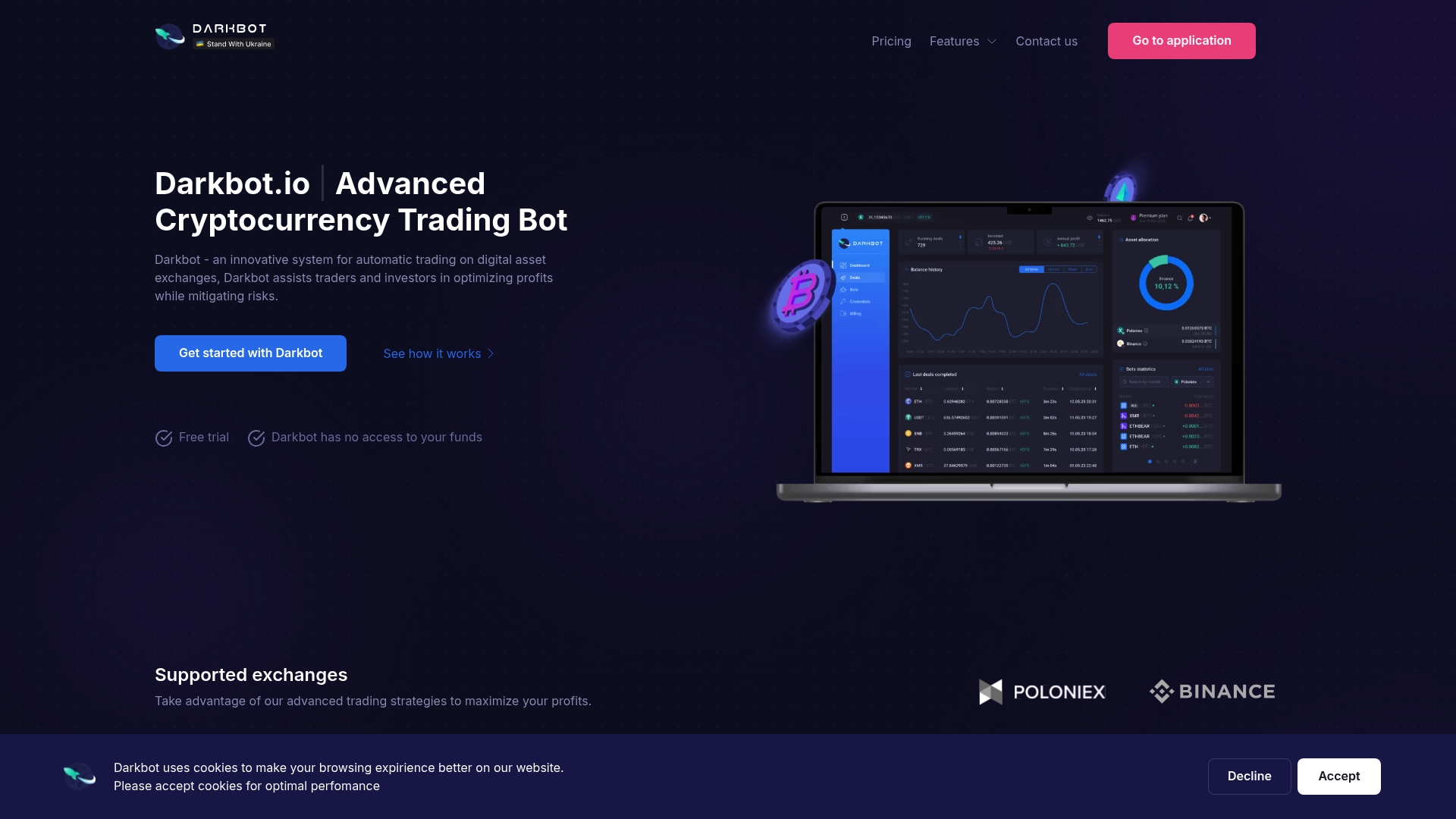
Darkbot is built on the same principles this article covers: rule-driven execution, real-time risk monitoring, and AI-assisted strategy management applied specifically to cryptocurrency markets. The platform connects to major exchanges via API, runs multiple automated strategies simultaneously, and provides portfolio-level analytics without requiring institutional infrastructure. For traders who want to apply systematic execution frameworks to crypto without building the technology from scratch, Darkbot’s trading automation provides the operational foundation. The portfolio management tools handle rebalancing, correlation tracking, and position sizing within a structured, auditable system. Discipline and consistency are built into the platform’s logic, not left to manual execution.
FAQ
What percentage of trading volume is algorithmic in 2026?
Algorithmic systems facilitate approximately 89% of global trading volume as of Q1 2026. The global algorithmic trading market reached an estimated $28.5 billion in 2025 and is projected to surpass $32.8 billion in 2026.
How does AI improve trading strategy performance?
Machine learning strategies in hedge funds outperformed traditional quant funds by an average of 2.4 percentage points during 2024–2025. AI identifies non-linear patterns across large datasets that rule-based quantitative models cannot detect.
What is a kill-switch in automated trading?
A kill-switch is a pre-programmed circuit breaker that halts all order activity when a loss threshold or system anomaly is triggered. It is a core component of fail-closed architecture in professional automated trading systems.
Why is human oversight still necessary in AI trading?
AI models struggle with adversarial awareness and multi-step reasoning in complex market conditions. The most reliable systems use AI for execution and monitoring while humans control strategy parameters, risk limits, and override conditions.
How fast has AI trading tool adoption grown in crypto?
Retail adoption of AI-powered trading tools grew by over 340% between 2022 and 2025, with the U.S. AI trading platform market surpassing $4.2 billion in 2026, driven largely by traders managing accounts between $10,000 and $100,000.
Recommended

Start trading on Darkbot with ease
Come and explore our crypto trading platform by connecting your free account!
Free plan available • No credit card required