Managing Volatility in Crypto Markets: 2026 Guide

TL;DR:
- Managing crypto market volatility involves applying systematic risk controls, such as position sizing rules and diversification, to protect capital from extreme price swings. Traders implement fixed risk limits like 1–2% per trade and use volatility-adjusted sizing based on ATR measurements to adapt to changing market conditions. Systematic frameworks consistently enforce these rules and incorporate event timing strategies, outperforming discretionary approaches that rely on emotional judgment.
Managing volatility in crypto markets is defined as the systematic application of risk controls, position sizing rules, and diversification frameworks to protect capital against the extreme price swings that characterize digital asset trading. Crypto markets operate 24 hours a day, seven days a week, without circuit breakers or regulatory halts, which makes uncontrolled exposure far more dangerous than in traditional equities. Professional traders address this through structured frameworks that include stop-loss placement, volatility-adjusted sizing, and strict drawdown limits. The industry term for this discipline is systematic risk management, and it separates traders who survive multi-year market cycles from those who do not.
How to manage volatility in crypto markets: core risk rules
The foundation of managing volatility in crypto markets is a set of non-negotiable risk parameters set before any trade is placed. Without these, position sizing becomes emotional and losses compound rapidly.
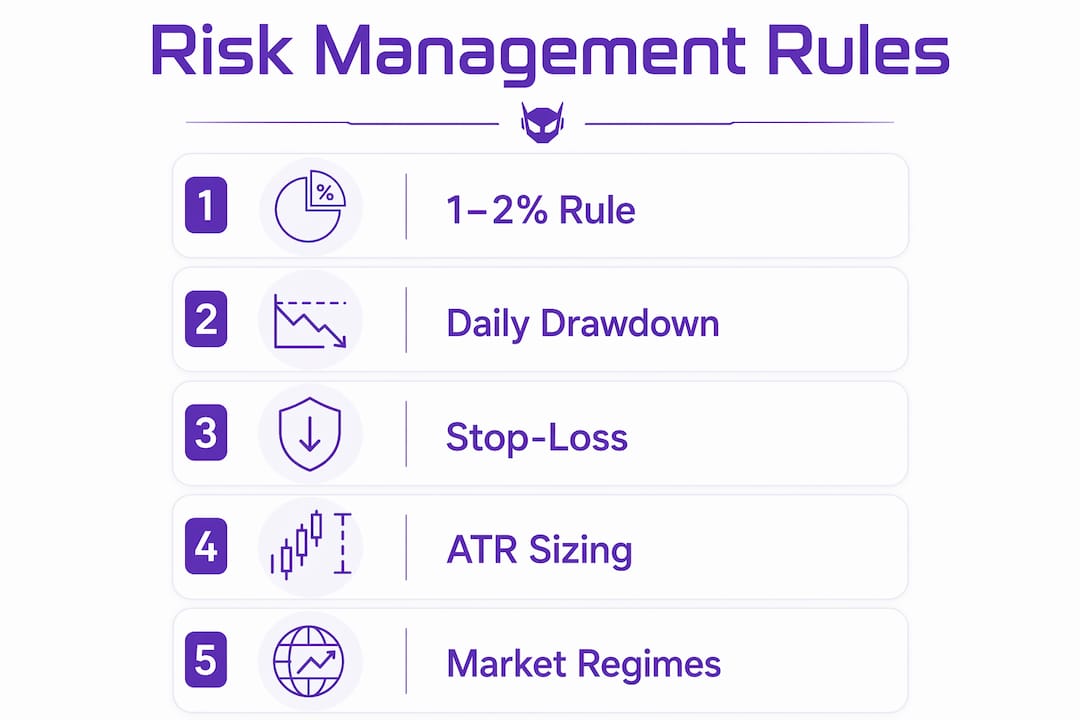
The 1–2% rule and daily drawdown limits
Professional traders limit risk on any single trade to no more than 1–2% of total account capital. That constraint means a ten-trade losing streak costs 10–20% of the account, not 50–80%. The math is what makes it work, not discipline alone.
Daily drawdown limits add a second layer. A 5–6% daily portfolio drawdown triggers an automatic trading halt, preventing compounding losses during trending downturns. This rule is especially relevant in crypto, where a single news event can move prices 15–30% within hours.
Pro Tip: Set your daily drawdown halt as a hard rule in your trading system, not a mental note. Mental notes fail under pressure.
Stop-loss placement that actually works
Stop-loss orders are the primary tool for capping downside on open positions. Stops placed below technical support levels, away from clustered round numbers, are less likely to be triggered by normal price noise. Trailing stops serve a different purpose: they lock in profits as price moves favorably without requiring manual intervention.
Here is a practical position sizing sequence:
- Determine account size and apply the 1–2% max risk rule to calculate the dollar amount at risk.
- Identify the stop-loss level based on technical support, not a fixed percentage.
- Calculate position size by dividing the dollar risk by the distance to the stop.
- Confirm the resulting position does not breach exchange exposure limits.
- Enter the trade only when all four parameters are satisfied simultaneously.
This sequence removes guesswork from every entry and keeps risk consistent across different assets and market conditions. You can review a detailed crypto risk checklist that walks through each step with examples.

Does volatility-adjusted position sizing improve risk control?
Fixed position sizes fail in crypto because volatility is not fixed. A position sized for a calm market becomes dangerously large during a volatility spike. Volatility-adjusted frameworks solve this by scaling size dynamically.
Using ATR to scale positions
The Average True Range (ATR) measures the average price movement over a set period, typically 14 days. ATR-based volatility measurements automatically reduce position sizes in high-volatility markets and expand them during calm periods. The result is consistent dollar risk per trade regardless of how much the market is moving.
The table below shows how position size adjustments work across different volatility regimes:
| Volatility Regime | 30-Day Realized Volatility | Position Size Adjustment |
|---|---|---|
| Low volatility | Below 30% | Full standard size |
| Moderate volatility | 30%–60% | Reduce by 20%–40% |
| High volatility | 60%–80% | Reduce by 50%–60% |
| Extreme volatility | Above 80% | Reduce by 75% or exit |
During Bitcoin’s March 2020 crash, 30-day volatility spiked above 80%, and systematic frameworks reduced position sizes by 75%. Traders who maintained full-size positions during that event faced drawdowns that took months to recover.
Adapting to market regimes
Risk parameters must be dynamic, not fixed. Recalibrating risk settings according to market regime prevents the common failure of applying bull-market position sizes during a bear-market environment. A bullish regime with low volatility supports standard sizing. A bearish regime with rising volatility demands reduced exposure and wider stops.
Pro Tip: Run a weekly volatility check using a 14-day ATR on your primary assets. If ATR has expanded more than 30% from its 30-day average, reduce all open and planned positions by at least one tier.
How should you diversify a crypto portfolio to reduce risk?
Diversification in crypto is more complex than in traditional finance because risk exists at multiple layers simultaneously. Owning ten tokens on a single blockchain is not diversification. It is concentrated exposure with the appearance of variety.
Crypto concentration risk exists at three layers: asset, protocol, and blockchain. Professionals apply specific caps at each layer:
- Asset level: No single token should dominate the portfolio to the point where one adverse event causes irreversible damage.
- Blockchain level: Maximum 60% of total holdings on any one blockchain. An Ethereum network outage or regulatory action affects every token built on it.
- Protocol level: Maximum 25% in any single DeFi protocol. Bridge hacks, smart contract exploits, and governance failures are protocol-specific risks that do not respect asset diversification.
- Exchange level: Maximum 10% of liquid capital per exchange, with no more than 20% total across all exchanges. Exchange insolvency risk, as demonstrated by multiple high-profile failures in recent years, is real and non-recoverable.
Correlation risk remains even with apparent diversification. Funds concentrated within one ecosystem carry correlated downside regardless of how many assets are held. A portfolio of ten Ethereum-based DeFi tokens will move together during an Ethereum-specific stress event. True diversification requires exposure across different blockchains, different protocol types, and different exchange custodians.
Diversification does not eliminate volatility. It reduces the probability that a single failure cascades into a portfolio-level crisis. You can explore exposure limits and diversification techniques in more detail to build a framework suited to your capital base.
Systematic vs. discretionary: which approach handles volatility better?
The data on discretionary trading is clear. Only 4% of retail traders achieve consistent profitability timing volatile crypto markets, despite 87% believing they can do it. That gap between confidence and outcome is the defining characteristic of discretionary trading.
Systematic trading operates on pre-defined rules that execute regardless of how the trader feels about a given setup. The advantages are measurable:
- Rules apply consistently across all market conditions, removing the variability of human judgment.
- Drawdown limits and position sizing are enforced automatically, not selectively.
- Performance can be backtested and refined using historical data.
- Emotional responses to losses, gains, or news events do not alter execution.
Discretionary traders, by contrast, size positions based on conviction, which is an emotional process rather than a mathematical one. Conviction-driven sizing is the primary driver of catastrophic losses in retail crypto trading. A trader who doubles position size because they “feel strongly” about a setup has abandoned risk management entirely.
AI-based trading bots enforce systematic risk controls like position sizing and stop placement without emotional interference. They execute the same rule set on the hundredth trade as on the first. That consistency is what systematic frameworks are designed to produce, and it is what discretionary traders structurally cannot replicate under pressure.
How do scheduled market events affect crypto volatility?
Scheduled macro and protocol events are predictable volatility catalysts. Treating them as surprises is a risk management failure, not bad luck.
FOMC meetings increase volatility by 15–30%, CPI and NFP releases by 20–40%, and protocol upgrades by approximately 25%. These figures represent average increases in realized volatility around the event window. Position sizes should reflect that elevated risk before the event occurs, not after.
A practical event management process:
- Maintain a rolling calendar of macro events (FOMC, CPI, NFP) and major protocol milestones (upgrades, token unlocks, governance votes).
- Two to three days before a high-impact event, reduce position sizes by 20–40% depending on the expected volatility increase.
- Widen stop-loss buffers to avoid being stopped out by pre-event noise rather than a genuine directional move.
- After the event resolves and volatility normalizes, return to standard position sizing using ATR confirmation.
- Avoid initiating new positions in the 12–24 hours immediately surrounding a major event unless the setup has strong technical confluence across multiple timeframes.
Options expiry dates deserve the same attention. Large open interest at specific strike prices creates predictable price magnetism and volatility around expiry. Tracking the options market on platforms like Deribit gives traders advance visibility into where volatility is likely to concentrate.
Key takeaways
Effective volatile cryptocurrency management requires systematic rules applied consistently across position sizing, diversification, and event timing, not discretionary judgment applied selectively.
| Point | Details |
|---|---|
| Apply the 1–2% rule | Limit each trade to 1–2% of account capital to prevent compounding losses. |
| Use volatility-adjusted sizing | Scale positions down by 20–75% as 30-day realized volatility rises above 60%. |
| Diversify across layers | Cap exposure at 60% per blockchain, 25% per protocol, and 10% per exchange. |
| Prefer systematic frameworks | Rule-based execution outperforms discretionary timing; only 4% of retail timers succeed consistently. |
| Prepare for scheduled events | Reduce position sizes 20–40% ahead of FOMC, CPI, and major protocol events. |
Why discipline matters more than market knowledge
I have watched traders with deep market knowledge blow up accounts that traders with average knowledge kept intact for years. The difference was never analytical skill. It was whether they followed their rules when it was uncomfortable to do so.
The most common failure pattern I see is this: a trader builds a solid risk framework, follows it through several losing trades, then abandons it on the next setup because the conviction is high. That one deviation often produces the largest loss of the year. The framework was not the problem. The decision to override it was.
Volatility dynamics in 2026 are not fundamentally different from prior cycles, but the speed of information and the depth of derivatives markets mean that volatility spikes resolve faster and punish hesitation more severely. Systematic approaches are better suited to this environment than they were five years ago, not less.
One practice I recommend consistently is trade journaling with a specific focus on rule adherence, not just outcomes. A winning trade that violated your position sizing rule is a warning, not a success. A losing trade that followed every rule is evidence your system is working. Separating process quality from outcome quality is the clearest path to improving long-term performance.
— Grisha
How Darkbot enforces risk rules automatically
Knowing the right risk rules and executing them consistently under pressure are two different problems. Darkbot addresses the second one.
Darkbot is an AI-powered trading automation platform built for traders who want systematic execution without manual intervention on every decision. The platform enforces position sizing rules, stop-loss placement, and drawdown limits as hard parameters within each bot configuration. When volatility spikes, Darkbot’s rule-based logic adapts exposure without requiring the trader to act in real time. For traders managing multiple assets across several exchanges, Darkbot’s portfolio management tools provide centralized visibility and automated rebalancing. The result is a consistent risk framework that runs the same way on a volatile Tuesday at 3 a.m. as it does on a calm Monday afternoon. Explore the full platform at Darkbot.
FAQ
What is the maximum risk per trade in crypto?
Professional traders limit each trade to 1–2% of total account capital. This prevents any single loss from causing irreversible damage to the portfolio.
How does ATR help with position sizing?
ATR measures average price movement over a set period and scales position sizes down as volatility rises. This keeps dollar risk per trade consistent regardless of market conditions.
What is the recommended exchange exposure limit?
Retail traders should hold no more than 10% of liquid capital on any single exchange and no more than 20% across all exchanges combined. This limits losses from exchange insolvency or operational failure.
Why do systematic traders outperform discretionary traders in volatile markets?
Systematic frameworks enforce rules consistently, removing emotional override. Only 4% of retail traders succeed at timing volatile markets discretionarily, compared to systematic approaches that apply the same logic on every trade.
How should i adjust positions before a major macro event?
Reduce position sizes by 20–40% ahead of FOMC meetings, CPI releases, and major protocol upgrades. Widen stop-loss buffers to absorb pre-event noise, then return to standard sizing once volatility normalizes.
Recommended

Start trading on Darkbot with ease
Come and explore our crypto trading platform by connecting your free account!
Free plan available • No credit card required