Spread Protection Bots: How Crypto Execution Controls Compare
A spread protection bot is an automated trading tool that checks the gap between the best bid and the best ask before it sends an order. It skips, delays, shrinks or reroutes the order when the gap is too wide. No single product owns the term. Exchanges apply it as an order-level rule, DEX protocols enforce it in code, and bots apply it as a filter inside a strategy. This article compares how each layer works, what it does and does not cover, and where Darkbot fits.
TL;DR
- Spread protection limits how far a market order can drift from the best opposite-side quote. Slippage protection limits the gap between expected and actual execution price. They overlap but are not identical.
- Exchange-level protection, such as Kraken’s and Bitvavo’s, cancels or partially fills market orders. Bot-level filters decide whether an order is sent at all.
- A spread check cannot guarantee a cheap fill. Spreads can widen after the check, and thin markets are where protection triggers most often.
- Darkbot is an AI-based automation platform built around rule-driven execution and structured risk control. Plans start free, with Standard at $12.50 per month and Premium at $25.00 per month.
What spread protection means in a trading bot
The spread is the difference between the best price a buyer will pay and the best price a seller will accept. Coinbase describes it as the difference between the current market price and the price at which you buy or sell. Every market order pays some of it. The question for automation is how much is acceptable.
At the exchange level, Bitvavo explains that its spread price protection caps the total drift of a market order from the best opposite-side quote. The cap counts both the bid-ask spread and slippage across price levels, it differs per market, and the result can be a full or partial cancellation.
At the bot level, the logic is a filter. A spread filter reads the best bid and ask, computes ask minus bid, and compares the result with a limit. If the spread is too wide, the strategy may skip the trade, wait, reduce size or switch order type, depending on the strategy and the exchange API.
The two layers work in sequence. The bot filter decides whether to act. The exchange rule decides whether a market order that was sent is allowed to fill.

Spread versus slippage
The terms are often mixed up, so it helps to separate them:
- Spread is a standing condition of the order book before you trade.
- Slippage is what happens during execution. Coinbase defines it as an order filling at a much higher or lower price than expected, and it attributes higher slippage primarily to low liquidity or low trading activity.
- Price impact, in DEX terms, is separate again. Cedra’s documentation treats it as the difference between execution price and spot price caused by trade size, while slippage is the difference between expected and actual output caused by other trades.
A single market order on a thin book can be exposed to all three. A sound protection setup therefore needs a spread limit, a slippage tolerance and a size limit, not one of them alone.
How bots detect a wide spread and limit an order
The mechanism is simple and rule-based, which is why it suits systematic execution:
- Read the book. The bot pulls the best bid and best ask through the exchange API.
- Compute the spread. Ask minus bid, usually expressed as a percentage of the mid price so one threshold works across assets with different prices.
- Compare with a limit. The limit is set per strategy and, ideally, per market, since a major pair and a small-cap pair rarely share a sensible threshold.
- Apply a response. Skip, wait and re-check, reduce size, or place a limit order instead of a market order.
- Log the decision. A skipped order is data. Reviewing how often and when spreads blocked entries shows which markets suit the strategy.
The response matters as much as the threshold. Waiting preserves the signal logic but may miss the entry. Switching to a limit order controls price but introduces fill uncertainty. Reducing size keeps exposure proportional to available liquidity. None is universally correct, which is why configurable rules beat fixed ones.
Where protection lives: four layers compared
The options below are not interchangeable products. They are different places where protection can be applied. Most traders end up combining two or more.
| Layer | Example | What it controls | What it leaves open |
|---|---|---|---|
| Exchange order rule | Kraken Market Price Protection | Cancels market orders when the spread is unusually wide | Applies to market orders only, and only on that exchange |
| Exchange order rule | Bitvavo spread price protection | Caps combined spread and slippage drift of a market order | Can result in no fill or a partial fill |
| Exchange display and fee model | Coinbase | Includes spread in the displayed price, cancels when the spread slips more than 10% | Slippage still depends on liquidity |
| Protocol-level tolerance | Cedra slippage module | Reverts the transaction if output falls outside tolerance | Specific to that DEX environment |
| Market-making bot | Hummingbot | Quotes bid and ask with inventory management to capture spread | Requires market-making expertise and its own parameter tuning |
| Automation platform | Darkbot | Rule-driven execution, strategy customization, risk management tools | Works on top of each exchange’s own order rules |
Kraken: Market Price Protection
Kraken’s support page defines Market Price Protection as canceling market orders to prevent fills at a bad price in an illiquid or volatile market. It triggers when the bid/ask spread becomes unusually wide. The cancellation range runs from 2.5% to 20% of market price depending on the currency pair, and market buy orders also carry a 5% order spending limit. Kraken lists the thresholds by pair, so a bot that trades there should treat that table as an input to its own settings.

Bitvavo: spread price protection
Bitvavo’s rule applies only to market orders. It is most likely to trigger in markets where less is traded, or when the order is large relative to the liquidity at the best prices. The outcome can be a partial fill or no fill. A bot sending market orders there should expect that outcome and handle it, rather than assume every order completes.
Coinbase: spread inside the price
Coinbase takes a different approach. It includes the spread in the displayed price when you buy or sell, or in the exchange rate when you convert. It also notes that an order can be canceled if the spread slips more than 10%. For automation, this means the cost is embedded in the quote, so comparing effective prices across exchanges is more informative than comparing headline fees.
Cedra: enforcement in the transaction
On-chain, Cedra’s price protection guide uses user-specified maximum tolerances for slippage and price impact, expressed in basis points. The transaction validates that actual output meets expected output within tolerance and reverts if it does not. This is a stricter form of protection than an alert, because the trade cannot settle outside the limit.
Hummingbot: capturing the spread
Hummingbot sits at the other end of the spectrum. Coin Bureau’s scalping bot comparison describes it as a market-making tool that quotes bids and asks with inventory management to capture spread, supporting centralized and decentralized spot markets. Here the spread is the revenue source, not just a cost to avoid. It suits traders who understand inventory risk and are comfortable configuring quoting behavior.
Where Darkbot fits
Darkbot is an AI-based crypto trading automation platform, not a signal provider. It connects to exchanges through API keys, routes orders directly, and lets you customize strategies, run backtests and paper trading, operate several bots at once, and apply risk management tools with real-time analytics.
In a spread-protection context, the useful property is rule-driven execution. A strategy that defines when it may enter, how large the order may be and what risk limits apply is a strategy that can treat spread conditions as one more constraint. The AI component is used for consistency and probabilistic pattern evaluation within those rules. It does not predict prices and it does not promise outcomes.
Darkbot works alongside each exchange’s own rules. Kraken’s and Bitvavo’s cancellations still apply to market orders sent there, and a well-structured strategy anticipates them. For the wider framework, see our pieces on risk management in crypto trading bots, the 1-2% risk rule checklist and multi-exchange integration.
Choosing a setup: criteria that matter
Compare options on execution criteria rather than feature counts.
| Criterion | Question to ask | Why it matters |
|---|---|---|
| Order type | Do you send market orders, limit orders or both? | Exchange spread rules in this comparison apply to market orders |
| Market liquidity | Are you trading major pairs or thin ones? | Protection triggers most often in less-traded markets |
| Order size | How large is each order relative to best-price depth? | Large orders consume several price levels |
| Failure handling | What does the strategy do after a cancellation or partial fill? | Cancellations are expected behavior, not errors |
| Exchange coverage | How many exchanges does the strategy run on? | Thresholds differ per exchange and per pair |
| Risk limits | Are position size and loss limits defined independently of the spread filter? | A filter is one layer, not the whole control set |
For small accounts the order-size row is the most practical. A $50 order rarely strains a major pair, so spread is the dominant cost. On a thin pair the same order can still move the price, so slippage dominates.
Limits of spread protection
Spread filters reduce exposure to poor fills. They do not remove it. The Traadence glossary notes that spreads can widen after the check, markets can gap and orders can queue. Filters do not replace slippage controls, price collars, position limits or kill switches.
Three practical consequences follow:
- Pair the filter with a slippage tolerance. The filter checks conditions before the order. The tolerance bounds the result after it.
- Plan for partial fills. Both Kraken’s and Bitvavo’s rules can cancel or partially fill a market order, so position-tracking logic should read actual filled quantity.
- Count total cost. Fees, spread and slippage all reduce returns, independent of any bot subscription fee.
Security of the account is a separate layer again. Trade-only API keys and withdrawal restrictions are covered in our guide to crypto trading bot security. If an exchange itself is compromised, the matter becomes legal rather than one of execution, and a Spanish-language resource on crypto exchange hack recovery describes how affected users in Spain approach it.
Our perspective
We build Darkbot around the idea that execution quality is a process, not a feature toggle. A spread limit is useful, but it is only one rule among several that a strategy needs: position size, loss limits, order type and exchange-specific behavior all interact.
That is why we focus on customizable strategies, risk management tools and backtesting and paper trading, so rules can be defined and reviewed before capital is committed. Our approach keeps a human in oversight of the system, with orders routed directly to the exchange.
We use machine learning for consistency and probabilistic pattern evaluation inside defined rules. We do not use it for forecasts. For a trader, the practical benefit is repeatable logic that behaves the same way at 3 a.m. as it does at noon.
Grisha
Pricing and getting started
Darkbot offers a Free plan with limited features, a Standard plan at $12.50 per month, a Premium plan at $25.00 per month, and an Enterprise tier without a published price. Paid plans carry a 14-day money-back guarantee. Current details are on the pricing page.
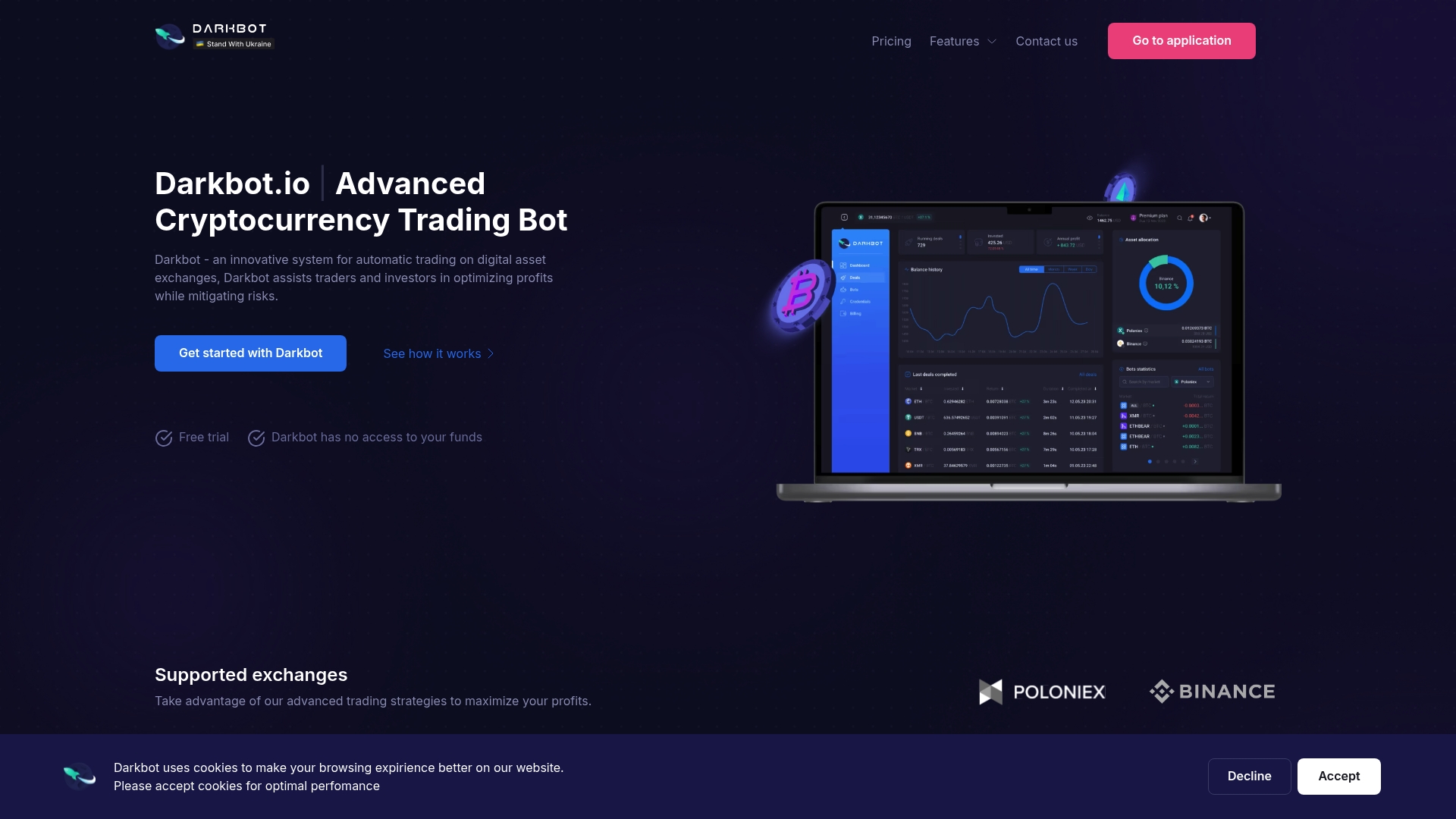
If you want to define execution rules and risk limits for your own trading, you can start from the Darkbot platform and connect an exchange through API keys.
Because each exchange applies its own market-order protection, review the relevant help page for every exchange you connect, then set your strategy limits with those thresholds in mind.
FAQ
Is a spread protection bot the same as slippage protection?
No. Spread protection looks at the gap between the best bid and ask. Slippage protection bounds the difference between expected and actual fill price. Some exchange rules, such as Bitvavo’s, count both together in one cap. A bot should usually set both.
Does spread protection guarantee a good fill?
No. Spreads can widen after the check and markets can gap. Protection reduces the chance of an unusually bad fill, and it is best combined with slippage tolerances, position limits and a kill switch.
Which orders does exchange spread protection affect?
In the Bitvavo and Kraken rules covered here, it applies to market orders. A market order may be canceled or partially filled when the spread is too wide. Limit orders set their own price, so they are not subject to the same cancellation.
When does spread protection trigger most often?
In thin markets and on large orders relative to best-price liquidity, according to Bitvavo. Coinbase similarly links higher slippage to low liquidity or low trading activity.
Sources
- What is spread price protection? – Bitvavo Help Center
- Understanding slippage and spread – Coinbase Help
- Market Price Protection – Kraken Support
- Adding Price Protection Mechanisms – Cedra Docs
- Spread Filter – Traadence Glossary
- Best Crypto Scalping Bots in 2026 – Coin Bureau
- Crypto exchange hack recovery – Solvendi Abogados
Recommended

Start trading on Darkbot with ease
Come and explore our crypto trading platform by connecting your free account!
Free plan available • No credit card required