Crypto Spot Trading Explained: A Beginner's Guide
TL;DR:
- Crypto spot trading involves buying and owning a cryptocurrency at the current market price with immediate settlement and no leverage.
- It differs from futures trading because it provides direct asset ownership and limits maximum losses to invested amounts.
Crypto spot trading is defined as buying or selling a digital asset at the current market price, with settlement happening immediately and ownership transferring directly to the buyer. No leverage, no contracts, no borrowed capital. You pay for an asset, and you own it. The global crypto market reached a valuation of $6.16 trillion in 2026, with around 67 million Americans trading crypto. That scale makes understanding what is crypto spot trading more relevant than ever for anyone entering the space. This guide covers the mechanics, the risks, and the practical decisions new traders face from day one.
What is crypto spot trading and how does it work?
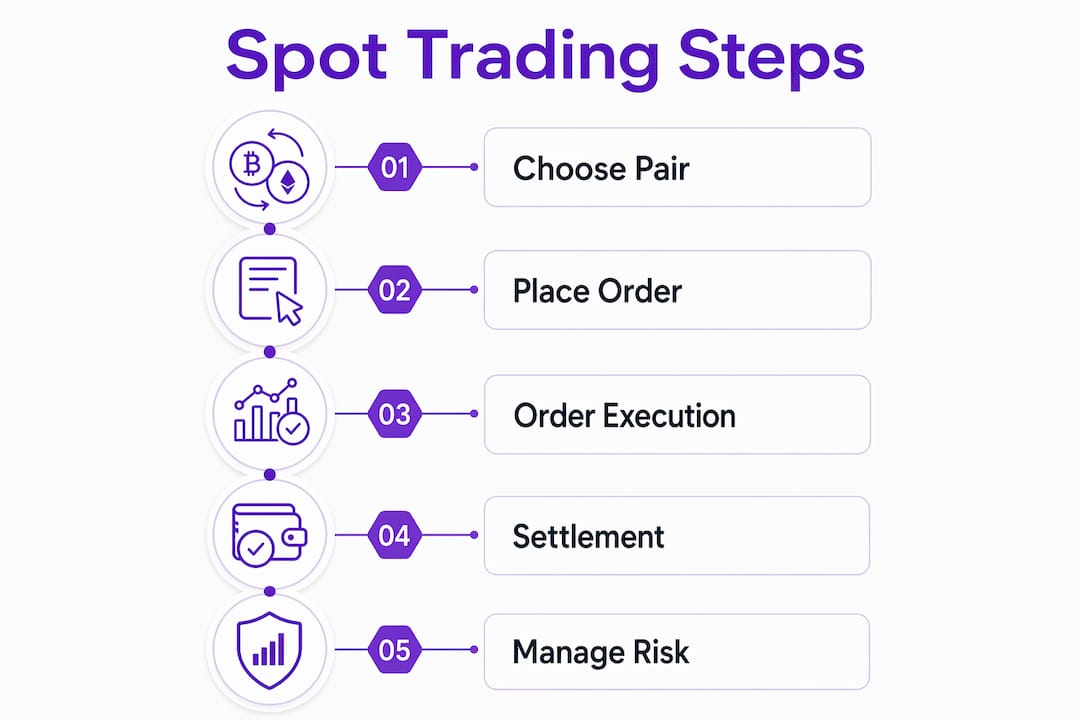
Crypto spot trading is the foundational method of cryptocurrency trading. A trader selects an asset pair, places an order, and the exchange executes the trade at the current price. The result is direct ownership of the purchased asset, credited to the trader’s account.
The process starts with choosing a trading pair. Pairs like BTC/USDT represent the asset being bought (Bitcoin) and the currency used to buy it (Tether). Every trade on a crypto spot market involves two sides: a buyer and a seller matched through the exchange’s order book.
Two order types drive most spot activity. A market order executes instantly at the best available price. A limit order sets a specific price target and only fills when the market reaches that level. Market orders prioritize speed. Limit orders prioritize price control.
Settlement on centralized exchanges happens as a balance update. When you buy 0.1 BTC, your account reflects the change within seconds. On decentralized exchanges, settlement happens on-chain after block confirmation, meaning the asset transfer depends on network speed and congestion. Both methods result in the same outcome: you hold the asset outright.
Fees and slippage affect every trade. Most exchanges charge a percentage of the trade value as a maker or taker fee. Large orders in thin markets cause slippage, where the order fills across multiple price levels and produces a worse average price than expected. Choosing liquid pairs reduces this risk significantly.
Pro Tip: Start with high-volume pairs like BTC/USDT or ETH/USDT. These pairs have deep order books, which means tighter spreads and less slippage on your fills.
How does spot trading differ from futures and leveraged trading?
The core difference is ownership. Spot trading gives you the actual asset. Futures and leveraged products give you a contract tied to the asset’s price, without ever transferring ownership.
Spot trading carries no liquidation risk because there is no leverage involved. If you buy $500 worth of Ethereum and the price drops 30%, you still hold your Ethereum. You have an unrealized loss, but your position stays open. In a leveraged futures trade, a 30% move against you at 3x leverage wipes your entire margin and closes the position automatically.
This distinction matters enormously for new traders. Futures require understanding margin requirements, funding rates, and liquidation thresholds before placing a single trade. Spot trading requires understanding price and order types. The learning curve is substantially shorter.
Spot trading limits your risk to the amount you invest. You cannot lose more than you put in. Leveraged products can produce losses that exceed the initial position, depending on the structure of the product and the exchange’s risk policies.
Price behavior also differs between the two markets. Spot prices reflect actual supply and demand for the asset. Derivatives markets can diverge from spot prices, especially during periods of high volatility or extreme funding rates. For traders focused on understanding real asset value, the spot market provides a cleaner signal.
The table below summarizes the key structural differences.
| Feature | Spot trading | Futures and leveraged trading |
|---|---|---|
| Asset ownership | Direct ownership of the asset | Contract only, no ownership |
| Liquidation risk | None | Yes, forced closure at margin threshold |
| Maximum loss | Limited to invested amount | Can exceed initial investment |
| Complexity | Low | High |
| Best suited for | Beginners, long-term holders | Experienced traders with risk tolerance |
What should new traders consider before entering the spot market?
The crypto spot market operates 24 hours a day, 7 days a week, without pause. That continuous operation changes how price discovery works compared to traditional stock markets. Prices can move significantly overnight, over weekends, or during low-liquidity hours when fewer participants are active.
Disciplined risk management and starting with small positions are non-negotiable for new traders. Crypto transactions are irreversible. There is no customer service line to reverse a bad trade or recover funds sent to the wrong address. Every decision carries permanent consequences.
New traders should address these practical considerations before placing their first trade:
- Position sizing. Never allocate more to a single trade than you can afford to lose entirely. A common starting framework caps any single position at 1%–5% of total capital.
- Exchange selection. Choose a regulated, established exchange with strong security practices and transparent fee structures. Account security directly affects your ability to hold assets safely.
- Custody. Understand the difference between holding assets on an exchange and holding them in a personal wallet. Exchange custody is convenient but introduces counterparty risk.
- Liquidity. Low-liquidity pairs produce wider spreads and higher slippage costs. Stick to major pairs until you understand how order books behave.
- Exit planning. Decide before entering a trade at what price you will exit, both for a profit target and a loss limit. Entering without an exit plan leads to emotional decision-making.
Operational security in permissionless crypto markets deserves serious attention. Two-factor authentication, withdrawal address whitelisting, and API key restrictions are baseline protections, not optional extras.
Pro Tip: Set price alerts rather than watching charts continuously. Constant monitoring leads to impulsive decisions. Alerts let you act on your plan instead of reacting to noise.
How to execute spot trades effectively and avoid common mistakes
Successful spot trading requires more than identifying an asset you believe will rise. Effective execution demands analysis of order book liquidity, price structure, and market conditions at the time of the trade.
The most common mistakes new traders make fall into predictable patterns:
- Using market orders on illiquid pairs. A market order on a thinly traded asset can fill at a price far worse than the displayed quote. Use limit orders when liquidity is uncertain.
- Ignoring fees. A 0.1% fee per trade sounds small. Across dozens of trades per month, cumulative fees reduce net returns meaningfully. Factor fees into every trade calculation.
- Chasing price. Entering a trade after a large price move, hoping the momentum continues, is one of the most reliable ways to buy at the top. Wait for a defined entry level rather than reacting to price spikes.
- Holding without a plan. Owning an asset means full exposure to its price swings. Without a clear exit strategy, a temporary loss can become a permanent one if the trader holds indefinitely hoping for recovery.
- Overtrading. Placing frequent trades to feel active generates fees without generating returns. Fewer, higher-quality trades outperform high-frequency guesswork.
Understanding crypto market structure means reading where buyers and sellers are concentrated in the order book, not just watching the current price. A large cluster of buy orders below the current price suggests support. A wall of sell orders above suggests resistance. These signals inform better entry and exit decisions.
Applying structured risk management strategies from the start builds habits that protect capital over time. The traders who last in crypto markets are not necessarily the most aggressive. They are the most disciplined.
Key Takeaways
Crypto spot trading is the most direct and risk-controlled method of participating in cryptocurrency markets, requiring disciplined execution, clear exit planning, and a solid understanding of order types and liquidity.
| Point | Details |
|---|---|
| Direct ownership | Spot trading transfers the actual asset to you, with no contracts or leverage involved. |
| No liquidation risk | Your position stays open regardless of price moves, unlike leveraged futures products. |
| Slippage management | Trade liquid pairs and use limit orders to avoid poor fills on large or illiquid trades. |
| Risk is capped | Your maximum loss equals your invested amount, making spot trading safer for beginners. |
| Exit planning is mandatory | Define profit targets and loss limits before entering any trade to avoid emotional decisions. |
Spot trading is still the foundation, and that will not change
Derivatives get more attention because they generate larger headlines. Liquidation cascades, funding rate anomalies, and leveraged long squeezes make for dramatic market events. But every one of those events traces back to the spot market, where actual supply and demand set the underlying price.
I have watched traders skip spot entirely and go straight to perpetual futures because the potential returns looked bigger. Most of them learned an expensive lesson within weeks. The mechanics of leverage are not complicated to understand intellectually. They are very hard to manage emotionally when a position moves against you at 5x or 10x.
Spot trading forces a different kind of discipline. You own the asset. You feel the full weight of a 20% drawdown without the forced exit that leverage provides. That experience, uncomfortable as it is, teaches you something about your own risk tolerance that no amount of paper trading replicates.
The rise of AI-driven automated trading strategies has made systematic spot trading more accessible. Automation removes the emotional variable from execution. A rule-based system does not panic at 3:00 AM when a token drops 15%. It executes the plan. That consistency is what separates sustainable trading from speculative gambling.
My advice to anyone starting out: spend at least three months trading spot only. Learn how order books move. Learn what slippage feels like on a real trade. Understand your own reaction to unrealized losses. That foundation makes every more complex strategy you attempt later significantly more likely to succeed.
— Grisha
Darkbot and systematic crypto spot trading
Spot trading rewards consistency and penalizes impulsive decisions. Darkbot applies AI-driven logic to execute rule-based strategies across multiple exchanges, removing the emotional friction that causes most new traders to deviate from their plans.
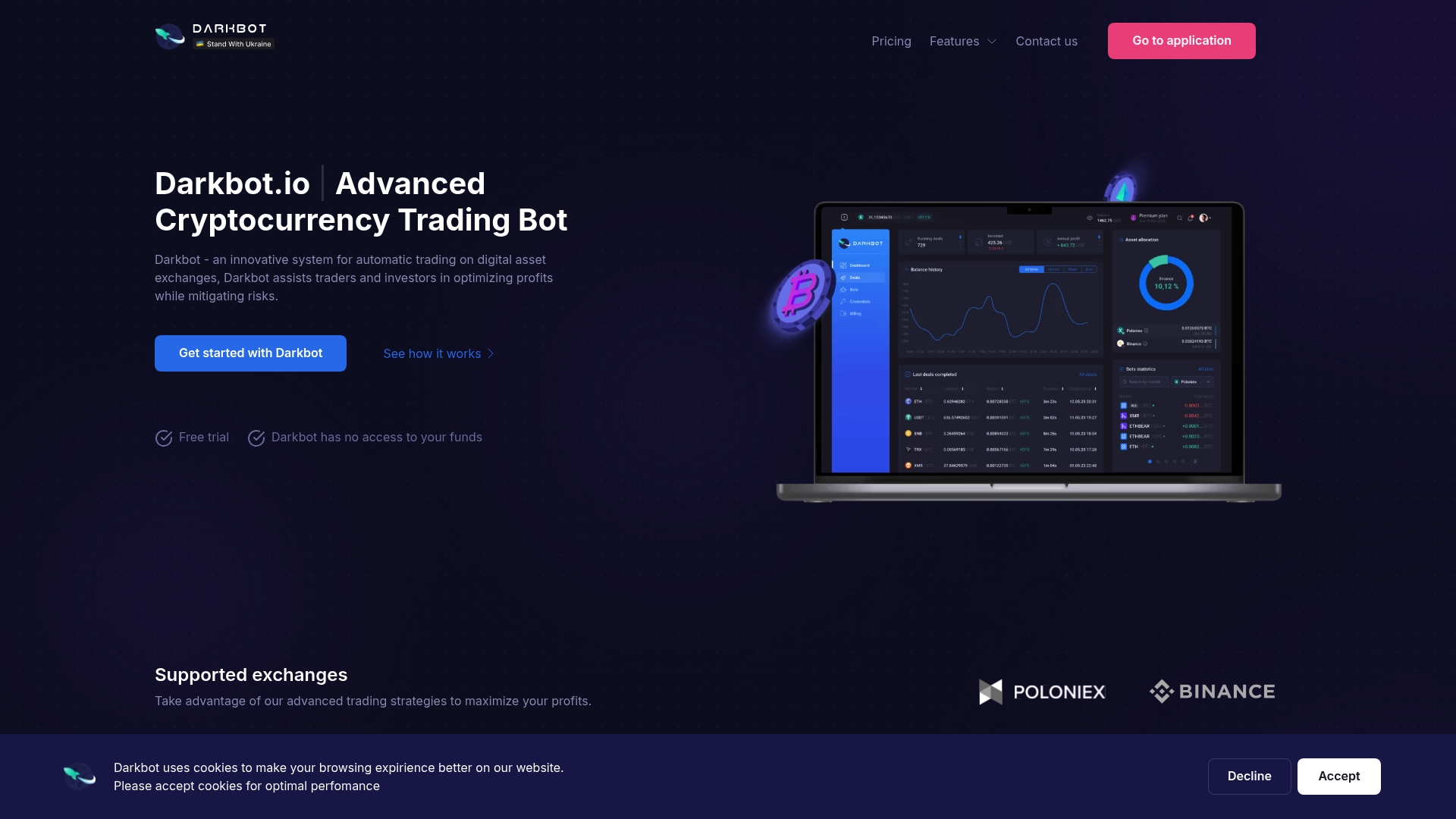
Darkbot connects to exchanges via API keys, monitors market conditions continuously, and executes trades based on defined parameters rather than sentiment. The platform supports portfolio management across spot positions, with automated rebalancing and real-time analytics built in. For traders who understand spot mechanics and want to apply them systematically, Darkbot’s trading platform provides the infrastructure to do so without manual intervention on every trade.
FAQ
What is crypto spot trading in simple terms?
Crypto spot trading is buying or selling a cryptocurrency at the current market price, with the asset transferring to your ownership immediately after the trade settles.
Is spot trading safer than futures trading?
Spot trading carries less structural risk than futures because there is no leverage and no liquidation mechanism. Your maximum loss is limited to the amount you invested.
What order types are used in spot trading?
Spot traders primarily use market orders for instant execution and limit orders to target a specific entry or exit price. Limit orders reduce slippage risk on less liquid pairs.
How does slippage affect spot trades?
Slippage occurs when a large order fills across multiple price levels in a thin order book, resulting in a worse average price than the quoted rate. Trading liquid pairs minimizes this effect.
Can beginners start with crypto spot trading?
Spot trading is the recommended starting point for new traders because it requires no understanding of margin, leverage, or liquidation. Starting with small positions on major pairs like BTC/USDT builds practical experience with controlled risk.
Recommended

Start trading on Darkbot with ease
Come and explore our crypto trading platform by connecting your free account!
Free plan available • No credit card required