Futures Bot for Crypto: How the Main Options Compare
A crypto futures bot is software that places and manages futures orders for you under rules you set. Most of them trade perpetual contracts on crypto exchanges. They fall into three groups: tools built into an exchange, subscription platforms that connect to your exchange account by API key, and open-source frameworks you run yourself. The right choice depends on where you trade, how much leverage you accept and how much rule-setting you want to control. For multi-exchange, rule-driven automation with structured risk control, Darkbot is the option we recommend.
TL;DR
- Exchange-native bots (Binance, Bybit, Pionex) have no separate subscription, but they work only on that exchange and you pay its trading fees.
- Subscription platforms (3Commas, Bitsgap, Darkbot) connect through API keys and work across exchanges, which suits traders who use more than one venue.
- Leverage is the variable that matters most. A bot executes rules consistently, but it does not remove liquidation risk.
- Darkbot is an AI-based automation platform, not a signal provider. Standard is 12.50 $ per month and Premium is 25.00 $ per month, with a free tier.
- Before using real funds, use paper trading and backtesting to check logic, and treat their results as a test of rules, not a forecast.
What a futures bot does and does not do
A futures bot turns a trading rule into repeatable execution. You define an entry condition, a position size, a leverage setting, an exit and a stop. The bot checks those conditions around the clock and sends orders to the exchange through its API. The benefit is consistency: the same rule is applied the same way at 3 a.m. as at noon, without fatigue or second-guessing.
What it does not do is change the risk of the contract. Futures positions are leveraged, so a small adverse move can close a position at a loss or trigger liquidation. The effect is the same whether a person or a bot opened the trade. That is why the guardrails you configure matter more than the label “AI” on the product. One recent industry review makes the same point: in most products, the AI is an assistant that suggests settings, or an agent that places orders within limits you set, so the limits carry the weight.
A second clarification is about market scope. Crypto bots trade perpetual futures on crypto exchanges, not CME futures. Reviews of futures-broker bots draw this line, so a bot built for one market cannot be moved to the other.
The three types of crypto futures bot
| Type | Examples | Typical cost | Works across exchanges | Main trade-off in design |
|---|---|---|---|---|
| Exchange-native | Binance Trading Bots, Pionex, Bybit bots | Standard trading fees | No | Tied to one venue and its strategy list |
| Subscription platform | 3Commas, Bitsgap, Darkbot | Monthly or annual plan | Yes, via API keys | Requires API setup and key hygiene |
| Open-source framework | Hummingbot | Free software, your own hosting | Yes | Requires technical skill to configure and maintain |
The categories matter because cost, control and setup effort differ in each. Exchange-native tools are the quickest to start. Subscription platforms centralize several accounts. Frameworks give maximum control to people who are comfortable with code.
Exchange-native bots
Binance
Binance built eight automated tools into its platform, including Spot Grid, Futures Grid, DCA, Rebalancing, Auto-Invest, TWAP, VP and Spot Algo. According to a CoinCodeCap overview, there is no separate subscription or API setup. You open them under “Trading Bots” in the app or on the web, and the cost is the standard trading fee. For a futures trader the relevant tool is Futures Grid, which places orders across a price range on a perpetual contract.
If Binance is your main venue, our guide to using trading bots on Binance walks through the setup, and our comparison of automated platforms for Binance covers the wider field.
Pionex
Pionex is both an exchange and a bot platform. A 2025 review lists more than 16 built-in bots, including Futures Grid, Futures DCA with up to 10x leverage, Spot-Futures Arbitrage and Futures Martingale. The same review reports futures fees of 0.02% to 0.05% and no separate bot subscription. The arbitrage bot is described there with a target of 15% to 50% APR. Treat any such figure as a marketing target rather than an expected result, since it depends on funding rates and market conditions at the time.
Bybit
The same review describes Bybit’s futures grid in three modes with leverage up to 50x, futures DCA across up to five coins, futures Martingale and combo bots that manage 2 to 10 contracts with automatic rebalancing. Leverage of that size leaves very little room between entry and liquidation, so position size and stop rules become the main design decision.
Subscription platforms
3Commas and Bitsgap
Both connect to several exchanges through API keys. According to a 2026 cost review, 3Commas costs $20, $50 or $140 per month, and its Starter plan is for spot trading, so a futures trader needs to look above the entry tier. The same review lists Bitsgap at $29, $69 or $149 per month, or $23, $55 or $119 billed annually. Plans and features change, so confirm the current tier on each provider’s pricing page before subscribing.

Darkbot
Darkbot is an AI-based crypto trading automation platform. It is not a signal provider: it does not tell you what to buy, it executes the strategy you define. Its design centers on systematic execution, structured risk control and repeatable logic.
The main capabilities, as described on our site:
- Exchange integration through API keys, with direct order routing.
- Strategy customization and fine-tuning.
- Backtesting and paper trading.
- Multiple simultaneous bots.
- Portfolio management and automated rebalancing.
- Risk management tools and real-time analytics.
- Human oversight and personalized support.
Pricing is published on the Darkbot pricing page: a Free plan with limited features, Standard at 12.50 $ per month, Premium at 25.00 $ per month, and an Enterprise tier without a published price. Paid plans carry a 14-day money-back guarantee.
Hummingbot
Hummingbot is an open-source framework for market making and algorithmic trading, released under the Apache 2.0 license. It suits developers who want to run and maintain their own infrastructure. It is a different product from a hosted dashboard, and the effort sits in setup and upkeep.
Side-by-side comparison
| Option | Type | Futures strategies named | Cost | Notes |
|---|---|---|---|---|
| Binance Trading Bots | Native | Futures Grid, DCA | Trading fees only | Binance only |
| Pionex | Native | Futures Grid, DCA (up to 10x), Martingale, Spot-Futures Arbitrage | Futures fees of 0.02% to 0.05% | Pionex only |
| Bybit bots | Native | Futures Grid (up to 50x), DCA, Martingale, Combo | Trading fees | Bybit only |
| 3Commas | Platform | Varies by tier | $20, $50 or $140 per month | Starter tier is spot only |
| Bitsgap | Platform | Varies by tier | $29, $69 or $149 per month | Annual billing lowers the rate |
| Darkbot | Platform | Rule-based custom strategies | Free; 12.50 $ or 25.00 $ per month | AI-based execution, paper trading, backtesting |
| Hummingbot | Framework | Configurable in code | Free software | You host and maintain it |
How to choose
Work through these criteria in order. Each one narrows the field.
- Venue. If you trade on one exchange and want the lowest setup effort, its native tools are the starting point. If you use two or more exchanges, a platform with API integration avoids rebuilding rules in each interface.
- Strategy fit. Grid logic suits ranging markets, DCA suits staged entries, and rule-based systems suit anyone who wants entry, sizing and exit conditions defined explicitly. Match the logic to how you would trade manually.
- Risk controls. Look for configurable stop losses, take profits, position limits and a way to cap total exposure. On a leveraged product these are not optional extras.
- Testing tools. Paper trading and backtesting let you check that a rule set behaves as designed before real capital is involved.
- Cost against account size. A flat monthly fee weighs differently on a $500 account than on a $50,000 one. Compare the fee to the capital it manages.
- Support and oversight. Futures positions can need attention during volatile sessions. Access to support and the ability to intervene matter.
Risk controls to set before going live
Leverage multiplies both the position’s exposure and the speed at which an adverse move reaches your liquidation price. A bot executes your settings exactly, so the settings are the risk model. These are the parameters to define first:
- Leverage cap. Choose the lowest leverage that supports your strategy, not the highest the exchange allows.
- Position size. Define risk per trade as a fixed share of account equity, so no single position decides the outcome.
- Stop loss. Set an explicit exit for every position and place it before the estimated liquidation price.
- Take profit or trailing exit. Decide in advance how a winning position closes.
- Total exposure limit. Cap the number of simultaneous bots and their combined margin.
- Margin buffer. Keep unallocated funds available, so a drawdown does not force liquidation.
Our articles on risk management in crypto trading bots and defining risk management in crypto go through these controls in more detail.
Connecting a bot to your exchange safely
Platforms connect through an API key you generate on the exchange. A few habits reduce exposure:
- Create a key dedicated to the bot, not one reused elsewhere.
- Enable only the permissions the bot needs, which means reading balances and placing orders. Leave withdrawal permission off.
- Where the exchange supports it, restrict the key to the platform’s IP addresses.
- Review active keys periodically and delete those you no longer use.
These are standard precautions. Check the exchange’s own API documentation for the exact permission names and options it offers.
Testing before committing capital

Paper trading runs your rules against live prices with virtual funds. Backtesting runs them against historical data. Both have limits worth understanding. A backtest reflects past conditions, and a rule set tuned too closely to history may behave differently on new data. Paper trades also do not fully reproduce real-world slippage and fill timing. Use these tools to confirm that the logic does what you intended, that stops trigger where expected and that exposure stays inside your limits. Do not read their output as a forecast.
Our perspective
Futures automation is a process problem before it is a technology problem. The traders who use it well define their rules, their sizing and their exit conditions first, and then let software apply them without deviation.
That is how we built Darkbot. It is an AI-based execution platform, not a signal service. We use machine learning as a mechanism for consistency: evaluating conditions probabilistically and adapting within rules you set, never as a prediction of price. Orders are routed directly to your exchange through your API keys, and human oversight and support stay part of the process.
We think the right question is not which bot promises the most, but which one makes your risk visible and your rules repeatable. Strategy customization, paper trading, backtesting, multiple simultaneous bots and risk management tools exist for that purpose.
Grisha
Where Darkbot fits
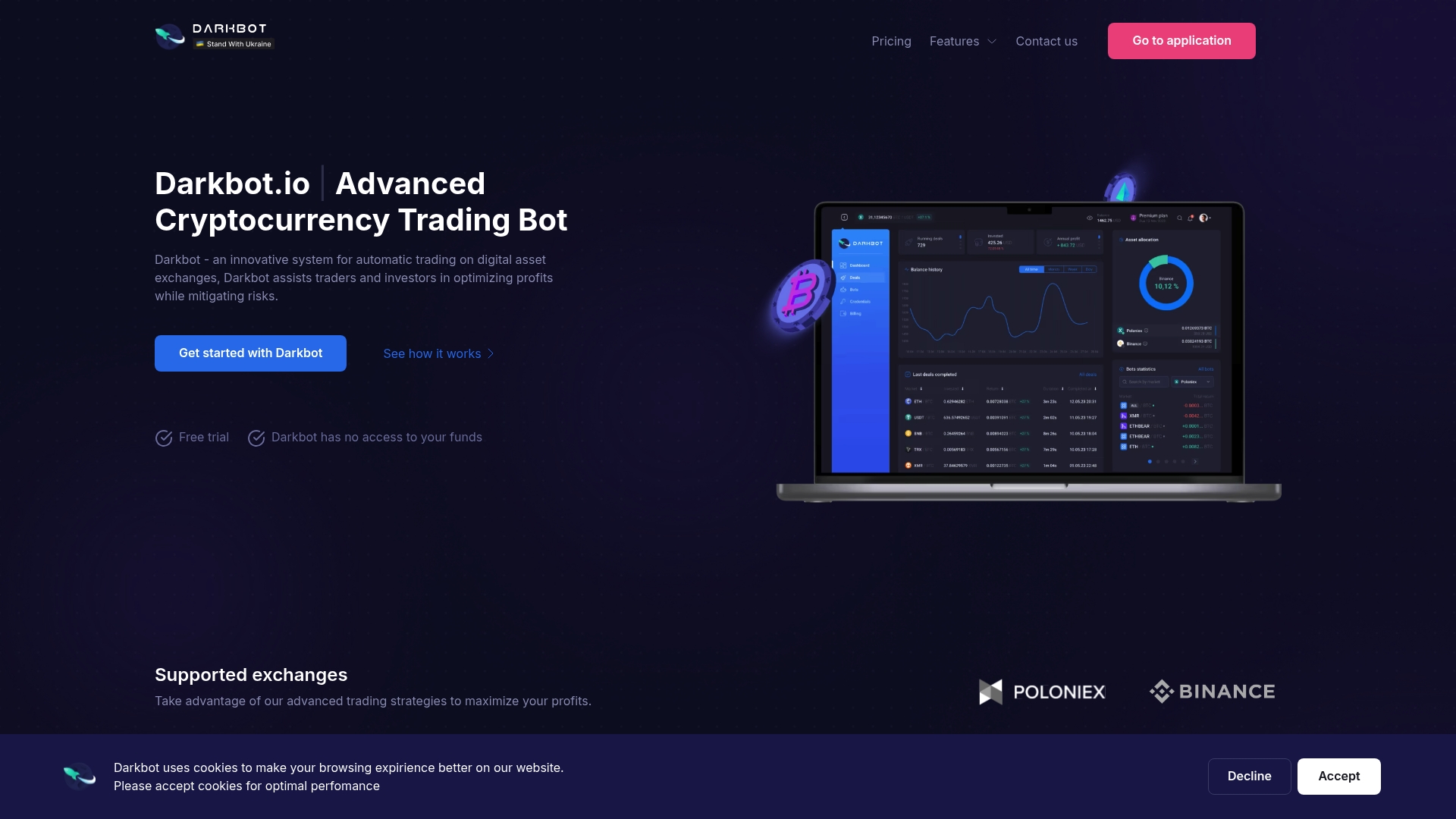
If you run strategies on more than one exchange, or want to define and test your own rules instead of selecting a preset, Darkbot is built for that workflow. You can start on the Free plan to learn the interface, then move to Standard or Premium when you need more capacity. Current plans and limits are listed on the pricing page.
For background on the approach, see our guides on how to automate crypto trading and AI in algorithmic trading.
Who should use a futures bot
A futures bot fits traders who already understand leverage, margin and liquidation, and who can define a rule set in writing. It suits people who cannot watch markets continuously, since the bot applies rules around the clock. It fits less well as a first step into trading with no plan. Begin with small position sizes, a low leverage cap and paper trading, and increase exposure only when the behavior of your rules is clear. Futures can lose more than a small account can absorb, so risk only capital you can afford to lose.
FAQ
Do crypto futures bots trade CME futures?
No. Crypto bots trade perpetual futures on crypto exchanges, so they do not run on prop firm or futures broker accounts. CME-style futures need bots built for those brokers.
Are exchange-native bots cheaper than subscription platforms?
They have no separate subscription, and you pay the exchange’s trading fees. Subscription platforms charge a monthly plan but work across exchanges and often add more customization. The better fit depends on how many venues you use.
What does “AI” mean in a futures bot?
In most products it means an assistant that suggests settings, or an agent that places orders within limits you define. In Darkbot it is a mechanism for consistent, rule-driven evaluation, not price prediction. In every case, the limits you set govern the outcome.
Can I test a futures bot without risking money?
Yes. Paper trading uses virtual funds against live prices, and backtesting uses historical data. Darkbot offers both, and its Free plan lets you start with limited features.
Sources
- AI Crypto Futures & Scalping Bots: Features, Fees, Risks
- Top 8 Binance Trading Bots, CoinCodeCap
- Best Crypto Futures Trading Bots 2026: Top 8 Platforms
- Best Crypto Trading Bots: Costs & Testing (2026)
- Best Futures Trading Bots: NinjaTrader and CME Bots
- Hummingbot open-source framework
Recommended

Start trading on Darkbot with ease
Come and explore our crypto trading platform by connecting your free account!
Free plan available • No credit card required