Binance Futures Explained: A Beginner's Clear Guide
Binance Futures is a derivatives trading platform where you trade contracts that track the future price of a cryptocurrency, without ever holding the underlying asset. You agree to buy or sell at a set price at a future point, or in the case of perpetual contracts, you hold the position indefinitely while a funding mechanism keeps the price anchored to the spot market. The core appeal is straightforward: you can profit whether prices rise or fall by going long or short, and you can amplify your exposure through leverage.
Key features at a glance:
- Go long or short on major cryptocurrencies, capturing moves in either direction
- Leverage from 1x up to 125x depending on the trading pair
- Perpetual contracts with no expiry date, the most widely used contract type on the platform
- USD-Margined (USD-M) contracts settled in USDT or USDC, and COIN-Margined (COIN-M) contracts settled in native crypto
- Mandatory knowledge quiz before accessing the platform, a regulatory safeguard ensuring you understand leveraged risk
- Maker-taker fee model with rates that decrease as your trading volume and BNB balance increase
Binance Futures is not a shortcut to easy profits. It is a structured derivatives environment where disciplined traders use leverage and directional flexibility as tools, not as a substitute for a coherent strategy.
What types of futures contracts does Binance offer?
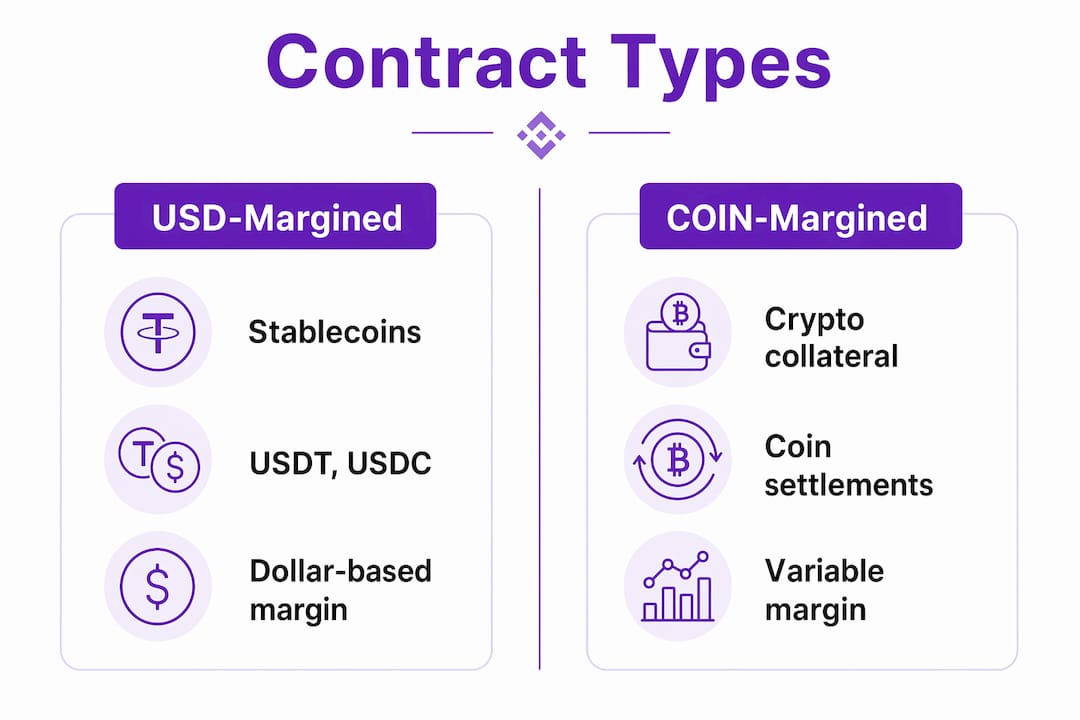
Binance Futures offers two main contract categories: USD-Margined and COIN-Margined. Each has its own settlement logic, and both come in perpetual and delivery (fixed-expiry) variants.

USD-Margined (USD-M) Futures
Collateral and settlement happen in stablecoins, primarily USDT and USDC. Your profit, loss, and margin are all denominated in dollars, which makes position sizing and risk calculation straightforward. For most beginners, this is the right starting point because your exposure to crypto price swings is limited to the contract itself, not your collateral.
COIN-Margined (COIN-M) Futures
Here, the collateral is the native cryptocurrency, BTC or ETH for example. If you are trading a BTC/USD COIN-M contract, your margin and settlement are in BTC. This structure suits traders who already hold crypto and want to hedge without converting to stablecoins, but it adds a layer of complexity: your margin value fluctuates with the underlying asset price even before the trade moves.
Perpetual vs. delivery contracts
- Perpetual contracts have no expiration date. They stay open as long as you maintain sufficient margin. A funding rate mechanism transfers payments between long and short holders every eight hours to keep the contract price close to the spot price.
- Delivery contracts expire on a fixed date, at which point the position settles automatically at the contract price. They behave more like traditional commodity futures and are used primarily for hedging or structured strategies.
For beginners, USD-M perpetual contracts are the practical choice. The dollar-denominated margin removes one variable, and the perpetual structure means you are not racing against an expiry clock while you are still learning.
How leverage works on Binance Futures and what it costs you
Leverage lets you control a position larger than your deposited margin. At 10x leverage, $100 controls a $1,000 position. At 20x, that same $100 controls $2,000. Binance allows up to 125x on certain pairs, though the maximum available decreases as position size increases.
The math cuts both ways. A 1% move in your favor at 10x leverage produces a 10% gain on your margin. The same 1% move against you produces a 10% loss. At 20x, a 5% adverse move wipes the entire margin.
Isolated margin vs. cross margin
These two modes determine how much of your account is exposed if a position goes wrong.
- Isolated margin allocates a fixed amount to a single position. If that position is liquidated, only the assigned funds are lost, not your entire futures wallet. This is the more controlled mode for beginners.
- Cross margin draws from your entire futures wallet balance to prevent liquidation. It gives positions more breathing room, but a bad trade can drain your full account balance before you realize what is happening.
Pro Tip: Start at 5x or lower until you have at least 20–30 live trades logged. Higher leverage compresses your margin for error to near zero, and the liquidation price will be much closer to your entry than it appears on paper. Know your liquidation price before you place the order, not after.
The practical implication of leverage is not just about position size. It also affects your funding rate exposure, your margin maintenance requirements, and how quickly a volatile market can move against you. Treat leverage as a precision tool, not a multiplier for speculation.
What risks come with Binance Futures trading?
Leveraged futures trading carries a different risk profile than spot trading. The most immediate risk is liquidation: if the market moves far enough against your position and your margin falls below the maintenance threshold, Binance automatically closes the position. You lose the margin assigned to it.
Core risks to understand before trading:
- Liquidation risk: A position can be closed automatically, and you lose the margin allocated to it
- Funding rate costs: In perpetual contracts, funding fees transfer between long and short holders every eight hours. Holding a position on the wrong side of a strong trend means paying funding repeatedly, eroding your margin even if price barely moves
- Volatility amplification: Leverage magnifies both gains and losses. A 10% adverse move at 10x leverage is a full loss of margin
- Emotional decision-making: Reactive position management under pressure is one of the most consistent sources of avoidable loss in futures trading
Binance addresses some of this through a mandatory knowledge quiz that new users must pass before accessing the futures platform. It is a regulatory safeguard, not a guarantee of competence, but it does force engagement with the mechanics of leveraged risk.
Practical risk controls that matter:
- Stop-loss orders: Define the maximum loss per trade before entering. A stop-loss placed at a technically meaningful level, not just a round number, is more likely to hold its logic under pressure.
- Position sizing: Risk a fixed percentage of your account per trade rather than a fixed dollar amount. This keeps losses proportional as your account grows or shrinks.
- Risk limits: Binance allows you to set account-level risk limits. Use them.
Pro Tip: Consistent profitability in futures depends far more on systematic execution and strict adherence to a trading plan than on predicting price direction. Traders who define their rules in advance and follow them mechanically tend to outperform those who adjust their strategy in real time based on how a trade feels.
Futures trading is not gambling in the technical sense, but it becomes indistinguishable from gambling when approached without a defined edge, position sizing rules, and a clear exit framework, as explained in Is Cryptocurrency Zakatable? What Muslim Investors Need to Know.
How to start trading on Binance Futures step by step
Getting started requires a few setup steps before you place your first order. None of them are complicated, but skipping any one of them creates gaps that tend to show up at the worst possible moment.
Step 1: Create and verify your Binance account
Complete KYC verification. Without it, you cannot access the futures platform. Identity verification typically takes a few minutes with a government-issued ID.
Step 2: Pass the futures knowledge quiz
Binance requires all new futures users to complete a mandatory quiz covering leverage mechanics, margin modes, and liquidation. Answer it carefully. The concepts it tests are the same ones that will cost you money if you misunderstand them.
Step 3: Transfer funds to your futures wallet
- For USD-M Futures: transfer USDT or USDC from your spot wallet
- For COIN-M Futures: transfer the relevant cryptocurrency (BTC, ETH, etc.)
Funds sit in a separate futures wallet and are not automatically available for spot trading.
Step 4: Select a trading pair and contract type
Navigate to the Binance Futures interface, choose USD-M or COIN-M, and select your pair (BTC/USDT is the most liquid starting point).
Step 5: Set your leverage and margin mode
Choose isolated or cross margin, then set your leverage. For beginners, isolated margin at 5x or lower is the more controlled setup.
Step 6: Place your order
- Market order: executes immediately at the current price; you pay taker fees
- Limit order: executes only at your specified price; you pay maker fees, which are lower
- Stop-limit order: triggers a limit order when price reaches a set level, useful for automated stop-losses
Step 7: Monitor and close your position
Track your unrealized PnL, margin ratio, and liquidation price in the positions panel. Close the position manually when your target or stop is reached, or let a stop-loss order handle it automatically.
A note on starting capital: Technically, positions can be opened with as little as $1, but fees and the margin buffer needed to survive normal volatility make that impractical. A more realistic minimum is enough capital to absorb several losing trades without hitting zero, which varies by leverage and position size but generally means starting with at least a few hundred dollars if you intend to trade seriously.
Fee structure: Binance Futures uses a maker-taker model. For USDT-M contracts, maker fees start at 0.02% and taker fees at 0.05% for standard users, decreasing at higher VIP levels. USDC-M Futures fees are typically 10% lower than those for USDT-M contracts. If you pay fees with BNB, you receive an additional 10% discount on eligible contract types.
Frequently asked questions about Binance Futures
What is the minimum amount needed to start trading Binance Futures?
While a position can technically be opened with $1, that amount is not practical. Fees and the margin buffer required to survive normal price swings make it necessary to start with a meaningful capital base. Most traders find a few hundred dollars the realistic floor for learning without constant liquidation pressure.
Is Binance Futures trading the same as gambling?
No. Futures trading is a speculative activity, but it is structured around defined contracts, transparent pricing, and risk management tools like stop-loss orders. The distinction comes down to whether you approach it with a systematic strategy and disciplined execution or react emotionally to price movements. The former is trading; the latter tends to produce gambling-like outcomes regardless of the instrument.
How do funding rates affect my position?
Funding rates are periodic payments exchanged between long and short holders every eight hours on perpetual contracts. If you hold a long position when the funding rate is positive, you pay the short holders. If you hold a short when the rate is negative, you receive payment. Over time, funding costs can meaningfully erode the profitability of a position held through multiple funding intervals, particularly during trending markets.
What happens if my position gets liquidated?
Liquidation occurs when your margin falls below the maintenance margin threshold. Binance closes the position automatically, and you lose the margin assigned to it. In isolated margin mode, the loss is capped at that allocation. In cross margin mode, the platform can draw from your entire futures wallet balance before liquidating.
Can I use leverage to trade both rising and falling markets?
Yes. Going long profits from price increases; going short profits from price decreases. This bidirectional flexibility, combined with leverage, is one of the structural advantages futures trading has over spot trading, where profiting from a declining asset requires more complex arrangements.
How Darkbot helps you trade Binance Futures more systematically
Manual futures trading works, but it has a consistent weak point: the trader. Fatigue, emotional reactions to drawdowns, and inconsistent execution under pressure are not character flaws. They are predictable outcomes of asking a human to make rapid, high-stakes decisions repeatedly. Automation addresses this at the structural level.
Darkbot is an AI-powered trading bot platform built for systematic execution across major exchanges, including Binance Futures. It connects via API integration, meaning your funds stay on Binance while Darkbot executes trades according to the rules you define. Nothing moves without a rule triggering it.
Key capabilities relevant to futures trading:
- API-based exchange integration: connects directly to your Binance Futures account without requiring fund transfers to a third party
- Customizable strategies: define entry conditions, exit targets, stop-loss levels, and position sizing rules in advance
- Risk management controls: set maximum drawdown limits, position size caps, and automated stop-loss execution
- Portfolio management and rebalancing: track exposure across multiple positions and adjust allocations systematically
- Backtesting and paper trading: test a strategy against historical data or in a live simulation before committing real capital
The underlying logic is probabilistic pattern evaluation and rule-based adaptation. Darkbot does not predict market direction. It applies a defined framework consistently, which is what strategy optimization for profitable automation actually requires: not better predictions, but better execution of a repeatable process.
For traders working with smart risk management on Binance, automation enforces the discipline that is hardest to maintain manually: holding to stop-loss levels, not over-leveraging after a winning streak, and not abandoning a strategy after two losing trades.
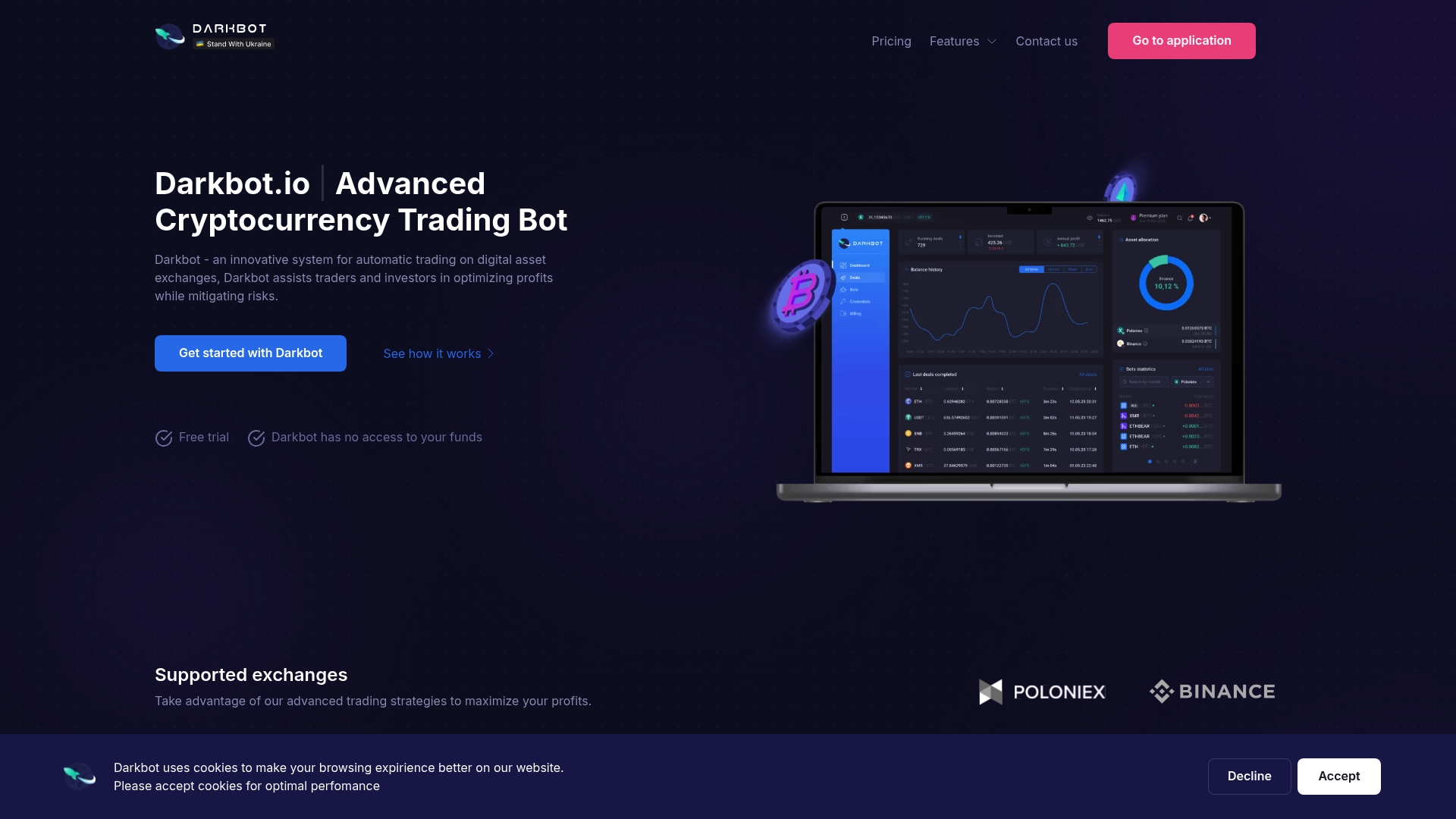
Darkbot offers a free entry tier with limited features, plus standard and premium subscription plans for traders who need multiple simultaneous bots, advanced strategy customization, and full analytics. A 14-day money-back guarantee applies to paid plans. Explore the full feature set at Darkbot’s trading platform or review the portfolio management tools designed for active futures traders.
Key Takeaways
Binance Futures gives traders directional flexibility and leverage, but consistent results depend on systematic execution, defined risk rules, and understanding the cost structure before placing a trade.
| Point | Details |
|---|---|
| Contract types matter | USD-M perpetual contracts are the practical starting point; COIN-M suits traders already holding crypto collateral. |
| Leverage amplifies both sides | At 10x leverage, $100 controls a $1,000 position, and a 10% adverse move eliminates the margin. |
| Funding rates are a real cost | Perpetual contract holders pay or receive funding every eight hours; holding through multiple intervals affects net profitability. |
| Fees follow a maker-taker model | USDC-M Futures fees are typically 10% lower than those for USDT-M contracts. If you pay fees with BNB, you receive an additional 10% discount on eligible contract types. |
| Automation enforces discipline | AI-driven platforms like Darkbot apply rule-based execution consistently, removing the emotional variables that undermine manual trading. |
Recommended

Start trading on Darkbot with ease
Come and explore our crypto trading platform by connecting your free account!
Free plan available • No credit card required