What is rebalancing in crypto? A 2026 guide for traders

Most crypto traders believe buying and holding is enough. Yet portfolios drift wildly as Bitcoin surges while altcoins crash, or vice versa. Without rebalancing your crypto portfolio, you risk overexposure to volatile assets and miss opportunities to lock in gains. This guide explains what rebalancing means in cryptocurrency investing, explores proven strategies for different trading styles, and shows how automation tools can optimize your portfolio performance in 2026’s dynamic market.
Key takeaways
| Point | Details |
|---|---|
| Rebalancing restores target allocations | Adjusting asset weights back to original percentages controls risk exposure effectively |
| Manual and automated approaches exist | Traders can rebalance manually or use bots for precision and speed |
| Different strategies suit different goals | Time-based, threshold-based, and hybrid methods each offer unique advantages |
| Automation improves execution quality | AI-powered tools eliminate emotion and optimize rebalancing timing |
| Proper rebalancing enhances long-term returns | Disciplined adjustments capture gains and reduce downside volatility |
Understanding rebalancing in crypto portfolios
Rebalancing involves periodically adjusting your assets back to a target allocation to maintain risk levels. When you initially build a crypto portfolio, you might decide on 50% Bitcoin, 30% Ethereum, and 20% altcoins based on your risk tolerance. Market movements quickly change these percentages. Bitcoin might surge to represent 65% of your portfolio value, creating unintended risk concentration.
Cryptocurrency portfolio balancing becomes crucial in crypto due to extreme volatility. Digital assets experience price swings of 10% to 30% within hours, far exceeding traditional stock movements. Without rebalancing, your carefully planned risk profile disappears as winning assets dominate your holdings.
Rebalancing mitigates overexposure by systematically selling portions of assets that have grown beyond target weights and buying underweighted positions. This process forces you to take profits from winners and add to positions that may be temporarily undervalued. It stabilizes returns by preventing any single asset from controlling portfolio outcomes.
Traders typically choose between two rebalancing approaches:
- Time-based rebalancing executes adjustments on fixed schedules like weekly, monthly, or quarterly intervals regardless of price movements
- Threshold-based rebalancing triggers only when asset weights drift beyond predetermined tolerance bands, such as 5% or 10% from targets
- Hybrid strategies combine both methods, checking thresholds at regular time intervals
Consider a practical example. You start with a $10,000 portfolio split 50/50 between Bitcoin and altcoins, meaning $5,000 in each. Bitcoin doubles while altcoins stay flat. Your portfolio now holds $10,000 in Bitcoin and $5,000 in altcoins, creating a 67/33 split instead of your intended 50/50. Rebalancing means selling $2,500 of Bitcoin and buying $2,500 of altcoins to restore the original allocation. You lock in Bitcoin gains and position yourself to benefit if altcoins recover.

Popular rebalancing strategies for crypto traders
Time-based rebalancing follows calendar schedules. You might rebalance every Monday morning or on the first day of each month. This approach offers predictability and simplicity. You know exactly when to review and adjust positions. Transaction timing becomes routine rather than reactive.
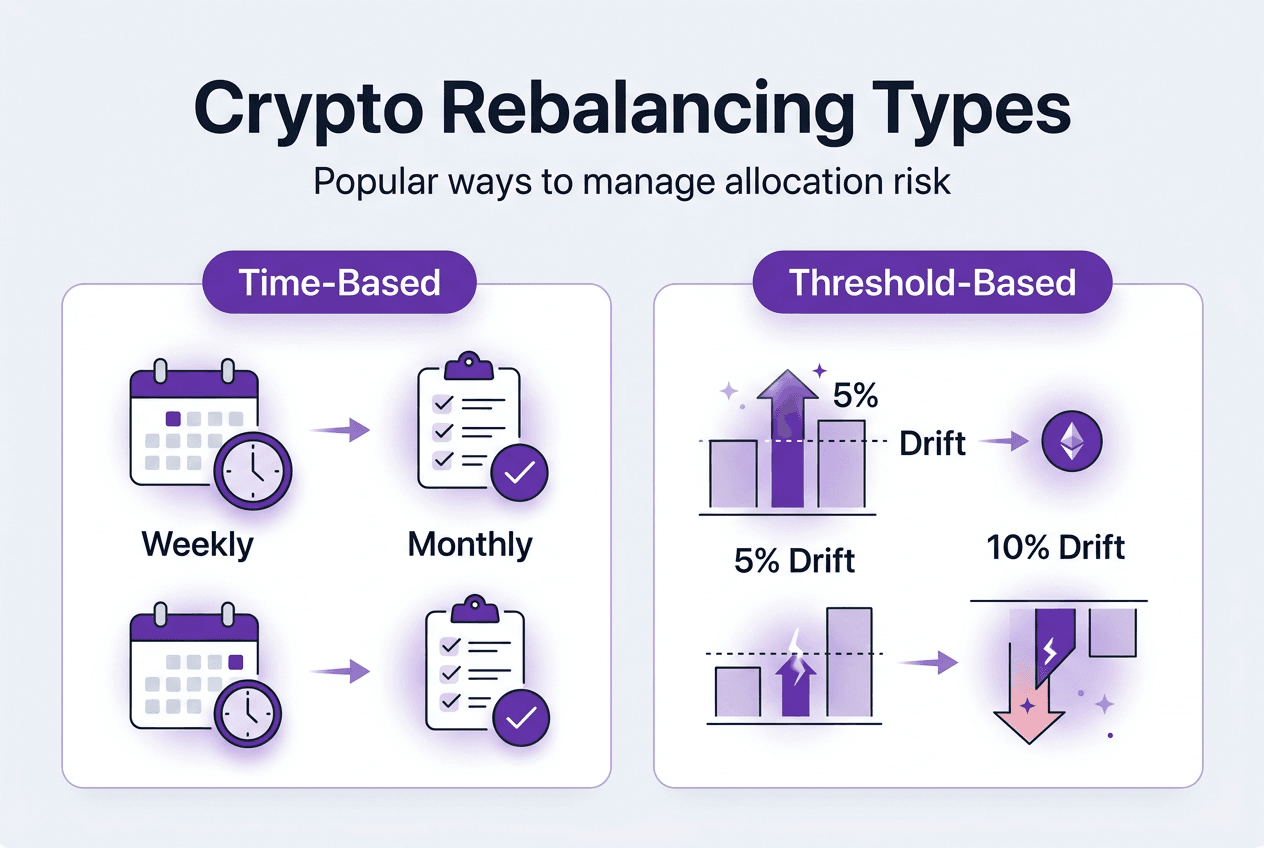
Threshold-based rebalancing monitors portfolio drift continuously. When any asset deviates from its target weight by your chosen threshold, you execute trades to restore balance. A 5% threshold means rebalancing when Bitcoin moves from 50% to 55% or 45% of portfolio value. This method responds directly to market volatility.
Hybrid strategies merge both approaches. You might check thresholds weekly but only rebalance if drift exceeds 7%. This reduces unnecessary trades during stable periods while ensuring responsiveness to significant moves. Crypto portfolio management strategies often recommend hybrid methods for balancing control with efficiency.
Each strategy presents distinct tradeoffs:
| Strategy | Frequency | Risk Control | Transaction Costs | Best For | | — | — | — | | Time-based | Fixed schedule | Moderate | Predictable | Disciplined traders preferring routine | | Threshold-based | As needed | High | Variable | Active managers in volatile markets | | Hybrid | Scheduled checks with drift triggers | High | Optimized | Traders balancing control and efficiency |
Transaction costs matter significantly in crypto. Exchange fees, network gas costs, and potential slippage add up quickly with frequent rebalancing. A daily time-based strategy might generate excessive fees that erode returns. Threshold-based approaches reduce unnecessary trades but require constant monitoring.
Pro Tip: Set your rebalancing threshold at 10% to 15% for most crypto portfolios to balance risk control with transaction cost efficiency. Lower thresholds increase trading frequency and costs, while higher thresholds allow excessive drift that defeats rebalancing benefits.
Your trading style should guide strategy selection. Conservative long-term holders might rebalance quarterly using time-based methods. Active traders managing multiple positions benefit from threshold-based automation that responds to rapid price movements. Portfolio size also matters since larger accounts absorb transaction costs more easily, allowing tighter thresholds.
Automating rebalancing: tools and techniques for crypto portfolios
Automated rebalancing transforms portfolio management by executing adjustments instantly without emotional interference. Trading bots optimize rebalancing by monitoring positions continuously and executing trades at optimal moments. Speed matters in crypto markets where prices shift dramatically within minutes.
Automation removes emotional decision making. Manual rebalancing tempts traders to second-guess selling winners or buying losers. You might hesitate to trim a surging Bitcoin position or add to struggling altcoins. Bots execute predetermined rules without fear or greed, maintaining discipline through market swings.
Precision improves with automation. Bots calculate exact trade sizes needed to restore target weights, accounting for fees and slippage. They execute across multiple exchanges simultaneously if needed, ensuring efficient rebalancing even with complex multi-asset portfolios.
Automated trading systems that incorporate rebalancing strategies have shown consistent outperformance compared to static buy-and-hold approaches, particularly during high-volatility periods common in cryptocurrency markets.
Several bot types handle rebalancing effectively:
- Portfolio management bots designed specifically for maintaining asset allocations across exchanges
- Grid trading bots that naturally rebalance by buying dips and selling rallies within price ranges
- AI-powered adaptive bots that adjust rebalancing parameters based on market conditions
Setting up automated rebalancing follows a straightforward process:
- Define your target asset allocation based on risk tolerance and investment goals
- Choose rebalancing triggers using time intervals, drift thresholds, or hybrid rules
- Connect your crypto trading bot to exchanges via secure API keys with trading permissions
- Configure transaction limits and safety parameters to prevent excessive trading during extreme volatility
- Monitor bot performance regularly and adjust parameters as your strategy evolves
Pro Tip: Start with conservative rebalancing parameters when automating, such as monthly checks with 15% drift thresholds, then optimize based on actual performance data and market conditions specific to your portfolio.
Integrating automation with manual oversight creates the best approach. Let bots handle routine rebalancing execution while you review performance metrics and adjust strategic allocation targets. Crypto trading optimization combines algorithmic precision with human judgment about market trends and portfolio goals.
Automation particularly benefits traders managing multiple positions across different exchanges. Manually tracking drift percentages and executing coordinated trades becomes impractical with more than five or six assets. Bots scale effortlessly to manage dozens of positions simultaneously.
When and why to rebalance your crypto portfolio in 2026
Market conditions in 2026 make disciplined rebalancing essential. Crypto volatility and asset cycles create rapid portfolio drift that demands active management. Bitcoin’s institutional adoption has reduced but not eliminated its price swings, while altcoins continue experiencing dramatic moves tied to technology developments and regulatory changes.
Several factors should influence your 2026 rebalancing frequency. Portfolio size matters because transaction costs consume a larger percentage of smaller accounts. A $5,000 portfolio paying $20 per rebalance loses significant value to fees with weekly adjustments. A $100,000 portfolio absorbs those same costs easily.
Market volatility directly impacts optimal rebalancing frequency. During stable periods with daily price changes under 3%, monthly rebalancing suffices. When volatility spikes above 5% daily moves, weekly or threshold-based rebalancing prevents excessive drift. Trading costs have declined in 2026 as exchanges compete for volume, making more frequent rebalancing economically viable.
Personal risk tolerance shapes rebalancing triggers. Conservative investors maintaining 70% Bitcoin and 30% altcoins might use 20% drift thresholds, allowing significant movement before rebalancing. Aggressive traders with equal-weighted portfolios across ten assets need 10% thresholds to maintain their risk profile.
Recent performance data shows rebalancing frequency impact:
| Frequency | Average Annual Return | Maximum Drawdown | Transaction Cost Ratio |
|---|---|---|---|
| Daily | 24.3% | 31% | 2.8% |
| Weekly | 26.7% | 28% | 1.2% |
| Monthly | 25.1% | 35% | 0.4% |
| Quarterly | 21.8% | 42% | 0.1% |
Weekly rebalancing produced the best risk-adjusted returns by capturing gains while controlling drawdowns without excessive costs. Daily rebalancing generated higher transaction costs that offset potential benefits. Quarterly rebalancing allowed too much drift, increasing maximum drawdown significantly.
Best practices for timely rebalancing in current market conditions include:
- Monitor portfolio drift at least weekly even if you rebalance less frequently to stay aware of exposure changes
- Set calendar reminders for time-based rebalancing to maintain consistency regardless of market distractions
- Use smart crypto portfolio management tools that alert you when thresholds are breached
- Rebalance during lower-volatility periods like weekends when spreads tighten and slippage decreases
- Document your rebalancing decisions and outcomes to refine your approach over time
Timing rebalancing around major market events requires judgment. Avoid rebalancing immediately before known catalysts like Federal Reserve announcements or major protocol upgrades that could trigger sustained directional moves. Wait for initial volatility to settle, then rebalance to restore your target allocation.
Explore automated crypto portfolio management with Darkbot
Managing crypto portfolio rebalancing manually consumes time and mental energy you could direct toward strategy refinement and market research. Darkbot offers AI-powered automation that handles rebalancing execution with precision while you focus on higher-level decisions.
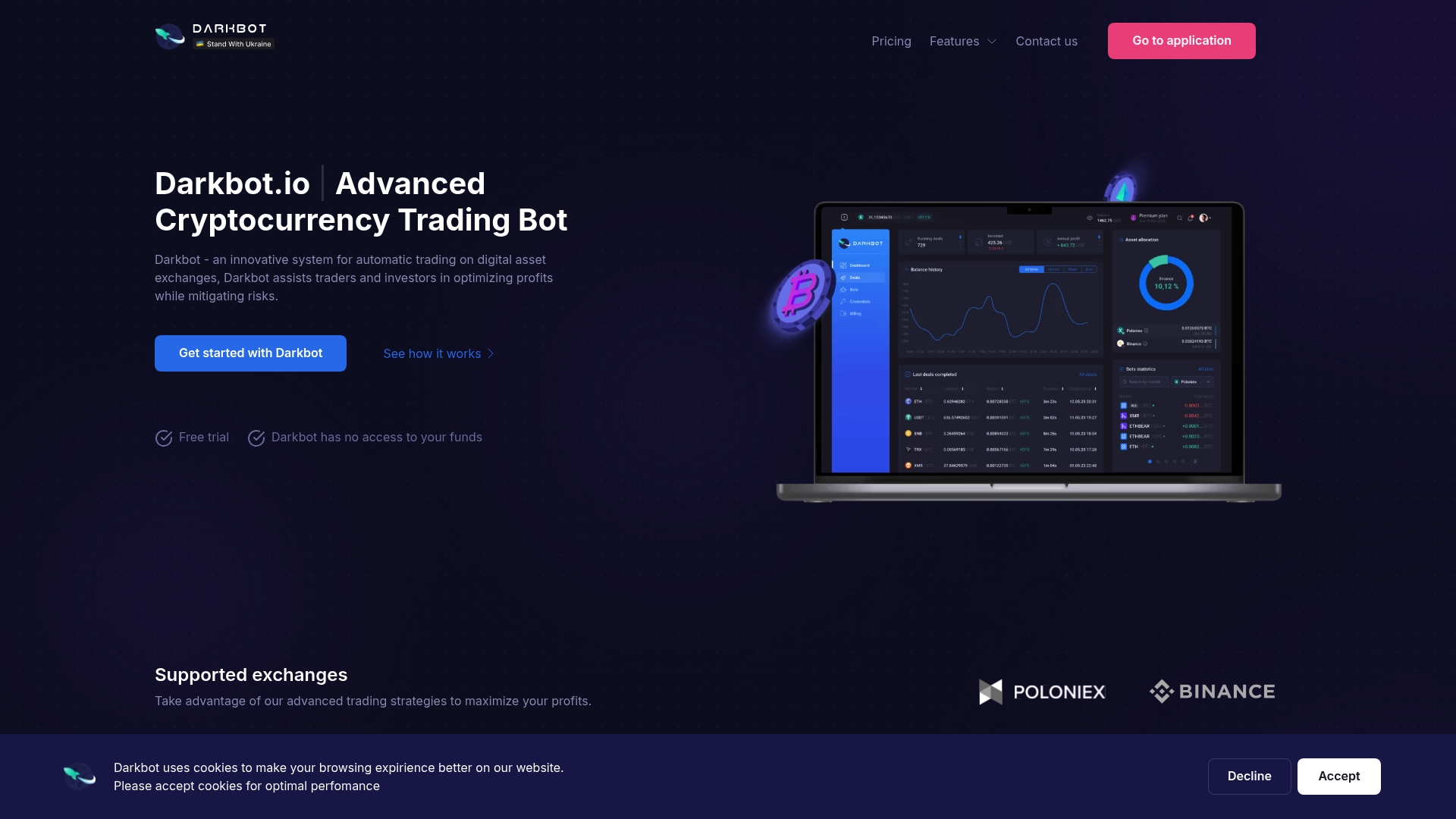
The platform integrates seamlessly with major exchanges through secure API connections, enabling automated rebalancing across your entire portfolio from one interface. You set your target allocations and rebalancing rules, then Darkbot monitors positions continuously and executes adjustments when needed. Advanced algorithms optimize trade timing to minimize costs and slippage.
Cryptocurrency portfolio management becomes effortless with customizable strategies that adapt to your risk profile and market conditions. Whether you prefer conservative monthly rebalancing or aggressive threshold-based adjustments, Darkbot implements your approach consistently. Real-time analytics show exactly how rebalancing impacts your returns, helping you refine your strategy based on actual performance data. Explore the portfolio balancing guide to see how automation transforms portfolio management from a time-consuming chore into a strategic advantage.
Frequently asked questions
What does rebalancing mean in cryptocurrency investing?
Rebalancing means adjusting your crypto holdings back to predetermined target percentages after market movements change their relative weights. If you planned a 50/50 Bitcoin/Ethereum split but Bitcoin surges to represent 70% of portfolio value, rebalancing involves selling some Bitcoin and buying Ethereum to restore the 50/50 allocation. This maintains your intended risk exposure.
How often should I rebalance my crypto portfolio?
Rebalancing frequency depends on market volatility, portfolio size, and transaction costs. Most traders find weekly or monthly rebalancing optimal for balancing risk control with cost efficiency. Threshold-based approaches that trigger at 10% to 15% drift work well during volatile periods. Very frequent rebalancing increases transaction costs without proportional benefits.
What are the main benefits of automated rebalancing?
Automation eliminates emotional decision making that causes traders to hold winners too long or avoid buying dips. Bots execute rebalancing instantly when triggers activate, capturing optimal prices that manual traders miss. They calculate exact trade sizes accounting for fees and maintain discipline through market swings. Automation scales effortlessly across multiple assets and exchanges.
What risks come with portfolio rebalancing?
Transaction fees and potential slippage reduce returns, especially with frequent rebalancing of smaller portfolios. Rebalancing forces you to sell appreciating assets that might continue rising and buy declining assets that could fall further. Poor timing around major market moves can lock in losses. Tax implications from selling winners may offset rebalancing benefits depending on your jurisdiction.
Does rebalancing suit all crypto investors?
Rebalancing works best for investors maintaining diversified portfolios with specific risk targets rather than concentrated positions in one or two assets. It suits medium to long-term holders more than day traders who actively manage positions. Investors with very small portfolios under $5,000 might find transaction costs outweigh rebalancing benefits. Those comfortable with higher risk concentration may prefer letting winners run without systematic rebalancing.
Recommended

Start trading on Darkbot with ease
Come and explore our crypto trading platform by connecting your free account!
Free plan available • No credit card required