Trading Bot Privacy Features: What Traders Must Know

TL;DR:
- Most traders overlook evaluating their crypto trading bots’ privacy and security features, risking sensitive credential exposure. Core protections include limiting API permissions, using sub-accounts, IP whitelisting, and avoiding credential sharing; advanced tools like zero-knowledge proofs further enhance privacy. Consistent operational discipline, such as key rotation and proper account separation, is essential for safeguarding assets and strategy confidentiality.
Most traders who automate their crypto strategies spend significant time evaluating performance and fees. Far fewer spend equivalent time evaluating trading bot privacy features. That gap creates real risk. Cryptocurrency trading bots connect to exchange accounts, execute orders autonomously, and handle sensitive credentials 24 hours a day. Each of those touchpoints is a potential exposure point. This article breaks down the specific privacy and security mechanisms that separate well-designed bots from careless ones, and gives you a clear framework for hardening your own setup.
Key takeaways
| Point | Details |
|---|---|
| API withdrawal permissions are critical | Never grant a trading bot withdrawal rights; limit keys to trade and read permissions only. |
| Sub-accounts isolate exposure | Using dedicated sub-accounts caps the damage if a bot’s credentials are ever compromised. |
| IP whitelisting adds a hard barrier | Restricting API key access to specific IP addresses blocks unauthorized use even if keys leak. |
| Credential handling discipline matters | Never share API keys in AI chatbots, public forums, or version control systems. |
| Advanced privacy tools are evolving | Technologies like zero-knowledge proofs and privacy infrastructure layers now support compliant confidential trading. |
Trading bot privacy features: the core risk landscape
Before evaluating features, you need to understand what you are actually protecting against. The privacy concerns in trading bots are not theoretical. They stem from specific, well-documented attack surfaces that affect anyone running an automated system connected to real funds.
The most immediate risk is API key compromise. A trading bot authenticates with your exchange through API keys. If those keys are stolen, misconfigured, or over-permissioned, an attacker can operate inside your account. Bots with admin-level or withdrawal permissions represent major security threats because most losses come from overly permissive configurations rather than bot bugs alone.
Beyond direct theft, there are subtler risks that traders routinely underestimate:
- Bot provider data logging: Many third-party bot platforms require you to input your API credentials through their interface. If that provider logs those inputs, your credentials exist on infrastructure you do not control.
- Public blockchain exposure: Every on-chain transaction your bot executes is publicly visible. Sophisticated observers can link your trading wallet to your identity, map your strategy, or frontrun your positions by watching mempool activity.
- Insufficient wallet separation: Running a bot connected to the same wallet that holds your long-term holdings creates a single point of failure. A compromised bot key does not just threaten your active trading capital; it threatens everything in that account.
- Third-party integrations: Bots that connect to AI assistants, Telegram, or external analytics platforms multiply the number of systems that touch your data.
The fundamental principle of bot privacy is containment: limit what any single compromised component can reach, and limit what any external observer can infer from watching you trade.
Understanding this containment principle shapes every technical decision that follows.
Technical features that protect bot privacy
Reputable platforms and exchanges have converged on a consistent set of technical controls. Understanding how each one works, not just that it exists, helps you evaluate whether a bot provider is actually using them correctly.

API permission scoping
API keys should never have withdrawal rights. This is the single most consequential configuration decision you make when connecting a bot. A key with only trade and read permissions limits an attacker to placing trades at worst. A key with withdrawal permissions gives an attacker the ability to drain your account entirely. No legitimate trading bot requires withdrawal access to function.
IP whitelisting and 2FA
Exchanges like Bitget, Binance, and Kraken enforce IP whitelisting, two-factor authentication, and strict API permission controls as standard security layers. IP whitelisting means an API key only accepts requests from pre-approved IP addresses. Even if someone steals the key, they cannot use it from an unregistered location. Combined with 2FA on the exchange account itself, this creates two independent barriers before any unauthorized action can occur.
Encrypted credential storage
How a bot stores your API keys locally matters as much as how it transmits them. Best practice requires storing API keys and passphrases with strict file system permissions, such as chmod 600, avoiding sharing in AI chats, and never committing keys to version control. Any bot that stores keys in plaintext configuration files or transmits them over unencrypted connections fails this standard.
Open-source code transparency
Open-source MCP servers enable code audits that verify no logging or credential leaks are occurring. Community review catches bugs and exposes vulnerabilities that closed-source systems can hide indefinitely. For traders evaluating secure trading software features, open-source availability is a meaningful signal of whether privacy claims can be verified independently.
Pro Tip: When evaluating any bot platform, check whether the developer’s identity is publicly known and whether the codebase is auditable. Transparency of developer identity and open-source code directly supports the trustworthiness of any privacy claims a platform makes.
The table below summarizes the core technical features and their primary function:
| Feature | What it protects against | Strength level |
|---|---|---|
| API permission scoping (no withdrawals) | Fund extraction if keys are stolen | Very high |
| IP whitelisting | Unauthorized key use from unknown locations | High |
| Two-factor authentication | Account takeover via credential theft | High |
| Encrypted credential storage | Local key exposure on compromised devices | Medium-high |
| Open-source code | Hidden logging, undisclosed data collection | Medium |
Advanced privacy infrastructure and emerging tools
The controls above address the most common attack vectors. But for traders running larger positions or operating in environments where strategy confidentiality matters, a second layer of privacy technology is becoming relevant.
On-chain privacy layers
Public blockchains expose every transaction your bot executes. The Gh0st privacy infrastructure on BNB Chain addresses this directly by hiding the link between a main wallet and trade execution. Trades are routed through coordinated wallets that separate execution footprints from identity wallets. This matters because visible wallet connections allow competitors and algorithms to identify your strategy by watching your on-chain behavior.
The same infrastructure reduces risks of frontrunning and copy trading by decoupling your execution footprint from your identity. For institutional traders and high-frequency strategies, that separation is not optional; it is operationally necessary.
Zero-knowledge proofs and compliance
One common concern is that privacy and regulatory compliance are mutually exclusive. They are not. Privacy and compliance can coexist through technologies like zero-knowledge proofs, which allow confidential trading while still enabling regulatory oversight when required. This matters for traders who want anonymity in normal operations but need to demonstrate compliance on demand.
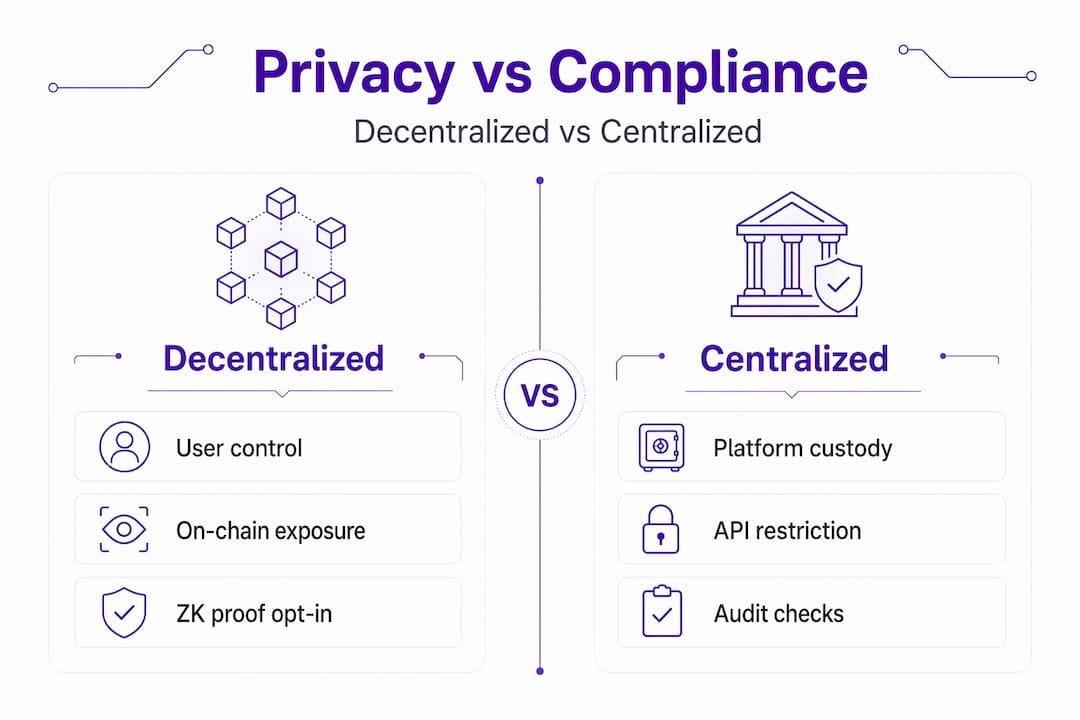
The table below compares decentralized and centralized bot platforms across key privacy dimensions:
| Dimension | Decentralized platforms | Centralized platforms |
|---|---|---|
| Data custody | User retains control | Provider holds credentials |
| Code auditability | Often open-source | Usually proprietary |
| On-chain exposure | Full public visibility (without privacy layers) | Off-chain execution; less visible |
| Regulatory clarity | Variable by jurisdiction | Generally clearer |
| Frontrunning risk | Higher without privacy infrastructure | Lower for off-chain bots |
Pro Tip: If you operate on-chain bots with meaningful capital, evaluate whether the chain or DEX you use has any privacy infrastructure available. Running an identical strategy with and without execution-layer privacy can produce measurably different outcomes in liquid markets where copy trading and frontrunning are common.
Best practices for managing bot privacy day to day
Technical features only protect you when they are consistently applied. The following practices translate feature awareness into operational discipline.
-
Use dedicated sub-accounts with limited capital. Dedicated sub-accounts with limited funds isolate bot risk from your main portfolio. If the bot’s API keys are compromised, only the capital in the sub-account is exposed. Your primary holdings remain untouched.
-
Rotate API keys on a scheduled basis. Key rotation limits the window of opportunity for any credential that has been silently compromised. Monthly rotation is a reasonable baseline for active bots; weekly is better for high-frequency strategies.
-
Audit permissions after every exchange update. Exchanges periodically update their API systems. After any platform update, confirm that your key permissions have not been reset to defaults, which may include broader access than you intended.
-
Never share credentials in AI chatbots or public channels. Users must never share API credentials or passphrases in AI chatbots or public forums. Large language models and third-party bots may log inputs, which means anything you paste into a chat interface could be stored on external servers.
-
Test in demo mode before deploying live. Running a new bot configuration in a paper trading or demo environment catches configuration errors and unexpected behavior before real capital is at risk. This is particularly relevant when you are deploying a strategy for the first time or after significant parameter changes.
-
Monitor API usage logs for anomalous activity. Regularly monitoring API key usage logs for suspicious IP addresses or unauthorized activity provides early breach detection. Exchanges maintain detailed logs; reviewing them periodically is the difference between catching a compromise in minutes and discovering it after significant damage has been done.
-
Hardcode position size and trade limits externally. Hardcoding position size and trade limits outside AI control prevents runaway bot behavior. Risk limits set at the account or sub-account level act as a circuit breaker independent of bot logic.
For a structured checklist of these and related security factors, the 2026 trading bot checklist covers the full set of criteria worth evaluating before deployment.
Trade-offs in choosing privacy-focused bot software
No privacy configuration is without cost. Understanding these trade-offs helps you make decisions that reflect your actual risk tolerance and operational constraints rather than chasing a theoretical ideal.
- Open-source vs. convenience: Open-source bots allow full code inspection, but they typically require more technical setup and self-managed infrastructure. Managed SaaS platforms are easier to deploy but require trusting the provider’s claims about data handling. Privacy-first tools that avoid selling or analyzing user data, like the approach taken by tools such as Edgewonk in the journaling space, demonstrate that professional tools can emphasize user data protection without sacrificing functionality.
- Third-party provider risk: Every third-party service you connect to a bot is an additional attack surface. The more integrations a bot platform has, the larger its data footprint and the more you rely on each provider’s own security practices.
- Privacy vs. regulatory compliance: Stronger anonymity measures may conflict with exchange KYC requirements or local financial regulations. Zero-knowledge proof systems offer a path through this tension, but their adoption is still limited to specific chains and protocols.
- Official exchange integrations: Bots built with direct, officially documented exchange API support generally carry less risk than those using unofficial endpoints or reverse-engineered interfaces. Official integrations are updated when exchanges make security changes; unofficial ones may silently break or introduce vulnerabilities. A deeper look at API key security practices clarifies exactly how permission scopes work in practice.
My perspective on what actually matters
I’ve spent a lot of time reviewing how traders configure their bots, and the pattern I keep seeing is that people spend hours optimizing entry logic and almost no time on permission configuration. The withdrawal permission issue is not a nuanced edge case. It is the most foreseeable catastrophic failure in the entire setup. A bot never needs it. Granting it anyway is accepting a risk with no corresponding benefit.
What I’ve also found is that portfolio isolation does more practical work than any advanced privacy tool. Knowing that your main holdings are structurally unreachable from the bot’s operating environment changes how you think about risk. You can let the bot run aggressively in a sub-account, test unusual strategies, and absorb the occasional bad outcome without threatening your core position.
The credential-sharing problem with AI chatbots concerns me more than most people realize. People paste API keys into chatbot interfaces to get setup help, not thinking about where that text goes. The damage from that mistake is not always immediate, which makes it harder to connect cause and effect. My strong recommendation is to treat API credentials with the same discipline as passwords: never share them, store them encrypted, and rotate them regularly.
Privacy infrastructure like Gh0st and zero-knowledge trading pools are genuinely interesting developments. They address a real problem for on-chain traders. But for most traders using centralized exchanges, the fundamentals I’ve described above cover the vast majority of realistic threat scenarios. Start there before exploring advanced tooling.
— Grisha
How Darkbot approaches privacy and security
Darkbot is built around the principle that automation should not mean handing over control. The platform supports dedicated sub-account management so your bot capital is always isolated from your main holdings. API connections are scoped to trade and read permissions by design, and the platform’s portfolio management tools give you a clear view of what each bot can and cannot access.
Darkbot’s demo mode lets you test any strategy configuration fully before committing real capital, which directly supports the kind of pre-deployment verification that serious traders require. Risk management parameters are set at the platform level, independent of individual bot logic, so you have structural limits in place regardless of how a specific strategy behaves. If you want to see how these controls work in practice, explore the Darkbot platform and review the full feature set before your next deployment.
FAQ
What are the most critical trading bot privacy features?
The most critical trading bot privacy features are API permission scoping without withdrawal rights, IP whitelisting, encrypted credential storage, and the use of dedicated sub-accounts. These four controls address the majority of realistic attack vectors.
How do I protect my trading bot from API key leaks?
Store keys with strict file permissions, never share them in public forums or AI chatbots, enable IP whitelisting on your exchange, and rotate keys on a regular schedule. Monitoring API usage logs for unrecognized IP addresses also provides early warning of a compromise.
Are decentralized trading bots more private than centralized ones?
Decentralized bots give users more data custody but expose all transactions publicly on-chain, which creates its own privacy risks. Centralized platforms handle execution off-chain but require trusting the provider with your credentials. Neither is categorically more private without additional controls.
Can privacy features coexist with regulatory compliance?
Yes. Technologies like zero-knowledge proofs allow traders to execute confidentially while still being able to demonstrate compliance when regulators require it. This approach is gaining traction on specific chains and protocols as of 2026.
What is the biggest privacy mistake traders make with bots?
Granting withdrawal permissions to a trading bot’s API key is the single highest-risk configuration error. It converts a potentially limited breach into a complete fund loss scenario with no recovery path.
Recommended

Start trading on Darkbot with ease
Come and explore our crypto trading platform by connecting your free account!
Free plan available • No credit card required