Cryptocurrency Risk Management Checklist for Traders

TL;DR:
- Trading without a structured cryptocurrency risk management checklist is akin to making a wager, not a strategy.
- Implementing systematic controls like position sizing, security practices, platform due diligence, and scam detection is essential for preserving capital and avoiding preventable losses.
Working through crypto markets without a structured cryptocurrency risk management checklist is less a strategy and more a wager. Crypto fraud losses exceeded $11.3 billion in 2025 alone, with 181,000 complaints filed through the FBI’s Internet Crime Complaint Center. That figure does not include the capital quietly destroyed by poor position sizing, platform failures, and preventable security lapses. This article provides a detailed, structured framework covering position sizing, security controls, platform due diligence, and scam detection. Every item is grounded in systematic trading principles, not speculation.
Key takeaways
| Point | Details |
|---|---|
| Risk 1-2% per trade | Limiting exposure per position preserves capital viability across losing streaks. |
| Stops invalidate the thesis | Place stop-losses where the trade is wrong, not just where the loss feels tolerable. |
| Hardware wallets are non-negotiable | Cold storage and multisig setups protect assets from the most common attack vectors. |
| Platform due diligence saves capital | Verify regulatory status, custody model, and proof of reserves before depositing funds. |
| Cooling-off periods stop scam losses | A mandatory verification delay disrupts the urgency tactics scammers rely on most. |
1. Your cryptocurrency risk management checklist framework
Before any individual checklist item makes sense, the underlying criteria need to be defined. Risk management functions best as a dynamic, integrated system where position sizing, stop placement, correlation, and drawdown limits operate together rather than in isolation.
The foundational principles that anchor the full checklist are:
- Position sizing. Professional traders recommend risking only 1-2% of total portfolio capital per trade. This single rule, applied consistently, is what separates traders who survive multi-month drawdowns from those who do not.
- Stop-loss placement. Stops belong below the level that invalidates the trade thesis. Stops set too tight in high-volatility crypto conditions produce premature exits and capital erosion through repeated small losses.
- Correlation management. Holding BTC, ETH, and multiple altcoins looks like diversification. In a broad market selloff, they frequently move together. Monitor correlation coefficients across positions and reduce total exposure when assets are highly correlated.
- Leverage awareness. 10x leverage liquidates a position on a 10% adverse move, which is a routine daily occurrence in crypto. Leverage multiplies not just gains but the precision required for both entry and stop placement.
- Drawdown thresholds. Drawdown pauses set at 10-15% protect capital and preserve decision quality during losing streaks. Define your threshold in advance and treat a breach as a mandatory trading pause.
Pro Tip: Review the 1-2% position sizing rule in detail before setting your first position. The math behind it is simple, but most traders underestimate how quickly oversized positions compound losses.
2. Security best practices checklist
Security failures destroy capital faster than any bad trade. The good news is that most common attack vectors are entirely preventable with the right controls in place.
- Hardware wallets and multisig. Store the majority of holdings in cold storage. For large balances, a multi-signature setup requiring multiple approvals before any transfer adds a second layer of defense that single-device wallets do not offer.
- Offline seed phrase storage. Emergency recovery kits should include seed phrases and restoration instructions stored offline in fire and water-resistant containers, tested at least once per year. Testing matters. Discovering a corrupted backup during an emergency is a costly lesson.
- Transaction address verification. Clipboard hijacking malware silently replaces copied wallet addresses with attacker-controlled ones. Always cross-check the first and last six characters of any address before confirming a transfer, on a separate device when possible.
- Authenticator-based 2FA. SMS-based two-factor authentication is vulnerable to SIM swapping attacks that accounted for $410 million in wallet thefts in 2025. Use an authenticator app instead.
- Social engineering resistance. Legitimate support teams never request private keys or seed phrases. Any communication that does is an attack, regardless of how official it appears.
Pro Tip: Treat your seed phrase like a bearer instrument worth the full value of your portfolio. Physical security, not digital encryption, is the correct protection model for it.
3. Operational and platform risk mitigation checklist
Choosing where to trade is a risk decision, not just a convenience preference. Platform failures have cost investors billions across collapsed exchanges and opaque custody arrangements.
Before depositing on any platform, work through this structured verification process:
- Legal entity and regulatory status. Verify counterparties’ legal status and regulatory licensing before committing capital. A platform operating without a license in its jurisdiction is carrying regulatory risk that you absorb as a customer.
- Custody model clarity. Understand exactly where your assets are held. Exchange custody means the platform controls the keys. Third-party custody adds an intermediary. Self-custody gives you full control but full responsibility. Each model carries distinct tradeoffs.
- Liquidity depth and withdrawal reliability. Test withdrawals with small amounts before depositing significant capital. Check order book depth at your target position sizes. Thin liquidity during stress events can prevent exits at any reasonable price.
- Rehypothecation and forced liquidation risk. Read platform terms for clauses allowing the exchange to lend out customer assets or unilaterally change margin requirements. Both have caused significant customer losses during market stress events.
The table below summarizes key platform due diligence criteria:
| Criterion | What to check | Risk if ignored |
|---|---|---|
| Regulatory licensing | Licensed jurisdiction, active status | Legal recourse eliminated |
| Proof of reserves | Third-party audit, frequency | Hidden insolvency risk |
| Insurance coverage | Custodial insurance amount, scope | Zero recovery on platform failure |
| Custody model | Exchange vs. self-custody options | Counterparty exposure |
| Withdrawal terms | Limits, delays, stress-period policies | Capital trapped during crisis |
4. Identifying and avoiding crypto scams
Global crypto investment scams caused approximately $17 billion in losses in 2025. The tactics are well-documented. The losses continue because scammers operate on psychological rather than technical vulnerabilities.
The following checklist covers the most reliably effective verification steps:
- Recognize high-pressure urgency signals. Scammers primarily target emotional vulnerabilities through urgency and false trust. Any platform or individual creating artificial time pressure to invest is using a documented scam mechanic.
- Reject guaranteed return claims. No legitimate investment offers guaranteed returns in any asset class. In crypto, anyone claiming otherwise is either misleading you or operating a scheme that depends on new deposits to pay existing participants.
- Verify project fundamentals. For any DeFi or token project, confirm: named and verifiable developers, independently audited smart contracts, liquidity locks with public verification, and active governance documentation. Anonymous teams with unaudited contracts are not automatically scams, but they carry materially higher risk.
- Check platform authenticity independently. Search domain age, look for the platform in regulatory registers, and verify proof of reserves through third-party sources. Fake platforms frequently mimic legitimate ones with near-identical domain names.
- Apply a cooling-off period. Introduce a mandatory 24-hour delay before any first deposit on a new platform or investment in a new asset. This single friction point is one of the most effective countermeasures against social engineering attacks.
5. Risk management checklist comparison table
The table below places the major components of a crypto risk management checklist side by side, with purpose, priority level, and applicability across trader profiles.
| Checklist component | Purpose | Priority | Best for |
|---|---|---|---|
| Position sizing (1-2% rule) | Limit per-trade capital exposure | Critical for all traders | All profiles |
| Stop-loss placement | Exit when trade thesis fails | Critical for all traders | Active traders |
| Portfolio correlation review | Reduce concentration in correlated assets | High for portfolios with 3+ assets | Portfolio investors |
| Hardware wallet and multisig | Protect assets from theft and key loss | Critical for all holders | All profiles |
| Platform due diligence | Assess counterparty and custody risk | High before any deposit | All profiles |
| 2FA with authenticator app | Reduce account takeover risk | Critical for all accounts | All profiles |
| Smart contract audit verification | Reduce DeFi and token exploit risk | High for DeFi/yield strategies | DeFi participants |
| Drawdown threshold with pause | Protect capital and decision quality | High for active traders | Active traders |
| Scam cooling-off period | Counter social engineering tactics | High for new platforms | All profiles |
The crypto risk management fundamentals that underpin this table deserve deeper study, particularly for traders using derivatives or structured products where the checklist items interact with leverage in non-obvious ways.
My perspective on why checklists fail without enforcement
I have watched traders treat risk management as a pre-flight checklist they complete once and then file away. That is not how it works in practice, and it is not how I approach it either.
The most consistent pattern I have seen in blow-up accounts is not ignorance of risk rules. It is selective application. Traders apply their crypto risk management checklist on days when they feel uncertain and skip it on days when they feel most confident. That is exactly backwards. Confidence in crypto markets often signals FOMO bias, not genuine edge. Applying a rigid checklist consistently matters most precisely when you are certain the trade will work.
The second failure mode I see frequently is treating the checklist items as independent variables. Correlation risk and position sizing interact. Stop placement and leverage interact. Platform risk and drawdown thresholds interact. If you optimize each rule in isolation without understanding how they compound, the checklist gives you false confidence rather than real protection.
My own approach treats risk management as a dynamic framework, not a static document. The specific thresholds change as market volatility regimes shift. The underlying logic does not. Execution discipline beats conviction every time. The traders I respect most are not the ones with the best calls. They are the ones still trading three years later.
— Grisha
How Darkbot helps enforce disciplined crypto risk management
Knowing the rules is only half the problem. Executing them consistently under live market conditions, especially during high-volatility events, is where most traders lose ground.
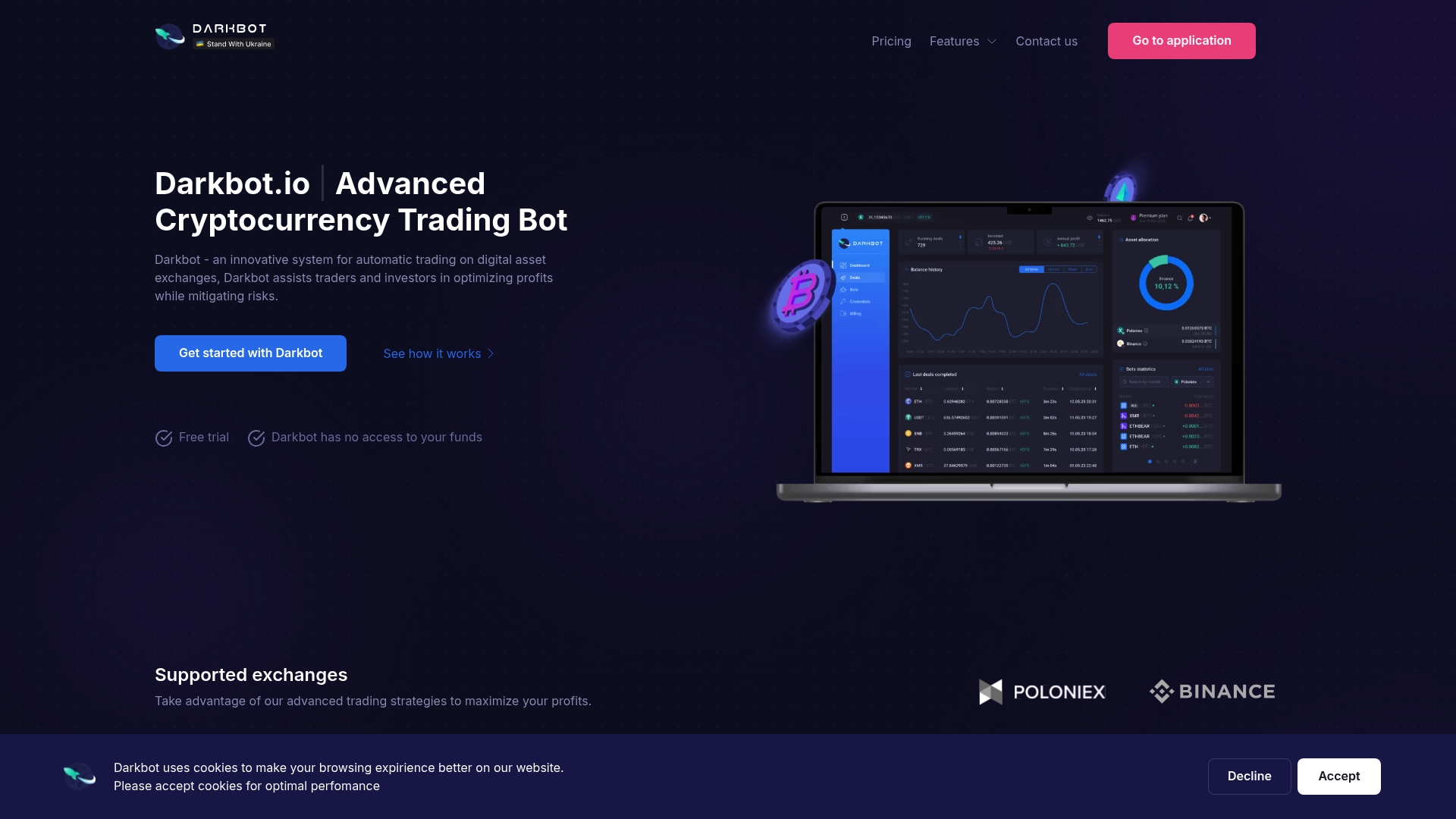
Darkbot is built around exactly this problem. The platform integrates rule-driven risk controls directly into automated trading strategies, enforcing position sizing limits, stop-loss logic, and portfolio correlation monitoring without requiring manual intervention on every trade. The automation removes the emotional override that makes risk rules so difficult to follow in real time. Drawdown thresholds can be configured to pause trading automatically when predefined loss limits are reached, preserving capital and preventing the kind of revenge trading that amplifies losses. For traders who want to apply the full automated risk management framework described in this article, Darkbot provides the infrastructure to do it at scale across multiple exchanges simultaneously. Explore the platform at Darkbot.
FAQ
What is the 1-2% rule in crypto risk management?
The 1-2% rule means risking no more than 1-2% of your total portfolio capital on any single trade. It is the most widely applied position sizing standard among professional traders because it preserves capital viability across extended losing streaks.
How should stop-losses be placed in crypto markets?
Stop-losses should be placed at the price level that invalidates the trade thesis, not at an arbitrary fixed dollar loss. Crypto volatility requires wider stops than traditional markets to avoid premature exits on normal price fluctuations.
Why is SMS-based 2FA risky for crypto accounts?
SMS two-factor authentication is vulnerable to SIM swapping, where attackers socially engineer a carrier into transferring your phone number. This attack method was linked to $410 million in wallet thefts in 2025. Authenticator apps eliminate this vector.
What due diligence should I do before using a new crypto exchange?
Verify the platform’s regulatory licensing, custody model, proof of reserves through a third-party audit, and withdrawal reliability. Test withdrawals with a small amount before committing significant capital to any new platform.
How do I verify a crypto project is legitimate?
Check for named and verifiable developers, independently audited smart contracts with public results, locked liquidity with verifiable proof, and active governance documentation. Anonymous teams combined with unaudited contracts represent the highest-risk profile in DeFi and token investments.
Recommended

Start trading on Darkbot with ease
Come and explore our crypto trading platform by connecting your free account!
Free plan available • No credit card required