AI in crypto trading: strategies and risk management

TL;DR:
- AI trading systems are complex and fragile, requiring careful understanding of their strengths and limitations to avoid portfolio failures.
- While powerful, AI strategies depend heavily on risk controls, execution quality, and adaptability to changing market regimes for real-world success.
Plenty of traders have been sold on the idea that an AI bot is basically a money printer. Set it up, walk away, watch the profits roll in. That story sells subscriptions, but it skips the hard parts. AI trading systems are genuinely powerful, but they are also complex, fragile in certain market conditions, and only as good as the logic and risk controls built into them. Understanding how these systems actually work, where they excel, and where they break down is the difference between using AI as a real edge and watching it blow up your portfolio.
Key Takeaways
| Point | Details |
|---|---|
| AI enhances trading decisions | Artificial intelligence enables predictive modeling and automated signals for more informed cryptocurrency trading. |
| Risk management is critical | AI-driven risk overlays and execution protocols help limit losses and optimize execution, but traders must supervise outcomes. |
| Beware of real-world frictions | Operational challenges like latency, fees, and API limits can significantly impact results compared to backtested performance. |
| AI is not foolproof | Model limitations and unpredictable market conditions mean AI trading bots cannot guarantee profits and require careful monitoring. |
| Automated solutions are evolving | Agentic AI systems and benchmarking improvements are shaping safer, more efficient crypto trading practices in 2026. |
What is artificial intelligence in cryptocurrency trading?
AI in crypto trading is not one single thing. It is a collection of techniques, including machine learning, predictive modeling, and risk overlays, all working together inside a structured pipeline. The goal is to process enormous amounts of market data faster and more systematically than any human trader could manage manually.
A typical AI trading architecture moves through several distinct stages:
- Data ingestion: Raw price data, order book depth, volume, on-chain metrics, and sometimes sentiment signals from news or social platforms are pulled in continuously.
- Signal generation: Models analyze the data and produce predictions about future price movements or directional probabilities.
- Position sizing: Risk controls determine how much capital to allocate to each signal, factoring in volatility and portfolio exposure.
- Execution: Orders are sent to exchanges via API connections, often with logic to minimize slippage and execution costs.
- Monitoring: The system tracks open positions, checks for anomalies, and adjusts or closes trades based on pre-set rules.
Machine-learning approaches for crypto trading typically frame the task as predictive modeling, estimating price return movement, and evaluate predictive accuracy with metrics such as MAE (mean absolute error), RMSE (root mean squared error), and R², then translate model outputs into actionable trading signals.
“The power of AI in trading isn’t that it predicts the future perfectly. It’s that it processes more information, more consistently, with fewer emotional errors than a human trader working alone.”
This architecture transforms what is possible in trading, but it also introduces layers of complexity that novice users often underestimate. Each stage in the pipeline can fail or degrade, and a weak link anywhere can turn a theoretically profitable strategy into a losing one. For a broader look at how this plays out in practice, the discussion on smarter, safer trading is worth reading before you commit to any automated setup.
How AI-powered trading strategies work
Once data is ingested and processed, the AI system needs to generate signals that are actually tradeable. This is where model architecture choices matter enormously.
Ensemble methods vs. deep learning
A study on 30 cryptocurrencies over a four-year period trained models including Gradient Boosting, XGBoost, SVR (support vector regression), and LSTM (long short-term memory networks). The results showed that ensemble methods outperformed SVR and LSTM consistently, and the study used predictions combined with moving-average-style signals to generate actionable trading decisions.
| Model type | Strengths | Weaknesses |
|---|---|---|
| Gradient Boosting / XGBoost | High accuracy on structured data, fast training | Can overfit on noisy crypto data |
| LSTM (deep learning) | Captures time-series patterns well | Computationally heavy, slower to adapt |
| SVR | Works well in low-noise environments | Struggles with high volatility regimes |
| Ensemble methods | Combines strengths, reduces single-model risk | More complex to tune and maintain |
From prediction to real trade: a step-by-step workflow
- The model generates a predicted price return or directional probability for a given asset over a defined time horizon.
- A signal conversion layer applies thresholds, for example, only act if the predicted return exceeds 0.5% after fees.
- Position sizing logic calculates how much capital to deploy based on signal confidence and current portfolio risk.
- The execution engine sends the order to the exchange, applying limit or market order logic depending on liquidity conditions.
- A monitoring layer tracks the trade and applies stop-loss or take-profit rules if pre-set conditions are hit.
This workflow is where crypto automation explained becomes practical rather than theoretical. The difference between a model that looks great on paper and one that performs in live markets almost always comes down to steps four and five, execution and monitoring.
Pro Tip: Never evaluate an AI strategy purely on its raw prediction accuracy. A model with 55% directional accuracy and tight risk controls will outperform a 70% accurate model with no stop-loss logic in volatile markets. Focus on risk-adjusted returns, not just win rates.
For traders who want to go deeper on how machine learning drives smarter automated trading, the mechanics of signal generation are worth studying before deploying real capital.
AI for risk management and order execution
Strategy generation gets most of the attention, but risk management and execution quality are where AI systems deliver some of their most measurable value, and where the gap between good and bad implementations becomes obvious.

Agentic AI and automated risk protocols
Gemini launched Agentic Trading, enabling AI models to interact with digital asset trading accounts via the Model Context Protocol open framework, with automation for market surveillance, transaction execution, and risk management using pre-configured trading approaches governed by established protocols. This represents a significant shift: AI is no longer just generating signals for humans to act on. It is managing the entire operational loop, from watching the market to placing and monitoring orders.
VWAP and execution quality
VWAP stands for Volume Weighted Average Price, a benchmark used to measure whether a trade was executed at a favorable price relative to the market’s activity during that period. Poor execution can erode profits even when the underlying strategy is sound. A deep learning framework for VWAP directly optimizes the VWAP execution objective by bypassing volume-curve prediction entirely, and reports lower VWAP slippage versus conventional approaches in cryptocurrency-focused empirical analysis.
Practical risk management features AI enables:
- Dynamic stop-loss adjustment: Rather than a fixed percentage, AI can widen or tighten stops based on current volatility, protecting capital during flash crashes without exiting too early in normal fluctuations.
- Inventory controls: Limits on how much exposure the system can hold in a single asset or correlated group of assets at any time.
- Drawdown monitoring: Real-time tracking of portfolio drawdown with automatic position reduction if losses exceed a defined threshold.
- Fee-aware execution: Routing logic that accounts for exchange fees, slippage, and spread to ensure trades are only executed when net profitability is realistic.
The practical impact of these features on trading success is substantial. A strategy that ignores execution costs and risk controls in backtesting will almost always disappoint in live trading. AI systems that bake these factors in from the start are far more likely to produce consistent results. For a detailed breakdown of how these tools work together for boosting profits and managing risks, the operational side of AI trading deserves as much attention as the predictive side.
Challenges and real-world limitations of AI in crypto trading
Here is where the marketing materials tend to go quiet. AI trading systems have real, documented limitations that every trader needs to understand before trusting one with their capital.
Overfitting and generalizability
Overfitting happens when a model learns the noise in historical data rather than the actual patterns. It performs brilliantly on past data and poorly on new data. Crypto markets are especially prone to this problem because the underlying market structure changes frequently, driven by regulatory shifts, new exchange dynamics, liquidity changes, and macro conditions.
ML system limitations in crypto trading include overfitting, poor generalizability, interpretability gaps, and real-world frictions such as latency, API limits, order book depth, and fees that can erode backtested returns significantly.
Interpretability gaps
Many high-performing models, especially deep learning architectures, are essentially black boxes. They produce outputs without clear explanations of why. This creates a real problem when the model starts behaving unexpectedly: you cannot easily diagnose what changed or why the system is making certain decisions.
Operational frictions that backtests ignore
- Latency: The time between a signal being generated and an order being filled can be significant, especially in fast-moving markets.
- API rate limits: Exchanges cap how many requests a bot can make per second, which can delay execution during high-volatility periods.
- Order book depth: A strategy that works at small scale may move the market against itself when deployed with larger capital.
- Fee drag: Layered fees across maker/taker structures, withdrawal costs, and spread can turn a marginally profitable strategy into a losing one.
LLM-based agents and benchmark risks
LLM-based trading agents can struggle to reason robustly about prices, inventory, and risk even when they can generate executable trading code. Benchmark-style evaluation separates “can run” from “correct P&L/drawdown paths,” which is a critical distinction. A bot that executes without errors is not the same as a bot that manages risk correctly.
Pro Tip: Always stress-test your AI strategy against at least three distinct market regimes: a trending bull market, a trending bear market, and a choppy sideways market. A strategy that only works in one regime is not a strategy, it is a bet on conditions repeating.
Understanding these limitations is central to trading efficiency. The traders who get the most out of AI systems are the ones who treat them as powerful tools with known failure modes, not as autonomous profit generators.
A realistic perspective: what AI means for crypto traders in 2026
Let us be direct about something the broader AI trading conversation often avoids. The gap between what AI trading systems promise in academic benchmarks and what they deliver in live markets is real, and it is not shrinking as fast as the hype suggests.
Backtests can overstate real-world viability due to execution frictions, latency and API limits, data issues, and publication bias. Publication bias is particularly important: studies that show AI trading strategies working get published. Studies showing they fail often do not. This skews the available literature toward optimism.
The most effective traders we see using AI-powered systems in 2026 share a few consistent habits. They treat their models as hypotheses, not facts. They monitor for regime shifts, the moments when market structure changes enough that a previously profitable strategy stops working. They maintain manual override capability so they can shut down a misbehaving bot quickly. And they prioritize operational reliability, meaning they care more about whether the system executes correctly under pressure than whether it shows a slightly higher Sharpe ratio in backtesting.
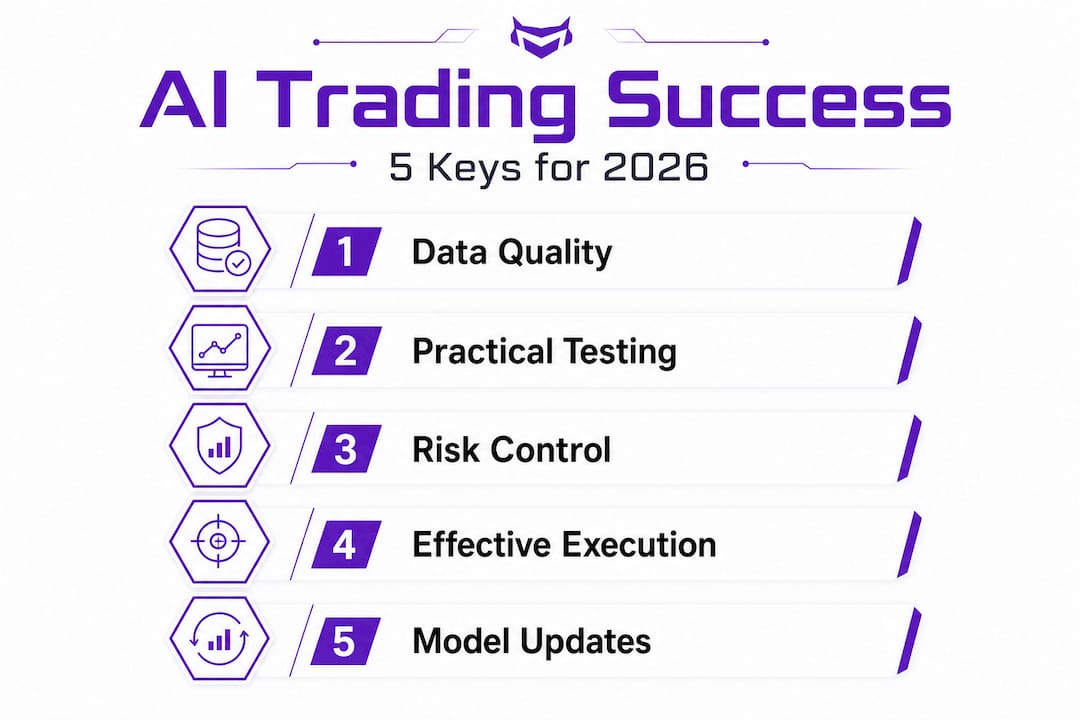
The contrarian view worth holding onto is this: AI is not making trading easier. It is making certain kinds of complexity more manageable. The traders who thrive are the ones who use AI to handle the parts of trading that benefit from speed and consistency, execution, risk monitoring, rebalancing, while keeping human judgment in the loop for strategy decisions and regime assessment.
For a forward-looking view on optimizing crypto trading with machine learning in 2026, the practical frameworks matter more than the theoretical performance numbers.
Explore AI-powered solutions for crypto trading
For those ready to put AI insights into action, Darkbot offers automated tools designed for real-world trading.
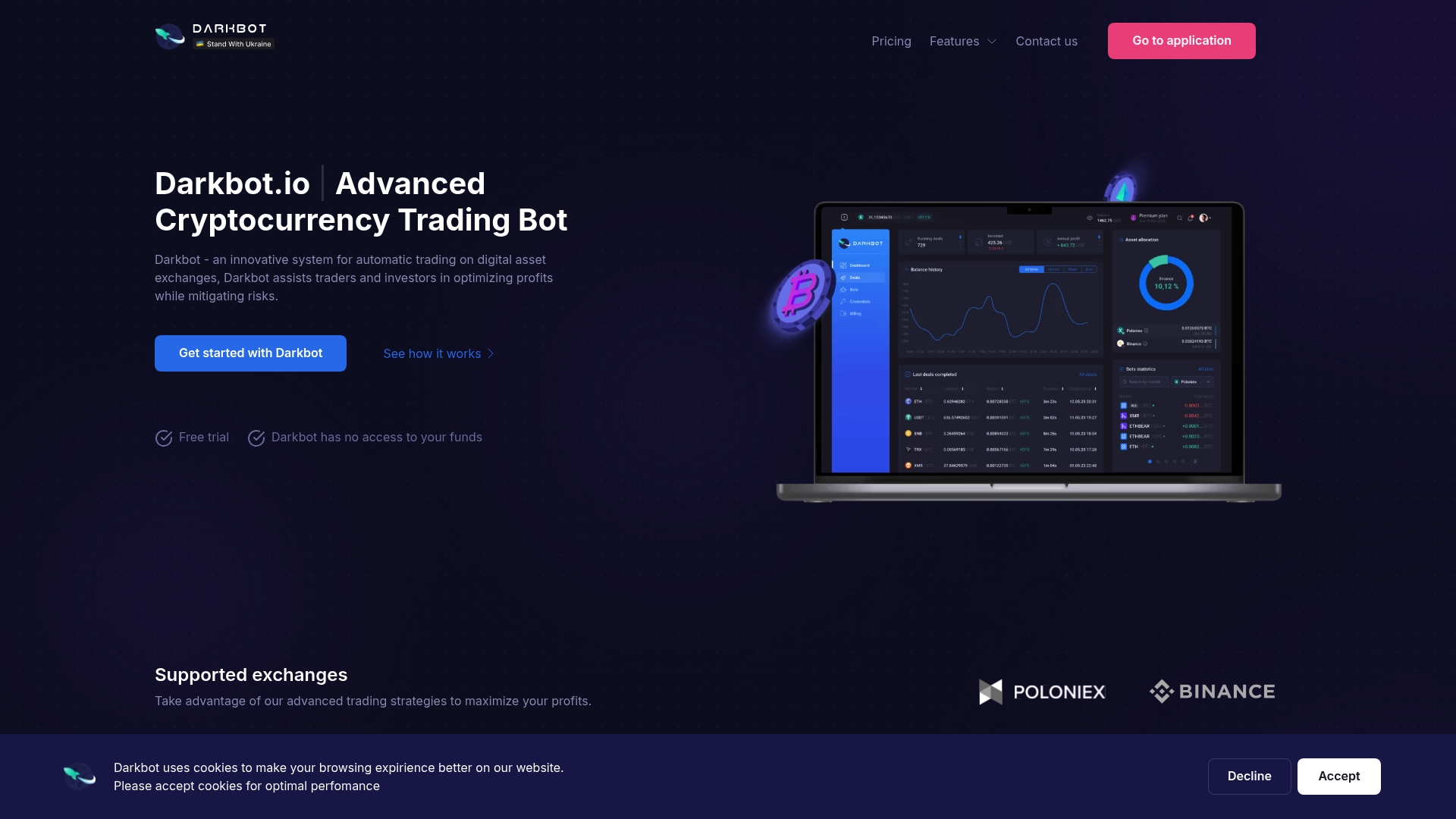
Darkbot’s AI-powered trading bot connects to multiple exchanges via secure API keys, letting you deploy automated strategies without writing a single line of code. The platform handles signal execution, position sizing, and real-time monitoring so you can focus on strategy rather than operations. With flexible pricing tiers from free to premium, you can start small and scale as your confidence grows. Darkbot’s portfolio management and optimization tools go further, enabling automated rebalancing, risk overlays, and performance analytics so your portfolio stays aligned with your goals even as market conditions shift.
Frequently asked questions
How do AI algorithms predict cryptocurrency prices?
AI algorithms use historical price data, volume, and on-chain metrics to train predictive models that estimate future price movements. These models are evaluated using metrics like MAE, RMSE, and R² before their outputs are converted into trading signals.
Can AI-powered trading bots guarantee profits?
No. Even the most sophisticated AI trading bots cannot guarantee profits because real-world frictions including latency, API limits, fees, and unpredictable market conditions can erode returns that look strong in backtesting.
What are some risks of using AI in crypto trading?
Key risks include overfitting to historical data, poor interpretability, latency delays, API rate limits, and fee drag. The Springer article on ML limitations notes that many studies assess algorithms under idealized conditions that diverge significantly from live trading realities.
How do agentic AI systems improve trading operations?
Agentic AI connects models directly to trading accounts, automating market surveillance, order execution, and risk management under pre-configured protocols. Gemini’s Agentic Trading is a real-world example of this architecture in action.
Why is benchmarking important in AI-based crypto trading?
Benchmarking ensures that performance metrics like profit and drawdown reflect actual costs and constraints rather than idealized conditions. MARKET-BENCH research shows that separating whether an agent “can run” from whether it produces correct P&L paths is essential for honest evaluation.
Recommended

Start trading on Darkbot with ease
Come and explore our crypto trading platform by connecting your free account!
Free plan available • No credit card required