Secure Trading Algorithms: A 2026 Crypto Safety Guide

TL;DR:
- Secure trading algorithms rely on cryptographic key custody, deterministic pre-trade risk validation, and policy enforcement layers to prevent key leaks, erroneous orders, and system failures. TEEs store private keys securely inside hardware enclaves with per-trade attestation, substantially reducing exposure risks compared to traditional credential storage. Separating order intent from authorization through tamper-evident receipts ensures auditability and system accountability for secure and compliant crypto trading.
Secure trading algorithms are systems that combine cryptographic key custody, deterministic pre-trade risk validation, and policy enforcement layers to protect automated crypto trading from key leaks, errant orders, and execution failures. In quantitative and systematic trading, this discipline is formally called algorithmic trading security. Open-source frameworks like Aetheris-Labs Aegis, AgentTrading, and the Agent Transaction Firewall (ATF) specification have pushed the field forward considerably in 2026, giving traders and developers concrete reference architectures. The risks these systems mitigate are not theoretical: a single exposed API key or an unvalidated order can trigger cascading losses within seconds on a live exchange.
How do secure trading algorithms use cryptographic key custody?
Cryptographic key custody is the foundation of any safe trading algorithm. Without it, every other security layer sits on unstable ground.

The most significant advance in this area is the use of Trusted Execution Environments (TEEs). Frameworks like Aetheris-Labs Aegis generate and store signing keys inside hardware enclaves using Intel TDX and AMD SEV-SNP, so the private key never exists in accessible memory. Each trade carries a remote attestation quote, and every execution is written to an immutable JSONL audit log. The default quote TTL is 600 seconds, which prevents stale signatures from being replayed or tampered with after the fact. This architecture makes it cryptographically provable that a specific key signed a specific order at a specific time.
The contrast with common practice is stark. Many trading bots still store API credentials in ".env` files or hardcoded configuration strings. According to Judy AI Lab’s security guide, API key leaks via code repositories are among the most frequent attack vectors, and exploit timelines after exposure are measured in minutes, not hours. Rotating API keys every 90 days is the minimum hygiene standard, but TEE-based custody eliminates the exposure window entirely by keeping keys inside the enclave at all times.
Enterprise implementations go further. Platforms like Jdgafx’s advanced algorithmic trading architecture implement AES-256-GCM encrypted key storage alongside TLS 1.3 for data in transit, automated key rotation schedules, and log retention policies. That combination covers the full key lifecycle from generation through retirement.
Pro Tip: When evaluating any trading bot platform, check whether it supports read-only API key scoping for monitoring and restricts withdrawal permissions at the exchange level. This limits blast radius if a key is ever compromised, regardless of how it is stored.
What are deterministic pre-trade risk engines and why do they matter?
Pre-trade risk engines are the enforcement layer that sits between strategy logic and order execution. They validate every order against a defined set of rules before a single byte reaches the exchange.
The AgentTrading architecture implements an 8-gate risk engine that runs synchronously before execution. Each gate checks a specific condition, and a failure at any gate halts the order with a structured rejection reason logged to an HMAC-chained audit trail. That chaining means historical decisions cannot be altered without detection. The gates cover:
- Price validation — confirms the order price falls within an acceptable band relative to the current market.
- Quantity validation — rejects orders that exceed position size limits or minimum lot sizes.
- Notional limit checks — caps the total dollar value of any single order or aggregate exposure.
- Order rate throttling — prevents API abuse by enforcing maximum order frequency per time window.
- Global trading state enforcement — blocks new orders when the system is in a halted, cooldown, or error state.
- Instrument eligibility — confirms the asset is on the approved trading list.
- Balance sufficiency — verifies available margin or spot balance before submission.
- Dry-run mode enforcement — when LLM or agentic components are integrated, hard dry-run modes prevent AI decisions from submitting live trades and circumventing risk controls.
The Nautilus Trader RiskEngine formalizes this same pattern, running pre-trade checks synchronously before execution to prevent invalid or dangerous orders from reaching the exchange. The synchronous design is deliberate: asynchronous validation introduces race conditions where an order could slip through during the check interval.
“A common failure in secure trading algorithms is assuming strategy logic alone suffices. Deterministic pre-trade firewalls are critical for preventing erroneous orders and system failures.” — ESMA 2026 Supervisory Briefing
The ESMA 2026 Supervisory Briefing on algorithmic trading makes this expectation explicit for regulated investment firms, requiring pre-trade controls that prevent erroneous orders and system malfunctions capable of disrupting markets. Even traders operating outside MiFID II jurisdiction should treat this standard as a design baseline. The regulatory framing reflects a technical reality: strategy logic and execution logic must be separated, with risk validation as the mandatory bridge.
For practical guidance on applying these principles to your own position sizing, the 1-2% risk rule framework provides a concrete starting point for notional limit calibration.
How does policy enforcement add another layer to algorithmic trading security?
Policy enforcement operates at a higher abstraction level than pre-trade risk checks. Where risk engines validate order parameters, policy layers evaluate intent against a defined authorization framework before any execution is attempted.
The Agent Transaction Firewall (ATF) specification defines this as middleware sitting between bots and on-chain or off-chain execution. ATF evaluates every transaction intent deterministically, produces a machine-readable allow or deny decision, and generates a tamper-evident receipt that can be verified independently without requiring access to secret keys. The key design principle is separation: the policy layer decides, the execution layer acts, and neither can override the other without leaving a verifiable record.
This separation matters most in dispute resolution and audit scenarios. When a trade produces an unexpected outcome, the receipt chain proves exactly what the policy layer approved and when. That traceability is absent in systems where strategy logic and execution are tightly coupled.
The practical benefits of ATF-style enforcement include:
- Deterministic decisions — identical inputs always produce identical outputs, making behavior predictable and testable.
- Machine-readable outputs — downstream systems can parse decisions programmatically without human interpretation.
- Independent verifiability — receipts can be checked by any party with access to the public policy specification, not just the system operator.
- DeFi compatibility — the architecture applies equally to on-chain smart contract interactions and off-chain centralized exchange orders.
| Policy layer feature | Security benefit |
|---|---|
| Deterministic allow/deny logic | Eliminates ambiguous or context-dependent authorization decisions |
| Tamper-evident receipts | Provides verifiable proof of every trade intent and its outcome |
| No secret key required for verification | Enables third-party audit without exposing credentials |
| Separation of decision and execution | Prevents accidental or malicious bypassing of authorization controls |
Separating intent from authorization through deterministic validation is now considered a core design principle for accountable algorithmic trading systems. The audit trail it produces is not just a compliance artifact. It is the primary mechanism for understanding system behavior after the fact.
What advanced techniques strengthen safe trading algorithms further?
Beyond key custody, risk engines, and policy layers, a mature secure trading strategy incorporates several additional controls that address execution quality and failure scenarios.
Adverse-selection gating is one of the most underused techniques in retail algorithmic trading. The Toxiflow framework implements a pre-trade microstructure execution layer that tracks realized adverse selection metrics and either blocks or attenuates order size when the signal indicates toxic flow conditions. It supports both Observe mode, which logs without intervening, and Enforce mode, which actively gates orders. Deploying Observe mode first gives you a baseline before activating enforcement, which prevents over-restriction on legitimate signals.
Stress-testing against historical scenarios is the second layer. The CrossMind framework runs algorithmic strategies against historical crash and bull market data, scoring drawdown depth and survival probability for each scenario. It also implements a Dead Man’s Switch circuit breaker that auto-cancels open orders after a configurable timeout, preventing runaway losses when the system loses connectivity or enters an error state. Slippage modeling within CrossMind captures the difference between expected and realized execution prices, which is critical for realistic risk management beyond signal modeling alone.
Graded order-size attenuation combines both approaches. Rather than a binary block or pass decision, the system reduces order size proportionally as adverse-selection metrics worsen. This preserves participation in the market while limiting exposure during deteriorating conditions.
Pro Tip: Run your strategy through at least three historical stress scenarios before live deployment: the March 2020 COVID crash, the May 2021 crypto correction, and the November 2022 FTX collapse. Each represents a distinct failure mode. A strategy that survives all three has been tested against liquidity crises, sentiment reversals, and counterparty risk events.
For a broader view of how these techniques fit within automated trading systems architecture in 2026, the structural patterns have matured significantly from earlier generations of bot design.
Key takeaways
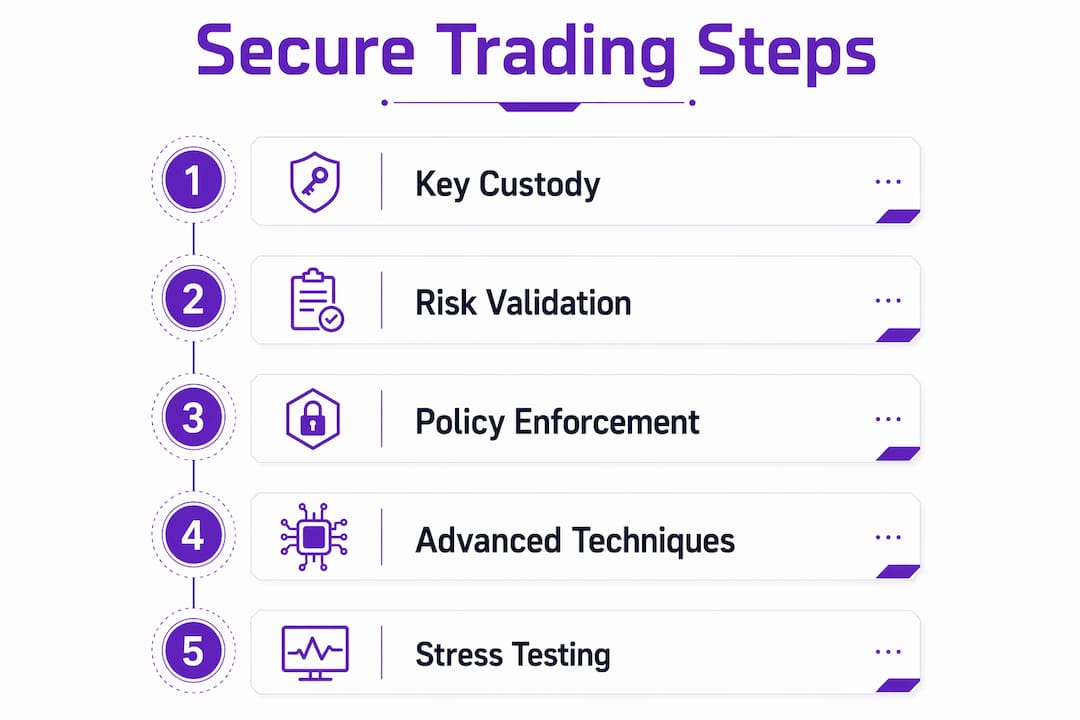
Secure trading algorithms require cryptographic key custody, deterministic pre-trade validation, and policy enforcement working together. No single layer is sufficient on its own.
| Point | Details |
|---|---|
| TEE-based key custody | Store signing keys inside Intel TDX or AMD SEV-SNP enclaves to prevent exposure and enable per-trade attestation. |
| Deterministic risk engines | Run synchronous pre-trade checks across price, quantity, notional, and state gates before any order reaches the exchange. |
| Policy enforcement layers | Use ATF-style middleware to separate intent from authorization and generate tamper-evident receipts for every trade. |
| Adverse-selection gating | Deploy Toxiflow-style microstructure monitoring to attenuate or block orders during toxic flow conditions. |
| Stress-testing and circuit breakers | Validate strategies against historical crash scenarios and configure Dead Man’s Switch timeouts to contain failure-mode losses. |
Why the intent-authorization boundary is the most important design decision
The most consequential design choice in any secure trading stack is where you draw the line between what the algorithm wants to do and what it is authorized to do. Most traders focus on signal quality and ignore this boundary entirely. That is the wrong priority order.
I have reviewed enough trading bot architectures to say with confidence that the majority of catastrophic failures trace back to tight coupling between strategy logic and execution. When a bug in the signal layer can directly submit an order without passing through an independent validation step, you have no defense in depth. The strategy is both the brain and the hand, and there is no check between them.
The ATF specification gets this right by treating the policy layer as a first-class architectural component, not an afterthought. The receipt-based verification model means you can reconstruct exactly what happened in any dispute without relying on the strategy code’s own logs, which could themselves be compromised or simply wrong.
The operational tension I see most often is between security rigor and latency. TEE-based key custody and synchronous risk engines add microseconds to execution. For high-frequency strategies, that matters. For the vast majority of crypto traders operating on minute or hourly timeframes, it does not. The latency cost is negligible, and the protection is substantial.
My practical advice: start with crypto trading bot security fundamentals before adding complexity. Get your key management right, implement a basic risk engine with notional limits and rate throttling, and add policy enforcement as your strategy matures. Backtesting and paper trading are not optional steps. They are the only way to validate that your risk gates are calibrated correctly before real capital is at stake.
— Grisha
How Darkbot approaches secure crypto trading automation
Darkbot is built around the same principles this article describes: systematic execution, structured risk control, and repeatable logic. The platform integrates AI-driven decision-making with layered security controls, including API key management, deterministic strategy execution, and real-time portfolio monitoring across multiple exchanges. Risk parameters are configurable at the strategy level, giving you direct control over notional limits, position sizing, and execution conditions without requiring custom code. For traders who want disciplined automation without building a risk engine from scratch, Darkbot’s trading automation provides the infrastructure. The portfolio management tools extend that control to multi-asset allocation and rebalancing with the same structured approach.
FAQ
What are secure trading algorithms?
Secure trading algorithms are automated trading systems that combine cryptographic key custody, deterministic pre-trade risk validation, and policy enforcement to prevent unauthorized trades, key exposure, and erroneous order execution.
How do TEEs improve algorithmic trading security?
Trusted Execution Environments like Intel TDX and AMD SEV-SNP store signing keys inside hardware enclaves so they never appear in accessible memory, with each trade carrying a remote attestation quote for independent verification.
What is a pre-trade risk engine in crypto trading?
A pre-trade risk engine is a synchronous validation layer that checks every order against price, quantity, notional, and state rules before submission, rejecting non-compliant orders and logging structured reasons for each decision.
How does the Agent Transaction Firewall work?
The ATF specification sits between trading bots and execution, evaluating every transaction intent against a defined policy and generating a tamper-evident receipt that can be verified by any party without access to secret keys.
How often should API keys be rotated for safe trading algorithms?
Rotating API keys every 90 days is the minimum standard, though TEE-based key custody eliminates the rotation window entirely by keeping keys inside a hardware enclave throughout their lifecycle.
Recommended

Start trading on Darkbot with ease
Come and explore our crypto trading platform by connecting your free account!
Free plan available • No credit card required