Top advantages of algorithmic trading for crypto traders
TL;DR:
- Algorithmic trading delivers unparalleled speed and reduced slippage compared to manual methods, especially in fast-moving crypto markets.
- It enables continuous, emotion-free execution, better risk management, and scalability across multiple strategies and assets.
Crypto markets move at a pace that no human can match. Prices shift in fractions of a second, arbitrage windows open and close before you finish typing, and a single delayed order can cost you meaningful profit. Manual trading is no longer just inconvenient in this environment — it’s becoming a structural disadvantage. Algorithmic trading flips that script by using computer programs to execute trades in milliseconds, capturing opportunities that vanish before any manual trader can react. This article breaks down the real advantages, shows you where the data supports the hype, and helps you decide how to apply these tools in your own portfolio.
Key Takeaways
| Point | Details |
|---|---|
| Faster execution | Algorithmic trading executes crypto trades in milliseconds, reducing delay and slippage for better outcomes. |
| Advanced risk control | Modern algorithms balance market impact and risk more efficiently than manual trading allows. |
| Consistent, emotion-free trades | Automated systems run 24/7 without fatigue or bias, ensuring every opportunity is seized. |
| Manual trading lag | Human traders in 2025 struggle to match the speed or effectiveness of automated strategies. |
| Strategic use recommended | Algorithmic trading offers the best returns in volatile and high-frequency settings when used with proper oversight. |
1. Lightning-fast execution and reduced slippage
With speed in mind, let’s break down exactly how algorithmic trading sets itself apart from manual methods.
Slippage is the difference between the price you expect on a trade and the price you actually receive. In fast-moving crypto markets, even a few milliseconds of delay can cause significant slippage, especially on larger orders. Manual traders are always at a disadvantage here because human reaction time simply cannot compete with automated execution.
Algorithmic systems respond to market conditions and fire off orders in microseconds. This is not a minor edge. Research comparing execution strategies shows that a DQN achieves 0.72 bps slippage (basis points) versus VWAP’s 7.27 bps — a 90% improvement in slippage reduction. For a trader moving $500,000 in volume, that difference in slippage translates directly to dollars saved on every single trade.
Here’s what algorithmic execution actually gives you in practice:
- Instant order routing: Orders are placed the moment conditions are met, with no hesitation or second-guessing.
- Consistent execution quality: The algorithm doesn’t have bad days, doesn’t rush, and doesn’t freeze under pressure.
- Better fill prices: Faster execution means you’re more likely to fill at or near your target price, especially in volatile conditions.
- Scalability: You can run multiple strategies across multiple pairs simultaneously, something no manual trader can realistically do.
Pro Tip: When evaluating any algorithmic trading system, ask specifically about latency benchmarks and slippage performance data. A platform that can’t show you real execution quality metrics is one you should treat with skepticism. Prioritize systems built on AI trading strategies that report execution metrics transparently.
The compounding effect of reduced slippage is often underestimated. Traders focus on big wins and ignore the slow drain of poor execution quality. Over hundreds of trades per month, shaving even 2 to 3 basis points off your average slippage can represent a substantial improvement in net returns, without changing your strategy at all.
2. Advanced strategies for risk and market impact management
Once speed is optimized, risk management becomes the next competitive advantage for experienced algorithmic traders.

Execution quality isn’t just about speed. It’s about balancing how quickly you complete an order against the market impact that large orders create. When you buy a significant amount of any asset, your own order moves the price against you. Sophisticated algorithms manage this trade-off in real time, something no manual trader has the computational bandwidth to do effectively.
Reinforcement learning (RL) based execution frameworks address this directly. These systems learn from market feedback and continuously refine how they slice orders, time entries, and adapt to liquidity conditions. The results are compelling: RL execution strategies outperform TWAP and VWAP baselines and operate near the Almgren-Chriss efficient frontier — a benchmark representing the optimal balance between execution speed and market impact cost.
“The Almgren-Chriss efficient frontier represents the theoretical ideal trade-off between execution speed and market impact. Getting close to it in live markets is a genuine performance milestone.”
To evaluate whether a trading strategy’s risk-return profile is worth deploying, consider these steps:
- Review slippage and market impact data: Look for documented performance against TWAP (time-weighted average price) and VWAP (volume-weighted average price) benchmarks over real market conditions.
- Measure the Sharpe ratio: This tells you how much return you’re generating per unit of risk. A higher Sharpe ratio means better risk-adjusted performance.
- Stress test the strategy: Run the algorithm against historical volatility spikes, flash crashes, and low-liquidity periods to see how it holds up.
- Check drawdown controls: Well-designed algorithms include maximum drawdown limits that automatically reduce position sizes or pause trading during adverse conditions.
- Review rebalancing logic: Strategies that incorporate automated rebalancing keep your portfolio aligned with your risk tolerance without requiring constant manual intervention.
By incorporating AI in trading strategies, traders gain access to execution frameworks that would otherwise require a full quantitative research team to build and maintain.
3. 24/7 market monitoring and emotion-free execution
Beyond advanced strategy, there’s a powerful, consistent advantage: reliability at all hours, with zero emotional bias.
Crypto markets never close. Bitcoin doesn’t take weekends off. Major price moves frequently happen outside traditional trading hours, and some of the most significant volatility spikes occur during Asia-Pacific sessions when North American traders are asleep. Manual traders miss these moves. Algorithms don’t.
The speed and efficiency advantages of automated systems extend beyond just execution time. They apply equally to market monitoring. An algorithm scans price action, volume data, order book depth, and technical indicators continuously, 24 hours a day, 365 days a year, without fatigue or distraction.
The emotional component is equally important. Consider what happens to a manual trader during a 20% flash crash. Fear kicks in, decisions become reactive, and the instinct to “do something” often leads to selling at the worst possible moment. Algorithms don’t experience fear. They execute the logic you programmed, consistently and without deviation.
Here’s what emotion-free execution eliminates from your trading:
- Panic selling: Algorithms follow your rules, not your gut. If your strategy says hold through a 15% drawdown, it holds.
- FOMO entries: Chasing prices after a breakout is a classic manual trading error. Algorithms only enter when objective criteria are met.
- Revenge trading: After a loss, manual traders often take larger, poorly considered positions to “make it back.” Algorithms have no ego to recover.
- Decision fatigue: Monitoring multiple pairs across multiple exchanges for hours leads to worse decisions over time. Automation eliminates this entirely.
Pro Tip: Set up volatility spike alerts within your algorithmic trading platform, even if you’re running fully automated strategies. Receiving an alert when a coin moves more than 10% in 15 minutes lets you review whether your algorithm’s response aligns with your current market thesis, without needing to watch charts all day. Platforms covering the full automated trading advantages let you customize these parameters with precision.
4. Comparing algorithmic vs manual trading: The edge in 2025
Seeing these benefits in isolation is powerful, but a head-to-head comparison shows why traders are switching to algorithmic approaches.
The 2025 crypto landscape is defined by tighter spreads on major pairs, faster exchange matching engines, and a more sophisticated participant base. In this environment, the gap between algorithmic and manual performance has widened considerably.
| Feature | Algorithmic trading | Manual trading |
|---|---|---|
| Execution speed | Microseconds | Seconds to minutes |
| Slippage (typical) | 0.72 bps (DQN) | 7.27 bps (VWAP baseline) |
| Emotional bias | None | High |
| 24/7 operation | Yes | No |
| Strategy execution consistency | Near-perfect | Variable |
| Risk framework | RL near efficient frontier | Manual judgment |
| Scalability (multiple pairs) | Unlimited (within platform limits) | Severely limited |
| Drawdown controls | Automated | Manual, often delayed |
| Learning and adaptation | Continuous (ML models) | Slow, experience-based |
| Setup complexity | Moderate (initial) | Low (ongoing is harder) |
The case study data is striking. A 90% improvement in slippage from using DQN-based execution over a standard VWAP approach isn’t a marginal gain. For active traders operating at scale, that’s the difference between a profitable strategy and a breakeven one after fees.
That said, manual trading isn’t completely dead. Niche situations where on-chain intelligence, community signals, or insider network knowledge drives the edge may still favor experienced human judgment. Small-cap altcoins with thin order books can also be tricky for pure algorithms because the act of trading itself can move the market significantly.
Understanding these trade-offs in depth before committing capital is the foundation of smart strategy design. If you want a full breakdown of where bots create the clearest edge, the analysis on trading bots for profit and risk is worth your time.
5. When should (and shouldn’t) you use algorithmic trading?
Even with clear advantages, algorithmic trading shouldn’t be used blindly — know when it fits your strategy.
Algorithmic trading delivers the most value in specific contexts. Understanding where it excels, and where it doesn’t, helps you allocate your capital and attention correctly.
Use algorithmic trading when:
- You’re trading high-frequency strategies: If your edge depends on executing many trades quickly across tight price ranges, automation is not optional — it’s the strategy.
- You’re managing a large-cap portfolio: Bitcoin, Ethereum, and large-cap assets have deep liquidity where algorithmic execution quality, especially near the Almgren-Chriss efficient frontier, translates directly to measurable performance gains.
- You need consistent coverage during volatile periods: Market-moving events like Fed announcements, ETF approval news, or large on-chain transfers often happen without warning. Algorithms react to the price action itself, not the news cycle.
- You’re running multiple simultaneous strategies: Diversifying across mean-reversion, momentum, and arbitrage strategies simultaneously is only feasible with automation.
- You want disciplined drawdown management: Automated risk rules enforce stop-losses and position limits without hesitation or override.
Consider manual or hybrid approaches when:
- You’re trading low-liquidity tokens: Thin order books mean your algorithm’s orders can become self-fulfilling price movers, often against you.
- You’re interpreting qualitative information: Community sentiment, project team announcements, and network-level governance changes require human interpretation that algorithms can’t reliably factor in yet.
- You’re testing a new strategy: Before deploying real capital, manually walking through your algorithm’s logic in a simulated environment gives you deeper insight into edge cases.
Pro Tip: Always test new algorithmic strategies using a paper trading or demo account before going live. Even well-designed strategies can behave unexpectedly in real market microstructure. Spending two to four weeks in demo mode lets you validate logic, observe real fills, and build confidence before actual capital is at risk. This is especially relevant for anyone exploring machine learning in trading for the first time.
Our take: Where most traders miss the true power of algorithms
Most traders who adopt algorithmic trading make the same mistake. They find a strategy, set it up, and then step back entirely, treating the algorithm like a vending machine they can ignore once it’s running. That mindset leaves enormous value on the table.
The real edge in algorithmic trading comes from the feedback loop. Your algorithm generates execution data, slippage records, drawdown patterns, and performance attribution across different market conditions. That data is a goldmine. But it only becomes useful if you’re actively reviewing it, questioning it, and using it to refine your approach. Most traders never do this systematically.
The other underappreciated element is strategy layering. Experienced algorithmic traders don’t run a single bot. They run multiple strategies that complement each other: one focused on momentum, one on mean-reversion, and one handling portfolio rebalancing. When these strategies are tuned to behave differently across market regimes, the portfolio as a whole becomes more resilient. The technology makes it possible, but the design thinking behind it is the actual competitive advantage.
Here’s the uncomfortable truth: algorithms don’t create edges — they amplify them. If your underlying strategy logic is flawed, automation just executes your mistakes faster. This is why algorithmic trading insights consistently emphasize that the work of defining clear, backtested entry and exit logic must come before any deployment decision.
The traders who win long-term with automation are not the ones who found the best bot. They’re the ones who built a disciplined process of testing, deploying, monitoring, and iterating. The algorithm is just the tool. The judgment driving it is still yours.
Ready to upgrade your trading with advanced automation?
If the data in this article reflects the kind of performance improvements you’re looking for — lower slippage, smarter risk management, and round-the-clock execution — then the next step is finding a platform built to deliver exactly that.
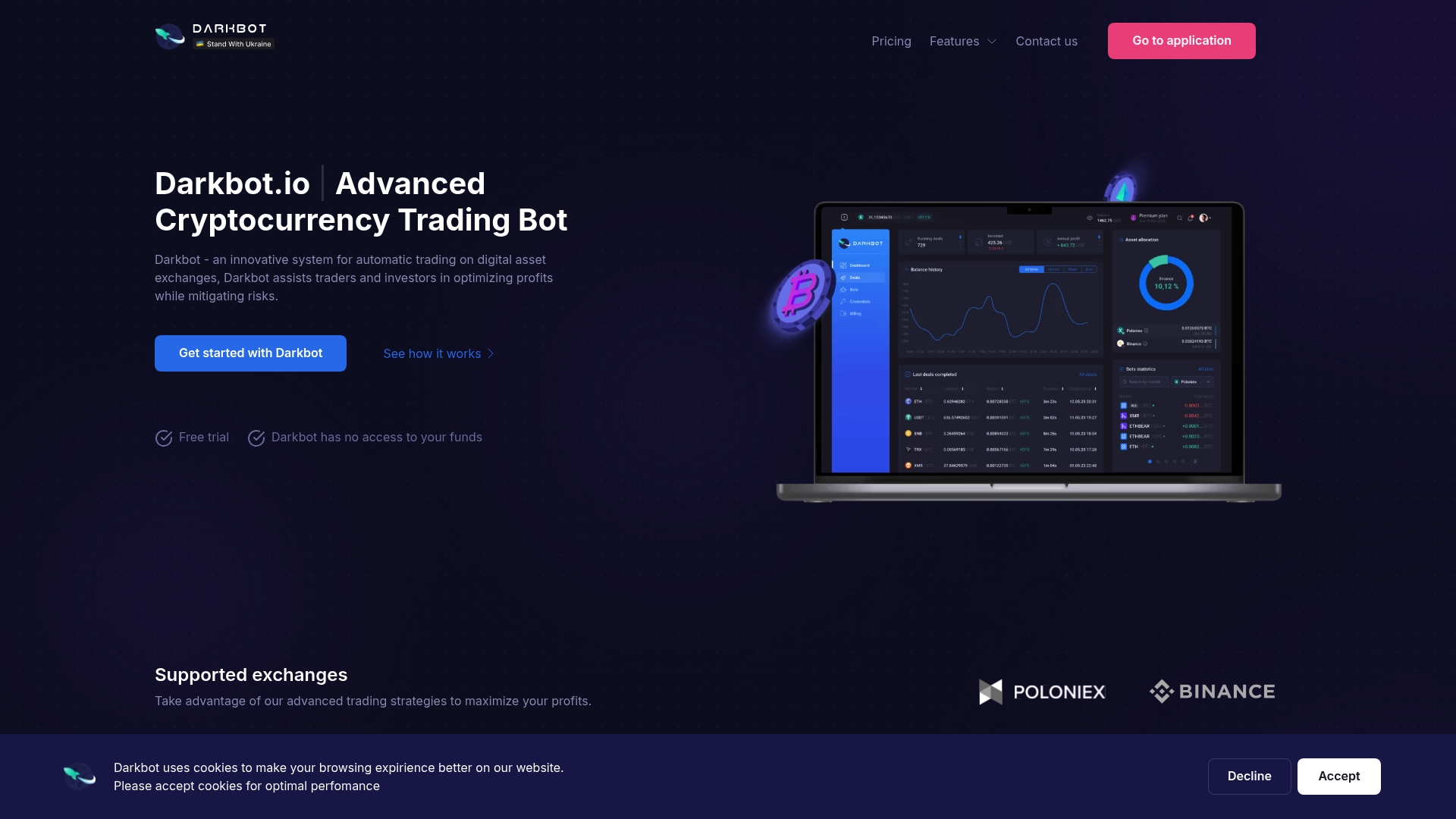
Darkbot.io is designed for crypto traders who want the full power of algorithmic automation without needing a quantitative finance degree to get started. From AI-powered strategy execution to real-time analytics and seamless exchange integration, the platform handles the technical complexity so you can focus on strategy. Explore the portfolio management tools to see how automated rebalancing, multi-bot support, and risk controls work together in a single platform. Whether you’re running your first bot or scaling a multi-strategy portfolio, Darkbot has a plan that fits.
Frequently asked questions
What is algorithmic trading and how does it work?
Algorithmic trading uses computer programs to automate buy and sell orders based on pre-defined strategies, letting you execute trades faster and more efficiently than any manual method can achieve.
How does algorithmic trading reduce trading risk?
By following strict, pre-programmed rules and leveraging advanced execution frameworks, algorithmic trading systems outperform TWAP/VWAP baselines and balance risk and market impact better than manual strategies can.
Is algorithmic trading suitable for beginners in crypto?
Yes, but beginners should start with simple, well-tested strategies or use demo accounts to validate their logic before deploying real capital in volatile markets.
Can manual trading still compete with algorithms in 2025?
Manual trading works in niche or illiquid markets, but for most crypto assets, algorithms hold a decisive edge in speed, consistency, and slippage reduction, with DQN achieving 0.72 bps slippage versus 7.27 bps for VWAP.
What kind of results can I expect from algorithmic trading?
With well-designed strategies, you can achieve lower slippage, faster execution, and improved risk-adjusted returns, as RL-based execution has been shown to operate near the theoretical optimal efficient frontier for trade execution.
Recommended

Start trading on Darkbot with ease
Come and explore our crypto trading platform by connecting your free account!
Free plan available • No credit card required