Trading Platform Ecosystem: What Traders Need to Know
TL;DR:
- A trading platform ecosystem is a network of interconnected systems that supports traders, liquidity providers, and data partners. It enables efficient, scalable trading workflows by integrating core components like OMS, EMS, PMS, SOR, and TCA. Customization and infrastructure choices heavily influence execution speed, reliability, and overall trading performance.
A trading platform ecosystem is defined as a multi-sided, technology-driven environment that connects traders, liquidity providers, developers, data partners, and infrastructure providers through a unified core platform. Unlike a single application, this ecosystem functions as the operating system of modern trading, coordinating every step from order entry to post-trade settlement. Industry frameworks such as the Order Management System (OMS) and Execution Management System (EMS) form its structural backbone. Understanding what is a trading platform ecosystem is the first step toward building a trading workflow that is both efficient and repeatable.
What is a trading platform ecosystem?
A trading platform ecosystem is not a single piece of software. It is an integrated network of systems connecting seven distinct participant groups: developers, end users, service providers, advertisers, data partners, infrastructure providers, and liquidity sources. Each group adds a layer of value that the others depend on. Remove one layer, and execution quality, data accuracy, or risk control degrades.

The term “ecosystem” is borrowed from biology deliberately. Just as organisms in a habitat depend on each other to survive, participants in a trading ecosystem depend on shared infrastructure and data flows. A trader placing an order triggers a chain of events across the OMS, EMS, Smart Order Router (SOR), Portfolio Management System (PMS), and Transaction Cost Analysis (TCA) engine simultaneously. Each system handles a distinct function, and the ecosystem’s value comes from how well those functions connect.
This architecture is distinct from what most traders see on screen. The user interface is the front door. The ecosystem is the entire building.
What are the essential components of a trading ecosystem?
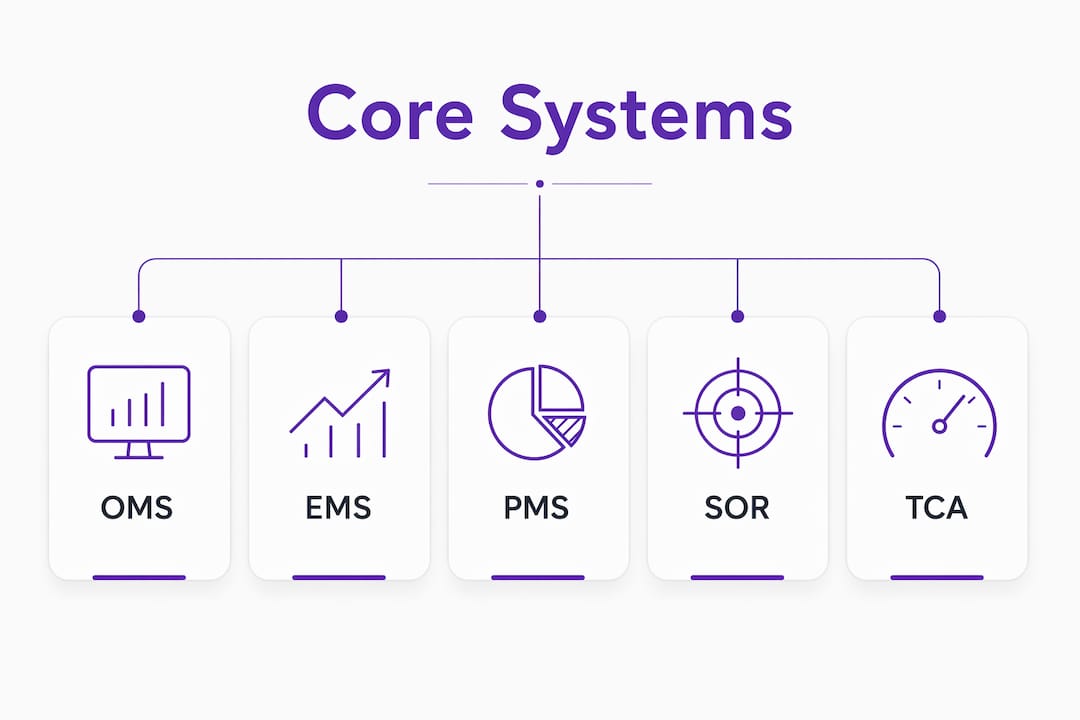
Professional trading ecosystems rest on five architectural pillars. Each one handles a specific function, and together they form a complete order lifecycle.
| Component | Core Function |
|---|---|
| Order Management System (OMS) | Captures, tracks, and manages orders across asset classes and accounts |
| Execution Management System (EMS) | Routes orders to venues and manages real-time execution |
| Portfolio Management System (PMS) | Tracks positions, exposures, and performance across portfolios |
| Smart Order Router (SOR) | Selects the optimal execution venue based on price, liquidity, and speed |
| Transaction Cost Analysis (TCA) | Measures execution quality and slippage against benchmarks |
APIs and protocol standards such as FIX (Financial Information eXchange) bind these systems together. API layers connect orders to venues, compliance systems, and back-office platforms without requiring a full rebuild when a new exchange or data provider is added. That modularity is what separates an ecosystem from a collection of isolated tools.
Latency is the performance variable that most traders underestimate. In liquid markets, order-to-execution matching occurs within fractions of a second. Institutional firms co-locate trading servers near exchange matching engines to reduce round-trip times to microseconds. For systematic and algorithmic strategies, that infrastructure choice directly affects fill quality and slippage.
Pro Tip: Before selecting any trading platform, ask the vendor specifically which of the five core systems are native and which rely on third-party integrations. Native integrations reduce latency and failure points.
How do trading ecosystems differ from standalone platforms?
A standalone platform handles one function well. An ecosystem handles many functions together, and the integrated workflow adds more business value than the sum of its parts. That distinction matters most when a trader scales up in volume, asset class diversity, or strategy complexity.
Retail-ready platforms prioritize ease of use. Professional ecosystems prioritize custom API support, FIX protocol connectivity, and segregated accounting across multiple accounts. The two categories serve different needs, and confusing them is a common and costly mistake.
The risks of complex ecosystems are real. The 2012 Knight Capital incident resulted in a $440 million loss caused by a faulty software deployment in a complex, integrated trading environment. That case illustrates how tightly coupled systems can amplify a single failure across an entire operation. Ecosystem complexity requires disciplined deployment practices and thorough testing protocols.
Key advantages of ecosystems over standalone platforms:
- Network effects: Each new participant or integration increases value for all existing users.
- Modularity: Traders configure access to only the tools relevant to their role and strategy.
- Unified data flow: Data is pushed to users in context rather than requiring manual retrieval across systems.
- Multi-asset support: A single ecosystem can handle equities, derivatives, and digital assets within one workflow.
- Compliance integration: Surveillance and reporting tools connect directly to execution data without manual reconciliation.
Key challenges to manage:
- Deployment complexity increases failure risk when multiple systems update simultaneously.
- Vendor dependency grows as more integrations are added.
- Latency can increase if API connections between components are poorly architected.
Pro Tip: Map every integration point in your ecosystem before any system update. A change in one component, such as an OMS upgrade, can break downstream connections to the TCA or compliance layer.
How do traders use and customize trading platform ecosystems?
Traders use ecosystems by assigning specific tools to specific roles within a workflow. A sales trader, an execution trader, and a compliance officer each access different layers of the same platform. Multi-role access allows each function to operate with the data and controls relevant to that role, without exposing unnecessary complexity.
Customization goes beyond role-based access. Traders can onboard third-party applications, connect proprietary datasets, and build custom APIs that extend the platform’s native capabilities. Platform users customize their environment well beyond out-of-box offerings, effectively turning the ecosystem into a personalized operating system. That flexibility supports algorithmic, discretionary, and quantitative strategies within the same infrastructure.
A practical customization workflow for a systematic trader typically follows this sequence:
- Connect data feeds. Integrate market data, alternative data, and historical datasets through API connections to the PMS and analytics layer.
- Define strategy parameters. Configure the OMS with order types, size limits, and risk controls specific to the strategy.
- Set routing rules. Program the SOR to prioritize venues based on liquidity, fee structure, and execution speed.
- Activate TCA monitoring. Set benchmarks and alert thresholds so execution quality is tracked in real time, not just reviewed post-trade.
- Integrate compliance checks. Connect surveillance tools to flag rule violations before orders reach the market.
Risk management sits at the center of this workflow, not at the edge. Managing trading risk within an ecosystem means embedding controls at every stage of the order lifecycle, from pre-trade checks through post-trade allocation. Treating risk as a separate function, bolted on after execution, is the structural flaw that causes most systematic failures.
What role do liquidity providers and brokers play in the ecosystem?
The broker is the ecosystem participant most traders interact with least directly, yet the broker’s infrastructure determines execution quality more than any front-end feature. Brokers aggregate liquidity from global banks and intermediary firms, presenting consolidated pricing behind a simple user interface. The trader sees a bid and ask. Behind that quote is a tiered network of prime brokers, regional banks, and electronic communication networks.
Tiered liquidity providers operate in layers. Tier 1 providers are large global banks with deep balance sheets. Tier 2 providers are regional banks and non-bank market makers. Electronic platforms aggregate these streams and present the best available price to the broker, who then passes it to the trader. Each layer adds a spread or fee, and the ecosystem’s architecture determines how many layers exist between the trader and the source of liquidity.
| Ecosystem Participant | Role in Execution |
|---|---|
| Tier 1 liquidity provider | Supplies raw pricing from major bank balance sheets |
| Prime broker | Aggregates multiple liquidity sources and provides credit |
| Electronic communication network | Matches orders across participants with minimal latency |
| Retail or institutional broker | Presents consolidated pricing and manages order routing |
| Trader | Places orders through the front-end platform |
The platform user interface is the last mile of this chain, not the whole chain. Traders who evaluate platforms based on interface design alone miss the infrastructure that determines whether their orders fill at the quoted price or slip. Understanding broker liquidity aggregation is a prerequisite for informed broker selection. For crypto traders, multi-exchange integration adds another layer to this structure, connecting multiple venue order books through a single API layer.
Key Takeaways
A trading platform ecosystem delivers its full value only when all five core systems, OMS, EMS, PMS, SOR, and TCA, operate as a connected whole rather than isolated tools.
| Point | Details |
|---|---|
| Ecosystem vs. standalone | Ecosystems integrate five core systems; standalone platforms handle one function and cannot scale the same way. |
| Latency matters | Execution speed measured in microseconds affects fill quality; infrastructure choices are as important as strategy design. |
| Broker infrastructure | The platform UI is the front door; broker liquidity aggregation determines actual execution quality behind it. |
| Customization is structural | Role-based access and custom APIs turn an ecosystem into a personalized operating system for any trading style. |
| Risk belongs in the workflow | Embedding risk controls at every stage of the order lifecycle prevents the cascading failures seen in events like the Knight Capital incident. |
Why most traders misread their trading environment
The most persistent misconception I encounter is that the platform interface equals the trading process. Traders spend hours comparing chart layouts and order entry screens while ignoring the OMS architecture, the SOR routing logic, and the latency profile of the broker’s liquidity connections. Those backend elements determine whether a strategy performs as designed or degrades under real market conditions.
Custom APIs and proprietary data integrations are where serious traders separate themselves. A platform that accepts external datasets and custom execution logic gives a trader the ability to build a workflow that fits the strategy, rather than fitting the strategy to the platform’s limitations. That distinction compounds over time. A workflow built on a rigid platform creates friction at every scale point.
Execution speed and connectivity are not just institutional concerns. In crypto markets, where API-based exchange integration determines how quickly a bot can act on a signal, latency between the trading system and the exchange matching engine directly affects strategy performance. A few hundred milliseconds of unnecessary delay can be the difference between a filled order and a missed opportunity.
The traders who get the most from an ecosystem are the ones who treat it as infrastructure to be understood and configured, not software to be used passively. Evaluate platforms on architecture first, features second. Ask about FIX protocol support, co-location options, and API rate limits before asking about the mobile app.
— Grisha
Darkbot and trading ecosystem integration
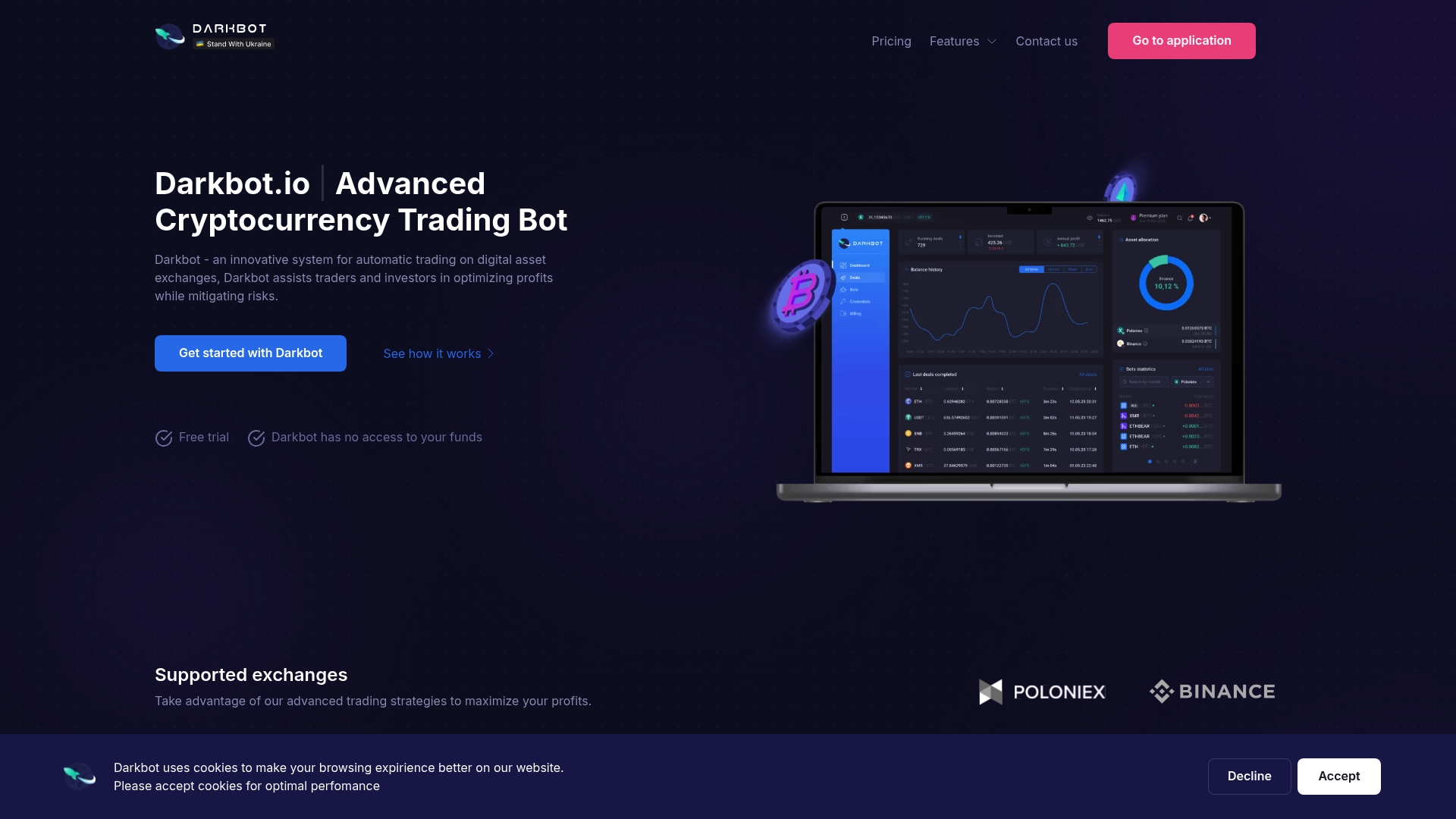
Darkbot applies the same ecosystem principles to automated crypto trading. The platform connects to multiple digital asset exchanges through API keys, routing orders systematically across venues without manual intervention. Its AI-driven logic evaluates market conditions against predefined rules, maintaining consistent execution discipline across volatile conditions.
Darkbot’s crypto portfolio management layer handles position tracking, automated rebalancing, and real-time analytics within a single interface. That architecture reflects the OMS and PMS functions described throughout this article, applied specifically to digital assets. Traders who want systematic execution with structured risk controls can explore Darkbot’s free, standard, and premium tiers to find the configuration that fits their workflow.
FAQ
What is a trading platform ecosystem in simple terms?
A trading platform ecosystem is an integrated network of systems, including order management, execution, portfolio tracking, and risk tools, that work together as a unified trading environment. It connects traders, brokers, liquidity providers, and data partners through a shared infrastructure.
How does an OMS differ from an EMS?
An OMS captures and manages orders across accounts and asset classes, while an EMS handles real-time routing and execution of those orders to specific venues. Both systems are core components of a professional trading ecosystem and typically operate in tandem.
Why does latency matter in a trading ecosystem?
Latency measures the time between order submission and execution confirmation. In liquid markets, this occurs within fractions of a second, and even microsecond differences affect fill quality and slippage, particularly for algorithmic and high-frequency strategies.
What caused the Knight Capital trading loss in 2012?
Knight Capital lost $440 million in 2012 due to a faulty software deployment in a complex, integrated trading environment. The incident demonstrates how tightly coupled ecosystem components can amplify a single technical failure across an entire operation.
How do traders customize a trading platform ecosystem?
Traders customize ecosystems by connecting proprietary datasets, building custom APIs, and configuring role-based access for different functions such as execution, compliance, and analytics. This turns the platform into a personalized operating system rather than fixed software.
Recommended

Start trading on Darkbot with ease
Come and explore our crypto trading platform by connecting your free account!
Free plan available • No credit card required