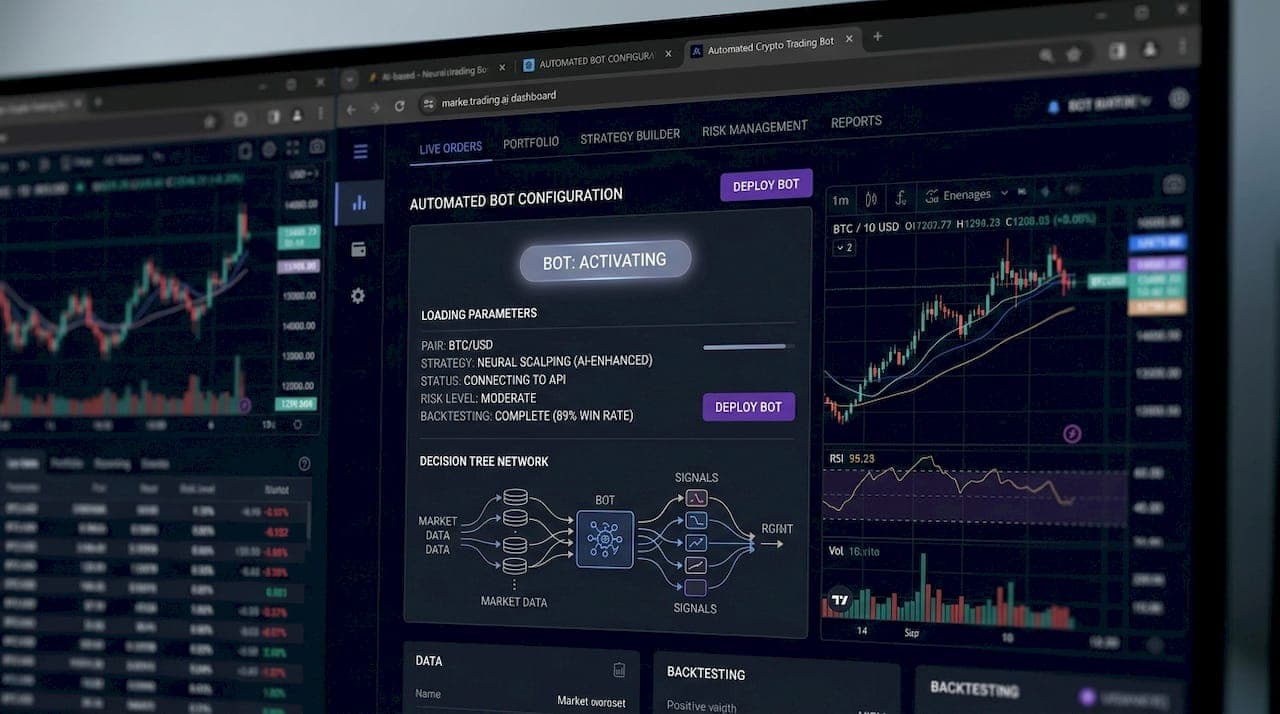
Automated crypto trading advantages for smarter profits
TL;DR:
- Automated trading offers significantly higher returns and consistency than manual strategies in crypto markets.
- Automation addresses emotional biases, executes faster, and continuously monitors multiple data sources.
- Properly implemented automation enhances risk management by tracking systemic risk and automating portfolio adjustments.
Most traders assume that with enough time, screen-watching, and gut instinct, they can beat the market manually. The uncomfortable reality is that crypto markets run 24 hours a day, across hundreds of exchanges, generating more data per second than any human brain can reliably process. Research now shows that automated multi-agent trading augmented with social sentiment signals achieved up to 50% higher returns in bull markets compared to traditional baselines. That is not a marginal edge. That is a structural advantage, and it is available to anyone willing to rethink how they trade.
Key Takeaways
| Point | Details |
|---|---|
| Evidence-backed performance edge | Automated crypto trading can achieve up to 50 percent higher returns in bull markets with the right data signals. |
| Superior risk management | Automation tracks and quantifies risk in ways manual trading can’t, especially for interconnected assets. |
| Emotion-free execution | Automation removes emotional bias for more reliable execution and smarter long-term strategies. |
| Not one-size-fits-all | Effective automation requires thoughtful setup, backtesting, and periodic fine-tuning. |
| Accessible to all levels | Both novices and experienced traders can benefit, but learning and adaptation remain key to long-term results. |
Why automation matters in modern crypto markets
The crypto market is unlike any traditional financial market. It never closes, sentiment can shift from euphoric to panic in under an hour, and a single tweet from a high-profile figure can wipe out weeks of carefully held positions. Manual traders face a compounding problem: the faster and louder the market becomes, the harder it is to stay rational.
Here is what consistently trips up manual traders:
- Emotional decision-making. Fear and greed drive most retail losses. Selling at the bottom and buying at the top is almost a cliché at this point, yet it keeps happening because humans feel pain more acutely than they feel gain.
- Fatigue and attention gaps. Even dedicated traders sleep. A major price move at 3 a.m. is an opportunity missed, or a risk ignored.
- Inconsistent execution. Manual traders rarely apply the same rules every single trade. Mood, recent wins, recent losses, all of it bleeds into execution.
- Information overload. Tracking correlations, volatility regimes, on-chain metrics, and news simultaneously is cognitively impossible at scale.
Automation addresses all four. Bots execute rules without emotion, run continuously without fatigue, apply strategies identically every time, and can process far more data streams simultaneously than any human operator.
“Automation can help benchmark systemic risk relationships in crypto markets, useful for risk management even if it is not a direct trading edge.”
This matters because risk management is often the underrated half of trading. Understanding how assets in your portfolio relate to each other, and how those relationships shift during stress events, is where automation provides deep structural value. The same research identifies Bitcoin and Ethereum as the primary sources of systemic risk across the crypto market, meaning automated systems that track their behavior can give you an early warning system for broader market stress.
The crypto automation benefits go well beyond simply executing trades faster. Automation changes the quality of decisions you make by removing the factors that reliably degrade human judgment under pressure.
Pro Tip: Set your automation to monitor both risk signals (volatility, correlation shifts, market drawdowns) and entry/exit trading signals simultaneously. Treating risk monitoring as a separate, always-on function is one of the most underused features of modern trading bots.
With the need for smarter, more risk-aware trading established, let’s examine what specific advantages automation provides over manual methods.
Core advantages of automated crypto trading
The case for automation is not just theoretical. Empirical research increasingly backs what sophisticated traders have observed in practice: automated systems, when properly configured, consistently outperform manual approaches across the metrics that matter most.
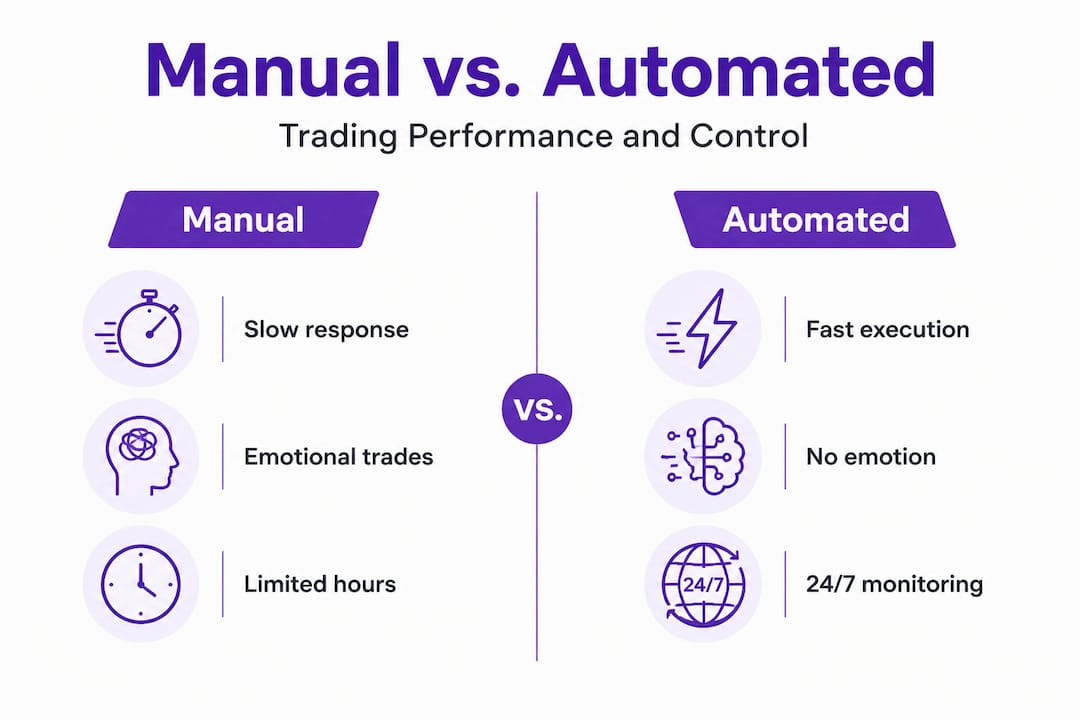
Consider this side-by-side comparison of manual versus automated trading across key performance dimensions:
| Dimension | Manual trading | Automated trading |
|---|---|---|
| Execution speed | Seconds to minutes | Milliseconds |
| Emotional bias | High | Minimal |
| Operating hours | Limited by human schedule | 24/7/365 |
| Data inputs processed | Few at a time | Multiple simultaneous signals |
| Backtesting capability | Manual and slow | Rapid and systematic |
| Consistency of execution | Variable | Identical every trade |
| Risk monitoring | Periodic | Continuous |
The performance gap is especially visible in dynamic market conditions. The PulseReddit study on multi-agent automated trading found that systems augmented with Reddit sentiment data achieved roughly 50% higher returns in bull market regimes and an average 5% improvement in Sharpe ratio compared to traditional baselines. The Sharpe ratio improvement is particularly significant because it measures return per unit of risk, meaning these systems were not just earning more, they were earning more efficiently.
Here is a structured breakdown of what you get from quality automation:
- Emotion-free execution. A bot does not hesitate when a trade triggers its rules. It does not second-guess based on yesterday’s loss. This consistency alone removes one of the most statistically costly behaviors in retail trading.
- Multi-signal integration. The best automated systems combine price action, volume, volatility metrics, and external data like social sentiment. Each additional signal source can meaningfully improve edge.
- Backtesting at scale. Before committing real capital, you can test a strategy across years of historical data in minutes. Manual backtesting would take weeks and would be riddled with hindsight bias.
- Continuous market coverage. Automated bots working across multiple exchanges and pairs catch opportunities that would simply not exist for a human who needs to sleep, eat, or manage other responsibilities.
- Strategy diversification. Running multiple bots with different strategies and timeframes simultaneously lets you diversify your approach the same way you diversify your assets.
The automated trading advantages extend to portfolio-level thinking, not just individual trade quality. When you automate multiple strategies across multiple assets, you start managing a system rather than reacting to a chart.
Pro Tip: Before going live, backtest your bot using at least three different market regimes: a strong bull run, a bear drawdown, and a sideways consolidation period. A strategy that only works in one regime is a liability in the others.
The automated crypto trading explained landscape is maturing fast, and platforms now offer tools that would have been institutional-only just five years ago. The playing field has leveled considerably.
Risk management: How automation helps protect your portfolio
Beyond headlines about profits, automation’s real value becomes clear when we explore its role in managing portfolio risk.
Most traders think about risk management in simple terms: set a stop-loss, size positions conservatively, diversify across a few coins. These are useful starting points, but they leave significant systemic risk unaccounted for. Crypto markets are heavily interconnected, meaning a shock to one major asset ripples through the entire ecosystem quickly.
Research using the GE-CoVaR approach reveals the depth of these connections. Here is what the data shows about systemic risk transmission across major assets:
| Asset | Role in systemic risk |
|---|---|
| Bitcoin (BTC) | Primary risk source, highest spillover to others |
| Ethereum (ETH) | Primary risk source, strong network effects |
| Solana (SOL) | Among most risk-affected (receiver) |
| Binance Coin (BNB) | Among most risk-affected (receiver) |
This distinction between risk sources and risk receivers is critically important for portfolio construction. If Bitcoin or Ethereum experiences a sharp drawdown, automated systems monitoring these relationships can trigger protective responses across your portfolio before the damage propagates fully.
What does automated risk management actually look like in practice? Here is what a well-configured system does continuously:
- Tracks correlation shifts. When assets that normally move independently start moving together, that is often a warning sign of market stress. Automation detects these shifts in real time.
- Enforces position limits. A bot will not let a winning trade grow beyond your defined maximum exposure, preventing concentration risk from building silently.
- Executes stop-losses without hesitation. The emotional difficulty of accepting a loss is one of the most costly behaviors in manual trading. Bots do not feel that difficulty.
- Triggers rebalancing automatically. When a portfolio drifts from its target allocation due to price movements, automation brings it back in line without requiring you to notice and act manually.
- Monitors volatility regimes. When market volatility spikes above a threshold, automated systems can reduce position sizes, shift to defensive assets, or pause new entries entirely.
“Automated systems that track Bitcoin and Ethereum risk dynamics give traders an early warning mechanism for market-wide stress events.”
The trading algorithms for risk management function as a constant, tireless compliance layer for your portfolio. They do not need reminders. They do not forget. They do not rationalize holding a losing position because they “feel” it will recover.
Making the most of automation: Practical frameworks and tips
Armed with a clearer understanding of automation’s risk and return advantages, let’s put the power in your hands with a step-by-step playbook.
Many traders set up a bot, let it run for a week, and judge the entire concept of automation based on that single limited experience. This is like judging whether exercise works after one week at the gym. Automation rewards systematic implementation and ongoing refinement.
Here is a practical framework for getting automation to work for you:
- Define your goals clearly before touching any settings. Are you targeting capital growth, income through arbitrage, or capital preservation? Your goals determine everything from the assets you trade to the risk parameters you set.
- Backtest with multiple signal sources. A strategy based purely on price action is leaving performance on the table. Test versions that incorporate volume, volatility, and where available, sentiment data. Research confirms that multi-signal systems achieve measurably better risk-adjusted returns.
- Set hard guardrails before going live. Define maximum drawdown limits, maximum position sizes, and conditions under which the bot pauses entirely. These are your circuit breakers, and they matter most during market shocks.
- Start with limited capital and scale up. Even a well-backtested strategy behaves differently in live market conditions. Give yourself a period to observe live performance before committing full capital.
- Review performance weekly, not daily. Daily performance noise can push you to tinker unnecessarily. Weekly reviews help you distinguish genuine strategy issues from normal variance.
- Refine based on what you learn. The best traders treat automation as an evolving system, not a set-and-forget solution. Market regimes change. Strategies need updating.
Common pitfalls to avoid actively:
- Overfitting to historical data. A strategy that perfectly fits past data often fails in live markets. Insist on out-of-sample testing, which means testing on data the strategy was not trained on.
- Over-automating without understanding. Automation amplifies your strategy. If your underlying strategy is flawed, the bot just executes that flaw faster and at larger scale.
- Ignoring transaction costs. Backtests that do not account for fees and slippage produce unrealistically optimistic results. Always model realistic costs.
- Single-signal dependence. Relying on one indicator makes your strategy brittle. Diversify your signal sources the same way you diversify your holdings.
The key benefits of trading automation compound over time for traders who treat implementation as a discipline rather than a shortcut. And the AI trading advantages available through modern platforms have made sophisticated, adaptive strategies accessible to individual traders who would have needed a quant team just a few years ago.
Pro Tip: Use your bot for both strategy execution and a separate, parallel risk monitoring function. Many traders run one bot for entries and exits, and another dedicated entirely to portfolio-level risk alerts. This separation of responsibilities keeps each function clean and auditable.
The uncomfortable truth about automation in crypto trading
Let’s be direct about something most guides on this topic avoid saying plainly: automation will not save a bad trader. It will, however, dramatically accelerate what a good trader does well.
The expectation many new users carry into automated trading is essentially a fantasy: plug in a bot, walk away, and watch the profits stack up. That mindset is how traders lose money faster than they did manually. A bot executing a flawed strategy executes that flaw every single second the market is open, without the hesitation or second-guessing that would have sometimes saved a manual trader from their worst decisions.
What automation actually does is remove the ceiling on good strategy execution. If you have put in the work to understand what you are trading, why your edge exists, and how to manage risk when you are wrong, automation lets you apply that edge at a scale and consistency that is humanly impossible to match manually.
The traders who get the most out of automation are, almost without exception, the ones who continue learning after deploying their first bot. Markets evolve. A strategy that worked beautifully in a high-volatility bull market may underperform or lose money in a grinding sideways market. Adaptation is not optional.
There is also a dangerous overconfidence that can emerge after early automated success. A few winning weeks can feel like proof that the system is permanently correct. The traders who have been doing this long enough know that every strategy has a drawdown period, and that the drawdown period is where discipline either holds or breaks down.
Smarter, safer investing through automation is genuinely achievable, but it requires treating it as a craft that requires skill, not a vending machine that requires cash. The edge in crypto automation in 2026 belongs to the traders who combine smart tools with ongoing discipline and intellectual honesty about what is and is not working.
Ready to get started? Automate your strategy with leading solutions
With a full understanding of how to make automation work for you, here is how you can put world-class tools to use today.
If you are ready to move beyond manual trading and start building systems that work while you sleep, Darkbot.io offers the infrastructure to make that transition. The platform gives you access to an automated trading bot powered by AI and machine learning, designed to integrate with your existing exchange accounts via secure API connections.
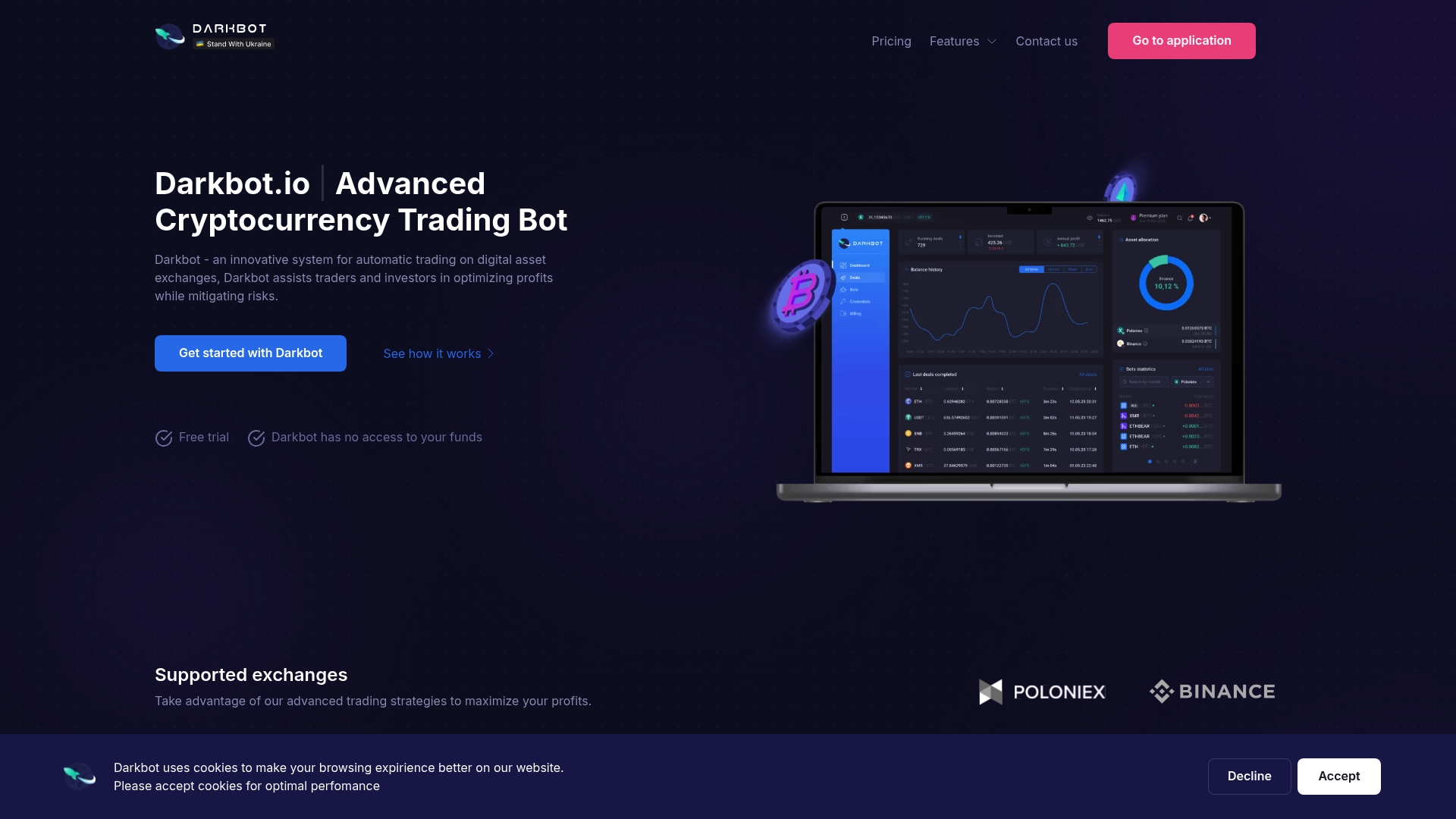
Darkbot.io’s portfolio management tools let you automate rebalancing, set risk guardrails, and track performance in real time across multiple assets simultaneously. Whether you are just starting out with a basic strategy or running multiple advanced bots in parallel, the platform scales with you. Free, standard, and premium tiers mean you can begin without upfront commitment and expand your capabilities as your confidence and strategy sophistication grow.
Frequently asked questions
What is the biggest advantage of automated crypto trading?
The biggest advantage is consistent, emotion-free execution that adapts to market changes 24/7. Research confirms that automated multi-agent systems can achieve up to 50% higher returns in bull markets compared to manual or traditional baselines.
Does automated trading help manage risk?
Yes, automation allows for continuous risk monitoring and faster portfolio adjustments than manual trading. Studies using the GE-CoVaR method show automation can quantify and track systemic risk relationships across interconnected crypto assets in real time.
Can beginners use automated crypto tools effectively?
Beginners can start with basic, well-defined strategies, but successful automation still requires a solid understanding of core trading principles, risk management, and realistic return expectations before deploying capital.
Is automation better for bull or bear markets?
Research suggests automation shows the strongest performance boosts in bull markets, with multi-agent systems achieving up to 50% higher returns in those conditions, while still providing meaningful risk management benefits across all market regimes.
Which coins does automation help the most with?
Automation is particularly effective for tracking Bitcoin and Ethereum since Bitcoin and Ethereum are identified as primary sources of systemic risk, making automated monitoring of their behavior a critical early warning mechanism for broader market moves.
Recommended

Start trading on Darkbot with ease
Come and explore our crypto trading platform by connecting your free account!
Free plan available • No credit card required