Trading Bot Parameters: A Beginner's Clear Guide
TL;DR:
- A trading bot parameter is a configurable setting that determines when and how a bot executes trades. Proper configuration of these parameters guides risk management, trade entry, and exit rules to maintain disciplined automation. Regular review of parameters and security settings ensures ongoing performance and account protection.
A trading bot parameter is a configurable variable within automated trading software that controls when and how the bot executes trades. These variables govern trade entry and exit, capital allocation, and risk limits. Together, they form the complete ruleset that drives every decision an automated strategy makes. Understanding what a trading bot parameter does is the first step toward using automation with discipline rather than guesswork.
What is a trading bot parameter and why does it matter?
A trading bot parameter is defined as the bot’s steering wheel, accelerator, and brake, all in one configurable setting. Each parameter tells the bot exactly what to do under a specific market condition. Without defined parameters, a bot has no logic to follow and cannot execute a coherent strategy.

Parameters matter because they translate a trader’s intentions into machine-readable rules. A trader who wants to risk no more than 2% of capital per trade must encode that intention as a position-sizing parameter. The bot then enforces that rule on every trade, removing emotional decision-making from the equation entirely.
The industry term for the full collection of these settings is “algorithm parameters” or “trading algorithm parameters.” Both phrases refer to the same concept: the numerical and logical inputs that define a bot’s behavior. Recognizing this terminology helps when reading documentation, backtesting reports, or platform guides.
Common types of trading bot parameters and their functions
Trading bot settings fall into four main categories. Each category controls a distinct aspect of the bot’s behavior.
Entry and exit conditions define when the bot opens or closes a position. These include technical indicator thresholds (such as a Relative Strength Index crossing 30), price triggers, and signal confirmation rules. A bot set to buy only when a 50-period moving average crosses above a 200-period moving average will never trade outside that condition.
Risk control parameters are the most consequential settings for capital preservation. Essential risk parameters include:
- Stop loss: The price level at which the bot exits a losing trade automatically.
- Take profit: The price level at which the bot locks in a gain.
- Maximum position size: The largest single trade the bot can place, expressed as a dollar amount or percentage of capital.
- Maximum portfolio exposure: The total percentage of capital the bot can have deployed at any one time, typically ranging from 0% to 40% depending on risk tolerance.
Capital allocation parameters determine how much the bot commits to each trade. Dynamic lot sizing, where the bot adjusts position size based on stop loss distance, is one method that improves risk consistency across trades with different volatility profiles.
Timing and execution controls filter out unfavorable market conditions. Max spread settings reject trades when the bid-ask spread widens beyond a defined threshold. Slippage controls set the maximum acceptable difference between the expected fill price and the actual fill price. These parameters protect execution quality, not just strategy logic.
Pro Tip: Start by mapping out all four parameter categories before touching any settings. Knowing which category each setting belongs to prevents accidental conflicts, such as setting a tight stop loss while also allowing maximum portfolio exposure.
How do parameter settings affect trading bot performance and risk?
Parameter choices directly determine a bot’s risk-reward profile. A stop loss set too tight triggers exits on normal market noise, producing a high loss rate even when the underlying strategy is sound. A stop loss set too wide allows losses to compound before the bot exits, damaging capital over time.
Performance evaluation should focus on risk-adjusted metrics rather than raw profit. The three most relevant measures are:
- Sharpe Ratio: Measures return relative to volatility. A higher ratio means the bot earns more return per unit of risk taken.
- Profit Factor: The ratio of gross profit to gross loss. A profit factor above 1.5 is generally considered acceptable for systematic strategies.
- Maximum Drawdown: The largest peak-to-trough decline in account value. This metric reveals how much pain a trader must tolerate before the strategy recovers.
A critical and often misunderstood point: stop losses are not guaranteed exits. During fast-moving markets or gap openings, slippage can cause the actual exit price to be significantly worse than the stop level. Traders who treat stop losses as absolute floors often face unexpected losses during volatile conditions.
Over-optimizing parameters to fit historical data creates a separate problem called curve-fitting. A bot tuned to perform perfectly on past data often fails in live markets because it has memorized noise rather than learned a repeatable pattern. Walk-forward validation addresses this by splitting historical data into in-sample and out-of-sample segments, testing whether parameters generalize across different market periods. This method is the professional standard for assessing parameter robustness.
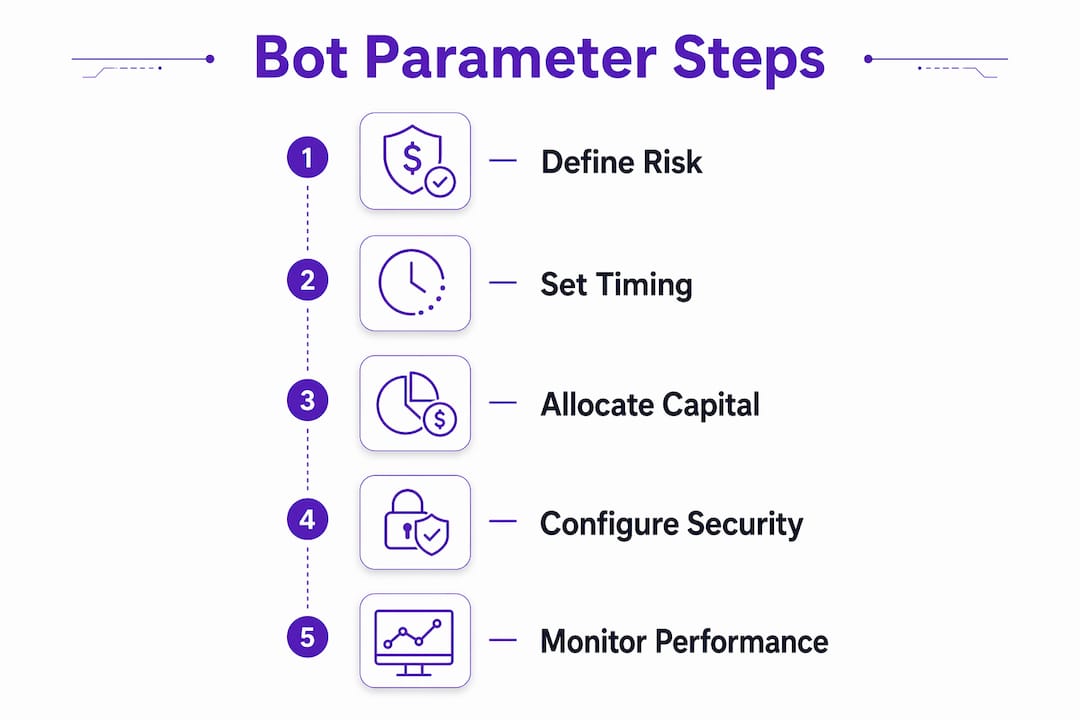
How to configure trading bot parameters step by step
Configuring bot settings correctly requires a structured process, not trial and error. The following sequence applies whether you are setting up a bot for the first time or reviewing an existing configuration.
-
Define your risk tolerance first. Decide the maximum percentage of capital you are willing to lose per trade before touching any other setting. Professional standards recommend risking no more than 1–2% of total capital per trade. This single decision constrains every other parameter you set.
-
Set entry and exit conditions based on a tested strategy. Choose indicator-based or price-based triggers that have a logical basis. Avoid adding multiple overlapping indicators without understanding how they interact, as this creates conflicting signals.
-
Configure stop loss and take profit levels. Base these on market structure, such as recent support and resistance levels, rather than arbitrary percentages. A take profit set at twice the stop loss distance produces a 2:1 reward-to-risk ratio, which is a common starting benchmark.
-
Apply capital allocation limits. Set a maximum position size and a maximum portfolio exposure limit. These two parameters work together to prevent the bot from concentrating too much capital in a single trade or market condition.
-
Use backtesting to evaluate the configuration. Run the parameter set against historical data and review Sharpe Ratio, Maximum Drawdown, and Profit Factor. A rising equity curve alone is not sufficient. Performance reports must disclose drawdown, trade frequency, and turnover costs to give a complete picture of strategy viability.
-
Apply walk-forward validation before going live. Test the parameters on data the bot has never seen. If performance degrades significantly on out-of-sample data, the parameters are over-fitted and need adjustment.
-
Review parameters regularly. Market volatility changes over time. A parameter set calibrated during a low-volatility period may perform poorly when volatility spikes. Automated tuning tools like hyperopt can efficiently explore many parameter combinations under defined performance metrics, reducing the manual effort required for ongoing optimization. For a broader framework on strategy optimization, systematic review cycles matter more than one-time configuration.
The most common beginner mistake is treating parameter configuration as a one-time task. Market conditions shift, and static settings erode performance gradually. Scheduled reviews, at minimum monthly, prevent slow capital erosion from going unnoticed.
What security parameters protect your trading bot?
Security parameters are as important as performance settings. A misconfigured API key can expose an entire account to unauthorized access, regardless of how well the trading strategy is designed.
Key security settings and practices include:
- Disable withdrawal permissions on API keys. A trading bot never needs withdrawal access. Removing this permission limits the damage if an API key is compromised.
- Whitelist IP addresses. Without IP whitelisting, API keys remain accessible from any location globally, creating a significant vulnerability. Restricting access to the bot’s server IP closes this exposure.
- Set maximum daily loss limits. Conservative daily loss caps of 2–3% of total capital enforce a hard stop on losses within a single trading session. This prevents a malfunctioning bot from draining an account overnight.
- Set maximum drawdown limits. A drawdown limit pauses or stops the bot when cumulative losses reach a defined threshold, protecting against slow capital erosion that daily limits alone might miss.
- Configure max spread and slippage thresholds. These settings reject trades during abnormal market conditions, such as flash crashes or low-liquidity periods, when execution quality deteriorates sharply.
Pro Tip: Treat API key setup as a separate checklist from strategy configuration. Complete security settings before enabling any live trading. A single overlooked permission can create a risk that no stop loss parameter can address.
Integrating security with risk parameters creates a layered defense. Strategy-level parameters control trade behavior. Security parameters control account-level exposure. Both layers must be configured correctly for the system to function safely.
For traders who want additional depth on adaptive parameter configuration, particularly in response to changing volatility, specialized resources on scalping-oriented setups offer practical frameworks that apply broadly across trading styles.
Key Takeaways
Trading bot parameters are the complete ruleset that determines how a bot behaves, and configuring them correctly is the foundation of any systematic trading approach.
| Point | Details |
|---|---|
| Parameters define bot behavior | Every trade entry, exit, and risk limit is controlled by a specific configurable variable. |
| Risk no more than 1–2% per trade | Professional standards cap single-trade risk at 1–2% of total capital to preserve long-term viability. |
| Use risk-adjusted metrics | Evaluate bots on Sharpe Ratio, Profit Factor, and Maximum Drawdown, not just net profit. |
| Avoid curve-fitting | Walk-forward validation tests parameters on unseen data to confirm they generalize beyond historical results. |
| Security parameters are non-negotiable | Disabling withdrawals and whitelisting IP addresses on API keys are baseline requirements before live trading. |
What I’ve learned from watching traders misconfigure their bots
Most beginners focus almost entirely on entry conditions. They spend hours selecting indicators and refining signal logic, then set a stop loss at a round number and call it done. The stop loss is often the most consequential parameter in the entire configuration, and it receives the least attention.
The second pattern I see consistently is over-reliance on backtesting results. A bot that shows a clean equity curve on historical data feels like a finished product. It is not. Walk-forward validation is not optional. Parameters that cannot survive out-of-sample testing will not survive live markets.
The third mistake is treating security as an afterthought. API key permissions take five minutes to configure correctly. Skipping IP whitelisting because it feels technical is a decision that can cost an entire account balance. The risk is not theoretical.
What actually works is a systematic framework: define risk tolerance first, configure security before strategy, backtest with realistic metrics, validate out-of-sample, and review on a schedule. This process is not exciting. It does not produce dramatic results quickly. It does produce consistent, defensible outcomes over time. That is the goal of automation.
Disciplined execution of a well-configured parameter set outperforms any amount of prediction or market speculation. The bot does not need to be clever. It needs to be consistent.
— Grisha
Darkbot’s approach to parameter-driven crypto automation
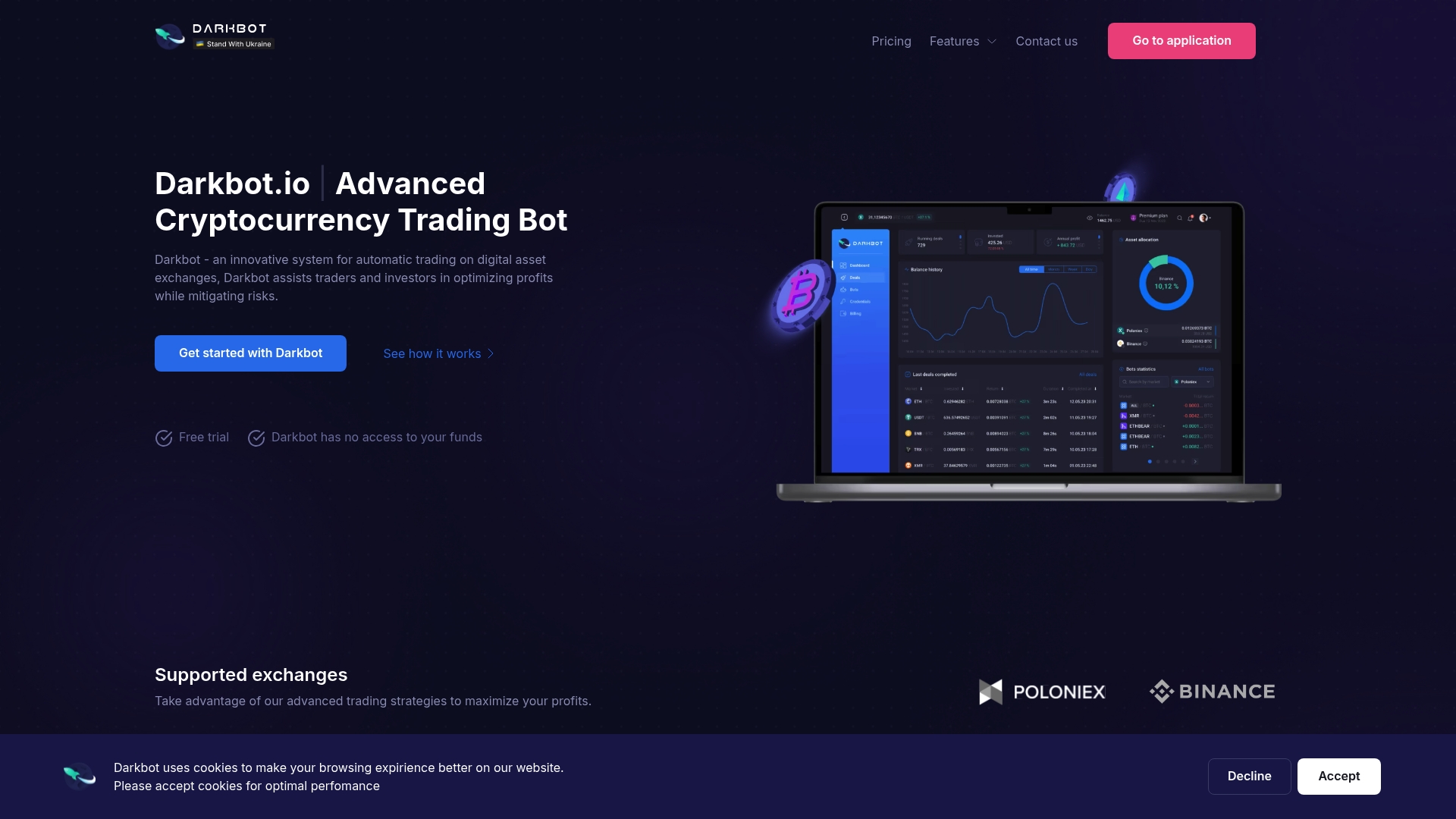
Darkbot is an AI-based cryptocurrency trading platform built around rule-driven execution and structured risk control. The platform supports flexible parameter configuration across multiple digital asset exchanges, allowing traders to define entry and exit conditions, position sizing, stop loss levels, and portfolio exposure limits within a single interface. Darkbot’s AI applies probabilistic pattern evaluation to adapt strategy execution, not to predict markets. For traders who want systematic control over their automated trading parameters, Darkbot provides the infrastructure to configure, test, and monitor bots with transparent performance reporting. The platform’s portfolio management tools support risk distribution across multiple assets and strategies simultaneously.
FAQ
What is a trading bot parameter in simple terms?
A trading bot parameter is a configurable setting that tells the bot when to buy, when to sell, how much to trade, and how much risk to accept. It is the rule the bot follows automatically on every trade.
What parameters should a beginner set first?
Beginners should configure risk parameters first, specifically stop loss, take profit, and maximum position size, before setting any entry or exit conditions. Capping single-trade risk at 1–2% of capital is the standard starting point.
How do I know if my parameters are working correctly?
Review Sharpe Ratio, Maximum Drawdown, and Profit Factor after backtesting. If the bot performs well on historical data but poorly on out-of-sample data, the parameters are over-fitted and need adjustment.
Can I leave my trading bot running without changing its parameters?
A “set and forget” approach leads to poor performance over time because market volatility changes and static parameters stop fitting current conditions. Regular reviews, at minimum monthly, are necessary to maintain performance.
How do security parameters differ from trading parameters?
Trading parameters control strategy behavior, such as when and how trades execute. Security parameters control account-level access, including API key permissions, IP whitelisting, and daily loss limits. Both must be configured before live trading begins.
Recommended

Start trading on Darkbot with ease
Come and explore our crypto trading platform by connecting your free account!
Free plan available • No credit card required