Best Bitcoin Trading Bots Need Testing, Hosted or Open Source
For traders seeking managed automation, managed platforms are one option, and we recommend Darkbot because it combines backtesting, paper trading, and configurable risk controls. Technically skilled traders can run free open-source tools if they accept the maintenance and security work. No bot guarantees profit, and regulators treat promises of guaranteed returns as a warning sign.
TL;DR:
- Before connecting an exchange, disable withdrawals on API keys, enable IP whitelisting when available, and confirm order routing, risk limits, and loss controls.
- Scalping needs fast execution and low fees, while swing trading depends more on scheduling and conditional triggers; test customer support before committing funds.
- Hosting a bot yourself avoids license fees but leaves you responsible for server uptime, updates, key security, and failure recovery; hosted services charge subscriptions.
- A convincing backtest is not enough: hold out unseen price data and repeat tests across rolling windows to expose strategies tuned to historical noise.
- Treat return guarantees, zero risk claims, and referral recruitment as fraud warnings; paper trade first, then risk only a small live allocation.
Which type of bitcoin bot fits your setup?
Bots fall into practical categories, and the right one depends on how much operational work you want to own.
- Hosted SaaS platforms: a route to automation, with onboarding, analytics, and support included. This is the category we recommend for traders who would rather not run servers.
- Self-hosted open-source frameworks: full transparency and control over the code, but you handle server upkeep, updates, and API security. A curated list of open-source frameworks shows how wide this field is for developers.
- Exchange-built bots: simple grid and dollar-cost-averaging (DCA) tools inside an exchange account. They suit basic strategies but offer limited customization.
If you want managed automation with configurable risk controls and a paper trading mode, consider Darkbot. Our walkthrough on how to automate crypto trading covers the first steps.
How do you choose a bitcoin trading bot?
Start with a checklist, then run a short, disciplined trial. Practitioners who vet automated systems use long rejection lists, and the MQL5 criteria for rejecting a trading bot stress parameter robustness, configurable risk exposure, and enough trades to mean something.
- Confirm the bot supports your exchange through API integration, and ask how orders are routed.
- Check security basics: API keys with withdrawals disabled and IP whitelisting where the exchange offers it.
- Look for backtesting and paper trading, so you can test before risking capital.
- Confirm you can set risk per trade, stop-loss levels, and a maximum drawdown limit.
- Ask for documented testing methodology. For open-source projects, check commit history and issue activity.
- Review pricing, trial terms, contact options, and privacy documentation.
- Paper trade for a period suited to your strategy, then allocate a small live amount with tight limits.
Pro Tip: Compare paper results against live results on the same strategy. A wide gap usually points to slippage, fees, or an overfitted backtest.
Also match the bot to your approach. Scalping needs fast execution and low fees, while swing trading cares more about scheduling and conditional triggers. Test how quickly support answers a real question before you commit funds.
Open-source or hosted: which should you pick?
Self-hosting means you own everything that can break. That includes:
- Server maintenance, uptime, and monitoring
- Security patches and dependency updates
- Safe storage and rotation of exchange API keys
- Logging, alerts, and recovery after failures
A hosted platform shifts most of that to the provider, along with hardened infrastructure and managed order routing. You still control strategy settings and risk limits, and you still decide how permissions are set on your exchange keys.
Cost works differently on each path. Open-source software usually carries no license fee, but hosting and your own time are real costs. Hosted platforms charge a subscription, and the price buys support and stability.
Why testing discipline decides this choice: LuxAlgo’s guidance on overfitting states that serious evaluation requires out-of-sample data and walk-forward validation, otherwise a bot is likely tuned to historical noise.

Our rule of thumb: self-host only if you can run production-grade operations and perform walk-forward validation yourself. Otherwise, a managed platform is the safer default.
How should you validate a bot and spot scams?
Overfitting is one reason a strong backtest can fail live. Out-of-sample testing holds back part of the data and tests the strategy on prices it never saw during tuning. Walk-forward validation repeats this across rolling windows: optimize on one segment, test on the next, then move forward. A strategy that survives several windows has a better claim to repeatability than one with a single impressive curve. Our strategy optimization guide explains how to tune parameters without fitting noise.
Marketing deserves the same scrutiny. The CFTC’s customer advisory is direct:
Automated trading bots are not money machines, and claims of guaranteed returns or AI-powered predictive profits are characteristic of fraud. — CFTC Customer Advisory
Before trusting any vendor, run these checks:
- Look up the domain age and who stands behind the company.
- Ask for the testing methodology in writing.
- Inspect repository activity for open-source tools.
- Treat guaranteed returns, “zero risk” claims, and referral-driven recruitment as red flags.
- Start with paper trading, never a large deposit.
If you suspect a scheme has already taken your funds, guidance on spotting fake crypto investment indicators explains how forensic analysis can document what happened.
What matters more than any single bot
My view is simple: repeatable execution and risk control matter more than any performance claim. A bot cannot supply an edge you have not verified, and the traders who stay in the game are the ones who size positions conservatively and write their rules down before the market tests them. Treat automation as a way to apply a rule set consistently, not as a source of returns. Move in steps: paper trade, then commit a small live allocation, then review the results honestly. Our guide to automated trading strategies is a practical place to start.
— Grisha
How we help you test automation with Darkbot
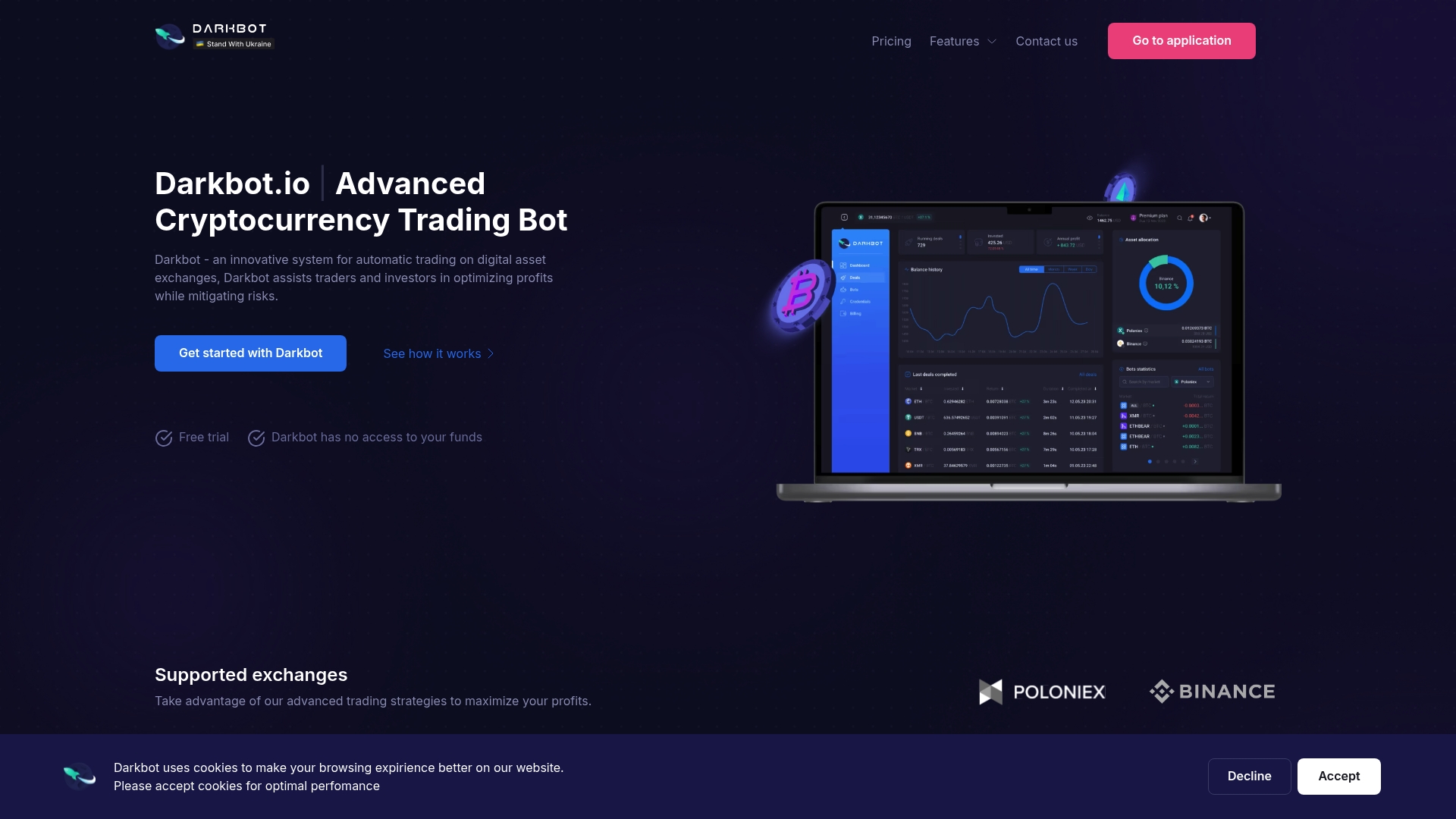
We built Darkbot as an AI-based automation platform around systematic execution, structured risk control, and repeatable logic. It is not a signal service, and the AI is there for consistency and rule-driven adaptation, not prediction. Here is what you get:
- API integration with major digital asset exchanges
- Customizable trading strategies and fine-tuning
- Backtesting and paper trading
- Multiple simultaneous bots
- Risk management tools, portfolio management, and automated rebalancing
- Real-time analytics
A free plan is available, so you can test strategies without a paid commitment. Standard is $12.50 per month and Premium is $25.00 per month, and Enterprise details are on the pricing page. To begin, sign up for the free plan, connect an exchange with withdrawal-disabled keys, and run your strategy in paper trading before using live funds.
FAQ
Can you make $100 a day from crypto?
No bot or strategy can promise a daily income, and results depend on capital, risk, and market conditions. The CFTC advisory treats guaranteed daily returns as a hallmark of fraud, so be skeptical of any such claim.
Where can you find free trading signals or tools?
Open-source frameworks cost nothing in licenses, and several are cataloged in a public list of crypto trading agents. Verify any signal source with paper trading, and remember that hosting and upkeep still cost time.
What is the most trusted bitcoin trading platform?
Trust is earned through verifiable practices rather than a ranking: transparent pricing, documented testing, clear contact details, and sound API security. Judge any platform against the checklist above before depositing funds.
Can ChatGPT code a trading bot?
An AI assistant can draft bot code, but generated code still needs review, backtesting, and out-of-sample validation. A working script is not a validated strategy, and you remain responsible for API security.
Sources

Start trading on Darkbot with ease
Come and explore our crypto trading platform by connecting your free account!
Free plan available • No credit card required