Best Altcoin Trading Bots in 2026: How to Compare Them

The best altcoin trading bot is the one whose execution logic you understand, whose costs you can quantify, and whose risk controls you can set yourself. No bot is the best in every market. Altcoins add specific constraints: thinner order books, wider spreads, uneven exchange support and sharper volatility. This guide compares the main options on criteria that affect execution quality, not on advertised returns.
TL;DR
- No bot is the “most successful” across conditions. Independent testing shows results depend on market regime and strategy type.
- Compare bots on exchange coverage, strategy types, custody model, total cost and risk controls. Ignore headline return figures.
- Fees and slippage can erase small edges, and regulators warn that “AI” and guaranteed-return claims often signal fraud.
- Backtest, then paper trade, then go live with small size. Responsibility for the strategy stays with you.
What makes altcoin trading different for a bot
A bot only executes the rules it is given. For major pairs such as BTC and ETH, liquidity is deep and slippage is usually small. For smaller altcoins, three things change the outcome.
Liquidity and slippage. A market order in a thin book moves the price against you. A bot that backtests well on mid-cap pairs can underperform live because fills are worse than the simulation assumed. Limit-order strategies such as grids and DCA ladders reduce this exposure but do not remove it.
Exchange coverage. Many altcoins list on only a few venues. A bot that connects to your exchange through API keys matters more than a long logo list.
API limits. Every exchange enforces request limits. Exceeding them produces 429 errors, and repeated violations can lead to temporary IP bans, as Binance documents. A bot running many pairs at once has to throttle requests properly, which is a practical quality marker.
Criteria we use to compare altcoin bots
- Strategy types: DCA, grid, rebalancing, signal or rule-based, and whether you can customize parameters.
- Exchange integration: which exchanges, spot or futures, and whether the bot trades through your own account via API keys.
- Custody: funds should stay on the exchange, with API keys limited to trade permissions and withdrawals disabled.
- Total cost: subscription, exchange fees, and any performance fee. Testing summarized by a regulator-cited review found that subscription costs can consume a large share of a small account.
- Validation tools: backtesting, paper trading, and honest handling of fees and slippage.
- Risk controls: position limits, stop logic, and the ability to pause or override.
- Transparency: clear documentation of what the “AI” actually does.
The main options compared
The table below summarizes how the platforms most often covered in reviews differ in approach. Pricing changes often, so verify on each vendor’s page before subscribing.
| Platform | Model | Typical strength | Typical limitation |
|---|---|---|---|
| 3Commas | Subscription, multi-exchange | DCA and grid bots, broad feature set | Live trading requires a paid tier; reviewers list paid plans from $20 per month |
| Cryptohopper | Subscription, multi-exchange | Strategy builder, marketplace of templates | Advanced features sit in higher tiers |
| Pionex | Exchange-integrated bots | No separate subscription; reviewed at a 0.05% trading fee | Limited to its own exchange |
| Coinrule | Subscription, rule-based | No-code if-then rules | Less suited to complex portfolio logic |
| Bitsgap | Subscription, multi-exchange | Grid bots with parameter assistance | Narrower strategy range |
| Freqtrade | Open source, self-hosted | Full control, keys stay on your hardware | Requires programming and maintenance |
| Darkbot | Subscription, multi-exchange via API keys | Rule-driven automation, portfolio tools, rebalancing, backtesting and paper trading | See below |
A few observations follow from the table.
Multi-exchange subscription platforms suit traders who hold altcoins across several venues. You pay for flexibility, and the subscription is a fixed cost whether the strategy performs or not.
Exchange-native bots such as Pionex remove the subscription but tie you to one venue’s pairs and liquidity. For a small account, that can be a reasonable trade.
Self-hosted tools such as Freqtrade give maximum control and keep API keys on your own machine. Reviewers recommend them mainly for developers, because you maintain the infrastructure.
Memecoin sniping tools (Banana Gun, Trojan, BullX) are a different category. They operate on-chain, and a 90-day comparison from a working trader highlights pre-flight simulation as a safeguard against honeypot contracts. Those tools solve a different problem than systematic exchange-based automation.
Where Darkbot fits
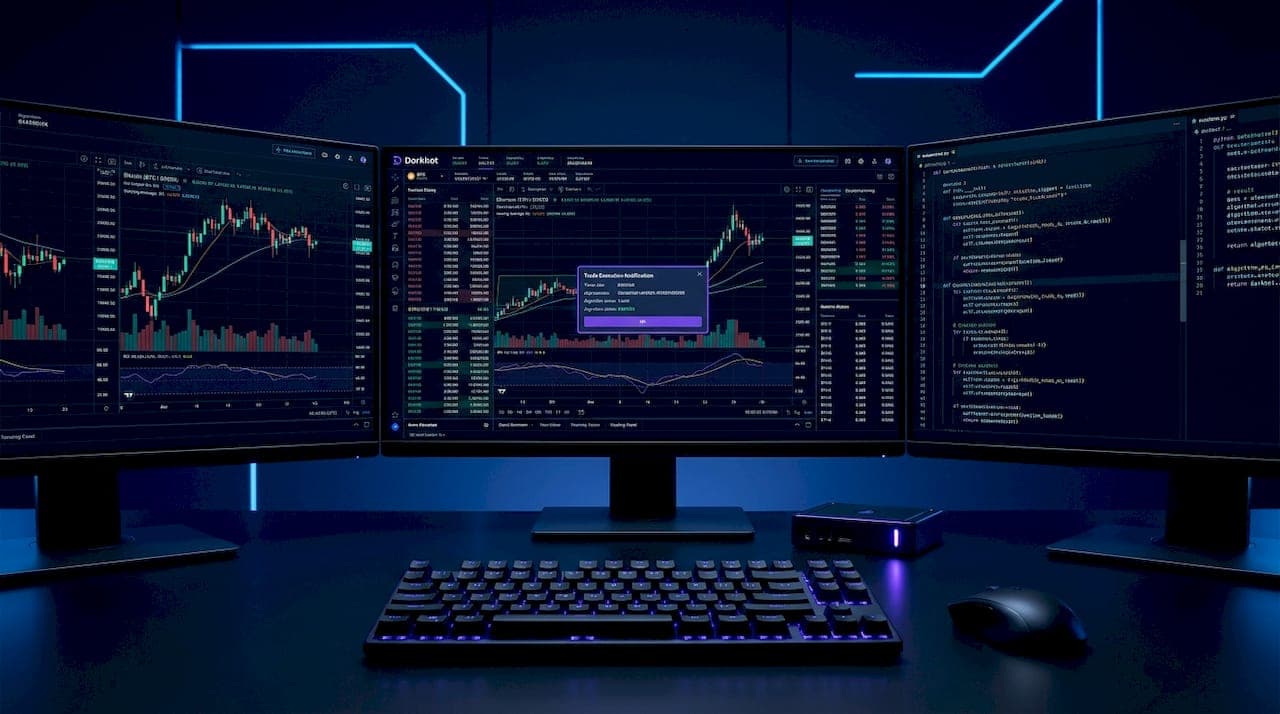
Darkbot is an AI-based automation platform for centralized exchange trading, not a signal provider. It connects to your exchange account through API keys, so orders route directly from the platform to your exchange. It supports customizable strategies, multiple simultaneous bots, portfolio management, automated rebalancing, backtesting and paper trading, and real-time analytics.
In practice that suits three altcoin use cases:
- Rule-based execution across several pairs, where consistency matters more than speed.
- Rebalancing a basket of altcoins back to target weights, so allocation drift is handled by a rule instead of by attention.
- Running several bots in parallel with different parameters, each tested in paper mode first.
Here AI means probabilistic pattern evaluation and rule-driven adaptation. It does not predict prices, and nothing in the platform should be read as a promise of returns. Plans are published on the pricing page: a Free plan with limited features, Standard at 12.50 $ per month, Premium at 25.00 $ per month, and Enterprise. A 14-day money-back guarantee applies to paid subscriptions.
What the evidence says about bot performance
The honest answer to “are bots profitable?” is that it depends on the strategy, the market and the costs.
One 90-day benchmark of eight bots reported that Stoic AI’s Meta strategy showed a Sharpe ratio of 1.42 and an 8.3% maximum drawdown. The same source concludes that grid and DCA bots are favored for systematic execution in sideways markets, not for forecasting. Treat any single test as one sample from one period.
There are structural reasons for caution:
- Costs. Fees, slippage and transaction costs frequently erode the edge of automated strategies.
- Backtest bias. Lookahead bias and data snooping make backtests look better than live results. Prefer tools that support out-of-sample validation.
- Market regime. Bots tend to do best in range-bound conditions and can lag simple buy-and-hold in strong trends, because risk rules exit positions early.
When you review your own results, log each trade with its fee and slippage, and compare against holding the same assets. Some traders also add physical execution tools for manual overrides; this overview of performance tools covers one such approach to rapid order handling and risk controls.
How to evaluate a bot before committing capital
- Define the strategy in plain rules. Write down entry, exit, position size and the maximum loss per trade. If you cannot state them, the bot cannot either.
- Backtest with realistic costs. Include exchange fees and a conservative slippage assumption for each altcoin pair.
- Paper trade. Run the same rules on live prices without capital for several weeks, across at least one change in market direction.
- Restrict API permissions. Enable trading only, disable withdrawals, and whitelist IP addresses where the exchange allows it. Our note on bot security covers this in more detail.
- Start small. Size positions so one failure is tolerable. A 1-2% risk rule per trade is a common starting framework.
- Review on a schedule. Check fills, fees and drawdown weekly, and change parameters deliberately rather than reactively.
Red flags when choosing a bot
The CFTC warns that fraudsters use public interest in AI to promote trading schemes promising unreasonably high or guaranteed returns. Avoid any provider that:
- Promises fixed or “risk-free” returns.
- Asks you to deposit funds into the provider’s wallet instead of connecting to your own exchange account.
- Requests withdrawal permissions on your API keys.
- Cannot explain what its AI does in operational terms.
- Shows only curated, cherry-picked results.
FINRA’s guidance on auto-trading by unregistered entities adds that supervision of the strategy remains with you. Understand the logic, your risk tolerance, and how the bot could fail in an unprecedented market move. For more on failure modes, see our pieces on key risks in automated trading and risks of crypto bot automation.
Our perspective
We build Darkbot on one premise: automation is a method of executing decisions consistently, not a source of decisions. A bot does not know where an altcoin is going. What it does well is apply the same rules at 3 a.m. as at noon, respect position limits, and avoid the errors that come from fatigue and impulse.

That shapes how we think about comparisons. The useful question is not which bot has the highest advertised return, but which one lets you define a strategy, test it under realistic costs, limit the damage when it is wrong, and keep human oversight over it. For altcoins specifically, we would weight liquidity assumptions and risk controls above feature counts. Thin markets punish optimistic backtests.
We also think small accounts should look closely at fixed costs. A subscription that is trivial for a large account is a real hurdle for a small one, so run the arithmetic against your capital before you subscribe to any platform, ours included. If you want a deeper treatment of parameters, see our strategy optimization guide and our overview of risk management in crypto bots.
— Grisha
Trying Darkbot
If you want to test rule-based altcoin automation, the Free plan lets you explore the platform with limited features before you pay. Paid plans start at 12.50 $ per month (Standard) and 25.00 $ per month (Premium), with a 14-day money-back guarantee. Begin with backtesting and paper trading, and move to live capital only after the rules behave as intended.
FAQ
What is the best bot for altcoin trading?
There is no single best. Multi-exchange platforms suit people who trade across venues, exchange-native bots suit small accounts on one exchange, and self-hosted tools suit developers. Choose by exchange support, strategy types, custody and total cost, then validate with paper trading.
Are altcoin trading bots profitable?
Sometimes, but not reliably. Results depend on strategy, market conditions, fees and slippage, and regulators caution against any claim of guaranteed returns. A bot automates your rules, so a weak strategy can lose money faster.
Are grid and DCA bots good for altcoins?
They are commonly used because they rely on limit orders and predefined rules. Reviews note they work best in sideways markets. In a sustained downtrend, a DCA bot keeps accumulating a falling asset, so set a hard cap on total exposure.
Is it safe to give a bot my API keys?
It can be, if you limit the risk. Enable trading permission only, disable withdrawals, restrict by IP where possible, and use a dedicated sub-account with limited funds. Never share keys with anyone who asks for withdrawal rights.
Sources
- Best Crypto Trading Bot 2026: Independent 90-Day Benchmark
- CFTC Customer Advisory: AI Won’t Turn Trading Bots into Money Machines
- FINRA: Auto-trading by unregistered entities
- ChainChoice: Best Crypto Trading Bots 2026
- AiCryptoCore: Top 10 AI Trading Bots Compared
- Binance Open Platform: General Info
- TradingBeavers: Pionex vs 3Commas vs Cryptohopper
- altFINS: Best Crypto Trading Bots in 2026
- TBot: Bot comparison
- Crypto Reporter: 90-day memecoin trading bot comparison
Recommended

Start trading on Darkbot with ease
Come and explore our crypto trading platform by connecting your free account!
Free plan available • No credit card required